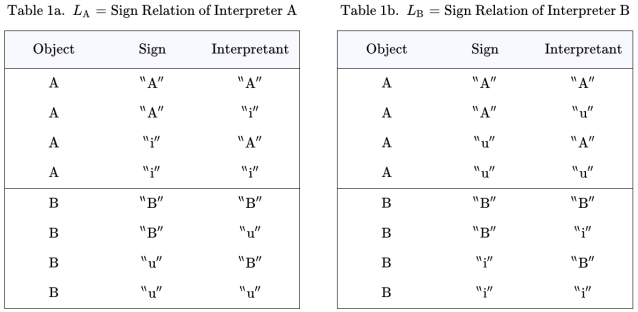
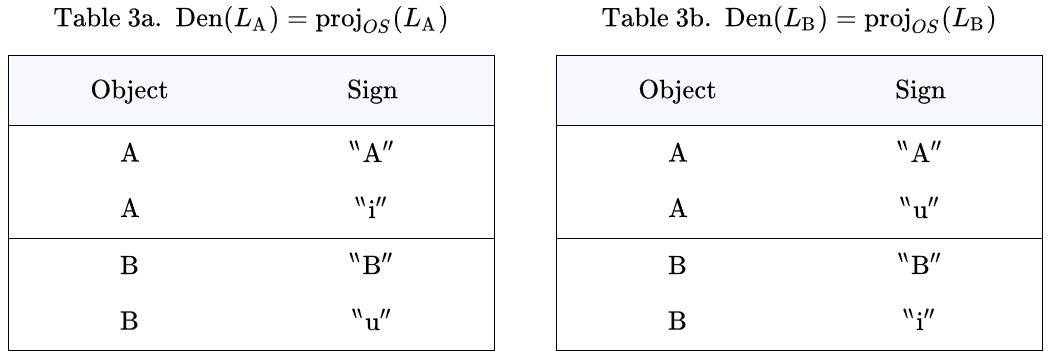
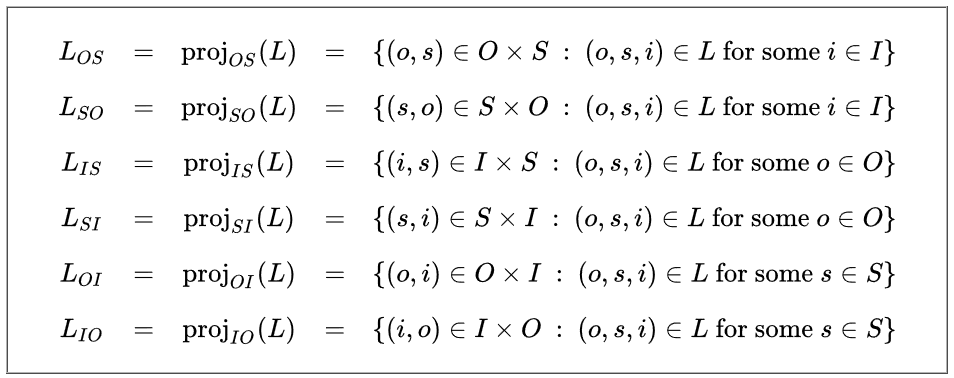
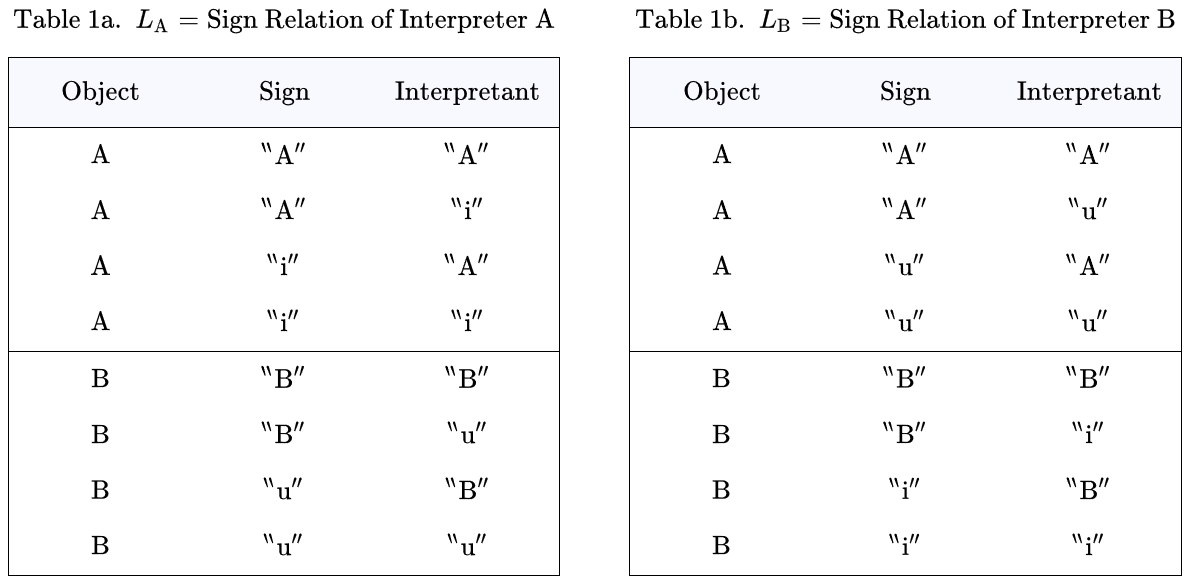
The object of reasoning is to find out …

No longer wondered what I would do in life but defined my object.
— C.S. Peirce (1861), “My Life, written for the Class-Book”, (CE 1, 3)

The object of reasoning is to find out, from the consideration of what we already know, something else which we do not know.
— C.S. Peirce (1877), “The Fixation of Belief”, (CP 5.365)

If the object of an investigation is to find out something we do not know then the clues we discover along the way are the signs which determine that object.

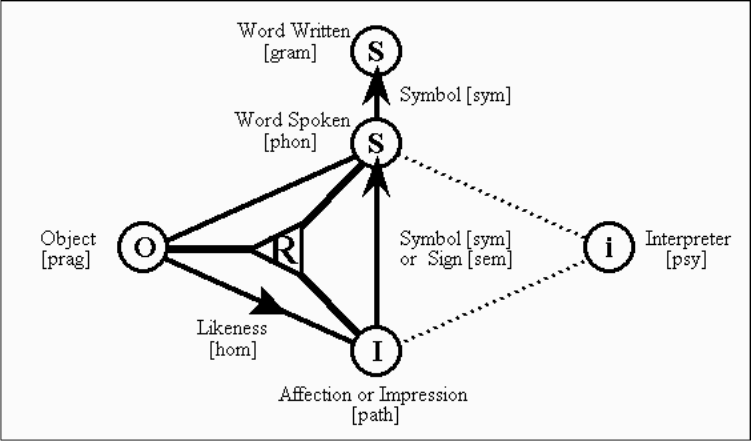
People will continue to be confused about determination so long as they can think of no other forms but analytic-behaviorist-causal-dyadic-temporal, object-as-stimulus, sign-as-response varieties.  It’s true ordinary language biases us toward billiard‑ball styles of dyadic determination but there are triadic forms of constraint, determination, and interaction not captured by S‑R chains of that order.

Pragmatic objects of signs and concepts are anything we talk or think about and semiosis does not conduct its transactions within the bounds of object as cue, sign as cue ball, and interpretants as solids, stripes, and pockets.

References

  • Peirce, C.S. (1859–1861), “My Life, written for the Class-Book”, pp. 1–3 in Writings of Charles S. Peirce : A Chronological Edition, Volume 1, 1857–1866, Peirce Edition Project, Indiana University Press, Bloomington, IN, 1982.
  • Peirce, C.S. (1877), “The Fixation Of Belief”, Popular Science Monthly 12 (Nov 1877), pp. 1–15.  Reprinted in Collected Papers, CP 5.358–387.  Online.

cc: FB | Inquiry Driven SystemsLaws of FormMathstodonAcademia.edu
cc: Conceptual GraphsCyberneticsStructural ModelingSystems Science

Posted in C.S. Peirce, Determination, Dyadic Relations, Fixation of Belief, Inference, Inquiry, Intention, Intentional Contexts, Intentional Objects, Logic, Objects Objectives Objectivity, Pragmata, Pragmatism, Reasoning, Scientific Inquiry, Semiotics, Sign Relations, Triadic Relations, Triadicity | Tagged , , , , , , , , , , , , , , , , , , | 6 Comments

Differential Propositional Calculus • Discussion 9

Consider what effects that might conceivably have practical bearings you conceive the objects of your conception to have.  Then, your conception of those effects is the whole of your conception of the object.

— C.S. Peirce • The Maxim of Pragmatism

Re: Facebook DiscussionTim Browning

TB:
Makes me wonder if all that is the case, i.e. the universe, is the existence of objects (materialism) or information (idealism).

“Objects of your conception” seems to imply a transcendent perspective that can distinguish between concept and object.  Am I overthinking this?

Hi Tim,

It helps to read “object” in a fuller sense than we often do in billiard‑ball philosophies, as a lot gets lost in the translation from the Greek “pragma” from which pragmatism naturally takes its cue.  For a sample of that fuller sense see the following lexicon entry.

Resources

cc: FB | Differential LogicLaws of FormMathstodonAcademia.edu
cc: Conceptual GraphsCyberneticsStructural ModelingSystems Science

Posted in Amphecks, Boolean Functions, C.S. Peirce, Cactus Graphs, Category Theory, Change, Computational Complexity, Cybernetics, Differential Analytic Turing Automata, Differential Calculus, Differential Logic, Discrete Dynamics, Dynamical Systems, Equational Inference, Functional Logic, Gradient Descent, Graph Theory, Group Theory, Hologrammautomaton, Indicator Functions, Logic, Logical Graphs, Mathematical Models, Mathematics, Minimal Negation Operators, Painted Cacti, Peirce, Propositional Calculus, Propositional Equation Reasoning Systems, Time, Visualization | Tagged , , , , , , , , , , , , , , , , , , , , , , , , , , , , , , | 4 Comments

In the Way of Inquiry • Discussion 1

Re: In the Way of Inquiry • Justification Trap
Re: Academia.edu • Bhupinder Singh Anand

BSA:
Thanks for highlighting what I perceive as some challenging issues in the foundations of what we seek to term as “Knowledge” and “Truth”.  …

Hi Bhupinder,

Just by way of venturing a few links between different schools of thought, a very rough hint of the pragmatic approach to truth and knowledge can be found in the following fork of a Wikipedia article I worked on many years ago.

Pragmatic Theory Of Truth, which begins as follows …

Pragmatic theory of truth refers to those accounts, definitions, and theories of the concept truth distinguishing the philosophies of pragmatism and pragmaticism.  The conception of truth in question varies along lines reflecting the influence of several thinkers, initially and notably, Charles Sanders Peirce, William James, and John Dewey, but a number of common features can be identified.  The most characteristic features are (1) a reliance on the pragmatic maxim as a means of clarifying the meanings of difficult concepts, truth in particular, and (2) an emphasis on the fact that the product variously branded as belief, certainty, knowledge, or truth is the result of a process, namely, inquiry[1]

cc: FB | Inquiry Driven SystemsLaws of FormMathstodonAcademia.edu
cc: Conceptual GraphsCyberneticsStructural ModelingSystems Science

Posted in Animata, C.S. Peirce, Inquiry, Inquiry Driven Systems, Inquiry Into Inquiry, Intelligent Systems, Semiotics | Tagged , , , , , , | 4 Comments

Riffs and Rotes • Happy New Year 2024

\text{Let} ~ p_n = \text{the} ~ n^\text{th} ~ \text{prime}.

\text{Then} ~ 2024  = 8 \cdot 11 \cdot 23  = p_{1}^{3} p_{5} p_{9}  = p_{1}^{p_2} p_{p_3} p_{p_2^2}  = p_{1}^{p_{p_1}} p_{p_{p_2}} p_{p_{p_1}^{p_1}}  = p_{1}^{p_{p_1}} p_{p_{p_{p_1}}} p_{p_{p_1}^{p_1}}

No information is lost by dropping the terminal 1s.  Thus we may write the following form.

2024 = p^{p_p} p_{p_{p_p}} p_{p_p^p}

The article referenced below tells how forms like these correspond to a family of digraphs called riffs and a family of graphs called rotes.  The riff and rote for 2024 are shown in the next two Figures.

Riff 2024

Riff 2024

Rote 2024

Rote 2024

Reference

cc: FB | Riffs and RotesLaws of FormMathstodonAcademia.edu • SeqFan
cc: Conceptual GraphsCyberneticsStructural ModelingSystems Science

Posted in Algebra, Combinatorics, Graph Theory, Group Theory, Logic, Mathematics, Number Theory, Riffs and Rotes | Tagged , , , , , , , | 1 Comment

Differential Propositional Calculus • 37

Foreshadowing Transformations • Extensions and Projections of Discourse

And, despite the care which she took to look behind her at every moment, she failed to see a shadow which followed her like her own shadow, which stopped when she stopped, which started again when she did, and which made no more noise than a well-conducted shadow should.

— Gaston Leroux • The Phantom of the Opera

Many times in our discussion we have occasion to place one universe of discourse in the context of a larger universe of discourse.  An embedding of the type [\mathcal{X}] \to [\mathcal{Y}] is implied any time we make use of one basis \mathcal{X} which happens to be included in another basis \mathcal{Y}.  When discussing differential relations we usually have in mind the extended alphabet \mathfrak{Y} has a special construction or a specific lexical relation with respect to the initial alphabet \mathfrak{X}, one which is marked by characteristic types of accents, indices, or inflected forms.

Resources

cc: FB | Differential LogicLaws of FormMathstodonAcademia.edu
cc: Conceptual Graphs (1) (2)CyberneticsStructural ModelingSystems Science

Posted in Amphecks, Boolean Functions, C.S. Peirce, Cactus Graphs, Category Theory, Change, Computational Complexity, Cybernetics, Differential Analytic Turing Automata, Differential Calculus, Differential Logic, Discrete Dynamics, Dynamical Systems, Equational Inference, Functional Logic, Gradient Descent, Graph Theory, Group Theory, Hologrammautomaton, Indicator Functions, Logic, Logical Graphs, Mathematical Models, Mathematics, Minimal Negation Operators, Painted Cacti, Peirce, Propositional Calculus, Propositional Equation Reasoning Systems, Time, Visualization | Tagged , , , , , , , , , , , , , , , , , , , , , , , , , , , , , , | 2 Comments

Differential Propositional Calculus • 36

Transformations of Discourse

It is understandable that an engineer should be completely absorbed in his speciality, instead of pouring himself out into the freedom and vastness of the world of thought, even though his machines are being sent off to the ends of the earth;  for he no more needs to be capable of applying to his own personal soul what is daring and new in the soul of his subject than a machine is in fact capable of applying to itself the differential calculus on which it is based.  The same thing cannot, however, be said about mathematics;  for here we have the new method of thought, pure intellect, the very well‑spring of the times, the fons et origo of an unfathomable transformation.

— Robert Musil • The Man Without Qualities

Here we take up the general study of logical transformations, or maps relating one universe of discourse to another.  In many ways, and especially as applied to the subject of intelligent dynamic systems, the argument will develop the antithesis of the statement just quoted.  Along the way, if incidental to my ends, I hope the present essay can pose a fittingly irenic epitaph to the frankly ironic epigraph inscribed at its head.

The goal is to answer a single question:  What is a propositional tangent functor?  In other words, the aim is to develop a clear conception of what manner of thing would pass in the logical realm for a genuine analogue of the tangent functor, an object conceived to generalize as far as possible in the abstract terms of category theory the ordinary notions of functional differentiation and the all too familiar operations of taking derivatives.

As a first step we examine the types of transformations we already know as extensions and projections and we use their special cases to illustrate several styles of logical and visual representation which figure in the sequel.

Resources

cc: FB | Differential LogicLaws of FormMathstodonAcademia.edu
cc: Conceptual Graphs (1) (2)CyberneticsStructural ModelingSystems Science

Posted in Amphecks, Boolean Functions, C.S. Peirce, Cactus Graphs, Category Theory, Change, Computational Complexity, Cybernetics, Differential Analytic Turing Automata, Differential Calculus, Differential Logic, Discrete Dynamics, Dynamical Systems, Equational Inference, Functional Logic, Gradient Descent, Graph Theory, Group Theory, Hologrammautomaton, Indicator Functions, Logic, Logical Graphs, Mathematical Models, Mathematics, Minimal Negation Operators, Painted Cacti, Peirce, Propositional Calculus, Propositional Equation Reasoning Systems, Time, Visualization | Tagged , , , , , , , , , , , , , , , , , , , , , , , , , , , , , , | 2 Comments

Differential Propositional Calculus • Discussion 8

Re: Drives and Their VicissitudesFourth Gear Orbits
Re: Laws of FormLyle Anderson

LA:
Some of your diagrams, specifically Figure 16. A Couple of Fourth Gear Orbits, are beginning to look like Heim’s sketches for the structure of the photon.  […]  I can’t quite see the connection, yet, but maybe you can.

Lyle,

There is a curious analogy between the primitive operations which lie at the basis of logical graphs and basic themes of quantum mechanics, for example, the evaluation of a minimal negation operator proceeds in a manner reminiscent of the way a wave function collapses.  That’s something I noticed early on in my work on logical graphs but I haven’t got much further than the mere notice so far.

I confess I’ve never gotten around to tackling Heim’s work — Peirce and Spencer Brown have loaded more than enough on my plate for any one lifetime — I do see lots of partial derivatives so maybe there’s a connection there — if I had to guess I would imagine any structure generated by a differential law as simple as what we have here is bound to find itself inhabiting all sorts of mathematical niches.

Regards,

Jon

Resources

cc: FB | Differential LogicLaws of FormMathstodonAcademia.edu
cc: Conceptual GraphsCyberneticsStructural ModelingSystems Science

Posted in Amphecks, Boolean Functions, C.S. Peirce, Cactus Graphs, Category Theory, Change, Computational Complexity, Cybernetics, Differential Analytic Turing Automata, Differential Calculus, Differential Logic, Discrete Dynamics, Dynamical Systems, Equational Inference, Functional Logic, Gradient Descent, Graph Theory, Group Theory, Hologrammautomaton, Indicator Functions, Logic, Logical Graphs, Mathematical Models, Mathematics, Minimal Negation Operators, Painted Cacti, Peirce, Propositional Calculus, Propositional Equation Reasoning Systems, Time, Visualization | Tagged , , , , , , , , , , , , , , , , , , , , , , , , , , , , , , | 4 Comments

Differential Propositional Calculus • 35

Example 2. Drives and Their Vicissitudes (concl.)

Applied to the example of 4^\text{th}‑gear curves, the indexing scheme results in the data of the next two Tables, showing one period for each orbit.

Fourth Gear Orbits 1 and 2

The states in each orbit are listed as ordered pairs (p_i, q_j), where p_i may be read as a temporal parameter indicating the present time of the state and where j is the decimal equivalent of the binary numeral s.

Grasped more intuitively, the Tables show each state q_s with a subscript s equal to the numerator of its rational index, taking for granted the constant denominator of 2^4 = 16.  In that way the temporal succession of states can be reckoned by a parallel round‑up rule.  Namely, if (d_k, d_{k+1}) is any pair of adjacent digits in the state index r then the value of d_k in the next state is {d_k}^\prime = d_k + d_{k+1}.

Resources

cc: FB | Differential LogicLaws of FormMathstodonAcademia.edu
cc: Conceptual Graphs (1) (2)CyberneticsStructural ModelingSystems Science

Posted in Amphecks, Boolean Functions, C.S. Peirce, Cactus Graphs, Category Theory, Change, Computational Complexity, Cybernetics, Differential Analytic Turing Automata, Differential Calculus, Differential Logic, Discrete Dynamics, Dynamical Systems, Equational Inference, Functional Logic, Gradient Descent, Graph Theory, Group Theory, Hologrammautomaton, Indicator Functions, Logic, Logical Graphs, Mathematical Models, Mathematics, Minimal Negation Operators, Painted Cacti, Peirce, Propositional Calculus, Propositional Equation Reasoning Systems, Time, Visualization | Tagged , , , , , , , , , , , , , , , , , , , , , , , , , , , , , , | 2 Comments

Differential Propositional Calculus • 34

Example 2. Drives and Their Vicissitudes (cont.)

With a little thought it is possible to devise a canonical indexing scheme for the states in differential logical systems.  A scheme of that order allows for comparing changes of state in universes of discourse that weigh in on different scales of observation.

To that purpose, let us index the states q \in \mathrm{E}^m X with the dyadic rationals (or the binary fractions) in the half-open interval [0, 2).  Formally and canonically, a state q_r is indexed by a fraction r = \tfrac{s}{t} whose denominator is the power of two t = 2^m and whose numerator is a binary numeral formed from the coefficients of state in a manner to be described next.

The differential coefficients of the state q are just the values \mathrm{d}^k\!A(q) for k = 0 ~\text{to}~ m, where \mathrm{d}^0\!A is defined as being identical to A.  To form the binary index d_0.d_1 \ldots d_m of the state q the coefficient \mathrm{d}^k\!A(q) is read off as the binary digit d_k associated with the place value 2^{-k}.  Expressed by way of algebraic formulas, the rational index r of the state q is given by the following equivalent formulations.

Differential Coefficients • State Coordinates

Resources

cc: FB | Differential LogicLaws of FormMathstodonAcademia.edu
cc: Conceptual Graphs (1) (2)CyberneticsStructural ModelingSystems Science

Posted in Amphecks, Boolean Functions, C.S. Peirce, Cactus Graphs, Category Theory, Change, Computational Complexity, Cybernetics, Differential Analytic Turing Automata, Differential Calculus, Differential Logic, Discrete Dynamics, Dynamical Systems, Equational Inference, Functional Logic, Gradient Descent, Graph Theory, Group Theory, Hologrammautomaton, Indicator Functions, Logic, Logical Graphs, Mathematical Models, Mathematics, Minimal Negation Operators, Painted Cacti, Peirce, Propositional Calculus, Propositional Equation Reasoning Systems, Time, Visualization | Tagged , , , , , , , , , , , , , , , , , , , , , , , , , , , , , , | 2 Comments

Differential Propositional Calculus • 33

Example 2. Drives and Their Vicissitudes (cont.)

Expressed in terms of drives and gears our next Example may be described as the family of 4^\text{th}‑gear curves in the fourth extension \mathrm{E}^4 X = \langle A, ~\mathrm{d}A, ~\mathrm{d}^2\!A, ~\mathrm{d}^3\!A, ~\mathrm{d}^4\!A \rangle.  Those are the trajectories generated subject to the dynamic law \mathrm{d}^4 A = 1, where it’s understood all higher order differences are equal to 0.

Since \mathrm{d}^4 A and all higher differences \mathrm{d}^k A are fixed, the state vectors vary only with respect to their projections as points of \mathrm{E}^3 X = \langle A, ~\mathrm{d}A, ~\mathrm{d}^2\!A, ~\mathrm{d}^3\!A \rangle.  Thus there is just enough space in a planar venn diagram to plot all the orbits and to show how they partition the points of \mathrm{E}^3 X.  It turns out there are exactly two possible orbits, of eight points each, as shown in the following Figure.

Example 2. Fourth Gear Orbits
\text{Example 2. Fourth Gear Orbits}

Resources

cc: FB | Differential LogicLaws of FormMathstodonAcademia.edu
cc: Conceptual Graphs (1) (2)CyberneticsStructural ModelingSystems Science

Posted in Amphecks, Boolean Functions, C.S. Peirce, Cactus Graphs, Category Theory, Change, Computational Complexity, Cybernetics, Differential Analytic Turing Automata, Differential Calculus, Differential Logic, Discrete Dynamics, Dynamical Systems, Equational Inference, Functional Logic, Gradient Descent, Graph Theory, Group Theory, Hologrammautomaton, Indicator Functions, Logic, Logical Graphs, Mathematical Models, Mathematics, Minimal Negation Operators, Painted Cacti, Peirce, Propositional Calculus, Propositional Equation Reasoning Systems, Time, Visualization | Tagged , , , , , , , , , , , , , , , , , , , , , , , , , , , , , , | 2 Comments