We continue with §3. Application of the Algebraic Signs to Logic.
The Signs for Multiplication (cont.)
Thus far, we have considered the multiplication of relative terms only. Since our conception of multiplication is the application of a relation, we can only multiply absolute terms by considering them as relatives.
Now the absolute term “man” is really exactly equivalent to the relative term “man that is ──”, and so with any other. I shall write a comma after any absolute term to show that it is so regarded as a relative term.
Then “man that is black” will be written:

But not only may any absolute term be thus regarded as a relative term, but any relative term may in the same way be regarded as a relative with one correlate more. It is convenient to take this additional correlate as the first one.
Then:

will denote a lover of a woman that is a servant of that woman.
The comma here after  should not be considered as altering at all the meaning of
  but as only a subjacent sign, serving to alter the arrangement of the correlates.
In point of fact, since a comma may be added in this way to any relative term, it may be added to one of these very relatives formed by a comma, and thus by the addition of two commas an absolute term becomes a relative of two correlates.
So:

interpreted like

means a man that is a rich individual and is a black that is that rich individual.
But this has no other meaning than:

or a man that is a black that is rich.
Thus we see that, after one comma is added, the addition of another does not change the meaning at all, so that whatever has one comma after it must be regarded as having an infinite number.
If, therefore,  is not the same as (as it plainly is not, because the latter means a lover and servant of a woman, and the former a lover of and servant of and same as a woman), this is simply because the writing of the comma alters the arrangement of the correlates.
And if we are to suppose that absolute terms are multipliers at all (as mathematical generality demands that we should), we must regard every term as being a relative requiring an infinite number of correlates to its virtual infinite series “that is ── and is ── and is ── etc.”
Now a relative formed by a comma of course receives its subjacent numbers like any relative, but the question is, What are to be the implied subjacent numbers for these implied correlates?
Any term may be regarded as having an infinite number of factors, those at the end being ones, thus:

A subjacent number may therefore be as great as we please.
But all these ones denote the same identical individual denoted by  ; what then can be the subjacent numbers to be applied to
  , for instance, on account of its infinite “that is” ’s? What numbers can separate it from being identical with ? There are only two. The first is zero, which plainly neutralizes a comma completely, since

and the other is infinity; for as  is indeterminate in ordinary algebra, so it will be shown hereafter to be here, so that to remove the correlate by the product of an infinite series of ones is to leave it indeterminate.
Accordingly,

should be regarded as expressing some man.
Any term, then, is properly to be regarded as having an infinite number of commas, all or some of which are neutralized by zeros.
“Something” may then be expressed by:

I shall for brevity frequently express this by an antique figure one 
“Anything” by:

I shall often also write a straight  for anything.
(Peirce, CP 3.73)

![\begin{array}{*{15}{c}} \mathbf{1} & = & \mathrm{B} & +\!\!, & \mathrm{C} & +\!\!, & \mathrm{D} & +\!\!, & \mathrm{E} & +\!\!, & \mathrm{I} & +\!\!, & \mathrm{J} & +\!\!, & \mathrm{O} \\[6pt] \mathrm{b} & = & \mathrm{O} \\[6pt] \mathrm{m} & = & \mathrm{C} & +\!\!, & \mathrm{I} & +\!\!, & \mathrm{J} & +\!\!, & \mathrm{O} \\[6pt] \mathrm{w} & = & \mathrm{B} & +\!\!, & \mathrm{D} & +\!\!, & \mathrm{E} \end{array}](https://s0.wp.com/latex.php?latex=%5Cbegin%7Barray%7D%7B%2A%7B15%7D%7Bc%7D%7D++%5Cmathbf%7B1%7D+%26+%3D+%26++%5Cmathrm%7BB%7D+%26+%2B%5C%21%5C%21%2C+%26++%5Cmathrm%7BC%7D+%26+%2B%5C%21%5C%21%2C+%26++%5Cmathrm%7BD%7D+%26+%2B%5C%21%5C%21%2C+%26++%5Cmathrm%7BE%7D+%26+%2B%5C%21%5C%21%2C+%26++%5Cmathrm%7BI%7D+%26+%2B%5C%21%5C%21%2C+%26++%5Cmathrm%7BJ%7D+%26+%2B%5C%21%5C%21%2C+%26++%5Cmathrm%7BO%7D++%5C%5C%5B6pt%5D++%5Cmathrm%7Bb%7D+%26+%3D+%26++%5Cmathrm%7BO%7D++%5C%5C%5B6pt%5D++%5Cmathrm%7Bm%7D+%26+%3D+%26++%5Cmathrm%7BC%7D+%26+%2B%5C%21%5C%21%2C+%26++%5Cmathrm%7BI%7D+%26+%2B%5C%21%5C%21%2C+%26++%5Cmathrm%7BJ%7D+%26+%2B%5C%21%5C%21%2C+%26++%5Cmathrm%7BO%7D++%5C%5C%5B6pt%5D++%5Cmathrm%7Bw%7D+%26+%3D+%26++%5Cmathrm%7BB%7D+%26+%2B%5C%21%5C%21%2C+%26++%5Cmathrm%7BD%7D+%26+%2B%5C%21%5C%21%2C+%26++%5Cmathrm%7BE%7D++%5Cend%7Barray%7D&bg=ffffff&fg=000000&s=1&c=20201002)
![\begin{array}{l} ^{\backprime\backprime}\, \text{lover of}\, \underline{~~~~}\, ^{\prime\prime} \\[6pt] ^{\backprime\backprime}\, \text{betrayer to}\, \underline{~~~~}\, \text{of}\, \underline{~~~~}\, ^{\prime\prime} \\[6pt] ^{\backprime\backprime}\, \text{winner over of}\, \underline{~~~~}\, \text{to}\, \underline{~~~~}\, \text{from}\, \underline{~~~~}\, ^{\prime\prime} \end{array}](https://s0.wp.com/latex.php?latex=%5Cbegin%7Barray%7D%7Bl%7D++%5E%7B%5Cbackprime%5Cbackprime%7D%5C%2C+%5Ctext%7Blover+of%7D%5C%2C+%5Cunderline%7B%7E%7E%7E%7E%7D%5C%2C+%5E%7B%5Cprime%5Cprime%7D++%5C%5C%5B6pt%5D++%5E%7B%5Cbackprime%5Cbackprime%7D%5C%2C+%5Ctext%7Bbetrayer+to%7D%5C%2C+%5Cunderline%7B%7E%7E%7E%7E%7D%5C%2C+%5Ctext%7Bof%7D%5C%2C+%5Cunderline%7B%7E%7E%7E%7E%7D%5C%2C+%5E%7B%5Cprime%5Cprime%7D++%5C%5C%5B6pt%5D++%5E%7B%5Cbackprime%5Cbackprime%7D%5C%2C+%5Ctext%7Bwinner+over+of%7D%5C%2C+%5Cunderline%7B%7E%7E%7E%7E%7D%5C%2C+%5Ctext%7Bto%7D%5C%2C+%5Cunderline%7B%7E%7E%7E%7E%7D%5C%2C+%5Ctext%7Bfrom%7D%5C%2C+%5Cunderline%7B%7E%7E%7E%7E%7D%5C%2C+%5E%7B%5Cprime%5Cprime%7D++%5Cend%7Barray%7D&bg=ffffff&fg=000000&s=1&c=20201002)
can be derived from the absolute term
by removing the absolute term
is an element of the dyadic relation associated with the relative term
can be derived from the absolute term
by removing the absolute terms
and
is an element of the triadic relation associated with the relative term
can be derived from the absolute term
by removing the absolute terms
and
is an element of the tetradic relation associated with the relative term


 will remind us of the cast of characters in Shakespeare’s Othello.
 for the universe
  for the character
  This permits the above description of the universe of discourse to be rewritten in the following fashion.



![\begin{array}{ccl} ^{\backprime\backprime}\mathrm{b}^{\prime\prime} & = & ^{\backprime\backprime}\mathrm{black}^{\prime\prime} \\[6pt] ^{\backprime\backprime}\mathrm{m}^{\prime\prime} & = & ^{\backprime\backprime}\mathrm{man}^{\prime\prime} \\[6pt] ^{\backprime\backprime}\mathrm{w}^{\prime\prime} & = & ^{\backprime\backprime}\mathrm{woman}^{\prime\prime} \end{array}](https://s0.wp.com/latex.php?latex=%5Cbegin%7Barray%7D%7Bccl%7D++%5E%7B%5Cbackprime%5Cbackprime%7D%5Cmathrm%7Bb%7D%5E%7B%5Cprime%5Cprime%7D++%26+%3D+%26++%5E%7B%5Cbackprime%5Cbackprime%7D%5Cmathrm%7Bblack%7D%5E%7B%5Cprime%5Cprime%7D++%5C%5C%5B6pt%5D++%5E%7B%5Cbackprime%5Cbackprime%7D%5Cmathrm%7Bm%7D%5E%7B%5Cprime%5Cprime%7D++%26+%3D+%26++%5E%7B%5Cbackprime%5Cbackprime%7D%5Cmathrm%7Bman%7D%5E%7B%5Cprime%5Cprime%7D++%5C%5C%5B6pt%5D++%5E%7B%5Cbackprime%5Cbackprime%7D%5Cmathrm%7Bw%7D%5E%7B%5Cprime%5Cprime%7D++%26+%3D+%26++%5E%7B%5Cbackprime%5Cbackprime%7D%5Cmathrm%7Bwoman%7D%5E%7B%5Cprime%5Cprime%7D++%5Cend%7Barray%7D&bg=ffffff&fg=000000&s=1&c=20201002)
![\begin{array}{*{15}{c}} \mathrm{b} & = & \mathrm{O} \\[6pt] \mathrm{m} & = & \mathrm{C} & +\!\!, & \mathrm{I} & +\!\!, & \mathrm{J} & +\!\!, & \mathrm{O} \\[6pt] \mathrm{w} & = & \mathrm{B} & +\!\!, & \mathrm{D} & +\!\!, & \mathrm{E} \end{array}](https://s0.wp.com/latex.php?latex=%5Cbegin%7Barray%7D%7B%2A%7B15%7D%7Bc%7D%7D++%5Cmathrm%7Bb%7D+%26+%3D+%26+%5Cmathrm%7BO%7D++%5C%5C%5B6pt%5D++%5Cmathrm%7Bm%7D+%26+%3D+%26+%5Cmathrm%7BC%7D+%26+%2B%5C%21%5C%21%2C+%26+%5Cmathrm%7BI%7D+%26+%2B%5C%21%5C%21%2C+%26+%5Cmathrm%7BJ%7D+%26+%2B%5C%21%5C%21%2C+%26+%5Cmathrm%7BO%7D++%5C%5C%5B6pt%5D++%5Cmathrm%7Bw%7D+%26+%3D+%26+%5Cmathrm%7BB%7D+%26+%2B%5C%21%5C%21%2C+%26+%5Cmathrm%7BD%7D+%26+%2B%5C%21%5C%21%2C+%26+%5Cmathrm%7BE%7D++%5Cend%7Barray%7D&bg=ffffff&fg=000000&s=1&c=20201002)
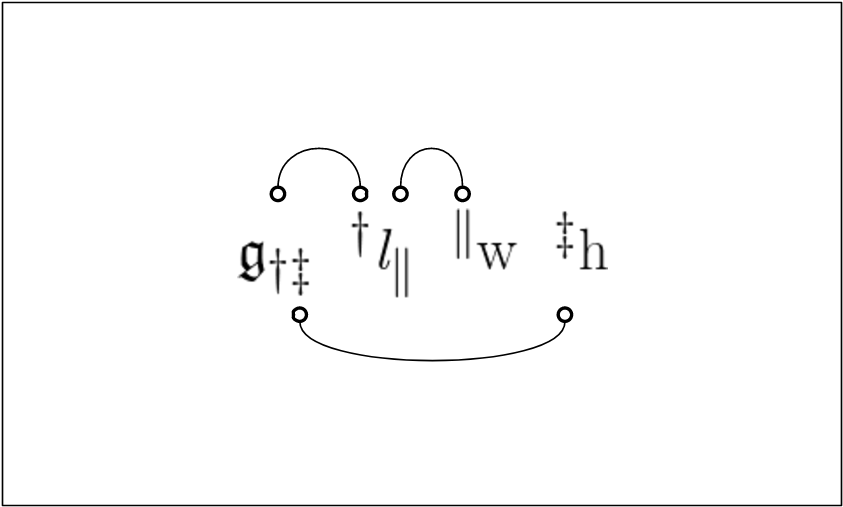

 which are placed subjacent to the relative term and before and above the correlate. Thus, giver of a horse to a lover of a woman may be written: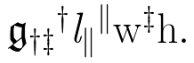
 a single letter for
 and we are asked to find all the ways of choosing a subset from this collection.
 represents the option we have, in choosing a subset of
  (signified by the
  ), or else to include it (signified by the
 bumper on the 3rd level, and then exits the board, represents a single term in the desired product and corresponds to the subset
 one obtains the sum:

 to
to  from the giver to
  and, therefore, I suppose the signification of the letter equivalent to such a relative to distinguish the correlates as first, second, third, etc., so that “giver of ── to ──” and “giver to ── of ──” will be expressed by different letters.
 denote the latter of these conjugative terms. Then, the correlates or multiplicands of this multiplier cannot all stand directly after it, as is usual in multiplication, but may be ranged after it in regular order, so that:
 of
of 
 so that if we put for
  ), and for
  horse (
 ),
),


 This is always very important. A term multiplied by two relatives shows that the same individual is in the two relations.




 shall denote whatever is lover of a woman. This notation is the same as that used by Mr. De Morgan, although he appears not to have had multiplication in his mind.
 will, then, denote whatever is servant of anything of the class composed of men and women taken together. So that:
 will denote whatever is lover or servant to a woman, and:
 will denote whatever stands to a woman in the relation of servant of a lover, and:
 we have:
 may be. For what is a lover of something identical with anything, is the same as a lover of that thing.
 at a time, can result in our receiving a distorted impression of the sign relation’s true nature and structure.
 where
where  denotes the Vice-President of the United States, and
  denotes the President of the Senate of the United States.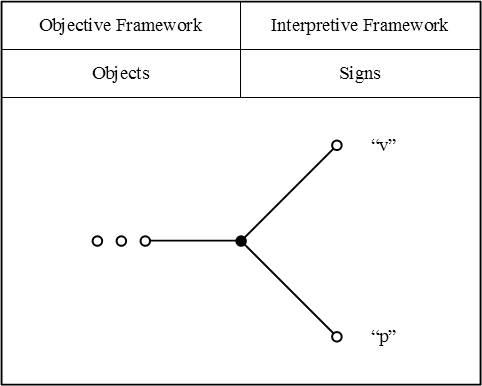

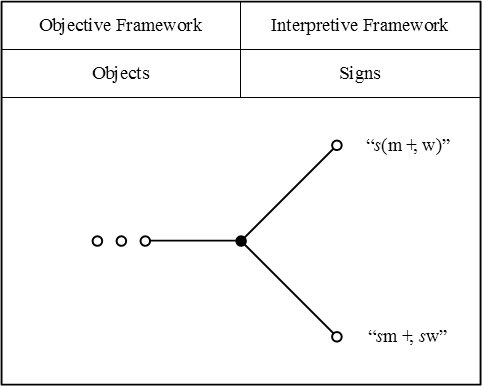


 and, besides, everything denoted by


 sign while withholding from it the name of addition.
 ; and this is the definition of zero. This interpretation is given by Boole, and is very neat, on account of the resemblance between the ordinary conception of zero and that of nothing, and because we shall thus have
![[0] ~=~ 0.](https://s0.wp.com/latex.php?latex=%5B0%5D+%7E%3D%7E+0.&bg=ffffff&fg=000000&s=1&c=20201002)
 denotes the Vice-President of the United States, and
  the President of the Senate of the United States,

 and
and  that the sign
  (or
(or  “as small as”) will mean “is”. Thus,


 is to say that
  is part of
  just as to write
  then the number of Frenchmen is less than the number of men, and if
  then the number of Vice-Presidents is equal to the number of Presidents of the Senate; so that the numbers may always be substituted for the terms themselves, in case no signs of operation occur in the equations or inequalities.
![[t]](https://s0.wp.com/latex.php?latex=%5Bt%5D&bg=ffffff&fg=333333&s=0&c=20201002) has one of its principal uses in providing a basis for the computation of frequencies, probabilities, and all the other statistical measures constructed from them, and thus in affording a “principle of correspondence” between probability theory and its limiting case in the forms of logic.
has one of its principal uses in providing a basis for the computation of frequencies, probabilities, and all the other statistical measures constructed from them, and thus in affording a “principle of correspondence” between probability theory and its limiting case in the forms of logic.


