Abduction, Deduction, Induction, Analogy, Inquiry • 24

Re: Peirce ListJon Alan Schmidt

Peirce’s categories are best viewed as categories of relations.  To a first approximation, firstness, secondness, thirdness are simply what all monadic, dyadic, triadic relations, respectively, have in common.  At a second approximation, we may take up the issues of generic versus degenerate cases of 1-, 2-, 3-adicity, but it is critical to address the first approximation first before attempting to deal with the second.

In that light, thirdness is a global property of the whole triadic relation in question and it is a category error to attribute thirdness to any one relational domain or role, much less any of the elements belonging to those domains or filling the roles of the triadic relation.

As it happens, we often approach a complex relation by picking one of its elements, that is, a single tuple as exemplary of the whole set of tuples making up the relation, and then we take up the components of that tuple in one convenient order or another.  That method lends itself to the impression k-ness abides in the k-th component we happen to take up, but that impression begs the question of whether that order is a property of the relation itself or merely an artifact of our choice.

Failing to examine that question puts us at risk for a type of error I’ve previously dubbed the Fallacy Of Misplaced Abstraction (FOMA).  As I see it, there is a lot of that going on in the present discussion, arising from a tendency to assign Peircean categories to everything in sight, despite the fact that Peirce’s categories apply only to certain levels of structure.

cc: Peirce List (1) (2) (3) (4) (5) (6) (7) (8) (9) (10) (11)

Posted in Abduction, Analogy, Aristotle, Artificial Intelligence, C.S. Peirce, Deduction, Induction, Inquiry, Inquiry Driven Systems, Intelligent Systems Engineering, Logic, Mental Models, Peirce, Scientific Method, Semiotics, Systems | Tagged , , , , , , , , , , , , , , , | 8 Comments

Abduction, Deduction, Induction, Analogy, Inquiry • 23

Re: Peirce ListBenjamin UdellJon Awbrey • Gary Richmond (1) (2)Jon Alan Schmidt

These days it takes me a web search to discover what I was thinking and writing the month before.  I went looking for the passage in McCulloch where he uses Case, Fact, Rule and it led me through hill and dale and back to my own post here on March 11.  See McCulloch’s paper with the Bardic title “What’s In The Brain That Ink May Character?”, but watch out for a few typos in the online copy.

Abductive reasoning was one of the first topics that pulled me into the briar patch of AI many years ago.  There were early papers by Harry Pople that I recall, partly because they came up again when I was working at the University of Texas Medical Branch and folks there were just beginning to explore computer-aided medical diagnosis.  At any rate, my search did turn up a copy of one of Pople’s early papers that references both Peirce and McCulloch.

  • Pople, H., and Werner, G. (1972), “An Information Processing Approach to Theory Formation in Biomedical Research”.  Online.

There have been four or five distinct waves of AI literature on so-called “abduction” since that time but almost all of it takes off from the same syntactic over-simplification of Peirce’s more complex model of abductive reasoning as it performs its role within the process of inquiry, so I have largely lost interest in that departure from the fons et origo.

References

  • McCulloch, W.S. (1964), “What’s in the Brain That Ink May Character?”, International Congress for Logic, Methodology, and Philosophy of Science, Israel, August 28, 1964.  Reprinted in Embodiments of Mind, pp. 387–397.
  • McCulloch, W.S. (1965), Embodiments of Mind, MIT Press, Cambridge, MA.
  • Pople, H., and Werner, G. (1972), “An Information Processing Approach to Theory Formation in Biomedical Research”, International Workshop on Managing Requirements Knowledge, December 5–7, 1972, Anaheim, CA, American Federation of Information Processing Societies (AFIPS), 1972 Proceedings of the Spring Joint Computer Conference, pp. 1125–1138.

cc: Peirce List (1) (2) (3) (4) (5) (6) (7) (8) (9) (10)

Posted in Abduction, Analogy, Aristotle, Artificial Intelligence, C.S. Peirce, Deduction, Induction, Inquiry, Inquiry Driven Systems, Intelligent Systems Engineering, Logic, Mental Models, Peirce, Scientific Method, Semiotics, Systems | Tagged , , , , , , , , , , , , , , , | 8 Comments

Types of Reasoning in C.S. Peirce and Aristotle • 2

Re: Peirce List DiscussionBen UdellGary Richmond

Present business has kept me from following much of the recent discussion on Peirce’s three types of reasoning, but we have been down this road before and so old tunes keep coming to mind whenever I get a chance to sample the stream.  I’ll use this thread to post what incidental reflections I may have, as they come to mind, in no particular order.

First, to the question recently discussed by Ben Udell and Gary Richmond, as to what we know and when we know it.

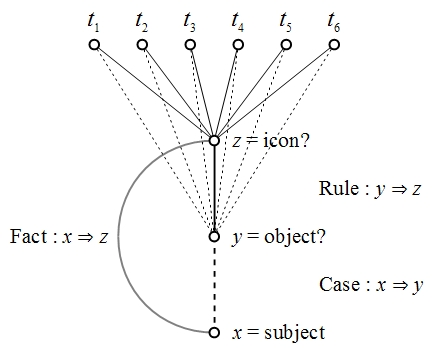
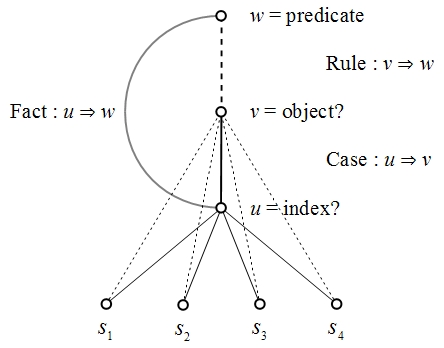
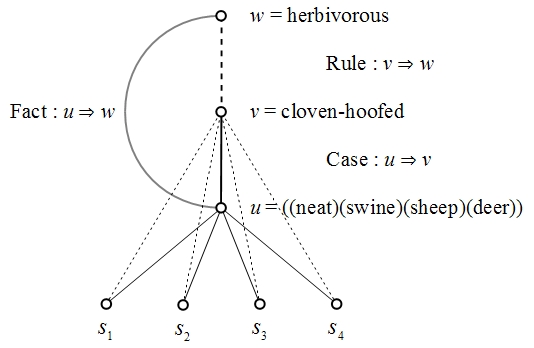
Inquiry situations where both premisses, major and minor, rule and case, arise at roughly the same time are very common, maybe even the archetype.  Aristotle said somewhere that the essence of wit was quickly grasping the middle term and I somewhat later dubbed this the process of discovering a “trial factorization” of a problem space or phenomenal field.  There is a bit of discussion in my essay titled Prospects for Inquiry Driven Systems in the section headed The Trees, The Forest.

For the present purpose, it should be recognized that this “trial factorization” of a problem space or phenomenal field is an important intellectual act in itself, one that deserves attention in the effort to understand the competencies that support intelligent functioning.  It is a good question to ask just what sort of reasoning processes might be involved in the ability to find such a middle term, as is served by “knowledge” in the example at hand.  Generally speaking, interest will reside in a whole system of middle terms, which might be called a “medium” of the problem domain or the field of phenomena.  This usage makes plain the circumstance that the very recognition and expression of a problem or phenomenon is already contingent upon and complicit with a particular set of hypotheses that will inform the direction of its resolution or explanation.

References

Posted in Abduction, Analogy, Argument, Aristotle, C.S. Peirce, Constraint, Deduction, Determination, Diagrammatic Reasoning, Diagrams, Differential Logic, Functional Logic, Hypothesis, Indication, Induction, Inference, Information, Inquiry, Logic, Logic of Science, Mathematics, Peirce, Peirce List, Philosophy, Probable Reasoning, Propositional Calculus, Propositions, Reasoning, Retroduction, Semiotic Information, Semiotics, Sign Relations, Syllogism | Tagged , , , , , , , , , , , , , , , , , , , , , , , , , , , , , , , , | 2 Comments

Types of Reasoning in C.S. Peirce and Aristotle • 1

Re: Peirce List Discussion

In one of his earliest treatments of the three types of reasoning, from his Harvard Lectures “On the Logic of Science” (1865), Peirce gives an example that illustrates how one and the same proposition might be reached from three different directions, as the end result of an inference in each of the three modes.  There is a discussion of this example in my project report on Inquiry and Analogy.

Preceding that section there is a table of diagrams giving a rough illustration of how the three types of inference relate to Aristotle’s figures of the syllogism.

Posted in Abduction, Analogy, Argument, Aristotle, C.S. Peirce, Constraint, Deduction, Determination, Diagrammatic Reasoning, Diagrams, Differential Logic, Functional Logic, Hypothesis, Indication, Induction, Inference, Information, Inquiry, Logic, Logic of Science, Mathematics, Peirce, Peirce List, Philosophy, Probable Reasoning, Propositional Calculus, Propositions, Reasoning, Retroduction, Semiotic Information, Semiotics, Sign Relations, Syllogism | Tagged , , , , , , , , , , , , , , , , , , , , , , , , , , , , , , , , | 1 Comment

Readings On Determination • Discussion 3

Re: Readings On Determination • 1

I keep coming back to Peirce’s early lectures on the logic of science because we see there the first inklings of his prospective theory of information, one of those ideas whose time was ripe enough but whose complete fruition lies yet in the future.  The ideas of constraint, definition, determination, information, and inquiry are naturally deeply intertwined.

Here is a link to my ongoing study of those lectures, focusing on the formula:

Definitions of Peirce’s various terms (content, sphere, etc.) may be found there.

Resources

cc: Peirce List

Posted in C.S. Peirce, Comprehension, Constraint, Definition, Determination, Differential Logic, Extension, Form, Indication, Information = Comprehension × Extension, Inquiry, Inquiry Driven Systems, Intension, Leibniz, Logic, Logic of Relatives, Mathematics, Peirce, Prigogine, Relation Theory, Relational Programming, Semiotics, Sign Relations | Tagged , , , , , , , , , , , , , , , , , , , , , , | 6 Comments

Readings On Determination • 1

Re: Peirce List (1) (2)

The concepts of definition and determination converge in their concern for setting bounds to the point where they coincide at a certain level of abstraction.  One avenue of approach to determination may then begin from a consideration of definition.

The moment, then, that we pass from nothing and the vacuity of being to any content or sphere, we come at once to a composite content and sphere.  In fact, extension and comprehension — like space and time — are quantities which are not composed of ultimate elements;  but every part however small is divisible.

The consequence of this fact is that when we wish to enumerate the sphere of a term — a process termed division — or when we wish to run over the content of a term — a process called definition — since we cannot take the elements of our enumeration singly but must take them in groups, there is danger that we shall take some element twice over, or that we shall omit some.  Hence the extension and comprehension which we know will be somewhat indeterminate.  But we must distinguish two kinds of these quantities.  If we were to subtilize we might make other distinctions but I shall be content with two.  They are the extension and comprehension relatively to our actual knowledge, and what these would be were our knowledge perfect.  (Peirce, CE 1, 462)

Reference

  • Peirce, C.S. (1866), “The Logic of Science;  or, Induction and Hypothesis”, pp. 357–504 in Writings of Charles S. Peirce : A Chronological Edition, Volume 1, 1857–1866, Peirce Edition Project, Indiana University Press, Bloomington, IN, 1982.

Resources

cc: Peirce List

Posted in C.S. Peirce, Comprehension, Constraint, Definition, Determination, Differential Logic, Extension, Form, Indication, Information = Comprehension × Extension, Inquiry, Inquiry Driven Systems, Intension, Leibniz, Logic, Logic of Relatives, Mathematics, Peirce, Prigogine, Relation Theory, Relational Programming, Semiotics, Sign Relations | Tagged , , , , , , , , , , , , , , , , , , , , , , | 8 Comments

Readings On Determination • Discussion 2

Re: Peirce List (1) (2)
Re: Jeffrey Downard (1) (2) (3)

Having been through this same discussion on many previous occasions I’ll try to sum up the more persistent confusions never ceasing to bedevil the subject.  Most of these arise from a failure to observe a number of critical distinctions.

  1. There is above all the distinction between relations and tuples.  When it is necessary to emphasize the distinction I will describe relations as “relations in general” or “relations proper” while referring to tuples as “elementary relations”.
  1. There is the corresponding distinction between sign relations and elementary sign relations or triples of the form (o, s, i).

Relations are, generally speaking, much more complex structures than elementary relations, so classifying relations is a much more complex affair than classifying elementary relations.

The same goes for sign relations and elementary sign relations.  Almost all the literature you see on “classifying sign relations” actually goes no further than the much simpler task of classifying elementary sign relations.  Classifying sign relations, in the proper sense of the word, is a task for the future.

  1. There is the distinction between formal or informational determination and causal or temporal determination.  The latter form of determination is a special case of the former.  A simple example of formal determination is found in such venerable phrases as “two points determine a line”.  Pairs of points do not cause lines or precede them in time.  Formal determination is defined at a higher level of abstraction than cause and time.
  1. There is the distinction between dyadic forms of determination and triadic forms of determination.  Here we run into a verbal problem.  There is something about the word “determination” — possibly the grammatical category of “to determine” as a transitive verb with a lone direct object — that almost inexorably drags the mind down into the ruts of dyadic thinking, so it helps to use the more general and less biased idea of constraint.

    In this more general perspective, the family of concepts including correspondence, determination, law, relation, structure, and so on all fall under the notion of constraint.  Constraint is present in a system to the extent that one set of choices is distinguished by some mark from a larger set of choices.  That mark may distinguish the actual from the possible, the desired from the conceivable, or any number of other divisions depending on the subject in view.

    Thus we have a form of determination wherever we have a form of constraint.  One of the most general ways of expressing a constraint is in terms of the subset relation:

    • A dyadic relation D is defined by the constraint D \subseteq X \times Y, where X and Y are the domains of the relation D.
    • A triadic relation T is defined by the constraint T \subseteq X \times Y \times Z, where X, Y, Z are the domains of the relation T.
    • A sign relation L is defined by the constraint L \subseteq O \times S \times I, where O, S, I are the domains of the sign relation L.

Resources

cc: Peirce List

Posted in C.S. Peirce, Comprehension, Constraint, Definition, Determination, Differential Logic, Extension, Form, Indication, Information = Comprehension × Extension, Inquiry, Inquiry Driven Systems, Intension, Leibniz, Logic, Logic of Relatives, Mathematics, Peirce, Prigogine, Relation Theory, Relational Programming, Semiotics, Sign Relations | Tagged , , , , , , , , , , , , , , , , , , , , , , | 6 Comments

Readings On Determination • Discussion 1

Re: Peirce List (1) (2)

What I’m really after here has to do with the way a certain concept of determination figures into Peirce’s better definitions of a sign relation — “better” meaning definitions strong enough to bear the load of a consequential theory.

That is a very old business with me and there are developments of it still unfinished but lately I have noticed a number of related issues which are not as clear as they need to be.

So I’ll be trying to do something about that, by the by.

Resources

cc: Peirce List

Posted in C.S. Peirce, Comprehension, Constraint, Definition, Determination, Differential Logic, Extension, Form, Indication, Information = Comprehension × Extension, Inquiry, Inquiry Driven Systems, Intension, Leibniz, Logic, Logic of Relatives, Mathematics, Peirce, Prigogine, Relation Theory, Relational Programming, Semiotics, Sign Relations | Tagged , , , , , , , , , , , , , , , , , , , , , , | 6 Comments

Definition and Determination • 13

Re: Peirce List (1) (2)
Re: Jerry Rhee (1) (2)

Verbal acrobatics can get a person only so far, even for a high-wire act like C.S. Peirce, and all the great failures to launch I’ve seen pragmatism and semiotics suffer from during the last century come about because people have a habit of getting waylaid in à priori armchair delicatessen methods of fixing their beliefs in premature contentments.

When it’s time to deal with real experimental data and realistic practical applications then there is no help for it but wrestling with the mathematical structures of triadic sign relations and relations in general.

Resources

cc: Inquiry List • Peirce List (1) (2) (3) (4) (5)

Posted in C.S. Peirce, Comprehension, Constraint, Definition, Determination, Extension, Form, Indication, Information = Comprehension × Extension, Inquiry, Intension, Logic, Logic of Science, Mathematics, Peirce, Semiotics, Structure | Tagged , , , , , , , , , , , , , , , , | 6 Comments

Definition and Determination • 12

Re: Peirce List (1) (2)
Re: Jerry Rhee, quoting Peirce (1) (2)

The surprising fact, C, is observed;
But if A were true, C would be a matter of course,
Hence, there is reason to suspect that A is true.  (CP 5.189)

For now I’m just focused on the bare essentials of Peirce’s semiotics, specifically, the minimal adequate definition of a sign relation as it figures into Peirce’s definition of logic along with the necessary concepts of triple correspondence and triadic determination on which all the rest depends.

The essential definitions of logic and sign relations can be found on the following page.

It would take a while to get from there to his full theory of inquiry, involving the interplay of abductive, deductive, and inductive styles of inference, but first things first, as they say.

Just as a side note, though, I’m sure every writer who ever attempted to introduce a complex subject to a new audience has tried the tactic of seeking out the simplest possible capsule summary of its main gist.  The pithy epitome of abduction cited above is a perfect example of just such a capsule and I have seen vast literatures in several areas spring from its pith and moment only to have their currents turn awry from its oversimplifications.  Let’s not get addicted to that capsule!

A better idea of the rich interplay among the three styles of reasoning and how they work in tandem to reinforce one another in genuine inquiry may be had from the study I carried out when I was working to view Peirce’s theories of inference, information, and inquiry from a systems analysis perspective on a systems engineering platform.  There is a sketch of that work in the following report.

cc: Inquiry List • Peirce List (1) (2) (3) (4) (5)

Posted in C.S. Peirce, Comprehension, Constraint, Definition, Determination, Extension, Form, Indication, Information = Comprehension × Extension, Inquiry, Intension, Logic, Logic of Science, Mathematics, Peirce, Semiotics, Structure | Tagged , , , , , , , , , , , , , , , , | 6 Comments