Minimal Negation Operators • 3

It will take a few more rounds of stage-setting before we are able to entertain concrete examples of applications but the following may indicate the direction of generalization embodied in minimal negation operators.

To begin, let’s observe two ways of generalizing the logical operation commonly known as exclusive disjunction (\textsc{xor}) or symmetric difference (\Delta).

Let \mathbb{B} = the boolean domain \{ 0, 1 \}.

Exclusive disjunction is a boolean function \Delta : \mathbb{B} \times \mathbb{B} \to \mathbb{B} isomorphic to the algebraic field addition + : \mathbb{B} \times \mathbb{B} \to \mathbb{B}, also known as addition mod 2.  Adding the language of minimal negation operators to the mix we have the following equivalent expressions.

\begin{matrix}  \textsc{xor}(p, q)  & = &  \Delta (p, q)  & = &  p + q  & = &  \nu (p, q)  & = &  \texttt{(} p \texttt{,} q \texttt{)}  \end{matrix}

Minimal Negation \texttt{(} p \texttt{,} q \texttt{)} as Parity Indicator

Generalizing the function p + q of two variables to more variables extends the sequence of functions in the fashion p\!+\!q\!+\!r,  p\!+\!q\!+\!r\!+\!s,  p\!+\!q\!+\!r\!+\!s\!+\!t,  and so on.  These are known as parity sums, returning a value of 0 when there are an even number of 1’s in the sum and returning a value of 1 when there are an odd number of 1’s in the sum.

Minimal Negation \texttt{(} p \texttt{,} q \texttt{)} as Border Indicator

The equivalent expressions \texttt{(} p \texttt{,} q \texttt{)} = \nu(p, q) = p + q = p \,\Delta\, q = p ~\textsc{xor}~ q may be read with a different connotation, indicating the venn diagram cells adjacent to the conjunction p \land q.  Generalizing the function \texttt{(} p \texttt{,} q \texttt{)} of two variables to more variables extends the sequence of functions in the fashion \texttt{(} p \texttt{,} q \texttt{,} r \texttt{)},  \texttt{(} p \texttt{,} q \texttt{,} r \texttt{,} s \texttt{)},  \texttt{(} p \texttt{,} q \texttt{,} r \texttt{,} s \texttt{,} t \texttt{)},  and so on.  That sequence of operators differs from the sequence of parity sums once it passes the 2-variable case.

The triple sum may be written in terms of 2-place minimal negations as follows.

\begin{matrix}  p + q + r  & = &  \texttt{((} p \texttt{,} q \texttt{)}\!\texttt{,} r \texttt{)}  & = &  \texttt{(} p \texttt{,} \texttt{(} q \texttt{,} r \texttt{))}  \end{matrix}

It is important to recognize the triple sum expressions and the 3-place minimal negation \texttt{(} p \texttt{,} q \texttt{,} r \texttt{)} have very different meanings.

Resources

cc: CyberneticsOntolog ForumPeirce ListStructural ModelingSystems Science
cc: FB | Minimal Negation OperatorsLaws of Form

Posted in Amphecks, Animata, Boolean Functions, C.S. Peirce, Cactus Graphs, Differential Logic, Functional Logic, Graph Theory, Laws of Form, Logic, Logical Graphs, Mathematics, Minimal Negation Operators, Painted Cacti, Peirce, Propositional Calculus, Propositional Equation Reasoning Systems, Semiotics, Venn Diagrams, Visualization | Tagged , , , , , , , , , , , , , , , , , , , | 11 Comments

Minimal Negation Operators • 2

Re: Minimal Negation Operators • 1

The brief description of minimal negation operators given in the previous post is enough to convey the rule of their construction.  For future reference, a more formal definition is given below.

Initial Definition

The minimal negation operator \nu is a multigrade operator (\nu_k)_{k \in \mathbb{N}} where each \nu_k is a k-ary boolean function defined by the rule that \nu_k (x_1, \ldots, x_k) = 1 if and only if exactly one of the arguments x_j is 0.

In contexts where the initial letter \nu is understood, minimal negation operators may be indicated by argument lists in parentheses.  In the discussion that follows a distinctive typeface will be used for logical expressions based on minimal negation operators, for example, \texttt{(} x \texttt{,} y \texttt{,} z \texttt{)} = \nu (x, y, z).

The first four members of this family of operators are shown below.  The third and fourth columns give paraphrases in two other notations, where tildes and primes, respectively, indicate logical negation.

Minimal Negation Operators

Resources

cc: CyberneticsOntolog ForumPeirce ListStructural ModelingSystems Science
cc: FB | Minimal Negation OperatorsLaws of Form

Posted in Amphecks, Animata, Boolean Functions, C.S. Peirce, Cactus Graphs, Differential Logic, Functional Logic, Graph Theory, Laws of Form, Logic, Logical Graphs, Mathematics, Minimal Negation Operators, Painted Cacti, Peirce, Propositional Calculus, Propositional Equation Reasoning Systems, Semiotics, Venn Diagrams, Visualization | Tagged , , , , , , , , , , , , , , , , , , , | 11 Comments

Minimal Negation Operators • 1

To accommodate moderate levels of complexity in the application of logical graphs to practical problems our Organon requires a class of organules called “minimal negation operators”.  I outlined the history of their early development from Peirce’s alpha graphs for propositional calculus in a previous series of posts.  The next order of business is to sketch their properties in a systematic fashion and to illustrate their uses.  As it turns out, taking minimal negations as primitive operators enables efficient expressions for many natural constructs and affords a bridge between boolean domains of two values and domains with finite numbers of values, for example, finite sets of individuals.

Brief Introduction

A minimal negation operator (\nu) is a logical connective which says “just one false” of its logical arguments.  The first four cases are described below.

  1. If the list of arguments is empty, as expressed in the form \nu(), then it cannot be true exactly one of the arguments is false, so \nu() = \mathrm{false}.
  2. If p is the only argument then \nu(p) says p is false, so \nu(p) expresses the negation of the proposition p.  Written in several common notations we have the following equivalent expressions.

    \nu(p) ~=~ \mathrm{not}(p) ~=~ \lnot p ~=~ \tilde{p} ~=~ p^{\prime}

  3. If p and q are the only two arguments then \nu(p, q) says exactly one of p, q is false, so \nu(p, q) says the same thing as p \neq q.  Expressing \nu(p, q) in terms of ands (\cdot), ors (\lor), and nots (\tilde{~}) gives the following form.

    \nu(p, q) ~=~ \tilde{p} \cdot q ~\lor~ p \cdot \tilde{q}

    It is permissible to omit the dot (\cdot) in contexts where it is understood, giving the following form.
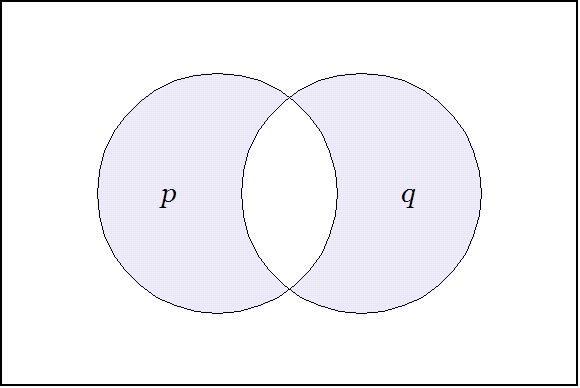
    \nu(p, q) ~=~ \tilde{p}q \lor p\tilde{q}

    The venn diagram for \nu(p, q) is shown in Figure 1.

    ν(p, q)

    \text{Figure 1.} ~~ \nu(p, q)

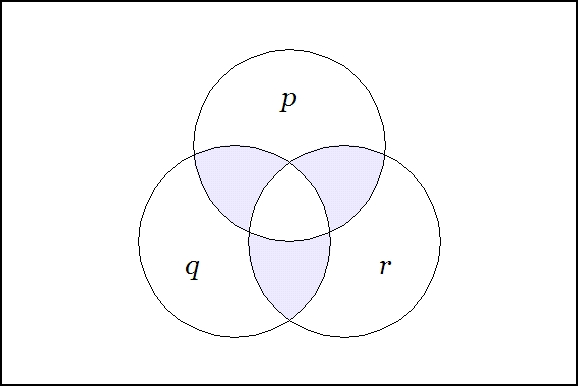
  4. The venn diagram for \nu(p, q, r) is shown in Figure 2.

    ν(p, q, r)

    \text{Figure 2.} ~~ \nu(p, q, r)

    The center cell is the region where all three arguments p, q, r hold true, so \nu(p, q, r) holds true in just the three neighboring cells.  In other words:

    \nu(p, q, r) ~=~ \tilde{p}qr \lor p\tilde{q}r \lor pq\tilde{r}

Resources

cc: CyberneticsOntolog ForumPeirce ListStructural ModelingSystems Science
cc: FB | Minimal Negation OperatorsLaws of Form

Posted in Amphecks, Animata, Boolean Functions, C.S. Peirce, Cactus Graphs, Differential Logic, Functional Logic, Graph Theory, Laws of Form, Logic, Logical Graphs, Mathematics, Minimal Negation Operators, Painted Cacti, Peirce, Propositional Calculus, Propositional Equation Reasoning Systems, Semiotics, Venn Diagrams, Visualization | Tagged , , , , , , , , , , , , , , , , , , , | 13 Comments

Charles Sanders Peirce, George Spencer Brown, and Me • 10

With any formal system it is easy to spend a long time roughing out primitives and reviewing first principles before getting on to practical applications, and logical graphs are no different in that respect.  But the promise of clearer and more efficient methods for solving realistic problems is what led me to the visual calculi of C.S. Peirce and Spencer Brown in the first place, so my aim throughout our rehearsal of rudiments is to make a bridge to applications a few steps nearer what the real world throws our way.

I’ve been thinking how to make the transition from basic ingredients of logical graphs and laws of form to slightly more interesting examples — still “toy worlds” as AI folk call them but suggestive to some degree of what might be possible in the long run.  I’ll spend a few days gathering assorted examples I’ve worked up previously and try presenting those.

cc: CyberneticsLaws of FormOntologPeirce ListStructural ModelingSystems Science

Posted in Abstraction, Amphecks, Analogy, Animata, Boolean Algebra, Boolean Functions, C.S. Peirce, Cactus Graphs, Cybernetics, Deduction, Differential Analytic Turing Automata, Differential Logic, Duality, Form, Graph Theory, Inquiry, Inquiry Driven Systems, Laws of Form, Logic, Logical Graphs, Mathematics, Minimal Negation Operators, Model Theory, Proof Theory, Propositional Calculus, Semiotics, Sign Relational Manifolds, Sign Relations, Spencer Brown, Theorem Proving, Time, Topology | Tagged , , , , , , , , , , , , , , , , , , , , , , , , , , , , , , , | 6 Comments

Charles Sanders Peirce, George Spencer Brown, and Me • 9

Re: Boundary Logic

A wider field of investigation opens up at this point, spanning the diversity of interactions among languages we use, and systems of signs in general, to the thoughts ever streaming through our heads, to the universes we talk and think upon, from Plato’s Heaven to Gaia’s Green Earth to the Tumbling Galaxies Beyond.

The complexities in play when we consider a domain of Signs, a domain of Ideas, and a domain of Objects all wound up in relationship to one another is what Peirce’s “semiotics” or theory of sign relations is all about.  Viewing the enterprise of logic within the broader frame of semiotics not only gives us more insight into its means and ends but affords us more “elbow room” for carrying out its operations.

To make a long story short, we don’t have to “escape language” because we don’t live inside any language or system of signs, even if we get so confused sometimes as to think we do.  We live in that wider world of reality and only use languages and other systems of signs to describe what little we can of it.

cc: CyberneticsLaws of FormOntologPeirceStructural ModelingSystems Science

Posted in Abstraction, Amphecks, Analogy, Animata, Boolean Algebra, Boolean Functions, C.S. Peirce, Cactus Graphs, Cybernetics, Deduction, Differential Logic, Duality, Form, Graph Theory, Inquiry, Inquiry Driven Systems, Laws of Form, Logic, Logical Graphs, Mathematics, Minimal Negation Operators, Model Theory, Peirce, Proof Theory, Propositional Calculus, Semiotics, Sign Relational Manifolds, Sign Relations, Spencer Brown, Theorem Proving, Time, Topology | Tagged , , , , , , , , , , , , , , , , , , , , , , , , , , , , , , , | 6 Comments

Charles Sanders Peirce, George Spencer Brown, and Me • 8

Re: Boundary Logic

For me, the heart of the matter is “what is the purpose of logic and what is the purpose of mathematics and what is their relationship?”

There are semiotic situations which appear to violate the initial conditions of logic but there are ways of approaching them without reducing our brains to jelly from the getgo.  Charles S. Peirce, following on Aristotle’s negotiation of the boundary between logic and rhetoric, developed his theory of triadic sign relations in large part to manage just those sorts of situations.

I’m determined to keep my gnosis close to the grinstone for the time being but here is a smattering of old notes which give a hint as to Peirce’s way of approaching the question.

C.S. Peirce on “General” and “Vague”

cc: CyberneticsLaws of FormOntologPeirceStructural ModelingSystems Science

Posted in Abstraction, Amphecks, Analogy, Animata, Boolean Algebra, Boolean Functions, C.S. Peirce, Cactus Graphs, Cybernetics, Deduction, Differential Logic, Duality, Form, Graph Theory, Inquiry, Inquiry Driven Systems, Laws of Form, Logic, Logical Graphs, Mathematics, Minimal Negation Operators, Model Theory, Peirce, Proof Theory, Propositional Calculus, Semiotics, Sign Relational Manifolds, Sign Relations, Spencer Brown, Theorem Proving, Time, Topology | Tagged , , , , , , , , , , , , , , , , , , , , , , , , , , , , , , , | 7 Comments

Charles Sanders Peirce, George Spencer Brown, and Me • 7

A statement P that implies both Q and \lnot Q is called a false statement, and anyone can prove anything at all from a false statement, as we all too frequently observe on the political front these days.
There is however a reasonable way of handling boundaries, for instance, as illustrated by the circumference of a region in a venn diagram, and that is by means of differential logic.  I’ve been tortoising my way toward the goal line of explaining all that, and it’s going a bit slow, but there’s a gentle introduction at the other end of the link below, if you wish to achilles ahead.

cc: CyberneticsLaws of FormOntologPeirceStructural ModelingSystems Science

Posted in Abstraction, Amphecks, Analogy, Animata, Boolean Algebra, Boolean Functions, C.S. Peirce, Cactus Graphs, Cybernetics, Deduction, Differential Logic, Duality, Form, Graph Theory, Inquiry, Inquiry Driven Systems, Laws of Form, Logic, Logical Graphs, Mathematics, Minimal Negation Operators, Model Theory, Peirce, Proof Theory, Propositional Calculus, Semiotics, Sign Relational Manifolds, Sign Relations, Spencer Brown, Theorem Proving, Time, Topology | Tagged , , , , , , , , , , , , , , , , , , , , , , , , , , , , , , , | 6 Comments

Charles Sanders Peirce, George Spencer Brown, and Me • 6

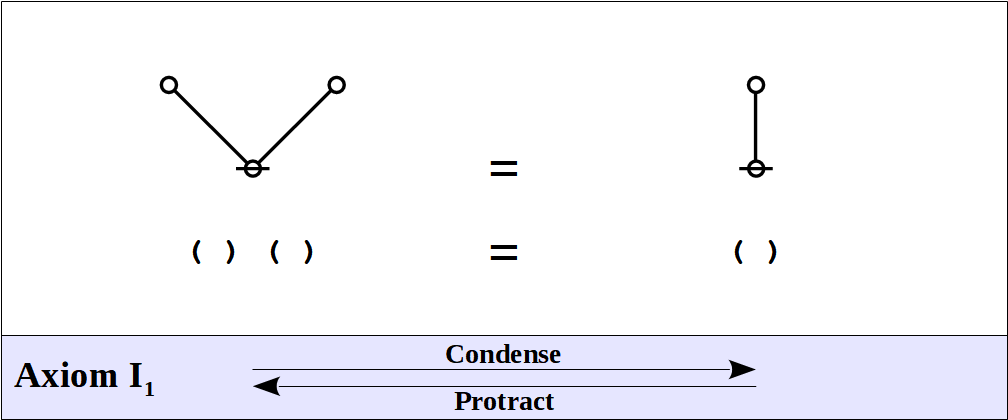
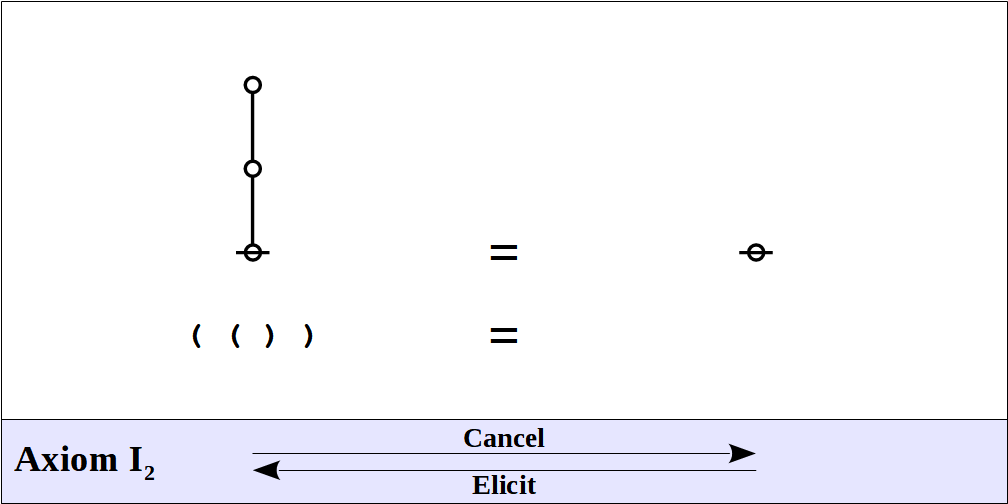
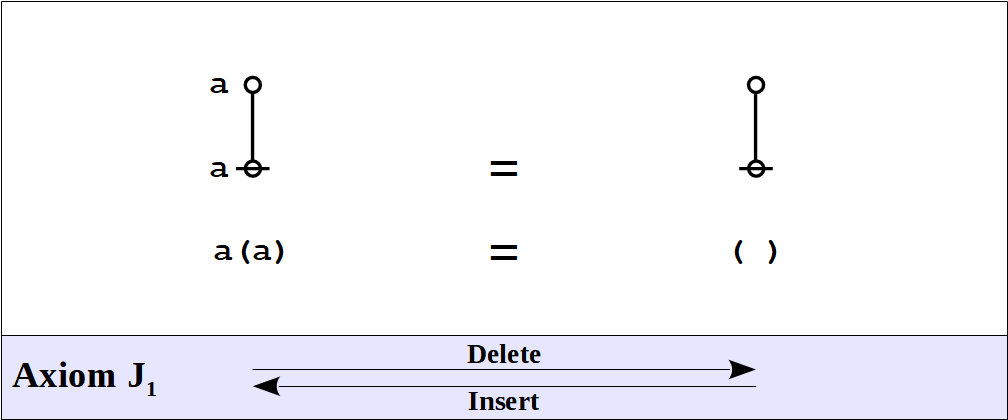
The formal system of logical graphs is defined by a foursome of formal equations, called initials when regarded purely formally, in abstraction from potential interpretations, and called axioms when interpreted as logical equivalences.  There are two arithmetic initials and two algebraic initials, as shown below.

Arithmetic Initials

I₁

I₂

Algebraic Initials

J₁

J₂

Spencer Brown uses a different formal equation for his first algebraic initial — where I use  a \texttt{(} a \texttt{)} = \texttt{(~)}  he uses  \texttt{(} a \texttt{(} a \texttt{))} = ~~.  For the moment, let’s refer to my \mathrm{J_1} as \mathrm{J_{1a}} and his \mathrm{J_1} as \mathrm{J_{1b}} and use that notation to examine the relationship between the two systems.

It is easy to see that the two systems are equivalent, since we have the following proof of \mathrm{J_{1b}} by way of \mathrm{J_{1a}} and \mathrm{I_2}.


 a   a
 o---o
 |
 @

 =======J1a {delete}

 o---o
 |
 @

 =======I2  {cancel}

 @

 =======QED J1b

In choosing between systems I am less concerned with small differences in the lengths of proofs than I am with other factors.  It is difficult for me to remember all the reasons for decisions I made forty or fifty years ago — as a general rule, Peirce’s way of looking at the relation between mathematics and logic has long been a big influence on my thinking and the other main impact is accountable to the nuts and bolts requirements of computational representation.

But looking at the choice with present eyes, I think I continue to prefer the \mathrm{I_1, I_2, J_{1a}, J_2} system over the alternative simply for the fact it treats two different types of operation separately, namely, changes in graphical structure versus changes in the placement of variables.

cc: CyberneticsLaws of FormOntologPeirceStructural ModelingSystems Science

Posted in Abstraction, Amphecks, Analogy, Animata, Boolean Algebra, Boolean Functions, C.S. Peirce, Cactus Graphs, Cybernetics, Deduction, Differential Logic, Duality, Form, Graph Theory, Inquiry, Inquiry Driven Systems, Laws of Form, Logic, Logical Graphs, Mathematics, Minimal Negation Operators, Model Theory, Peirce, Proof Theory, Propositional Calculus, Semiotics, Sign Relational Manifolds, Sign Relations, Spencer Brown, Theorem Proving, Time, Topology | Tagged , , , , , , , , , , , , , , , , , , , , , , , , , , , , , , , | 6 Comments

Charles Sanders Peirce, George Spencer Brown, and Me • 5

Peirce's Law

Here are blog and wiki versions of an article I wrote on Peirce’s Law, an axiom or theorem (depending on your choice of logical basis) which distinguishes classical from intuitionistic propositional calculus.  Aside from its pivotal logical status it affords a nice illustration of several important features of logical graphs in the style of Peirce and Spencer Brown.

Resource

cc: CyberneticsLaws of FormOntologPeirceStructural ModelingSystems Science

Posted in Abstraction, Amphecks, Analogy, Animata, Boolean Algebra, Boolean Functions, C.S. Peirce, Cactus Graphs, Cybernetics, Deduction, Differential Logic, Duality, Form, Graph Theory, Inquiry, Inquiry Driven Systems, Laws of Form, Logic, Logical Graphs, Mathematics, Minimal Negation Operators, Model Theory, Peirce, Proof Theory, Propositional Calculus, Semiotics, Sign Relational Manifolds, Sign Relations, Spencer Brown, Theorem Proving, Time, Topology | Tagged , , , , , , , , , , , , , , , , , , , , , , , , , , , , , , , | 6 Comments

Charles Sanders Peirce, George Spencer Brown, and Me • 4

Two things impacting my studies of Peirce and Spencer Brown over the years were my parallel studies in mathematics and computer science.  In the overlap between those areas came courses in logic, mathematical linguistics, and the theory of formal languages, grammars, and automata.

My intellectual wanderings over a nine‑year undergraduate career would take me through a cycle of majors from math and physics, to communication, psychology, philosophy, and a cross‑cultural liberal arts program, then back to grad school in mathematics.

The puzzles Peirce and Spencer Brown beset my brain with were a big part of what drove me back to math, since I could see I had no chance of resolving them without learning a lot more algebra, logic, and topology than I had learned till then.

Resources

cc: CyberneticsLaws of FormOntologPeirceStructural ModelingSystems Science

Posted in Abstraction, Amphecks, Analogy, Animata, Boolean Algebra, Boolean Functions, C.S. Peirce, Cactus Graphs, Cybernetics, Deduction, Differential Logic, Duality, Form, Graph Theory, Inquiry, Inquiry Driven Systems, Laws of Form, Logic, Logical Graphs, Mathematics, Minimal Negation Operators, Model Theory, Peirce, Proof Theory, Propositional Calculus, Semiotics, Sign Relational Manifolds, Sign Relations, Spencer Brown, Theorem Proving, Time, Topology | Tagged , , , , , , , , , , , , , , , , , , , , , , , , , , , , , , , | 6 Comments