Theory and Therapy of Representations • 3

Representation is a concept we find at the intersection of cybernetics, epistemology, logic, mathematics, psychology, and sociology.  In my studies it led me from math to psych and back again, with sidelong glances at the history of democratic governance.  Its time come round again, I find myself returning to the scenes of two recurring questions.

Scene 1.  Pragmatic Theory Of Truth • 18

We do not live in axiom systems.  We do not live encased in languages, formal or natural.  There is no reason to think we will ever have exact and exhaustive theories of what’s out there, and the truth, as we know, is “out there”.  Peirce understood there are more truths in mathematics than are dreamt of in logic — and Gödel’s realism should have put the last nail in the coffin of logicism — but some ways of thinking just never get a clue.

That brings us to Question 1 —

  • What are formalisms and all their embodiments in brains and computers good for?

Scene 2.  Theory and Therapy of Representations • 1

Statistics were originally the data a ship of state needed for stationkeeping and staying on course.  The Founders of the United States, like the Cybernauts of the Enlightenment they were, engineered a ship of state with checks and ballasts and error-controlled feedbacks for the sake of representing both reality and the will of the people.  In that connection Max Weber saw how a state’s accounting systems were intended as representations of realities its crew and passengers must observe or perish.

That brings us to Question 2 —

  • What are the forces distorting our representations of what’s observed, what’s expected, and what’s intended?

Resources

cc: Conceptual GraphsCyberneticsLaws of FormOntolog Forum
cc: FB | CyberneticsStructural ModelingSystems Science

Posted in Cybernetics, Democracy, Economics, Education, Expectation, Governance, Information, Inquiry, Intention, Justice, Law, Logic, Observation, Plato, Representation, Science, Semiosis, Semiotics, Society, Statistics, Virtue | Tagged , , , , , , , , , , , , , , , , , , , , | 2 Comments

History, Its Arc, Its Tangents • 1

Re: Renaissance MathematicusBoth Sides of History

I do not pretend to understand the moral universe;
the arc is a long one, my eye reaches but little ways;
I cannot calculate the curve and complete the figure by
the experience of sight;  I can divine it by conscience.
And from what I see I am sure it bends towards justice.

🙞 Theodore Parker

I think we are dealing with the scientific analogue of the moral figure above.  To inquire is to act as if inquiry pursued far enough will end in truth.  It’s a regulative principle, not a dogma, but a regulative principle is akin to a leap of faith.  Here we have a parting of the ways between those who think the end is near what we think we already know and those who think it’s more likely further down the road.  The two camps sort past and present ideas according to each one’s guess what the future holds.

cc: CyberneticsOntolog ForumPeirce ListStructural ModelingSystems Science
cc: FB | Inquiry Driven SystemsLaws of Form

Posted in History of Science, Inquiry, Mathematics, Science, Theodore Parker, Thony Christie | Tagged , , , , , | 1 Comment

Pragmatic Truth • Discussion 19

Going over the last few month’s posts about signs, systems, and theories of truth I see many unanswered questions deserving of further attention.  Seasonal diversions being what they are my mind will be elsewhere the rest of the year so I’ve put together a list of topics for future work.

cc: CyberneticsOntolog ForumStructural ModelingSystems Science

Posted in Aristotle, C.S. Peirce, Coherence, Concordance, Congruence, Consensus, Convergence, Correspondence, Dewey, Fixation of Belief, Information, Inquiry, John Dewey, Kant, Logic, Logic of Science, Method, Peirce, Philosophy, Pragmatic Maxim, Pragmatism, Semiotics, Sign Relations, Triadic Relations, Truth, Truth Theory, William James | Tagged , , , , , , , , , , , , , , , , , , , , , , , , , , | 5 Comments

Cybernetics • Regulation In Biological Systems • Discussion 3

Re: CyberneticsFaisal L. Kadri

Maybe it will help to say a few things about the way forward …

I’ll be getting back to Ashby’s text directly — it’s still the best guide I’ve found to the rudiments of cybernetics and the underlying logic of developing systems.  Once we’ve laid down a stable platform of basic ideas we’ll be equipped to explore many directions of application, extension, and generalization.

As far as the future goes …

The way I see it, scientific inquiry is a cybernetic process carried on at every scale from individual inquirers to whole communities of inquiry.  That’s the way forward for me, but it’s still a ways to go.

Reference

  • Ashby, W.R. (1956), An Introduction to Cybernetics, Chapman and Hall, London, UK.  Republished by Methuen and Company, London, UK, 1964.  Online.

cc: Cybernetics • Ontolog (1)(2) • Structural Modeling (1)(2) • Systems Science (1)(2)

Posted in Adaptive Systems, Ashby, C.S. Peirce, Communication, Control, Cybernetics, Evolution, Information, Inquiry Driven Systems, Learning, Logic, Mathematics, Peirce, Purpose, Regulation, Survival, Truth Theory, W. Ross Ashby | Tagged , , , , , , , , , , , , , , , , , | 7 Comments

Higher Order Sign Relations • Discussion 1

Re: FB | Charles S. Peirce SocietyJohn Corcoran

Questions about the proper treatment of use and mention from the standpoint of Peirce’s theory of signs came up recently in discussions on Facebook.  In pragmatic semiotics the trade‑off between “signs-of-objects” and “signs-as-objects” opens up the wider space of higher order sign relations.  In previous work on Inquiry Driven Systems I introduced the subject in the following way.

When interpreters reflect on their use of signs they require an appropriate technical language in which to pursue their reflections.  They need signs referring to sign relations, signs referring to elements and components of sign relations, and signs referring to properties and classes of sign relations.  The orders of signs developing as reflection evolves can be organized under the heading of “higher order signs” and the reflective sign relations involving them can be referred to as “higher order sign relations”.

References

Resources

cc: Conceptual GraphsCyberneticsLaws of FormOntolog Forum
cc: FB | Inquiry Driven SystemsStructural ModelingSystems Science

Posted in Arithmetization, C.S. Peirce, Gödel Numbers, Higher Order Sign Relations, Inquiry, Inquiry Driven Systems, Inquiry Into Inquiry, Logic, Mathematics, Quotation, Reflection, Reflective Interpretive Frameworks, Semiotics, Sign Relations, Triadic Relations, Use and Mention, Visualization | Tagged , , , , , , , , , , , , , , , , | 10 Comments

Cybernetics • Regulation In Biological Systems • Selection 8

We want to understand how a species of organisms might evolve:  (1) organic means of storing formal structures capable of bearing information about an organism’s state in the world, and (2) faculties for developing artificial extensions of those means.  Keeping that goal in mind, let’s follow Ashby’s thesis about the mark of a good regulator as he applies it to higher forms of regulation.

Regulation In Biological Systems

Survival

Ashby Cybernetics Figure 10.5.2

10/6.[concl.]   The same argument will apply, with obvious modifications, to the automatic pilot.  If it is a good regulator the passengers will have a smooth flight whatever the gustiness outside.  They will, in short, be prevented from knowing whether or not it is gusty outside.  Thus a good pilot acts as a barrier against the transmission of that information.

The same argument applies to an air-conditioner.  If I live in an air-conditioned room, and can tell, by the hotness of the room, that it is getting hot outside, then that conditioner is failing as a regulator.  If it is really good, and the blinds are drawn, I shall be unable to form any idea of what the outside weather is like.  The good conditioner blocks the flow inwards of information about the weather.

The same thesis applies to the higher regulations achieved by such activities as hunting for food, and earning one’s daily bread.  Thus while the unskilled hunter or earner, in difficult times, will starve and will force his liver and tissues (the essential variables) to extreme and perhaps unphysiological states, the skilled hunter or earner will go through the same difficult times with his liver and tissues never taken to extremes.  In other words, his skill as a regulator is shown by the fact, among others, that it prevents information about the times reaching the essential variables.  In the same way, the skilled provider for a family may go through difficult times without his family realising that anything unusual has happened.  The family of an unskilled provider would have discovered it.

In general, then, an essential feature of the good regulator is that it blocks the flow of variety from disturbances to essential variables.

Reference

  • Ashby, W.R. (1956), An Introduction to Cybernetics, Chapman and Hall, London, UK.  Republished by Methuen and Company, London, UK, 1964.  Online.

cc: CyberneticsOntolog ForumStructural ModelingSystems Science

Posted in Adaptive Systems, Ashby, C.S. Peirce, Communication, Control, Cybernetics, Evolution, Information, Inquiry Driven Systems, Learning, Logic, Mathematics, Peirce, Purpose, Regulation, Survival, Truth Theory, W. Ross Ashby | Tagged , , , , , , , , , , , , , , , , , | 7 Comments

Cybernetics • Regulation In Biological Systems • Discussion 2

Re: Systems ScienceJack Ring

In the last selection we found Ashby making what may strike us initially as a surprising inference.  Starting from the assumption that “an essential function of F as a regulator is that it shall block the transmission of variety from disturbance to essential variable” he draws the conclusion that “the regulator’s function is to block the flow of information”.

Ashby’s reasoning at this point caused me to do a double take, because I normally think of information as a resource for reducing variety, in other words, the dispersive quality of entropy.  But a little reflection convinced me Ashby is making sense here, so long as we read him right.

Jack Ring’s suggestion, “Consider that the regulator blocks information that is detrimental to the system mission”, serves to point us in the right direction.  Strictly speaking, though, it is not the information about temperature variation that is detrimental to the system’s mission but the temperature variation itself.  The regulator acts in such a way as to block the information about variation, but solely as a side effect of damping the real variation.

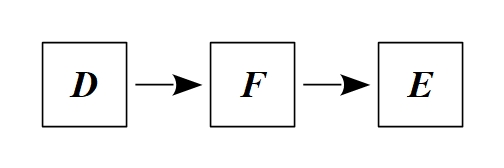
But we need to keep one thing in mind.  When we speak of the regulator blocking the flow of information, we are talking about the whole system (D, F, E) as a “black box”, where the net information flow from input to output is as low as possible.  When we turn to a finer-grained analysis of regulated systems we will see that all sorts of information has to be processed inside the system in order to achieve its mission.

Reference

  • Ashby, W.R. (1956), An Introduction to Cybernetics, Chapman and Hall, London, UK.  Republished by Methuen and Company, London, UK, 1964.  Online.

cc: CyberneticsOntolog ForumStructural ModelingSystems Science

Posted in Adaptive Systems, Ashby, C.S. Peirce, Communication, Control, Cybernetics, Evolution, Information, Inquiry Driven Systems, Learning, Logic, Mathematics, Peirce, Purpose, Regulation, Survival, Truth Theory, W. Ross Ashby | Tagged , , , , , , , , , , , , , , , , , | 7 Comments

Cybernetics • Regulation In Biological Systems • Selection 7

Let’s pick up the observation Ashby made at the end of the last selection, regarding the job of a regulator, and continue with his text from there.

Regulation In Biological Systems

Survival

Ashby Cybernetics Figure 10.5.2

10/6.[cont.]   If F is a regulator, the insertion of F between D and E lessens the variety that is transmitted from D to E.  Thus an essential function of F as a regulator is that it shall block the transmission of variety from disturbance to essential variable.

Since this characteristic also implies that the regulator’s function is to block the flow of information, let us look at the thesis more closely to see whether it is reasonable.

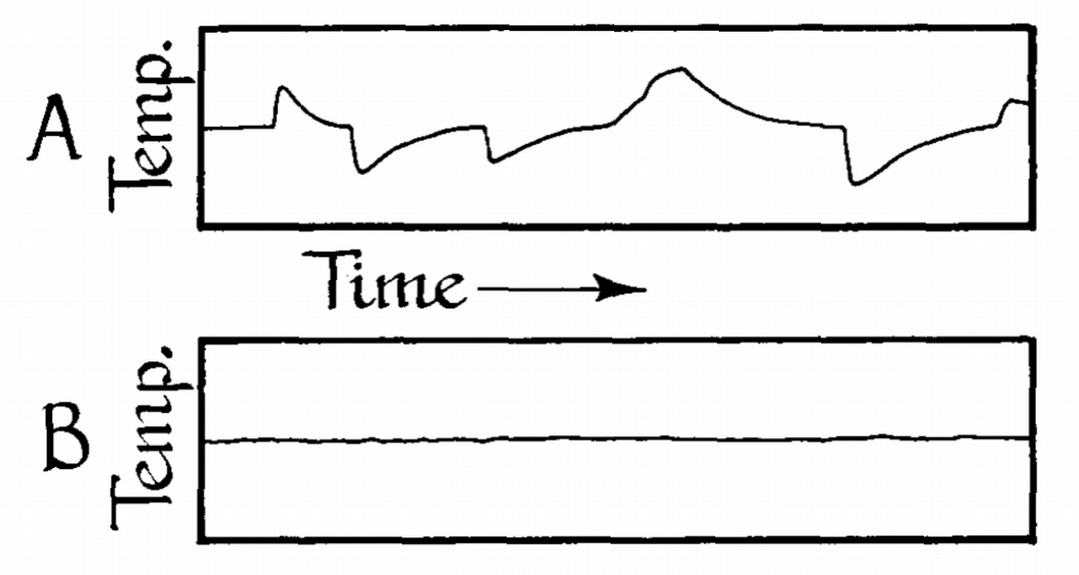
Suppose that two water-baths are offered me, and I want to decide which to buy.  I test each for a day against similar disturbances and then look at the records of the temperatures;  they are as in Fig. 10/6/1.

Ashby Cybernetics Figure 10.6.1

Fig. 10/6/1

There is no doubt that \mathrm{Model}~ B is the better;  and I decide this precisely because its record gives me no information, as does A\text{'s}, about what disturbances, of heat or cold, came to it.  The thermometer and water in bath B have been unable, as it were, to see anything of the disturbances D.

Reference

  • Ashby, W.R. (1956), An Introduction to Cybernetics, Chapman and Hall, London, UK.  Republished by Methuen and Company, London, UK, 1964.  Online.

cc: CyberneticsOntolog ForumStructural ModelingSystems Science

Posted in Adaptive Systems, Ashby, C.S. Peirce, Communication, Control, Cybernetics, Evolution, Information, Inquiry Driven Systems, Learning, Logic, Mathematics, Peirce, Purpose, Regulation, Survival, Truth Theory, W. Ross Ashby | Tagged , , , , , , , , , , , , , , , , , | 9 Comments

Cybernetics • Regulation In Biological Systems • Selection 6

Regulation In Biological Systems

Survival

Ashby Cybernetics Figure 10.5.2

10/6.   Regulation blocks the flow of variety.   On what scale can any particular mechanism F be measured for its value or success as a regulator?  The perfect thermostat would be one that, in spite of disturbance, kept the temperature constant at the desired level.  In general, there are two characteristics required:  the maintenance of the temperature within close limits, and the correspondence of this range with the desired one.  What we must notice in particular is that the set of permissible values, \eta, has less variety than the set of all possible values in E;  for \eta is some set selected from the states of E.  If F is a regulator, the insertion of F between D and E lessens the variety that is transmitted from D to E.  Thus an essential function of F as a regulator is that it shall block the transmission of variety from disturbance to essential variable.

Reference

  • Ashby, W.R. (1956), An Introduction to Cybernetics, Chapman and Hall, London, UK.  Republished by Methuen and Company, London, UK, 1964.  Online.

cc: CyberneticsOntolog ForumStructural ModelingSystems Science

Posted in Adaptive Systems, Ashby, C.S. Peirce, Communication, Control, Cybernetics, Evolution, Information, Inquiry Driven Systems, Learning, Logic, Mathematics, Peirce, Purpose, Regulation, Survival, Truth Theory, W. Ross Ashby | Tagged , , , , , , , , , , , , , , , , , | 9 Comments

Cybernetics • Regulation In Biological Systems • Discussion 1

Re: Ontolog ForumJon AwbreyPaola Di Maio

JA:
We continue in pursuit of a system-theoretic answer to the question:  What are formalisms and all their embodiments in brains and computers good for?
PDM:
Could you also provide a brief answer to the question, through your analysis of the text you reference — we all suffer from attention deficit and may forget what you were trying to say at the beginning.

I know what you mean.  Brevity is the soul of wit, but the brief lives of mortal attention spans struggle to embody half of it.  I personally have trouble remembering what I was thinking a few days ago unless I wrote it down somewhere I can easily find again.

My question about the good of embodied formalisms was intended to call attention to a natural connection between Pragmatic Truth and Cybernetic Purpose.  Pragmatic ways of thinking about the role of representations in relating interpreters to objective realities naturally harmonize with systems thinking about the role of information in achieving the objectives of agents.  In either mode of thinking we tend to become quickly dissatisfied with disembodied abstractions, detached from dynamic context and meaningful purpose.

Reference

  • Ashby, W.R. (1956), An Introduction to Cybernetics, Chapman and Hall, London, UK.  Republished by Methuen and Company, London, UK, 1964.  Online.

cc: CyberneticsOntolog ForumStructural ModelingSystems Science

Posted in Adaptive Systems, Ashby, C.S. Peirce, Communication, Control, Cybernetics, Evolution, Information, Inquiry Driven Systems, Learning, Logic, Mathematics, Peirce, Purpose, Regulation, Survival, Truth Theory, W. Ross Ashby | Tagged , , , , , , , , , , , , , , , , , | 6 Comments