Functional Logic • Inquiry and Analogy • Preliminaries

Functional Logic • Inquiry and Analogy

This report discusses C.S. Peirce’s treatment of analogy, placing it in relation to his overall theory of inquiry.  We begin by introducing three basic types of reasoning Peirce adopted from classical logic.  In Peirce’s analysis both inquiry and analogy are complex programs of logical inference which develop through stages of these three types, though normally in different orders.

Note on notation.  The discussion to follow uses logical conjunctions, expressed in the form of concatenated tuples e_1 ~\ldots~ e_k, and minimal negation operations, expressed in the form of bracketed tuples \texttt{(} e_1 \texttt{,} \ldots \texttt{,} e_k \texttt{)}, as the principal expression-forming operations of a calculus for boolean-valued functions, that is, for propositions.  The expressions of this calculus parse into data structures whose underlying graphs are called cacti by graph theorists.  Hence the name cactus language for this dialect of propositional calculus.

Resources

cc: FB | Peirce MattersLaws of FormMathstodonOntologAcademia.edu
cc: Conceptual GraphsCyberneticsStructural ModelingSystems Science

Posted in Abduction, Analogy, Argument, Aristotle, C.S. Peirce, Constraint, Deduction, Determination, Diagrammatic Reasoning, Diagrams, Differential Logic, Functional Logic, Hypothesis, Indication, Induction, Inference, Information, Inquiry, Logic, Logic of Science, Mathematics, Pragmatic Semiotic Information, Probable Reasoning, Propositional Calculus, Propositions, Reasoning, Retroduction, Semiotics, Sign Relations, Syllogism, Triadic Relations, Visualization | Tagged , , , , , , , , , , , , , , , , , , , , , , , , , , , , , , , | 4 Comments

Systems of Interpretation • 9

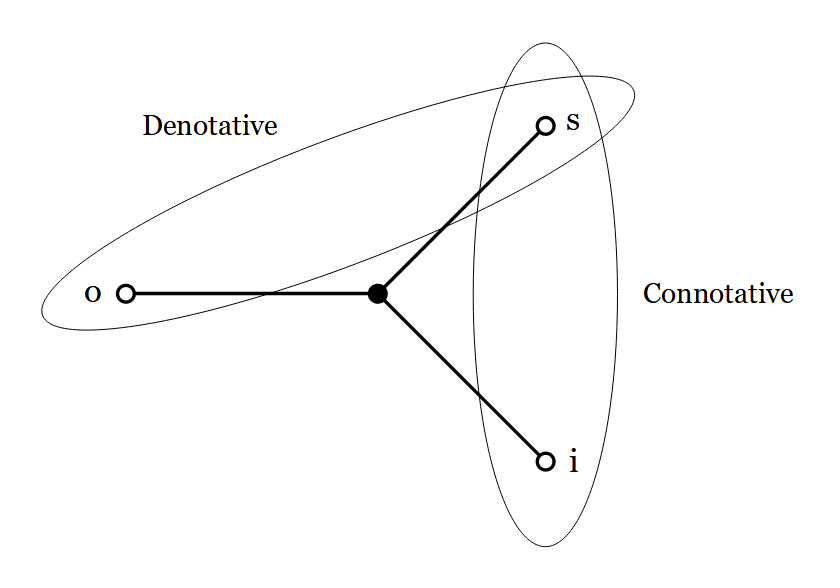
Elementary Sign Relation
\text{Figure 2. An Elementary Sign Relation}

Re: Peirce ListJerry Chandler

It is above all important to understand that Peirce’s concept of a sign relation is defined at a higher order of abstraction than any notion of causal or temporal order.

A sign relation L \subseteq O \times S \times I is a structure which can generate the temporal sequences of signs making up a semiotic process but there is no necessary temporal order associated with the relational domains O, S, I nor with the roles of objects, signs, and interpretant signs in any triple of the form (o, s, i).

As it happens, generative relationships between a generating structure and a generated class of structures are very common throughout mathematics and not unique to semiotics.

References

  • Awbrey, S.M., and Awbrey, J.L. (2001), “Conceptual Barriers to Creating Integrative Universities”, Organization : The Interdisciplinary Journal of Organization, Theory, and Society 8(2), Sage Publications, London, UK, 269–284.  AbstractOnline.
  • Awbrey, S.M., and Awbrey, J.L. (September 1999), “Organizations of Learning or Learning Organizations : The Challenge of Creating Integrative Universities for the Next Century”, Second International Conference of the Journal ‘Organization’, Re‑Organizing Knowledge, Trans‑Forming Institutions : Knowing, Knowledge, and the University in the 21st Century, University of Massachusetts, Amherst, MA.  Online.
  • Awbrey, J.L., and Awbrey, S.M. (1995), “Interpretation as Action : The Risk of Inquiry”, Inquiry : Critical Thinking Across the Disciplines 15(1), 40–52.  ArchiveJournal.  Online (doc) (pdf).

cc: Conceptual GraphsCyberneticsStructural ModelingSystems Science
cc: FB | SemeioticsMathstodonLaws of FormAcademia.edu

Posted in C.S. Peirce, Diagrammatic Reasoning, Interpretive Frameworks, Logic, Logical Graphs, Objective Frameworks, Relation Theory, Semiotics, Sign Relations, Systems of Interpretation, Triadic Relations, Visualization | Tagged , , , , , , , , , , , | 6 Comments

Systems of Interpretation • 8

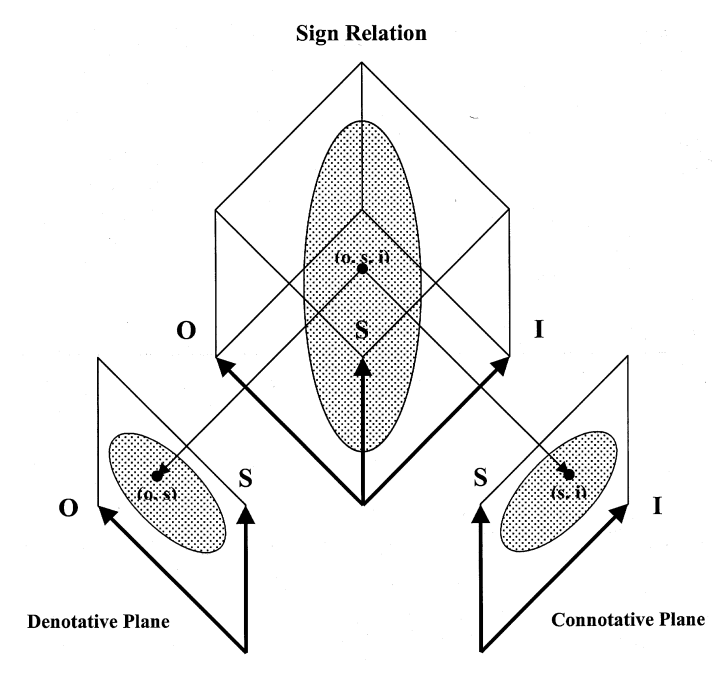
Aspects of a Sign Relation
\text{Figure 3. Aspects of a Sign Relation}

Re: Peirce ListKirsti Määttänen

One of the chief advantages of Peirce’s systems of logical graphs, entitative and existential, is the way they escape the bounds of 1‑dimensional syntax and thus make it clear that many constraints of order imposed by the ordinary lines of linguistic text are not of the essence for logic but purely rhetorical accidents.  That does, of course, leave open the question of what constraints imposed by the 2‑dimensional medium of Peirce’s logical graphs might also be inessential to logic.

As far as visualizations of sign relations go, without worrying about their use as a calculus, there is the above 3‑dimensional example from a paper Susan Awbrey and I presented at conference in 1999 and revised for publication in 2001.

Resources

References

  • Awbrey, S.M., and Awbrey, J.L. (2001), “Conceptual Barriers to Creating Integrative Universities”, Organization : The Interdisciplinary Journal of Organization, Theory, and Society 8(2), Sage Publications, London, UK, 269–284.  AbstractOnline.
  • Awbrey, S.M., and Awbrey, J.L. (September 1999), “Organizations of Learning or Learning Organizations : The Challenge of Creating Integrative Universities for the Next Century”, Second International Conference of the Journal ‘Organization’, Re‑Organizing Knowledge, Trans‑Forming Institutions : Knowing, Knowledge, and the University in the 21st Century, University of Massachusetts, Amherst, MA.  Online.
  • Awbrey, J.L., and Awbrey, S.M. (1995), “Interpretation as Action : The Risk of Inquiry”, Inquiry : Critical Thinking Across the Disciplines 15(1), 40–52.  ArchiveJournal.  Online (doc) (pdf).

cc: Conceptual GraphsCyberneticsStructural ModelingSystems Science
cc: FB | SemeioticsMathstodonLaws of FormAcademia.edu

Posted in C.S. Peirce, Diagrammatic Reasoning, Interpretive Frameworks, Logic, Logical Graphs, Objective Frameworks, Relation Theory, Semiotics, Sign Relations, Systems of Interpretation, Triadic Relations, Visualization | Tagged , , , , , , , , , , , | 4 Comments

Systems of Interpretation • 7

Elementary Sign Relation
\text{Figure 2. An Elementary Sign Relation}

Re: Peirce ListGary Fuhrman

Peirce’s existential graphs are a general calculus for expressing the same subject matter as his logic of relative terms and thus they serve to represent the structures of many‑place relations.  Cast at that level of generality, there is nothing to prevent existential graphs from being used to express the special cases of relative terms needed for a theory of triadic sign relations, for example, terms like “s stands to i for o” or “__ stands to __ for __” or any number of other forms, depending on the style one prefers.  It may give us pause that we have to use sign relations in order to mention sign relations but the fact is we do that all the time whether we are using Peirce’s semiotics or not.  Peirce’s pragmatic analysis of the process simply provides a clearer account than most other approaches do.

References

  • Awbrey, S.M., and Awbrey, J.L. (2001), “Conceptual Barriers to Creating Integrative Universities”, Organization : The Interdisciplinary Journal of Organization, Theory, and Society 8(2), Sage Publications, London, UK, 269–284.  AbstractOnline.
  • Awbrey, S.M., and Awbrey, J.L. (September 1999), “Organizations of Learning or Learning Organizations : The Challenge of Creating Integrative Universities for the Next Century”, Second International Conference of the Journal ‘Organization’, Re‑Organizing Knowledge, Trans‑Forming Institutions : Knowing, Knowledge, and the University in the 21st Century, University of Massachusetts, Amherst, MA.  Online.
  • Awbrey, J.L., and Awbrey, S.M. (1995), “Interpretation as Action : The Risk of Inquiry”, Inquiry : Critical Thinking Across the Disciplines 15(1), 40–52.  ArchiveJournal.  Online (doc) (pdf).

cc: Conceptual GraphsCyberneticsStructural ModelingSystems Science
cc: FB | SemeioticsMathstodonLaws of FormAcademia.edu

Posted in C.S. Peirce, Diagrammatic Reasoning, Interpretive Frameworks, Logic, Logical Graphs, Objective Frameworks, Relation Theory, Semiotics, Sign Relations, Systems of Interpretation, Triadic Relations, Visualization | Tagged , , , , , , , , , , , | 4 Comments

Systems of Interpretation • 6

Elementary Sign Relation
\text{Figure 2. An Elementary Sign Relation}

Re: Peirce ListJon AwbreyJohn Collier

JA:
Questions about the meaning of the “central hub” in the “three‑spoked” picture of an elementary sign relation have often come up.  The central “spot”, as Peirce called it in his logical graphs, is located on a different logical plane, since it is really a place‑holder for the whole sign relation or possibly for the individual triple.  Normally I would have labeled it with a letter to indicate the whole sign relation, say L, or else the individual triple, say \ell = (o, s, i).
JC:
I strongly agree, Jon.  Reading meaning into artefacts of the representation is not typically transparent.  I would say that the whole symbol represents the sign with its threefold character and that the node is not some separate signifier.  To put it on this level is, as you suggest, a category error.

Precisely.  And “artefact” is a very choice word here, with all the right connotations.  It would be unfortunate if this trivial “triskelion” figure became a caltrop to our thought, blocking the way of inquiry.

Aside from the ellipses we added to call attention to a couple of derivative dyadic relations, somewhat loosely called denotative and connotative in our paper, it is merely typical of the 3‑spoke figures in common use when I was first learning Peirce’s theory of signs, often arising to point out the differences between Saussure’s dyadic semiology and Peirce’s triadic semiotics.

The intervening decades have taught me all the ways diagrams and figures of that sort can be misinterpreted when the conventions of interpretation needed to understand them are not up and running.  It can be instructive to carry out post mortems on the various maps of misreading but if one is not up for the morbidity of that, it is probably wiser to move on to more viable representations.

References

  • Awbrey, S.M., and Awbrey, J.L. (2001), “Conceptual Barriers to Creating Integrative Universities”, Organization : The Interdisciplinary Journal of Organization, Theory, and Society 8(2), Sage Publications, London, UK, 269–284.  AbstractOnline.
  • Awbrey, S.M., and Awbrey, J.L. (September 1999), “Organizations of Learning or Learning Organizations : The Challenge of Creating Integrative Universities for the Next Century”, Second International Conference of the Journal ‘Organization’, Re‑Organizing Knowledge, Trans‑Forming Institutions : Knowing, Knowledge, and the University in the 21st Century, University of Massachusetts, Amherst, MA.  Online.
  • Awbrey, J.L., and Awbrey, S.M. (1995), “Interpretation as Action : The Risk of Inquiry”, Inquiry : Critical Thinking Across the Disciplines 15(1), 40–52.  ArchiveJournal.  Online (doc) (pdf).

cc: Conceptual GraphsCyberneticsStructural ModelingSystems Science
cc: FB | SemeioticsMathstodonLaws of FormAcademia.edu

Posted in C.S. Peirce, Diagrammatic Reasoning, Interpretive Frameworks, Logic, Logical Graphs, Objective Frameworks, Relation Theory, Semiotics, Sign Relations, Systems of Interpretation, Triadic Relations, Visualization | Tagged , , , , , , , , , , , | 4 Comments

Systems of Interpretation • Discussion 1

Re: FB | Systems SciencesEsteban Trev

ET:
What is the difference between sign and symbol?

In Peirce’s usage, “sign” is the generic term, covering all species or types of signs.  Signs are “symbolic” to the extent they mean what they do solely by virtue of being interpreted to do so.  In Peirce’s fully triadic semiotics all signs are symbolic to some degree, even when they have the additional properties required to qualify them as “icons”, “indices”, or more specialized types.

Resources

cc: Conceptual GraphsCyberneticsStructural ModelingSystems Science
cc: FB | SemeioticsMathstodonLaws of FormAcademia.edu

Posted in C.S. Peirce, Diagrammatic Reasoning, Interpretive Frameworks, Logic, Logical Graphs, Objective Frameworks, Relation Theory, Semiotics, Sign Relations, Systems of Interpretation, Triadic Relations, Visualization | Tagged , , , , , , , , , , , | 4 Comments

Systems of Interpretation • 5

Elementary Sign Relation
\text{Figure 2. An Elementary Sign Relation}

Re: Peirce ListJerry Chandler

An elementary sign relation is an ordered triple (o, s, i).  It is called elementary because it is one element of a sign relation L \subseteq O \times S \times I, where O is a set of objects, S is a set of signs, and I is a set of interpretant signs that are collectively called the domains of the relation.

But what is the significance of that ordering?

In any presentation of subject matter we have to distinguish the natural order of things from the order of consideration or presentation in which things are taken up on a given occasion.

The natural order of things comes to light through the discovery of invariants over a variety of presentations and representations.  That type of order tends to take a considerable effort to reveal.

The order of consideration or presentation is often more arbitrary, making some aspects of the subject matter more salient than others depending on the paradigm or perspective one has chosen.

In the case of sign relations, the order in which we take up the domains O, S, I or the components of a triple (o, s, i) is wholly arbitrary so long as we maintain the same order throughout the course of discussion.

References

  • Awbrey, S.M., and Awbrey, J.L. (2001), “Conceptual Barriers to Creating Integrative Universities”, Organization : The Interdisciplinary Journal of Organization, Theory, and Society 8(2), Sage Publications, London, UK, 269–284.  AbstractOnline.
  • Awbrey, S.M., and Awbrey, J.L. (September 1999), “Organizations of Learning or Learning Organizations : The Challenge of Creating Integrative Universities for the Next Century”, Second International Conference of the Journal ‘Organization’, Re‑Organizing Knowledge, Trans‑Forming Institutions : Knowing, Knowledge, and the University in the 21st Century, University of Massachusetts, Amherst, MA.  Online.
  • Awbrey, J.L., and Awbrey, S.M. (1995), “Interpretation as Action : The Risk of Inquiry”, Inquiry : Critical Thinking Across the Disciplines 15(1), 40–52.  ArchiveJournal.  Online (doc) (pdf).

cc: Conceptual GraphsCyberneticsStructural ModelingSystems Science
cc: FB | SemeioticsMathstodonLaws of FormAcademia.edu

Posted in C.S. Peirce, Diagrammatic Reasoning, Interpretive Frameworks, Logic, Logical Graphs, Objective Frameworks, Relation Theory, Semiotics, Sign Relations, Systems of Interpretation, Triadic Relations, Visualization | Tagged , , , , , , , , , , , | 4 Comments

Systems of Interpretation • 4

Re: Peirce ListMike BergmanValentine Daniel

For its pertinence to the present discussion, here again is what Peirce wrote about the mathematical way of using individual or particular cases to make general hypotheses or suppositions:

And just so we don’t forget that Peirce’s theory of individuals is not the run-of-the-mill absolute kind but makes the quality of individuality relative to the context of discussion — or the frame of reference as they say in physics — here is what he wrote about that:

cc: Conceptual GraphsCyberneticsStructural ModelingSystems Science
cc: FB | SemeioticsMathstodonLaws of FormAcademia.edu

Posted in C.S. Peirce, Diagrammatic Reasoning, Interpretive Frameworks, Logic, Logical Graphs, Objective Frameworks, Relation Theory, Semiotics, Sign Relations, Systems of Interpretation, Triadic Relations, Visualization | Tagged , , , , , , , , , , , | 4 Comments

Logic Syllabus • Discussion 2

Re: Logic Syllabus
Re: Laws of FormJohn Mingers

JM:
Is [the “just one true” operator] the same or different to xor?  I have read that xor is true when an odd number of variables are true which would make it different.  But I also read somewhere that xor was true when only one is true.

Here’s my syllabus entry on Exclusive Disjunction (xor), also known as Logical Inequality, Symmetric Difference, and a few other names.  It’s my best effort so far at straightening out the reigning confusions and also at highlighting the links between the various notations and visualizations we find in practice.

Exclusive disjunction, also known as logical inequality or symmetric difference, is an operation on two logical values, typically the values of two propositions, which produces a value of true just in case exactly one of its operands is true.

To say exactly one operand is true is to say the other is false, which is to say the two operands are different, that is, unequal.

Expressed algebraically, x_1 + x_2 = 1 ~ (\text{mod}~ 2).

Viewed in that light, it is tempting to think a natural extension of xor to many variables x_1, \ldots, x_m will take the form x_1 + \ldots + x_m = 1 ~ (\text{mod}~ 2).  And saying the bit sum of several boolean values is 1 is just another way of saying an odd number of the values are 1.

Sums of that order form a perfectly good family of boolean functions, ones we’ll revisit in a different light, but their kinship to the family of logical disjunctions is a bit more strained than uniquely natural.

cc: Conceptual GraphsCyberneticsStructural ModelingSystems Science
cc: FB | Logical GraphsMathstodonLaws of FormOntolog Forum

Posted in Amphecks, Animata, Boolean Functions, C.S. Peirce, Cactus Graphs, Differential Logic, Functional Logic, Graph Theory, Laws of Form, Logic, Logical Graphs, Mathematics, Minimal Negation Operators, Painted Cacti, Peirce, Propositional Calculus, Propositional Equation Reasoning Systems, Semiotics, Venn Diagrams, Visualization | Tagged , , , , , , , , , , , , , , , , , , , | 5 Comments

Logic Syllabus • Discussion 1

Re: Logic Syllabus
Re: Laws of FormJohn Mingers

JM:
In a previous post you mentioned the minimal negation operator.  Is there also the converse of this, i.e. an operator which is true when exactly one of its arguments is true?  Or is this just xor?

Yes, the “just one true” operator is a very handy tool.  We discussed it earlier under the headings of “genus and species relations” or “radio button logic”.  Viewed in the form of a venn diagram it describes a partition of the universe of discourse into mutually exclusive and exhaustive regions.  Reading \texttt{(} x_1 \texttt{,} \ldots \texttt{,} x_m \texttt{)} to mean just one of x_1, \ldots, x_m is false, the form \texttt{((} x_1 \texttt{),} \ldots \texttt{,(} x_m \texttt{))} means just one of x_1, \ldots, x_m is true.

For two logical variables, though, the cases “condense” or “degenerate” and saying “just one true” is the same thing as saying “just one false”.

\texttt{((} x_1 \texttt{),(} x_2 \texttt{))} = \texttt{(} x_1 \texttt{,} x_2 \texttt{)} = x_1 + x_2 = \textsc{xor} (x_1, x_2).

There’s more information on the following pages.

cc: Conceptual GraphsCyberneticsStructural ModelingSystems Science
cc: FB | Logical GraphsMathstodonLaws of FormOntolog Forum

Posted in Amphecks, Animata, Boolean Functions, C.S. Peirce, Cactus Graphs, Differential Logic, Functional Logic, Graph Theory, Laws of Form, Logic, Logical Graphs, Mathematics, Minimal Negation Operators, Painted Cacti, Peirce, Propositional Calculus, Propositional Equation Reasoning Systems, Semiotics, Venn Diagrams, Visualization | Tagged , , , , , , , , , , , , , , , , , , , | 5 Comments