Functional Logic • Inquiry and Analogy • Discussion 1

Re: Functional Logic • Inquiry and Analogy • 8

Post 8 used the following Figure to illustrate Dewey’s example of a simple inquiry process.

Dewey's “Sign of Rain” Example
\text{Dewey's ``Sign of Rain" Example}

John Mingers shared the following observations.

JM:
Liked the example — a couple of questions/comments.

  1. In the diagram you have included with the Triadic sign, although with dotted lines, an interpretive agent.  Now I thought that Peirce was a bit cagey about this.  Wasn’t he clear that the interpretant was not to be identified with an actual interpreter?  What is your thinking on this?
  2. I do agree that there needs to be an interpreter but does it need to be a person?  Surely it could be any organism that can interact with relations?

The cool air is something our hero interprets as a sign of rain and his thought of rain is an interpretant sign of the very same object.  The relation between the interpretant sign and the interpretive agent is clear enough as far as a beginning level of description goes.  But a fully pragmatic, semiotic, and system-theoretic account will demand a more fine-grained analysis of what goes on in the inquiry process.

Speaking very roughly, an interpreter is any agent or system — animal, vegetable, or mineral — which actualizes or embodies a triadic sign relation.

Several passages from Peirce will help to flesh out the bare abstractions.  I’ll begin collecting them on the linked blog page and discuss them further as we proceed.

Previous Discussions

Related Resources

Reference

  • Awbrey, J.L., and Awbrey, S.M. (1995), “Interpretation as Action : The Risk of Inquiry”, Inquiry : Critical Thinking Across the Disciplines 15(1), 40–52.  ArchiveJournal.  Online (doc) (pdf).

cc: FB | Peirce MattersLaws of FormMathstodonOntologAcademia.edu
cc: Conceptual GraphsCyberneticsStructural ModelingSystems Science

Posted in Abduction, Analogy, Argument, Aristotle, C.S. Peirce, Constraint, Deduction, Determination, Diagrammatic Reasoning, Diagrams, Differential Logic, Functional Logic, Hypothesis, Indication, Induction, Inference, Information, Inquiry, Logic, Logic of Science, Mathematics, Pragmatic Semiotic Information, Probable Reasoning, Propositional Calculus, Propositions, Reasoning, Retroduction, Semiotics, Sign Relations, Syllogism, Triadic Relations, Visualization | Tagged , , , , , , , , , , , , , , , , , , , , , , , , , , , , , , , | 4 Comments

Functional Logic • Inquiry and Analogy • 9

Inquiry and AnalogyDewey’s “Sign of Rain” • An Example of Inquiry

We turn again to Dewey’s vignette, tracing figures of logic on grounds of semiotic.

A man is walking on a warm day.  The sky was clear the last time he observed it;  but presently he notes, while occupied primarily with other things, that the air is cooler.  It occurs to him that it is probably going to rain;  looking up, he sees a dark cloud between him and the sun, and he then quickens his steps.  What, if anything, in such a situation can be called thought?  Neither the act of walking nor the noting of the cold is a thought.  Walking is one direction of activity;  looking and noting are other modes of activity.  The likelihood that it will rain is, however, something suggested.  The pedestrian feels the cold;  he thinks of clouds and a coming shower.

(John Dewey, How We Think, 6–7)

Inquiry and Inference

If we follow Dewey’s “Sign of Rain” example far enough to consider the import of thought for action, we realize the subsequent conduct of the interpreter, progressing up through the natural conclusion of the episode — the quickening steps, seeking shelter in time to escape the rain — all those acts form a series of further interpretants, contingent on the active causes of the individual, for the originally recognized signs of rain and the first impressions of the actual case.  Just as critical reflection develops the associated and alternative signs which gather about an idea, pragmatic interpretation explores the consequential and contrasting actions which give effective and testable meaning to a person’s belief in it.

Figure 10 charts the progress of inquiry in Dewey’s “Sign of Rain” example according to the stages of reasoning identified by Peirce, focusing on the compound or mixed form of inference formed by the first two steps.

Cycle of Inquiry
\text{Figure 10. Cycle of Inquiry}

  • Step 1 is Abductive, abstracting a Case from the consideration of a Fact and a Rule.
    • \begin{array}{lll} \textsc{Fact} & : & {C \Rightarrow A}, \end{array}     In the Current situation the Air is cool.

    • \begin{array}{lll} \textsc{Rule} & : & {B \Rightarrow A}, \end{array}     Just Before it rains, the Air is cool.
    • \begin{array}{lll} \textsc{Case} & : & {C \Rightarrow B}, \end{array}     The Current situation is just Before it rains.

  • Step 2 is Deductive, admitting the Case to another Rule and arriving at a novel Fact.
    • \begin{array}{lll} \textsc{Case} & : & {C \Rightarrow B}, \end{array}     The Current situation is just Before it rains.
    • \begin{array}{lll} \textsc{Rule} & : & {B \Rightarrow D}, \end{array}     Just Before it rains, a Dark cloud will appear.

    • \begin{array}{lll} \textsc{Fact} & : & {C \Rightarrow D}, \end{array}     In the Current situation, a Dark cloud will appear.

What precedes is nowhere near a complete analysis of Dewey’s example, even so far as it might be carried out within the constraints of the syllogistic framework, and it covers only the first two steps of the inquiry process, but perhaps it will do for a start.

References

  • Some passages adapted from:
    Awbrey, J.L., and Awbrey, S.M. (1995), “Interpretation as Action : The Risk of Inquiry”, Inquiry : Critical Thinking Across the Disciplines 15(1), 40–52.  ArchiveJournal.  Online (doc) (pdf).
  • Dewey, J. (1910), How We Think, D.C. Heath, Boston, MA.  Reprinted (1991), Prometheus Books, Buffalo, NY.  Online.

Resources

cc: FB | Peirce MattersLaws of FormMathstodonOntologAcademia.edu
cc: Conceptual GraphsCyberneticsStructural ModelingSystems Science

Posted in Abduction, Analogy, Argument, Aristotle, C.S. Peirce, Constraint, Deduction, Determination, Diagrammatic Reasoning, Diagrams, Differential Logic, Functional Logic, Hypothesis, Indication, Induction, Inference, Information, Inquiry, Logic, Logic of Science, Mathematics, Pragmatic Semiotic Information, Probable Reasoning, Propositional Calculus, Propositions, Reasoning, Retroduction, Semiotics, Sign Relations, Syllogism, Triadic Relations, Visualization | Tagged , , , , , , , , , , , , , , , , , , , , , , , , , , , , , , , | 4 Comments

Functional Logic • Inquiry and Analogy • 8

Inquiry and AnalogyDewey’s “Sign of Rain” • An Example of Inquiry

To illustrate the role of sign relations in inquiry we begin with Dewey’s elegant and simple example of reflective thinking in everyday life.

A man is walking on a warm day.  The sky was clear the last time he observed it;  but presently he notes, while occupied primarily with other things, that the air is cooler.  It occurs to him that it is probably going to rain;  looking up, he sees a dark cloud between him and the sun, and he then quickens his steps.  What, if anything, in such a situation can be called thought?  Neither the act of walking nor the noting of the cold is a thought.  Walking is one direction of activity;  looking and noting are other modes of activity.  The likelihood that it will rain is, however, something suggested.  The pedestrian feels the cold;  he thinks of clouds and a coming shower.

(John Dewey, How We Think, 6–7)

Inquiry and Interpretation

In Dewey’s narrative we can identify the characters of the sign relation as follows.  Coolness is a Sign of the Object rain, and the Interpretant is the thought of the rain’s likelihood.  In his description of reflective thinking Dewey distinguishes two phases, “a state of perplexity, hesitation, doubt” and “an act of search or investigation” (p. 9), comprehensive stages which are further refined in his later model of inquiry.

Reflection is the action the interpreter takes to establish a fund of connections between the sensory shock of coolness and the objective danger of rain by way of the impression rain is likely.  But reflection is more than irresponsible speculation.  In reflection the interpreter acts to charge or defuse the thought of rain (the probability of rain in thought) by seeking other signs this thought implies and evaluating the thought according to the results of that search.

Figure 9 shows the semiotic relationships involved in Dewey’s story, tracing the structure and function of the sign relation as it informs the activity of inquiry, including both the movements of surprise explanation and intentional action.  The labels on the outer edges of the semiotic triple suggest the significance of signs for eventual occurrences and the correspondence of ideas with external orientations.  But there is nothing essential about the dyadic role distinctions they imply, as it is only in special or degenerate cases that their shadowy projections preserve enough information to determine the original sign relation.

Dewey's “Sign of Rain” Example
\text{Figure 9. Dewey's ``Sign of Rain" Example}

References

  • Some passages adapted from:
    Awbrey, J.L., and Awbrey, S.M. (1995), “Interpretation as Action : The Risk of Inquiry”, Inquiry : Critical Thinking Across the Disciplines 15(1), 40–52.  ArchiveJournal.  Online (doc) (pdf).
  • Dewey, J. (1910), How We Think, D.C. Heath, Boston, MA.  Reprinted (1991), Prometheus Books, Buffalo, NY.  Online.

Resources

cc: FB | Peirce MattersLaws of FormMathstodonOntologAcademia.edu
cc: Conceptual GraphsCyberneticsStructural ModelingSystems Science

Posted in Abduction, Analogy, Argument, Aristotle, C.S. Peirce, Constraint, Deduction, Determination, Diagrammatic Reasoning, Diagrams, Differential Logic, Functional Logic, Hypothesis, Indication, Induction, Inference, Information, Inquiry, Logic, Logic of Science, Mathematics, Pragmatic Semiotic Information, Probable Reasoning, Propositional Calculus, Propositions, Reasoning, Retroduction, Semiotics, Sign Relations, Syllogism, Triadic Relations, Visualization | Tagged , , , , , , , , , , , , , , , , , , , , , , , , , , , , , , , | 5 Comments

Functional Logic • Inquiry and Analogy • 7

Inquiry and AnalogyPeirce’s Formulation of AnalogyVersion 2

C.S. Peirce • “A Theory of Probable Inference” (1883)

The formula of the analogical inference presents, therefore, three premisses, thus:

S^{\prime}, S^{\prime\prime}, S^{\prime\prime\prime}, are a random sample of some undefined class X, of whose characters P^{\prime}, P^{\prime\prime}, P^{\prime\prime\prime}, are samples,

\begin{matrix}  T ~\text{is}~ P^{\prime}, P^{\prime\prime}, P^{\prime\prime\prime};  \\[4pt]  S^{\prime}, S^{\prime\prime}, S^{\prime\prime\prime}, ~\text{are}~ Q\text{'s};  \\[4pt]  \text{Hence,}~ T ~\text{is a}~ Q.  \end{matrix}

We have evidently here an induction and an hypothesis followed by a deduction;  thus:

\begin{array}{l|l}  \text{Every}~ X ~\text{is, for example,}~ P^{\prime}, P^{\prime\prime}, P^{\prime\prime\prime}, ~\text{etc.},  &  S^{\prime}, S^{\prime\prime}, S^{\prime\prime\prime}, ~\text{etc., are samples of the}~ X\text{'s},  \\[4pt]  T ~\text{is found to be}~ P^{\prime}, P^{\prime\prime}, P^{\prime\prime\prime}, ~\text{etc.};  &  S^{\prime}, S^{\prime\prime}, S^{\prime\prime\prime}, ~\text{etc., are found to be}~ Q\text{'s};  \\[4pt]  \text{Hence, hypothetically,}~ T ~\text{is an}~ X.  &  \text{Hence, inductively, every}~ X ~\text{is a}~ Q.  \end{array}

\text{Hence, deductively,}~ T ~\text{is a}~ Q.

(Peirce, CP 2.733, with a few changes in Peirce’s notation to facilitate comparison between the two versions)

Figure 8 shows the logical relationships involved in the above analysis.

Peirce's Formulation of Analogy (Version 2)
\text{Figure 8. Peirce's Formulation of Analogy (Version 2)}

Resources

cc: FB | Peirce MattersLaws of FormMathstodonOntologAcademia.edu
cc: Conceptual GraphsCyberneticsStructural ModelingSystems Science

Posted in Abduction, Analogy, Argument, Aristotle, C.S. Peirce, Constraint, Deduction, Determination, Diagrammatic Reasoning, Diagrams, Differential Logic, Functional Logic, Hypothesis, Indication, Induction, Inference, Information, Inquiry, Logic, Logic of Science, Mathematics, Pragmatic Semiotic Information, Probable Reasoning, Propositional Calculus, Propositions, Reasoning, Retroduction, Semiotics, Sign Relations, Syllogism, Triadic Relations, Visualization | Tagged , , , , , , , , , , , , , , , , , , , , , , , , , , , , , , , | 4 Comments

Functional Logic • Inquiry and Analogy • 6

Inquiry and AnalogyPeirce’s Formulation of AnalogyVersion 1

C.S. Peirce • “On the Natural Classification of Arguments” (1867)

The formula of analogy is as follows:

S^{\prime}, S^{\prime\prime}, \text{and}~ S^{\prime\prime\prime} are taken at random from such a class that their characters at random are such as {P^{\prime}, P^{\prime\prime}, P^{\prime\prime\prime}}.

\begin{matrix}  T ~\text{is}~ P^{\prime}, P^{\prime\prime}, P^{\prime\prime\prime},  \\[4pt]  S^{\prime}, S^{\prime\prime}, S^{\prime\prime\prime} ~\text{are}~ Q;  \\[4pt]  \therefore T ~\text{is}~ Q.  \end{matrix}

Such an argument is double.  It combines the two following:

\begin{matrix}  1.  \\[4pt]  S^{\prime}, S^{\prime\prime}, S^{\prime\prime\prime} ~\text{are taken as being}~ P^{\prime}, P^{\prime\prime}, P^{\prime\prime\prime},  \\[4pt]  S^{\prime}, S^{\prime\prime}, S^{\prime\prime\prime} ~\text{are}~ Q;  \\[4pt]  \therefore ~(\text{By induction})~ P^{\prime}, P^{\prime\prime}, P^{\prime\prime\prime} ~\text{is}~ Q,  \\[4pt]  T ~\text{is}~ P^{\prime}, P^{\prime\prime}, P^{\prime\prime\prime};  \\[4pt]  \therefore ~(\text{Deductively})~ T ~\text{is}~ Q.  \end{matrix}

\begin{matrix}  2.  \\[4pt]  S^{\prime}, S^{\prime\prime}, S^{\prime\prime\prime} ~\text{are, for instance,}~ P^{\prime}, P^{\prime\prime}, P^{\prime\prime\prime},  \\[4pt]  T ~\text{is}~ P^{\prime}, P^{\prime\prime}, P^{\prime\prime\prime};  \\[4pt]  \therefore ~(\text{By hypothesis})~ T ~\text{has the common characters of}~ S^{\prime}, S^{\prime\prime}, S^{\prime\prime\prime},  \\[4pt]  S^{\prime}, S^{\prime\prime}, S^{\prime\prime\prime} ~\text{are}~ Q;  \\[4pt]  \therefore ~(\text{Deductively})~ T ~\text{is}~ Q.  \end{matrix}

Owing to its double character, analogy is very strong with only a moderate number of instances.

(Peirce, CP 2.513, CE 2, 46–47)

Figure 7 shows the logical relationships involved in the above analysis.

Peirce's Formulation of Analogy (Version 1)
\text{Figure 7. Peirce's Formulation of Analogy (Version 1)}

Resources

cc: FB | Peirce MattersLaws of FormMathstodonOntologAcademia.edu
cc: Conceptual GraphsCyberneticsStructural ModelingSystems Science

Posted in Abduction, Analogy, Argument, Aristotle, C.S. Peirce, Constraint, Deduction, Determination, Diagrammatic Reasoning, Diagrams, Differential Logic, Functional Logic, Hypothesis, Indication, Induction, Inference, Information, Inquiry, Logic, Logic of Science, Mathematics, Pragmatic Semiotic Information, Probable Reasoning, Propositional Calculus, Propositions, Reasoning, Retroduction, Semiotics, Sign Relations, Syllogism, Triadic Relations, Visualization | Tagged , , , , , , , , , , , , , , , , , , , , , , , , , , , , , , , | 4 Comments

Functional Logic • Inquiry and Analogy • 5

Inquiry and AnalogyAristotle’s “Paradigm” • Reasoning by Analogy

Aristotle examines the subject of analogical inference or “reasoning by example” under the heading of the Greek word παραδειγμα, from which comes the English word paradigm.  In its original sense the word suggests a kind of “side‑show”, or a parallel comparison of cases.

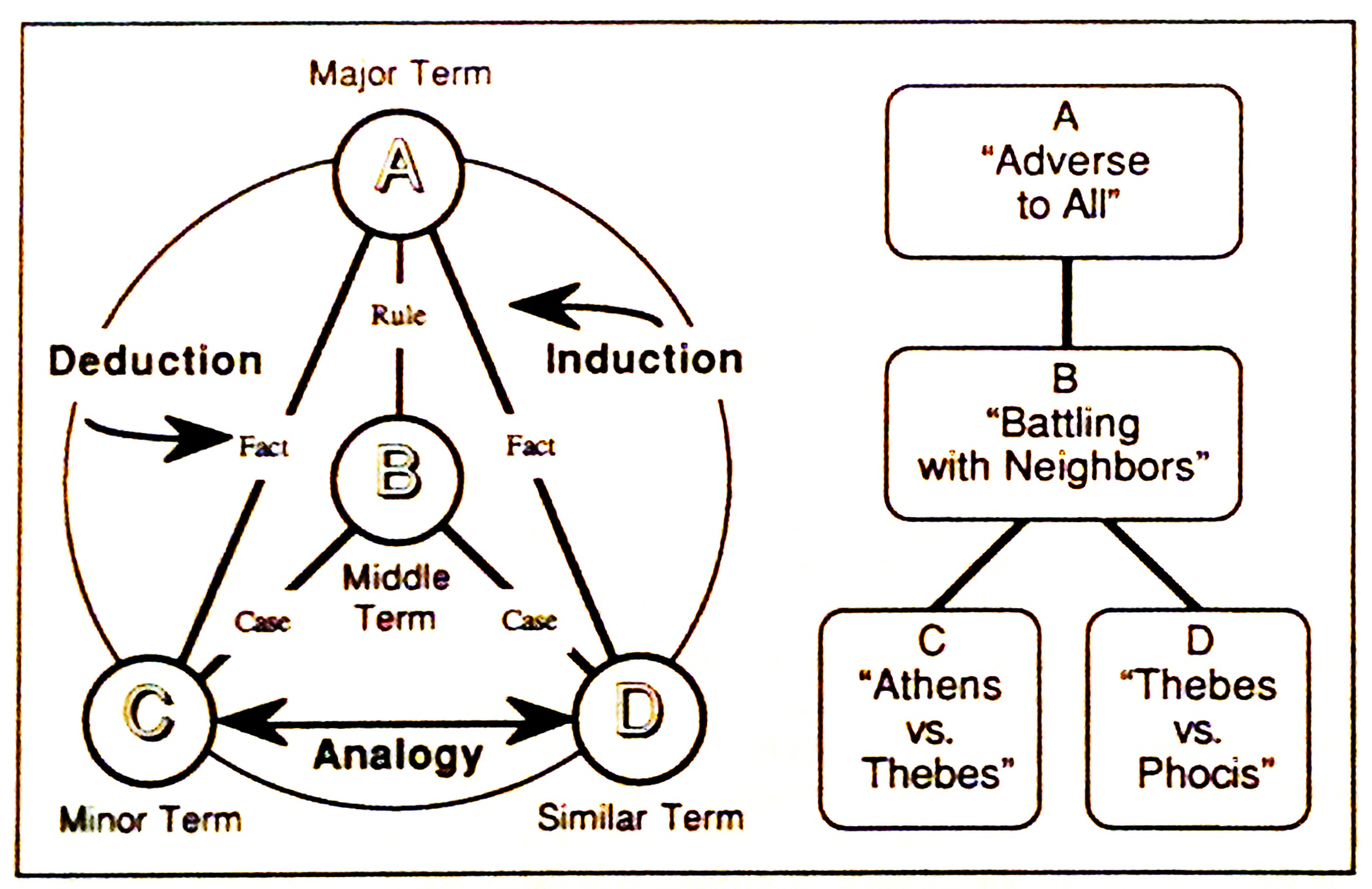
We have an Example (παραδειγμα, or analogy) when the major extreme is shown to be applicable to the middle term by means of a term similar to the third.  It must be known both that the middle applies to the third term and that the first applies to the term similar to the third.

E.g., let A be “bad”, B “to make war on neighbors”, C “Athens against Thebes”, and D “Thebes against Phocis”.  Then if we require to prove that war against Thebes is bad, we must be satisfied that war against neighbors is bad.  Evidence of this can be drawn from similar examples, e.g., that war by Thebes against Phocis is bad.  Then since war against neighbors is bad, and war against Thebes is against neighbors, it is evident that war against Thebes is bad.

Aristotle, “Prior Analytics” 2.24, Hugh Tredennick (trans.)

Figure 6 shows the logical relationships involved in Aristotle’s example of analogy.

Aristotle's “Paradigm”
\text{Figure 6. Aristotle's ``Paradigm"}

Resources

cc: FB | Peirce MattersLaws of FormMathstodonOntologAcademia.edu
cc: Conceptual GraphsCyberneticsStructural ModelingSystems Science

Posted in Abduction, Analogy, Argument, Aristotle, C.S. Peirce, Constraint, Deduction, Determination, Diagrammatic Reasoning, Diagrams, Differential Logic, Functional Logic, Hypothesis, Indication, Induction, Inference, Information, Inquiry, Logic, Logic of Science, Mathematics, Pragmatic Semiotic Information, Probable Reasoning, Propositional Calculus, Propositions, Reasoning, Retroduction, Semiotics, Sign Relations, Syllogism, Triadic Relations, Visualization | Tagged , , , , , , , , , , , , , , , , , , , , , , , , , , , , , , , | 4 Comments

Functional Logic • Inquiry and Analogy • 4

Inquiry and AnalogyAristotle’s “Apagogy” • Abductive Reasoning

Peirce’s notion of abductive reasoning is derived from Aristotle’s treatment of it in the Prior Analytics.  Aristotle’s discussion begins with an example which may seem incidental but the question and its analysis are echoes of the investigation pursued in one of Plato’s Dialogue, the Meno.  It concerns nothing less than the possibility of knowledge and the relationship between knowledge and virtue, or between their objects, the true and the good.  It is not just because it forms a recurring question in philosophy, but because it preserves a close correspondence between its form and its content, that we shall find this example increasingly relevant to our study.

We have Reduction (απαγωγη, abduction):  (1) when it is obvious that the first term applies to the middle, but that the middle applies to the last term is not obvious, yet nevertheless is more probable or not less probable than the conclusion;  or (2) if there are not many intermediate terms between the last and the middle;  for in all such cases the effect is to bring us nearer to knowledge.

(1) E.g., let A stand for “that which can be taught”, B for “knowledge”, and C for “morality”.  Then that knowledge can be taught is evident;  but whether virtue is knowledge is not clear.  Then if BC is not less probable or is more probable than AC, we have reduction;  for we are nearer to knowledge for having introduced an additional term, whereas before we had no knowledge that AC is true.

(2) Or again we have reduction if there are not many intermediate terms between B and C;  for in this case too we are brought nearer to knowledge.  E.g., suppose that D is “to square”, E “rectilinear figure”, and F “circle”.  Assuming that between E and F there is only one intermediate term — that the circle becomes equal to a rectilinear figure by means of lunules — we should approximate to knowledge.

Aristotle, “Prior Analytics” 2.25, Hugh Tredennick (trans.)

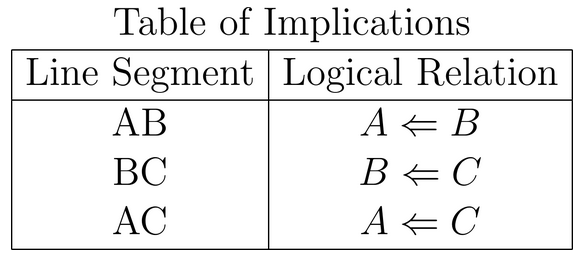
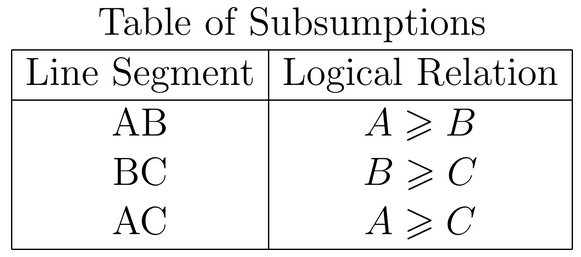
A few notes on the reading may be helpful.  The Greek text seems to imply a geometric diagram, in which directed line segments AB, BC, AC indicate logical relations between pairs of terms taken from A, B, C.  We have two options for reading the line labels, either as implications or as subsumptions, as in the following two paradigms for interpretation.

Table of Implications

Table of Subsumptions

In the latter case, P \geqslant Q is read as ``P ~\text{subsumes}~ Q", that is, ``P ~\text{applies to all}~ Q", or ``P ~\text{is predicated of all}~ Q".

The method of abductive reasoning bears a close relation to the sense of reduction in which we speak of one question reducing to another.  The question being asked is “Can virtue be taught?”  The type of answer which develops is as follows.

If virtue is a form of understanding, and if we are willing to grant that understanding can be taught, then virtue can be taught.  In this way of approaching the problem, by detour and indirection, the form of abductive reasoning is used to shift the attack from the original question, whether virtue can be taught, to the hopefully easier question, whether virtue is a form of understanding.

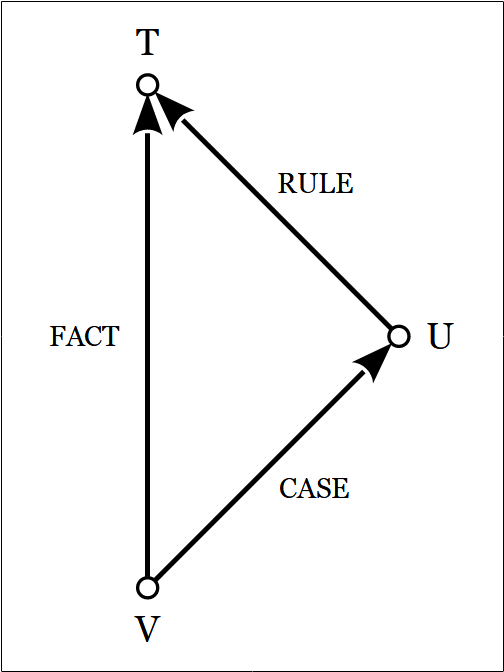
The logical structure of the process of hypothesis formation in the first example follows the pattern of “abduction to a case”, whose abstract form is diagrammed and schematized in Figure 5.

Teachability, Understanding, Virtue
\text{Figure 5. Teachability, Understanding, Virtue}

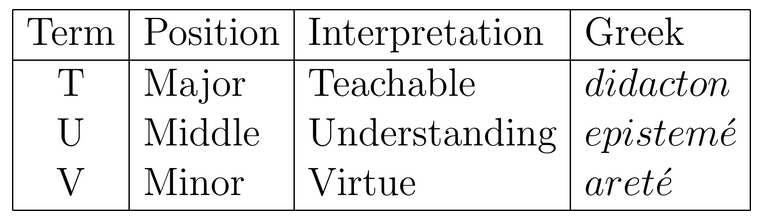
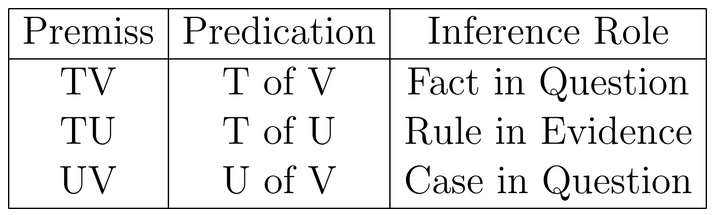
The sense of the Figure is explained by the following assignments.

Term, Position, Interpretation

Premiss, Predication, Inference Role

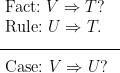
Abduction from a Fact to a Case proceeds according to the following schema.

\begin{array}{l}  ~ \text{Fact:}~ V \Rightarrow T?  \\  ~ \text{Rule:}~ U \Rightarrow T.  \\  \overline{~~~~~~~~~~~~~~~~~~~~~~} \\  ~ \text{Case:}~ V \Rightarrow U?  \end{array}

Resources

cc: FB | Peirce MattersLaws of FormMathstodonOntolog • Academia.edu (1) (2)
cc: Conceptual GraphsCyberneticsStructural ModelingSystems Science

Posted in Abduction, Analogy, Argument, Aristotle, C.S. Peirce, Constraint, Deduction, Determination, Diagrammatic Reasoning, Diagrams, Differential Logic, Functional Logic, Hypothesis, Indication, Induction, Inference, Information, Inquiry, Logic, Logic of Science, Mathematics, Pragmatic Semiotic Information, Probable Reasoning, Propositional Calculus, Propositions, Reasoning, Retroduction, Semiotics, Sign Relations, Syllogism, Triadic Relations, Visualization | Tagged , , , , , , , , , , , , , , , , , , , , , , , , , , , , , , , | 4 Comments

Functional Logic • Inquiry and Analogy • 3

Inquiry and AnalogyComparison of the Analyses

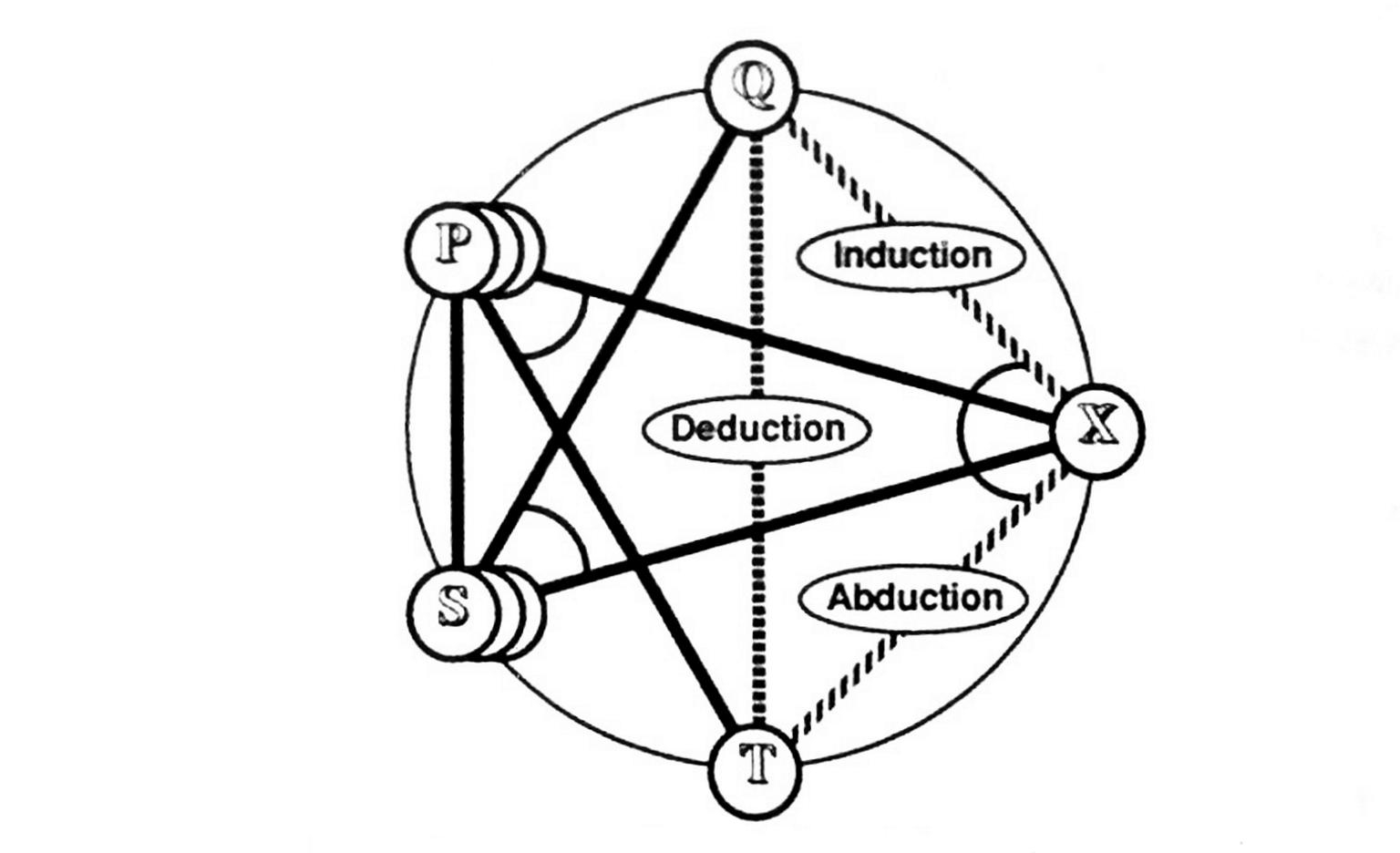
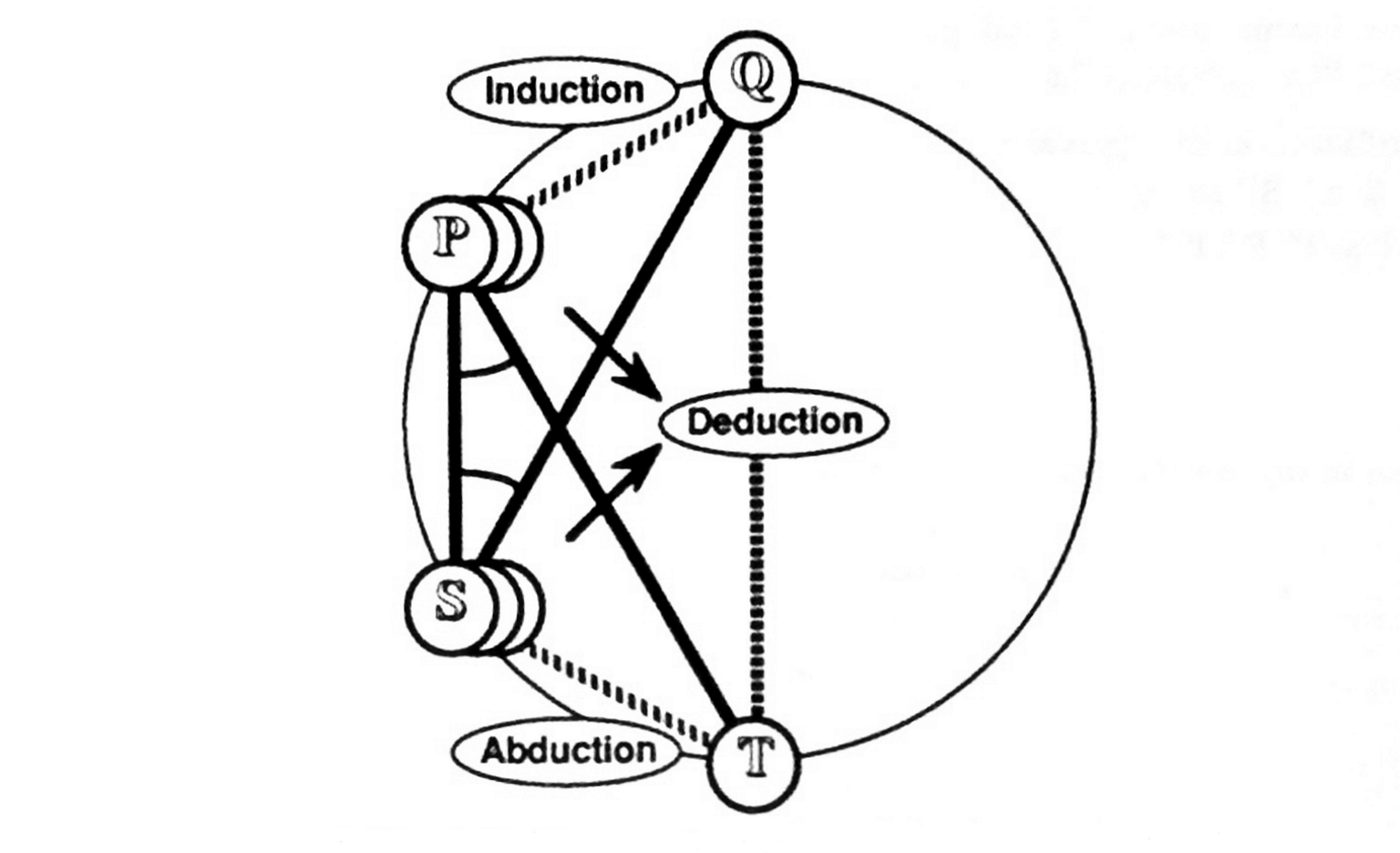
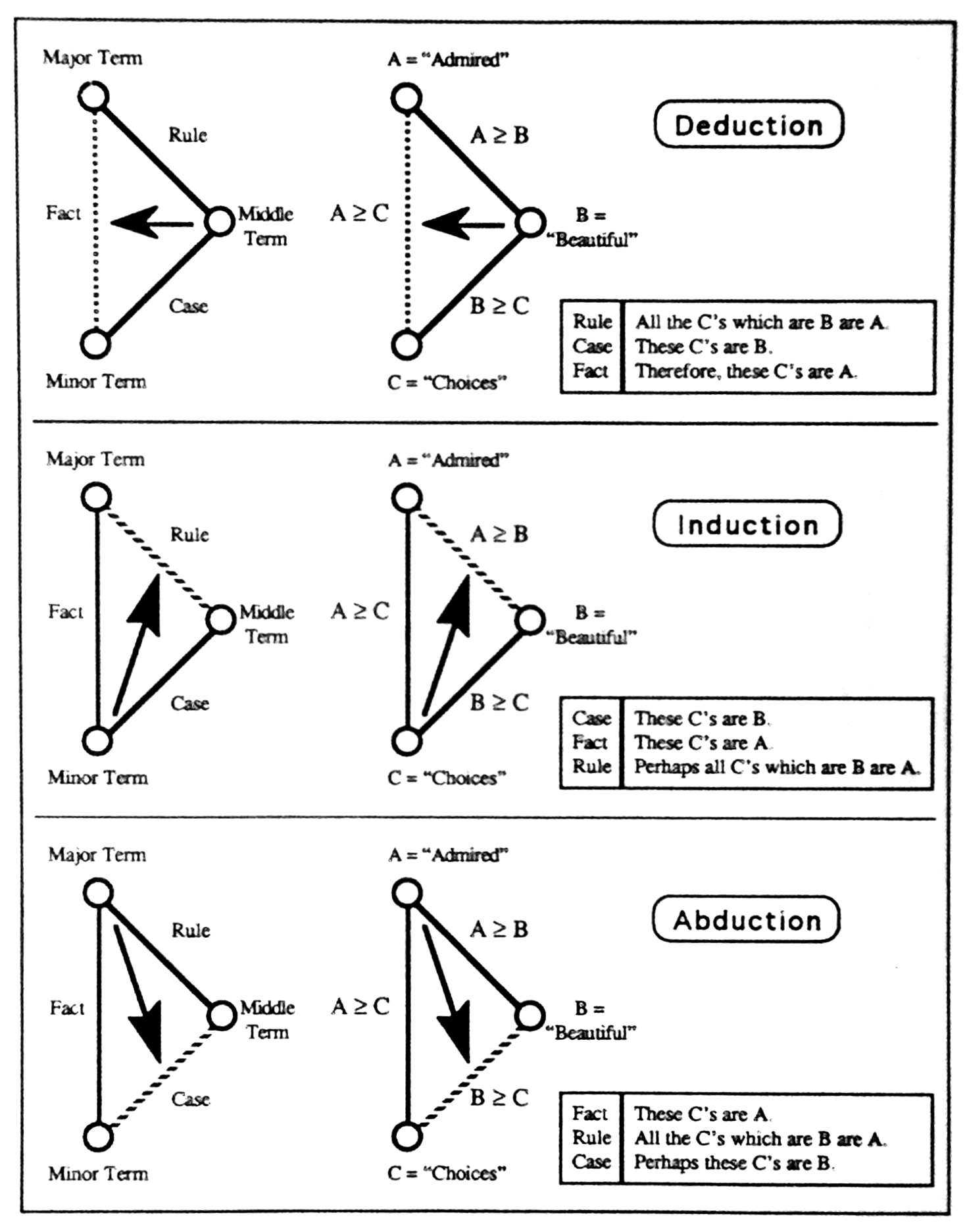
The next two Figures will be of use when we turn to comparing the three types of inference as they appear in the respective analyses of Aristotle and Peirce.

Types of Reasoning in Transition

Types of Reasoning in Transition
\text{Figure 3. Types of Reasoning in Transition}

Types of Reasoning in Peirce

Types of Reasoning in Peirce
\text{Figure 4. Types of Reasoning in Peirce}

Resources

cc: FB | Peirce MattersLaws of FormMathstodonOntolog • Academia.edu (1) (2)
cc: Conceptual GraphsCyberneticsStructural ModelingSystems Science

Posted in Abduction, Analogy, Argument, Aristotle, C.S. Peirce, Constraint, Deduction, Determination, Diagrammatic Reasoning, Diagrams, Differential Logic, Functional Logic, Hypothesis, Indication, Induction, Inference, Information, Inquiry, Logic, Logic of Science, Mathematics, Pragmatic Semiotic Information, Probable Reasoning, Propositional Calculus, Propositions, Reasoning, Retroduction, Semiotics, Sign Relations, Syllogism, Triadic Relations, Visualization | Tagged , , , , , , , , , , , , , , , , , , , , , , , , , , , , , , , | 4 Comments

Functional Logic • Inquiry and Analogy • 2

Inquiry and AnalogyThree Types of Reasoning

Types of Reasoning in C.S. Peirce

Peirce gives one of his earliest treatments of the three types of reasoning in his Harvard Lectures of 1865 “On the Logic of Science”.  There he shows how the same proposition may be reached from three directions, as the result of an inference in each of the three modes.

We have then three different kinds of inference.

  • Deduction or inference à priori,
  • Induction or inference à particularis,
  • Hypothesis or inference à posteriori.

(Peirce, CE 1, 267).

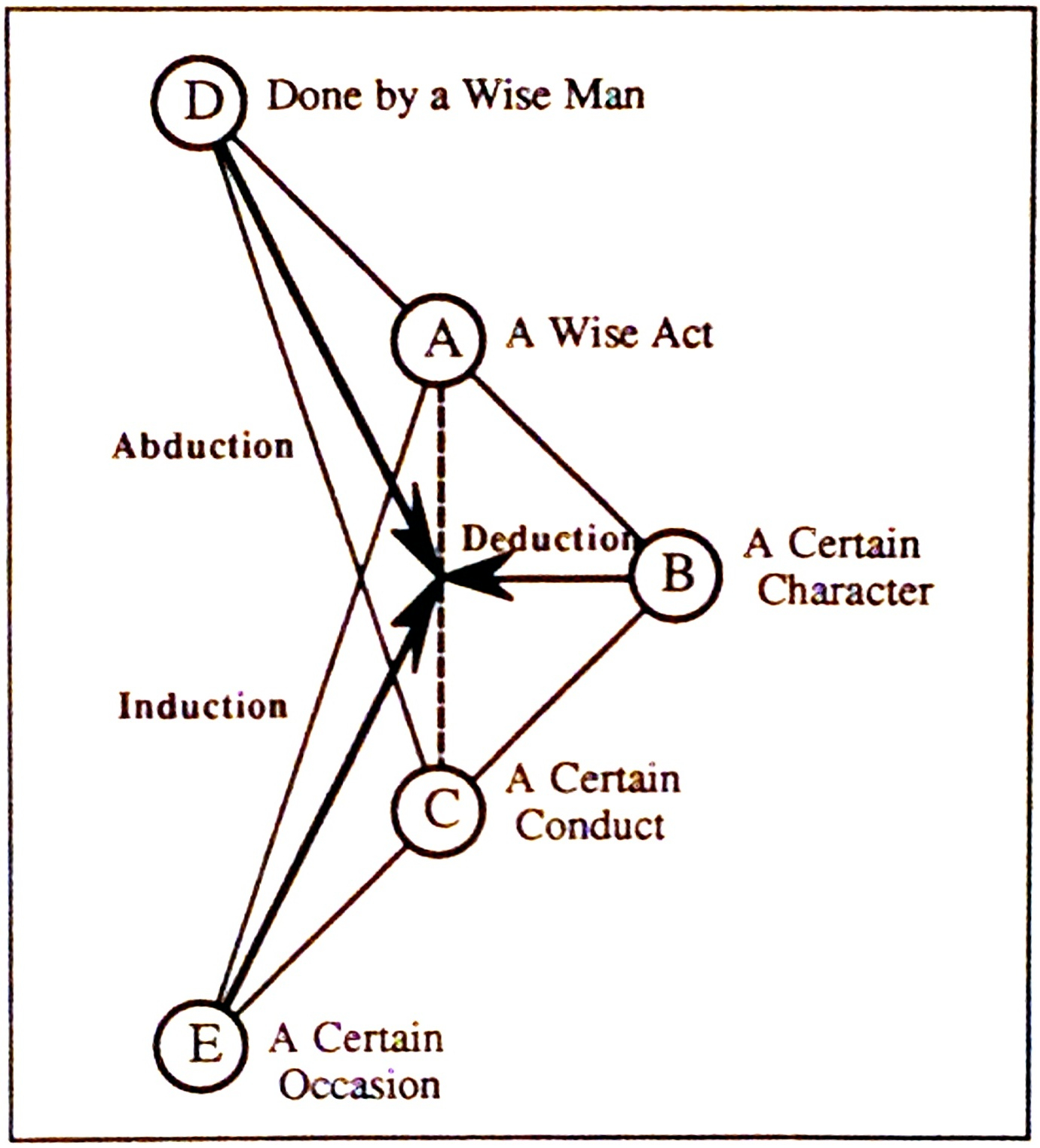
  • If I reason that certain conduct is wise because it has a character which belongs only to wise things, I reason à priori.
  • If I think it is wise because it once turned out to be wise, that is, if I infer that it is wise on this occasion because it was wise on that occasion, I reason inductively [à particularis].
  • But if I think it is wise because a wise man does it, I then make the pure hypothesis that he does it because he is wise, and I reason à posteriori.

(Peirce, CE 1, 180).

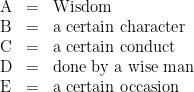
Suppose we make the following assignments.

\begin{array}{lll}  \mathrm{A} & = & \text{Wisdom}  \\  \mathrm{B} & = & \text{a certain character}  \\  \mathrm{C} & = & \text{a certain conduct}  \\  \mathrm{D} & = & \text{done by a wise man}  \\  \mathrm{E} & = & \text{a certain occasion}  \end{array}

Recognizing a little more concreteness will aid understanding, let us make the following substitutions in Peirce’s example.

\begin{array}{lllll}  \mathrm{B} & = & \text{Benevolence} & = & \text{a certain character}  \\  \mathrm{C} & = & \text{Contributes to Charity} & = & \text{a certain conduct}  \\  \mathrm{E} & = & \text{Earlier today} & = & \text{a certain occasion}  \end{array}

The converging operation of all three reasonings is shown in Figure 2.

A Triply Wise Act
\text{Figure 2. A Triply Wise Act}

The common proposition concluding each argument is AC, contributing to charity is wise.

  • Deduction could have obtained the Fact AC from the Rule AB, benevolence is wisdom, along with the Case BC, contributing to charity is benevolent.
  • Induction could have gathered the Rule AC, contributing to charity is exemplary of wisdom, from the Fact AE, the act of earlier today is wise, along with the Case CE, the act of earlier today was an instance of contributing to charity.
  • Abduction could have guessed the Case AC, contributing to charity is explained by wisdom, from the Fact DC, contributing to charity is done by this wise man, and the Rule DA, everything wise is done by this wise man.  Thus, a wise man, who does all the wise things there are to do, may nonetheless contribute to charity for no good reason and even be charitable to a fault.  But on seeing the wise man contribute to charity it is natural to think charity may well be the mark of his wisdom, in essence, that wisdom is the reason he contributes to charity.

Resources

cc: FB | Peirce MattersLaws of FormMathstodonOntologAcademia.edu
cc: Conceptual GraphsCyberneticsStructural ModelingSystems Science

Posted in Abduction, Analogy, Argument, Aristotle, C.S. Peirce, Constraint, Deduction, Determination, Diagrammatic Reasoning, Diagrams, Differential Logic, Functional Logic, Hypothesis, Indication, Induction, Inference, Information, Inquiry, Logic, Logic of Science, Mathematics, Pragmatic Semiotic Information, Probable Reasoning, Propositional Calculus, Propositions, Reasoning, Retroduction, Semiotics, Sign Relations, Syllogism, Triadic Relations, Visualization | Tagged , , , , , , , , , , , , , , , , , , , , , , , , , , , , , , , | 4 Comments

Functional Logic • Inquiry and Analogy • 1

Inquiry and AnalogyThree Types of Reasoning

Types of Reasoning in Aristotle

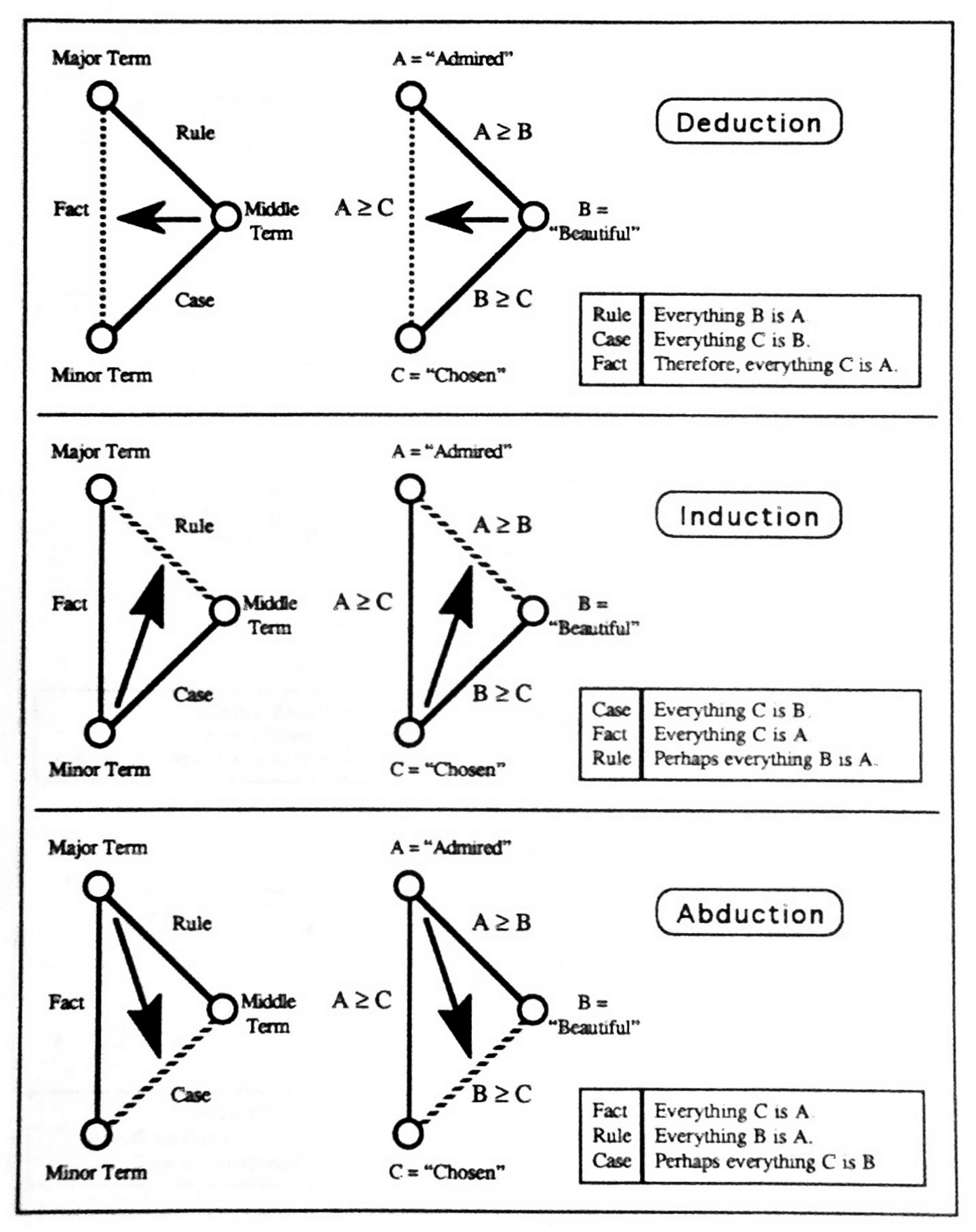
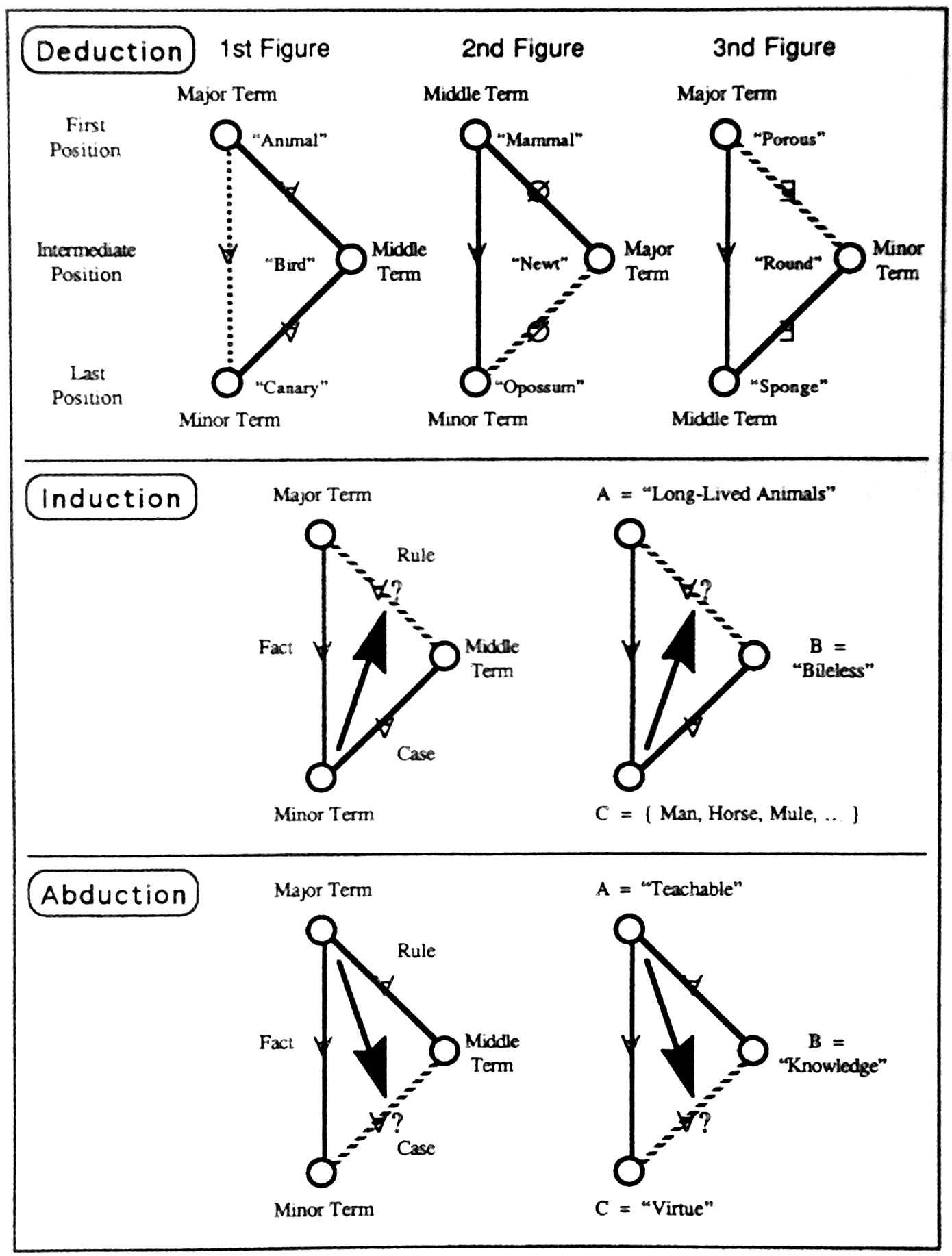
Figure 1 gives a quick overview of traditional terminology I’ll have occasion to refer to as discussion proceeds.

Types of Reasoning in Aristotle
\text{Figure 1. Types of Reasoning in Aristotle}

Resources

cc: FB | Peirce MattersLaws of FormMathstodonOntologAcademia.edu
cc: Conceptual GraphsCyberneticsStructural ModelingSystems Science

Posted in Abduction, Analogy, Argument, Aristotle, C.S. Peirce, Constraint, Deduction, Determination, Diagrammatic Reasoning, Diagrams, Differential Logic, Functional Logic, Hypothesis, Indication, Induction, Inference, Information, Inquiry, Logic, Logic of Science, Mathematics, Pragmatic Semiotic Information, Probable Reasoning, Propositional Calculus, Propositions, Reasoning, Retroduction, Semiotics, Sign Relations, Syllogism, Triadic Relations, Visualization | Tagged , , , , , , , , , , , , , , , , , , , , , , , , , , , , , , , | 4 Comments