
Inquiry and Analogy • Measure for Measure
Let us define two families of measures,

by means of the following equations:
![\begin{matrix} \alpha_i f & = & \Upsilon (f_i, f) & = & \Upsilon (f_i \Rightarrow f), \\[6pt] \beta_i f & = & \Upsilon (f, f_i) & = & \Upsilon (f \Rightarrow f_i). \end{matrix}](https://s0.wp.com/latex.php?latex=%5Cbegin%7Bmatrix%7D++%5Calpha_i+f+%26+%3D+%26+%5CUpsilon+%28f_i%2C+f%29+%26+%3D+%26+%5CUpsilon+%28f_i+%5CRightarrow+f%29%2C++%5C%5C%5B6pt%5D++%5Cbeta_i+f+%26+%3D+%26+%5CUpsilon+%28f%2C+f_i%29+%26+%3D+%26+%5CUpsilon+%28f+%5CRightarrow+f_i%29.++%5Cend%7Bmatrix%7D&bg=ffffff&fg=000000&s=0&c=20201002)
Table 14 shows the value of each 





Table 15 shows the value of each 



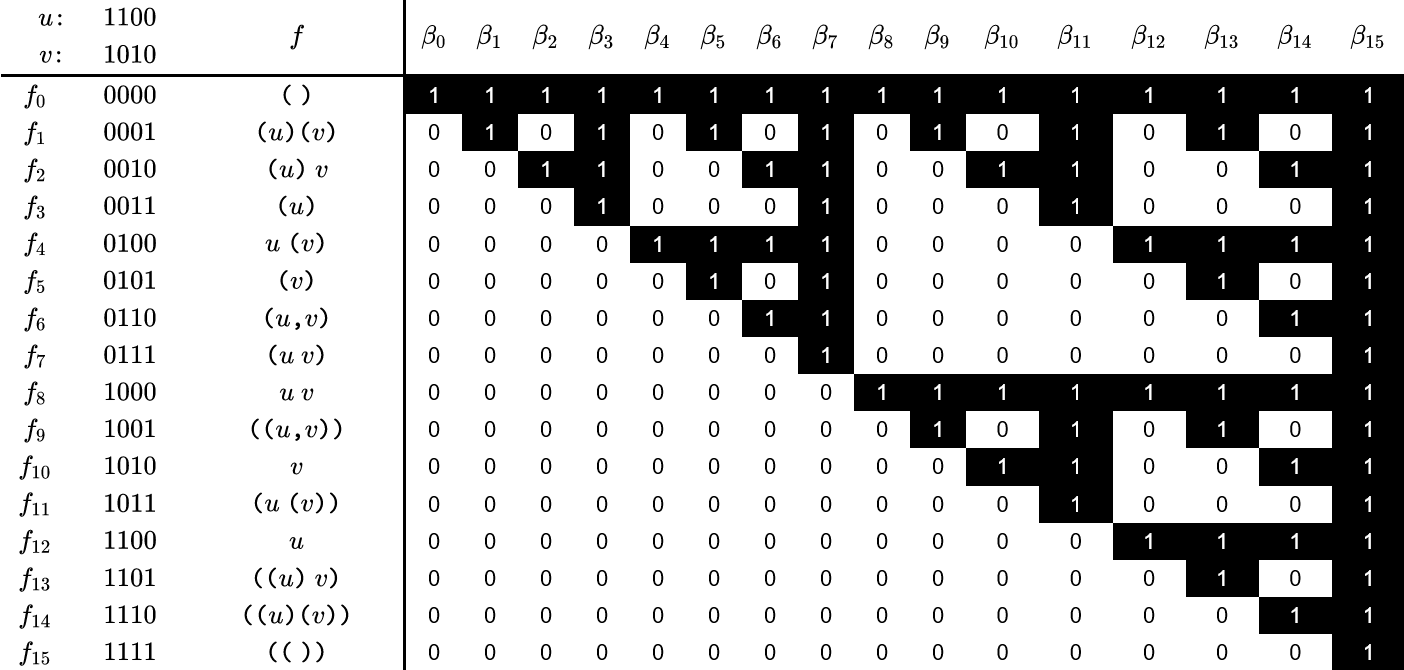
Applied to a given proposition 

![\begin{array}{*{8}{r}} \alpha_{0} f = 1 & \mathrm{iff} & f_{0} \Rightarrow f & \mathrm{iff} & 0 \Rightarrow f, & \mathrm{hence} & \alpha_{0} f = 1 & \mathrm{for~all} ~ f. \\[4pt] \alpha_{15} f = 1 & \mathrm{iff} & f_{15} \Rightarrow f & \mathrm{iff} & 1 \Rightarrow f, & \mathrm{hence} & \alpha_{15} f = 1 & \mathrm{iff} ~ f = 1. \\[4pt] \beta_{0} f = 1 & \mathrm{iff} & f \Rightarrow f_{0} & \mathrm{iff} & f \Rightarrow 0, & \mathrm{hence} & \beta_{0} f = 1 & \mathrm{iff} ~ f = 0. \\[4pt] \beta_{15} f = 1 & \mathrm{iff} & f \Rightarrow f_{15} & \mathrm{iff} & f \Rightarrow 1, & \mathrm{hence} & \beta_{15} f = 1 & \mathrm{for~all} ~ f. \end{array}](https://s0.wp.com/latex.php?latex=%5Cbegin%7Barray%7D%7B%2A%7B8%7D%7Br%7D%7D++%5Calpha_%7B0%7D+f+%3D+1++%26+%5Cmathrm%7Biff%7D++%26+f_%7B0%7D+%5CRightarrow+f++%26+%5Cmathrm%7Biff%7D++%26+0+%5CRightarrow+f%2C++%26+%5Cmathrm%7Bhence%7D++%26+%5Calpha_%7B0%7D+f+%3D+1++%26+%5Cmathrm%7Bfor%7Eall%7D+%7E+f.++%5C%5C%5B4pt%5D++%5Calpha_%7B15%7D+f+%3D+1++%26+%5Cmathrm%7Biff%7D++%26+f_%7B15%7D+%5CRightarrow+f++%26+%5Cmathrm%7Biff%7D++%26+1+%5CRightarrow+f%2C++%26+%5Cmathrm%7Bhence%7D++%26+%5Calpha_%7B15%7D+f+%3D+1++%26+%5Cmathrm%7Biff%7D+%7E+f+%3D+1.++%5C%5C%5B4pt%5D++%5Cbeta_%7B0%7D+f+%3D+1++%26+%5Cmathrm%7Biff%7D++%26+f+%5CRightarrow+f_%7B0%7D++%26+%5Cmathrm%7Biff%7D++%26+f+%5CRightarrow+0%2C++%26+%5Cmathrm%7Bhence%7D++%26+%5Cbeta_%7B0%7D+f+%3D+1++%26+%5Cmathrm%7Biff%7D+%7E+f+%3D+0.++%5C%5C%5B4pt%5D++%5Cbeta_%7B15%7D+f+%3D+1++%26+%5Cmathrm%7Biff%7D++%26+f+%5CRightarrow+f_%7B15%7D++%26+%5Cmathrm%7Biff%7D++%26+f+%5CRightarrow+1%2C++%26+%5Cmathrm%7Bhence%7D++%26+%5Cbeta_%7B15%7D+f+%3D+1++%26+%5Cmathrm%7Bfor%7Eall%7D+%7E+f.++%5Cend%7Barray%7D&bg=ffffff&fg=000000&s=0&c=20201002)
Expressed in terms of the propositional forms they value positively, 




Finally, in conformity with the use of fiber notation to indicate sets of models, it is natural to use notations like the following to denote sets of propositions satisfying the umpires in question.
![\begin{matrix} [| \alpha_i |] & = & \alpha_i^{-1}(1), \\[6pt] [| \beta_i |] & = & \beta_i^{-1}(1), \\[6pt] [| \Upsilon_p |] & = & \Upsilon_p^{-1}(1). \end{matrix}](https://s0.wp.com/latex.php?latex=%5Cbegin%7Bmatrix%7D++%5B%7C+%5Calpha_i+%7C%5D+%26+%3D+%26+%5Calpha_i%5E%7B-1%7D%281%29%2C++%5C%5C%5B6pt%5D++%5B%7C+%5Cbeta_i+%7C%5D+%26+%3D+%26+%5Cbeta_i%5E%7B-1%7D%281%29%2C++%5C%5C%5B6pt%5D++%5B%7C+%5CUpsilon_p+%7C%5D+%26+%3D+%26+%5CUpsilon_p%5E%7B-1%7D%281%29.++%5Cend%7Bmatrix%7D&bg=ffffff&fg=000000&s=0&c=20201002)
Resources
- Logic Syllabus
- Boolean Function
- Boolean-Valued Function
- Logical Conjunction
- Minimal Negation Operator
- Introduction to Inquiry Driven Systems
- Functional Logic • Part 1 • Part 2 • Part 3
- Cactus Language • Part 1 • Part 2 • Part 3 • References • Document History
cc: FB | Peirce Matters • Laws of Form • Mathstodon • Ontolog • Academia.edu
cc: Conceptual Graphs • Cybernetics • Structural Modeling • Systems Science


 Inquiry Into Inquiry
Pingback: Survey of Abduction, Deduction, Induction, Analogy, Inquiry • 2 | Inquiry Into Inquiry
Pingback: Survey of Abduction, Deduction, Induction, Analogy, Inquiry • 3 | Inquiry Into Inquiry