Riffs and Rotes • 59281

Re: Persiflage59281

Numberfile • What’s Special About 59,281?

If p is prime then the decimal expansion of 1/p repeats, so it makes sense to talk about the “average” of the digits of 1/p.  The average can be bigger than 4.5, equal to 4.5, or less than 4.5.  Which is most likely?  Which is least likely?  Click to find out.

\textsc{Challenge Problem.}  Is there any prime for which the digit average is bigger than it is for p = 59281?

I can’t imagine this will help with the problem, it’s just a thing I do with interesting numbers I encounter …

See Riffs and Rotes for the basic idea.

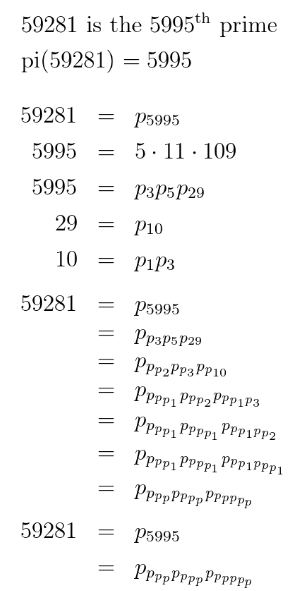
Doubly Recursive Factorization 59281

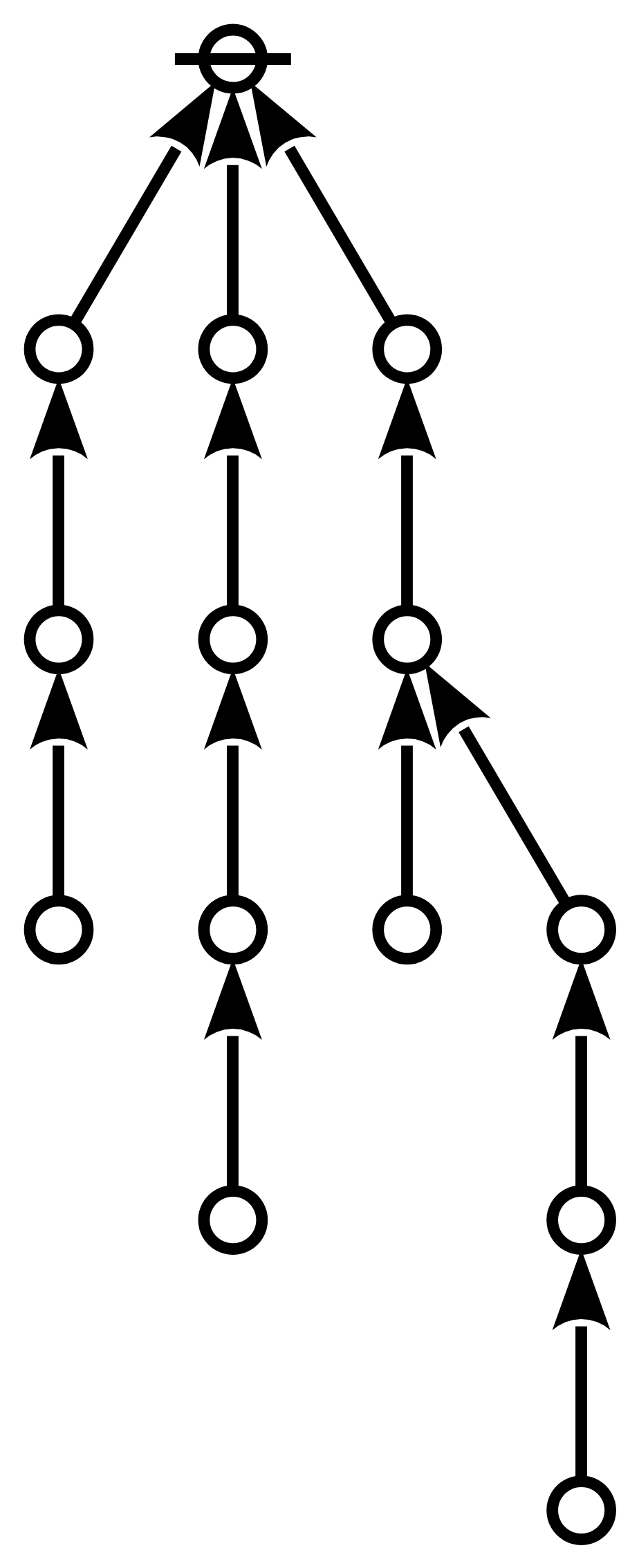
Here is the Riff for 59281

Riff 59281

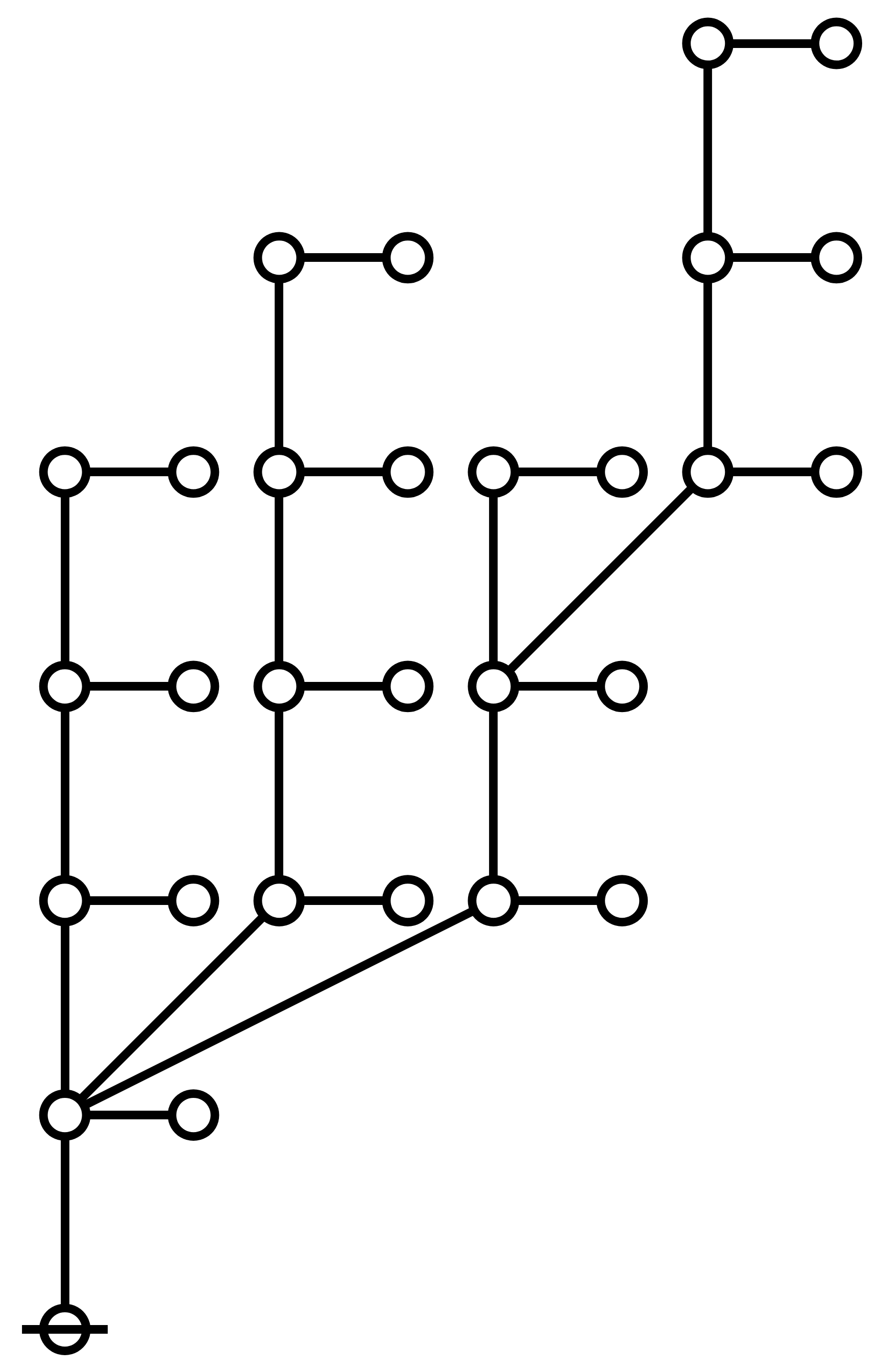
Here is the Rote for 59281

Rote 59281

One peculiar property of this number I notice is its being “square-free all the way down”.  Once again, I have no clue whether that has anything to do with the problem at hand.

Resources

cc: Category TheoryCyberneticsOntolog Forum • Peirce List (1) (2) (3)SeqFan
cc: FB | Riffs and RotesLaws of FormStructural ModelingSystems Science

Posted in Arithmetic, Combinatorics, Graph Theory, Group Theory, Logic, Mathematics, Number Theory, Riffs and Rotes | Tagged , , , , , , , | Leave a comment

On Reading Peirce • Discussion 2

Re: Peirce ListJon AwbreyGary Richmond

JA:
Well, it’s true, all science is under construction.
But not everything under construction is a science.
GR:
True.  But I’d suggest that there is no good reason to block the way of inquiry of those who think that phaneroscopy, for example, may prove to be a science even if, at present, it remains in my view but a science egg.  That it is not yet clear whether it can be fully developed as a science (I believe that there is good to think that it can) is, for me at least, one of the reasons why we’re having this slow read.

So, those who think phaneroscopy (involving the doctrine of categories) is worth looking further into include not only André De Tienne, but to cite again a recent book on the topic, Richard Kenneth Atkins’ 2018 monograph, Charles S. Peirce’s Phenomenology : Analysis and Consciousness.

Dear Gary,

You know me well enough to know I have nothing against neologisms — I used to coin 5 or 6 every morning before breakfast … but I’m much better now — and don’t get me wrong, I fully sympathize with Peirce’s desire to distinguish his take on phenomenology from Hegel’s mis-takes.  And I’m totally copacetic with using the word inquiry to describe any activity aimed at fixing belief, at least, in broad brush among friends.  But it’s one toke over the line if we call any form of inquiry a science, for then we’d have Tenacioscopy, Authorioscopy, Apriorioscopy to counter on a recurring basis, not that we don’t already have to deal with them under hosts and legions of the usual suspect old-fangled paleologisms.

So it’s gotta stop somewhere — and for that we have to acknowledge
critical criteria in our critique of what makes inquiry scientific.

I see I’m one neologism short of my old quota —
but I’ll save oöscience for next time …

Regards,

Jon

cc: Category TheoryCyberneticsLaws of FormOntolog ForumPeirce List
cc: FB | Peirce MattersStructural ModelingSystems Science

Posted in Anthem, C.S. Peirce, Inquiry, Inquiry Into Inquiry, Logic, Mathematics, Pragmatism, Science, Semiotics | Tagged , , , , , , , , | Leave a comment

On Reading Peirce • Discussion 1

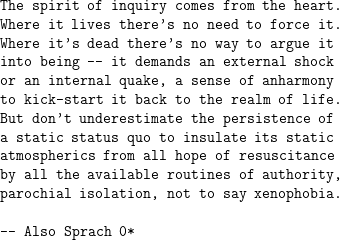
\begin{array}{l}  \texttt{The spirit of inquiry comes from the heart.}\\  \texttt{Where it lives there's no need to force it.}\\  \texttt{Where it's dead there's no way to argue it}\\  \texttt{into being -- it demands an external shock}\\  \texttt{or an internal quake, a sense of anharmony}\\  \texttt{to kick-start it back to the realm of life.}\\  \texttt{But don't underestimate the persistence of}\\  \texttt{a static status quo to insulate its static}\\  \texttt{atmospherics from all hope of resuscitance}\\  \texttt{by all the available routines of authority,}\\  \texttt{parochial isolation, not to say xenophobia.}\\  \\  \texttt{-- Also Sprach 0*}  \end{array}

Re: Peirce ListJon AwbreyJohn Sowa

JFS:
I detect a prebit of irony in your note.

Although I respect Peirce’s ethics of terminology and observe his recommendations when they are appropriate and realistic, I also know that most of them have died on the vine of common sense.

If Peirce had owned an automobile, he would have called it an autokineto.  Greece is the only country in the world that uses the word “autokineto”.

Dear John,

I actually like the sound (if not the fuzy) of “prebit”, there’s a lot of potential for playing off QM’s “qubit” and I once coined the term “ambit” for an ambiguous bit.

But seriously, Folks, my tone may be comic ironic but the underlying sentiment is straightforward enough.  I’ve been consistent in the way I read Peirce since my first encounters with his work over 50 years ago, the same way I read every other mathematician or scientist worth reading, doyen or pioneer or otherwise.  Of all the things they say or write, some things can be proven logically, some things can be supported experimentally, and then there’s a host of approximations, beliefs, conjectures, hypotheses, impressions, popular expositions, rhetorical parables, speculations, ad inf.

If the thinker in question is worth reading at all then all of that is worth reading in the proper light, but it takes the due sort of intellectual prism to sort it all out.

Regards,

Jon

cc: Category TheoryCyberneticsLaws of FormOntolog ForumPeirce List
cc: FB | Peirce MattersStructural ModelingSystems Science

Posted in Anthem, C.S. Peirce, Inquiry, Inquiry Into Inquiry, Logic, Mathematics, Pragmatism, Science, Semiotics | Tagged , , , , , , , , | Leave a comment

Semiotics, Semiosis, Sign Relations • Discussion 16

Re: FB | SemeioticsMarius V. Constantin

MVC:
Have you taken into consideration the difference between weak negation and strong negation?

I always begin classically where logic is concerned — I guess that means “strong” negation — we make a stronger start and get better mileage on that basis before we run into the specialized circumstances, mainly in computational and generalized semiotic settings, which force us to weaken our logic.

MVC:
It is so-called semiotic negation, which, by the way, was an aspect, for me, in so-called resolution logic (Ch. Sanders Peirce is mentioned on that one).

I took a computer science course on resolution-unification theorem provers at U. Illinois in the mid 1980s.  If that’s the same sort of resolution, it generalizes the modus ponens inference rule, all of which exemplify implicational inference.  Peirce’s logical graphs allow a degree of equational or information-preserving inference, a fact which Spencer Brown drew out and made more clear.

cc: Category Theory • Cybernetics (1) (2)
cc: Ontolog ForumStructural ModelingSystems Science
cc: FB | SemeioticsLaws of Form • Peirce List (1) (2) (3) (4) (5) (6) (7)

Posted in C.S. Peirce, Category Theory, Logic, Relation Theory, Semiosis, Semiotics, Sign Relations, Triadic Relations | Tagged , , , , , , , | 8 Comments

Semiotics, Semiosis, Sign Relations • Discussion 15

Re: Peirce ListRobert Marty (quoted)

RM:
I persist in the idea that in your six combinations [O, S, I] only one is relevant for semiotics, the others being out of the field […] On the projections, there is also matter for discussion … but to discuss well one must reserve a rather large agenda … I thus wait for your reply dealing with semiosis to resume a debate well-centered on the essential …

Dear Robert,

Returning to our discussion of 3-place relations and the 6 conversions they enjoy under the action of the symmetric group \mathrm{S}_3 permuting their places, it’s been a while so I’ll extract the substance of my last reply and continue from there.

We had been contemplating Peirce’s variations on a theme of giving as presented in the section of the Sign Relation article titled “Six Ways of Looking at a Sign Relation”.  That section begins as follows.

In the context of 3-adic relations in general, Peirce provides the following illustration of the six converses of a 3-adic relation, that is, the six differently ordered ways of stating what is logically the same 3-adic relation:

So in a triadic fact, say, for example

A ~\text{gives}~ B ~\text{to}~ C

we make no distinction in the ordinary logic of relations between the subject nominative, the direct object, and the indirect object.  We say that the proposition has three logical subjects.  We regard it as a mere affair of English grammar that there are six ways of expressing this:

Six Ways of Looking at a Triadic Relation

These six sentences express one and the same indivisible phenomenon.
(C.S. Peirce, “The Categories Defended”, MS 308 (1903), EP 2, 170–171).

I called attention to the moral Peirce draws.

  • “These six sentences express one and the same indivisible phenomenon.”

With that one statement Peirce draws the clearest possible line of demarcation between affairs of grammar and affairs of logic, mathematics, and phenomena.

The same lesson applies to any relation whose places are not in general reserved for fixed types of entities, in particular, it applies to triadic sign relations.  As we say, “objects, signs, and interpretants are roles not essences”.

Regards,

Jon

cc: Category Theory • Cybernetics (1) (2)
cc: Ontolog ForumStructural ModelingSystems Science
cc: FB | SemeioticsLaws of Form • Peirce List (1) (2) (3) (4) (5) (6) (7)

Posted in C.S. Peirce, Category Theory, Logic, Relation Theory, Semiosis, Semiotics, Sign Relations, Triadic Relations | Tagged , , , , , , , | 8 Comments

Semiotics, Semiosis, Sign Relations • Discussion 14

Re: Animated Logical Graphs • 81
Re: Semiotics, Semiosis, Sign Relations • Discussion 13

Topics arising in various circles I traverse on the web are flashing me back to my earliest influences in the ways of inquiry driven systems.  Dick Lipton and Ken Regan brought to mind the generative power of negative operations and the specific limits of perceptrons.  Peiyuan Zhu and Henry Story discussed a paper by Michael Heller and Jerzy Król titled “How Logic Interacts with Geometry : Infinitesimal Curvature of Categorical Spaces”.  It was over my head, just a bit, but it reminded me of early questions about logical atoms, individuals, nominalism vs. realism, and quantum logics, not to mention current pursuits in differential logic, all of which feedback into the ouroborian ampheckbaena of \textsc{nand} and \textsc{nnor} among negative ops.

It will be interesting to see what evolves …

Resources

cc: Category Theory • Cybernetics (1) (2)
cc: Ontolog ForumStructural ModelingSystems Science
cc: FB | SemeioticsLaws of Form • Peirce List (1) (2) (3) (4) (5) (6)

Posted in C.S. Peirce, Category Theory, Logic, Relation Theory, Semiosis, Semiotics, Sign Relations, Triadic Relations | Tagged , , , , , , , | 8 Comments

Semiotics, Semiosis, Sign Relations • Discussion 13

Re: Category TheoryPeiyuan ZhuHenry Story

Dear Peiyuan, Henry …

Way back during my first foundations + identity crisis I explored every alternative, deviant, non-standard version of logic and set theory I could scrape up — I remember saying to one of my professors, “How come we’re still talking about logical atoms in the quantum era?” — and he sent me off to read about quantum logics, which had apparently already fallen out of fashion at the time.  Remarkably enough, I did find one Peircean scholar who had done a lot of work on them, but they didn’t seem to be what I needed right then.

My present, still pressing applications require me to start from much more elementary grounds, stuff I can build up from boolean sources and targets, universes with coordinate spaces of type (\mathbb{B}^k, \mathbb{B}^k \to \mathbb{B}).

Regards,

Jon

cc: Category Theory • Cybernetics (1) (2)
cc: Ontolog ForumStructural ModelingSystems Science
cc: FB | SemeioticsLaws of Form • Peirce List (1) (2) (3) (4) (5) (6)

Posted in C.S. Peirce, Category Theory, Logic, Relation Theory, Semiosis, Semiotics, Sign Relations, Triadic Relations | Tagged , , , , , , , | 9 Comments

Animated Logical Graphs • 81

Re: R.J. Lipton and K.W. ReganA Negative Comment On Negations

Minsky and Papert’s Perceptrons was the work that nudged me over the line from gestalt psychology, psychophysics, relational biology, etc. and made me believe AI could fly.  I later found out a lot of people thought it had thrown cold water on the subject but that was not my sense of it.

The real reason Rosenblatt’s perceptrons short-shrift XOR and EQ among the sixteen boolean functions on two variables is the adoption of a particular role for neurons in the activity of the brain and a particular model of how neurons serve computation, namely, as threshold activation devices.  It is as if we tried to do mathematics using only the inequality \le instead of using equations.  Sure, we can express equations in roundabout ways but why tolerate the resulting inefficiency?  As a final observation, x \le y for boolean variables x, y is equivalent to x \Rightarrow y so this fits right in with the weakness of implicational inference compared to equational inference rules.

But there are other models for the role neurons play in the activity of the brain and the work they do in computation.

Resources

cc: Peirce List (1) (2) (3) (4) (5) (6) (7) (8) (9) (10) (11) (12) (13) (14) (15) (16) (17) (18)
cc: Category Theory • Cybernetics (1) (2) • Ontolog Forum (1) (2)
cc: Structural Modeling (1) (2) • Systems Science (1) (2)
cc: FB | Logical Graphs • Laws of Form (1) (2)

Posted in Amphecks, Animata, Boolean Algebra, Boolean Functions, C.S. Peirce, Cactus Graphs, Constraint Satisfaction Problems, Deduction, Diagrammatic Reasoning, Duality, Equational Inference, Graph Theory, Laws of Form, Logic, Logical Graphs, Mathematics, Minimal Negation Operators, Model Theory, Painted Cacti, Peirce, Proof Theory, Propositional Calculus, Propositional Equation Reasoning Systems, Spencer Brown, Theorem Proving, Visualization | Tagged , , , , , , , , , , , , , , , , , , , , , , , , , | 7 Comments

Semiotics, Semiosis, Sign Relations • Discussion 12

Re: Peirce ListRobert Marty (quoted)

RM:
I persist in the idea that in your six combinations [O, S, I] only one is relevant for semiotics, the others being out of the field […] On the projections, there is also matter for discussion … but to discuss well one must reserve a rather large agenda … I thus wait for your reply dealing with semiosis to resume a debate well-centered on the essential …

Dear Robert,

A bit of calm today — and feeling slaked after a day spent minding Voltaire’s advice and pulling weeds from our garden — I’ll take up one of your last problems first as it may be the one most quickly resolved.

I take it you are referring to the section of the Sign Relation article titled “Six Ways of Looking at a Sign Relation” which begins as follows.

In the context of 3-adic relations in general, Peirce provides the following illustration of the six converses of a 3-adic relation, that is, the six differently ordered ways of stating what is logically the same 3-adic relation:

So in a triadic fact, say, for example

A ~\text{gives}~ B ~\text{to}~ C

we make no distinction in the ordinary logic of relations between the subject nominative, the direct object, and the indirect object.  We say that the proposition has three logical subjects.  We regard it as a mere affair of English grammar that there are six ways of expressing this:

Six Ways of Looking at a Triadic Relation

These six sentences express one and the same indivisible phenomenon.
(C.S. Peirce, “The Categories Defended”, MS 308 (1903), EP 2, 170–171).

“These six sentences express one and the same indivisible phenomenon.”

It’s a statement telling of the difference between affairs of grammar and affairs of logic, mathematics, and phenomena.

To be continued …

cc: Category Theory • Cybernetics (1) (2)
cc: Ontolog ForumStructural ModelingSystems Science
cc: FB | SemeioticsLaws of Form • Peirce List (1) (2) (3) (4) (5) (6)

Posted in C.S. Peirce, Category Theory, Logic, Relation Theory, Semiosis, Semiotics, Sign Relations, Triadic Relations | Tagged , , , , , , , | 9 Comments

Semiotics, Semiosis, Sign Relations • Comment 4

ah, what do mathematicians know of life’s exigency?
proof is our rock and our soul necessity.
we don’t just make abstractions, we are abstractions.
it’s coffee and doughnuts all the way down …
no one disturbs our vain diagrams
till human voices wake us, and we drown.

🙞 also sprach 0*
— 23 august 2021

Cf: Apology : T.S. Eliot | Context : Ironic
cc: Category Theory • Cybernetics (1) (2)
cc: Ontolog ForumStructural ModelingSystems Science
cc: FB | SemeioticsLaws of Form • Peirce List (1) (2) (3) (4) (5) (6)

Posted in C.S. Peirce, Category Theory, Logic, Relation Theory, Semiosis, Semiotics, Sign Relations, Triadic Relations | Tagged , , , , , , , | 8 Comments