The  measures of type
  present a formidable array of propositions about propositions about 2‑dimensional universes of discourse. The early entries in their standard ordering define universes too amorphous to detain us for long on a first pass but as we turn toward the high end of the ordering we begin to recognize familiar structures worth examining from new angles.
Instrumental to our study we define a couple of higher order operators,

referred to as the relative and absolute umpire operators, respectively. If either operator is defined in terms of more primitive notions then the remaining operator can be defined in terms of the one first established.
Let  be a two‑dimensional boolean space,
  generated by two boolean variables or logical features
  and
and 
Given an ordered pair of propositions  as arguments, the relative umpire operator reports the value
  if the first implies the second, otherwise it reports the value

Expressing it another way:

In writing this, however, it is important to observe that the appearing on the left side and the appearing on the right side of the logical equivalence have different meanings. Filling in the details, we have the following.

Writing types as subscripts and using the fact that  it is possible to express this more succinctly as follows.

Finally, it is often convenient to write the first argument as a subscript. Thus we have the following equation.

The absolute umpire operator, also known as the umpire measure, is a higher order proposition  defined by the equation
  In this case the subscript on the left and the argument on the right both refer to the constant proposition
  In most settings where
  is applied to arguments it is safe to omit the subscript since the number of arguments indicates which type of operator is meant. Thus, we have the following identities and equivalents.

The umpire measure is defined on boolean functions regarded as mathematical objects but can also be understood in terms of the judgments it induces on the syntactic level. In that interpretation recognizes theorems of the propositional calculus over ![[u, v],](https://s0.wp.com/latex.php?latex=%5Bu%2C+v%5D%2C&bg=ffffff&fg=000000&s=0&c=20201002) giving a score of to tautologies and a score of
giving a score of to tautologies and a score of  to everything else, counting all contingent statements as no better than falsehoods.
One remark in passing for those who might prefer an alternative definition. If we had originally taken  to mean the absolute measure then the relative measure could have been defined as
Resources
cc: FB | Peirce Matters • Laws of Form • Mathstodon • Ontolog • Academia.edu
cc: Conceptual Graphs • Cybernetics • Structural Modeling • Systems Science




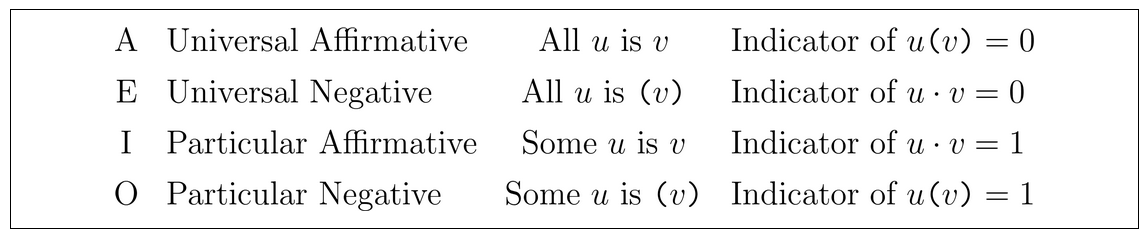
![X^\bullet = [u, v].](https://s0.wp.com/latex.php?latex=X%5E%5Cbullet+%3D+%5Bu%2C+v%5D.&bg=ffffff&fg=000000&s=0&c=20201002) A bridge between propositions and quantifications is afforded by a set of measures or qualifiers
A bridge between propositions and quantifications is afforded by a set of measures or qualifiers  defined by the following equations.
 namely, which elements in the space of type
  are assigned a positive value by
  Taken together, the
  operators give us a way to express many useful observations about the propositions in
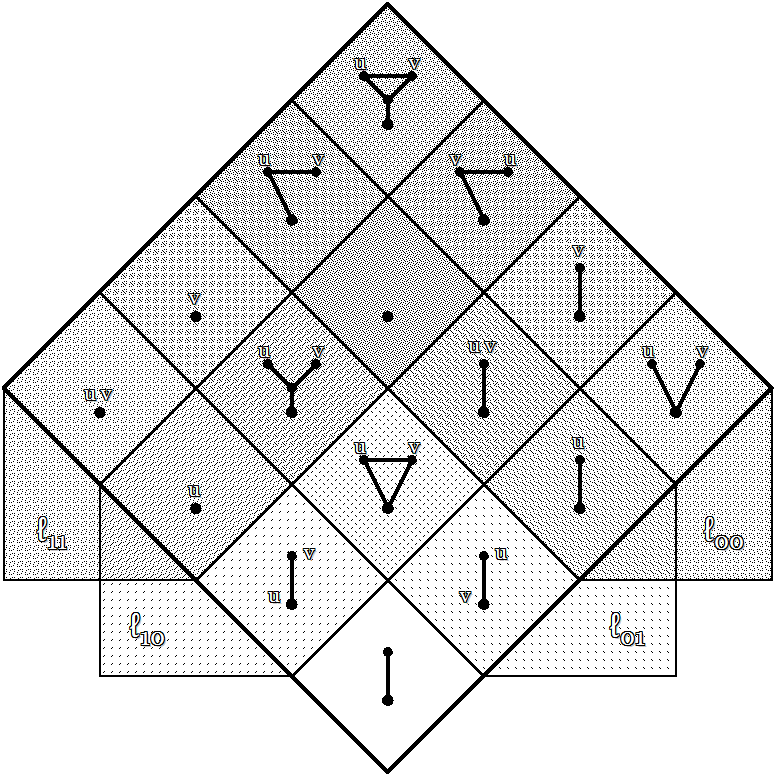
![\text{Figure 16. Higher Order Universe of Discourse}~ [ \ell_{00}, \ell_{01}, \ell_{10}, \ell_{11} ] \subseteq [[ u, v ]]](https://s0.wp.com/latex.php?latex=%5Ctext%7BFigure+16.+Higher+Order+Universe+of+Discourse%7D%7E+%5B+%5Cell_%7B00%7D%2C+%5Cell_%7B01%7D%2C+%5Cell_%7B10%7D%2C+%5Cell_%7B11%7D+%5D+%5Csubseteq+%5B%5B+u%2C+v+%5D%5D&bg=ffffff&fg=000000&s=0&c=20201002)

![\begin{matrix} \alpha_i f & = & \Upsilon (f_i, f) & = & \Upsilon (f_i \Rightarrow f), \\[6pt] \beta_i f & = & \Upsilon (f, f_i) & = & \Upsilon (f \Rightarrow f_i). \end{matrix}](https://s0.wp.com/latex.php?latex=%5Cbegin%7Bmatrix%7D++%5Calpha_i+f+%26+%3D+%26+%5CUpsilon+%28f_i%2C+f%29+%26+%3D+%26+%5CUpsilon+%28f_i+%5CRightarrow+f%29%2C++%5C%5C%5B6pt%5D++%5Cbeta_i+f+%26+%3D+%26+%5CUpsilon+%28f%2C+f_i%29+%26+%3D+%26+%5CUpsilon+%28f+%5CRightarrow+f_i%29.++%5Cend%7Bmatrix%7D&bg=ffffff&fg=000000&s=0&c=20201002)
 on each of the 16 boolean functions
  In terms of the implication ordering on the 16 functions,
  says that
  is above or identical to
  in the implication lattice, that is,
  in the implication ordering.

 on each of the 16 boolean functions
  says that
  in the implication ordering.
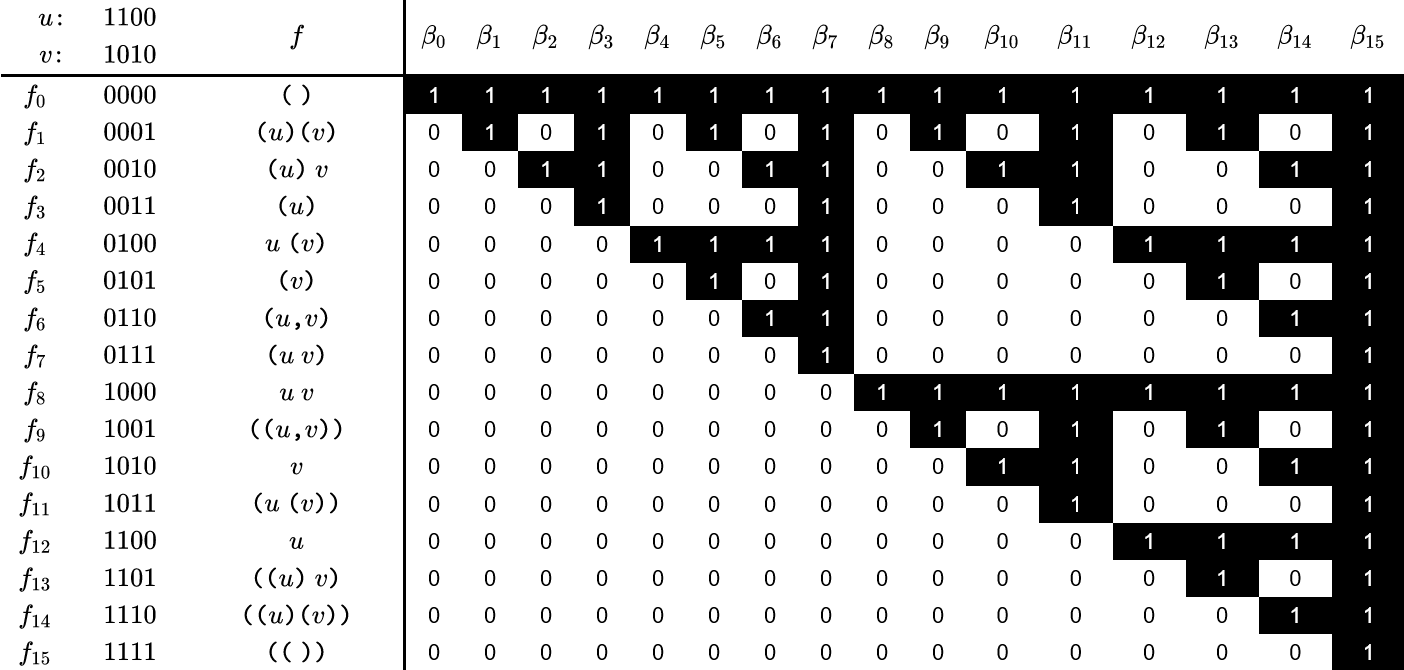
 the qualifiers
  respectively, in the implication ordering. By way of example, let us trace the effects of several such measures, namely, those which occupy the limiting positions in the Tables.
![\begin{array}{*{8}{r}} \alpha_{0} f = 1 & \mathrm{iff} & f_{0} \Rightarrow f & \mathrm{iff} & 0 \Rightarrow f, & \mathrm{hence} & \alpha_{0} f = 1 & \mathrm{for~all} ~ f. \\[4pt] \alpha_{15} f = 1 & \mathrm{iff} & f_{15} \Rightarrow f & \mathrm{iff} & 1 \Rightarrow f, & \mathrm{hence} & \alpha_{15} f = 1 & \mathrm{iff} ~ f = 1. \\[4pt] \beta_{0} f = 1 & \mathrm{iff} & f \Rightarrow f_{0} & \mathrm{iff} & f \Rightarrow 0, & \mathrm{hence} & \beta_{0} f = 1 & \mathrm{iff} ~ f = 0. \\[4pt] \beta_{15} f = 1 & \mathrm{iff} & f \Rightarrow f_{15} & \mathrm{iff} & f \Rightarrow 1, & \mathrm{hence} & \beta_{15} f = 1 & \mathrm{for~all} ~ f. \end{array}](https://s0.wp.com/latex.php?latex=%5Cbegin%7Barray%7D%7B%2A%7B8%7D%7Br%7D%7D++%5Calpha_%7B0%7D+f+%3D+1++%26+%5Cmathrm%7Biff%7D++%26+f_%7B0%7D+%5CRightarrow+f++%26+%5Cmathrm%7Biff%7D++%26+0+%5CRightarrow+f%2C++%26+%5Cmathrm%7Bhence%7D++%26+%5Calpha_%7B0%7D+f+%3D+1++%26+%5Cmathrm%7Bfor%7Eall%7D+%7E+f.++%5C%5C%5B4pt%5D++%5Calpha_%7B15%7D+f+%3D+1++%26+%5Cmathrm%7Biff%7D++%26+f_%7B15%7D+%5CRightarrow+f++%26+%5Cmathrm%7Biff%7D++%26+1+%5CRightarrow+f%2C++%26+%5Cmathrm%7Bhence%7D++%26+%5Calpha_%7B15%7D+f+%3D+1++%26+%5Cmathrm%7Biff%7D+%7E+f+%3D+1.++%5C%5C%5B4pt%5D++%5Cbeta_%7B0%7D+f+%3D+1++%26+%5Cmathrm%7Biff%7D++%26+f+%5CRightarrow+f_%7B0%7D++%26+%5Cmathrm%7Biff%7D++%26+f+%5CRightarrow+0%2C++%26+%5Cmathrm%7Bhence%7D++%26+%5Cbeta_%7B0%7D+f+%3D+1++%26+%5Cmathrm%7Biff%7D+%7E+f+%3D+0.++%5C%5C%5B4pt%5D++%5Cbeta_%7B15%7D+f+%3D+1++%26+%5Cmathrm%7Biff%7D++%26+f+%5CRightarrow+f_%7B15%7D++%26+%5Cmathrm%7Biff%7D++%26+f+%5CRightarrow+1%2C++%26+%5Cmathrm%7Bhence%7D++%26+%5Cbeta_%7B15%7D+f+%3D+1++%26+%5Cmathrm%7Bfor%7Eall%7D+%7E+f.++%5Cend%7Barray%7D&bg=ffffff&fg=000000&s=0&c=20201002)
 is a wholly indifferent or indiscriminate measure, accepting every proposition
  whereas the measures
  and
and  value the constant propositions
  and
and  respectively, above all others.
![\begin{matrix} [| \alpha_i |] & = & \alpha_i^{-1}(1), \\[6pt] [| \beta_i |] & = & \beta_i^{-1}(1), \\[6pt] [| \Upsilon_p |] & = & \Upsilon_p^{-1}(1). \end{matrix}](https://s0.wp.com/latex.php?latex=%5Cbegin%7Bmatrix%7D++%5B%7C+%5Calpha_i+%7C%5D+%26+%3D+%26+%5Calpha_i%5E%7B-1%7D%281%29%2C++%5C%5C%5B6pt%5D++%5B%7C+%5Cbeta_i+%7C%5D+%26+%3D+%26+%5Cbeta_i%5E%7B-1%7D%281%29%2C++%5C%5C%5B6pt%5D++%5B%7C+%5CUpsilon_p+%7C%5D+%26+%3D+%26+%5CUpsilon_p%5E%7B-1%7D%281%29.++%5Cend%7Bmatrix%7D&bg=ffffff&fg=000000&s=0&c=20201002)
![X^\bullet = [\mathcal{X}] = [x_1, x_2] = [u, v],](https://s0.wp.com/latex.php?latex=X%5E%5Cbullet+%3D+%5B%5Cmathcal%7BX%7D%5D+%3D+%5Bx_1%2C+x_2%5D+%3D+%5Bu%2C+v%5D%2C&bg=ffffff&fg=000000&s=0&c=20201002) based on two logical features or boolean variables
based on two logical features or boolean variables  consists of two parts, a set of points and a set of propositions.
 may be indicated by means of a singular proposition, that is, a proposition which describes it uniquely. This form of representation leads to the following enumeration of points.
 which the coordinate propositions
  take on that point. This form of representation leads to the following enumeration of points.

![X^{\bullet 2} = [X^\bullet] = [[u, v]],](https://s0.wp.com/latex.php?latex=X%5E%7B%5Cbullet+2%7D+%3D+%5BX%5E%5Cbullet%5D+%3D+%5B%5Bu%2C+v%5D%5D%2C&bg=ffffff&fg=000000&s=0&c=20201002) which may be developed in the following way. The propositions of
which may be developed in the following way. The propositions of  and the mappings of the type
  become the propositions of
  In addition, it is convenient to equip the discussion with a selected set of higher order operators on propositions, all of which have the form
![[u, v]](https://s0.wp.com/latex.php?latex=%5Bu%2C+v%5D&bg=ffffff&fg=000000&s=0&c=20201002) may be regarded as a gallery of sixteen venn diagrams, while the measures
may be regarded as a gallery of sixteen venn diagrams, while the measures  partitions the gallery of pictures into two aesthetic portions, the pictures
  that
that  that
that  measures of the form
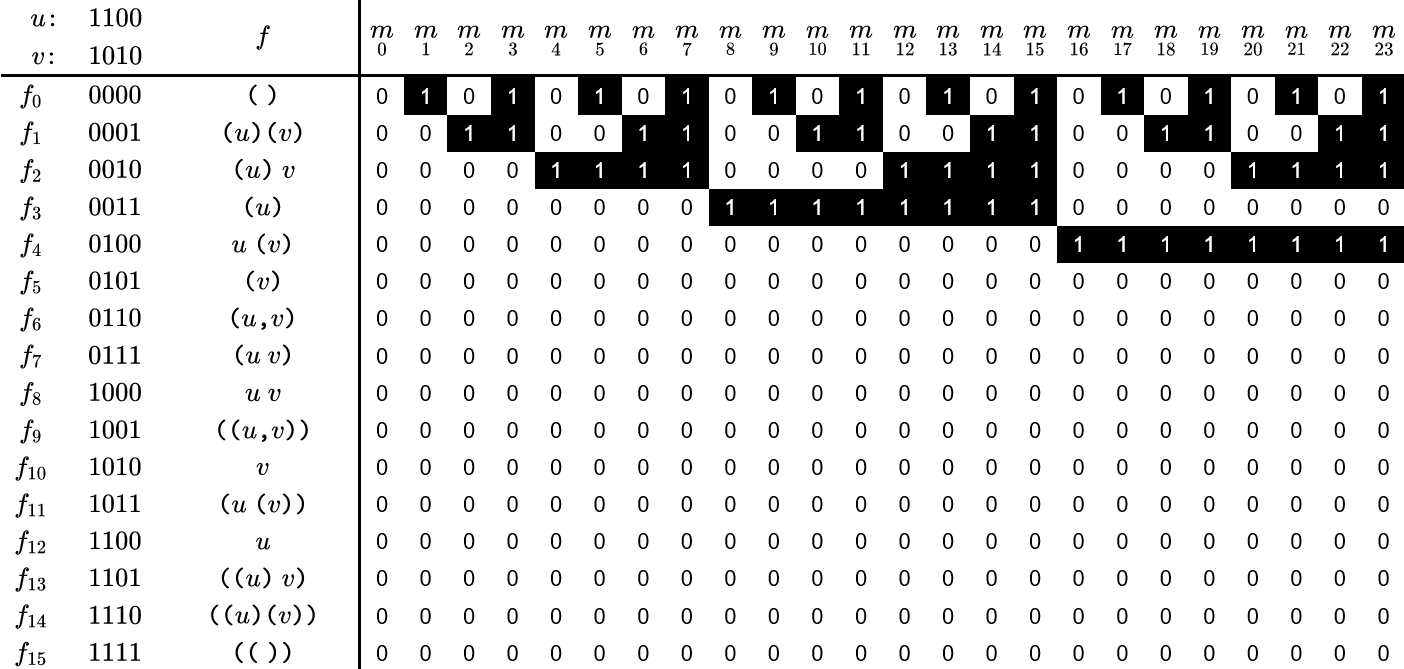
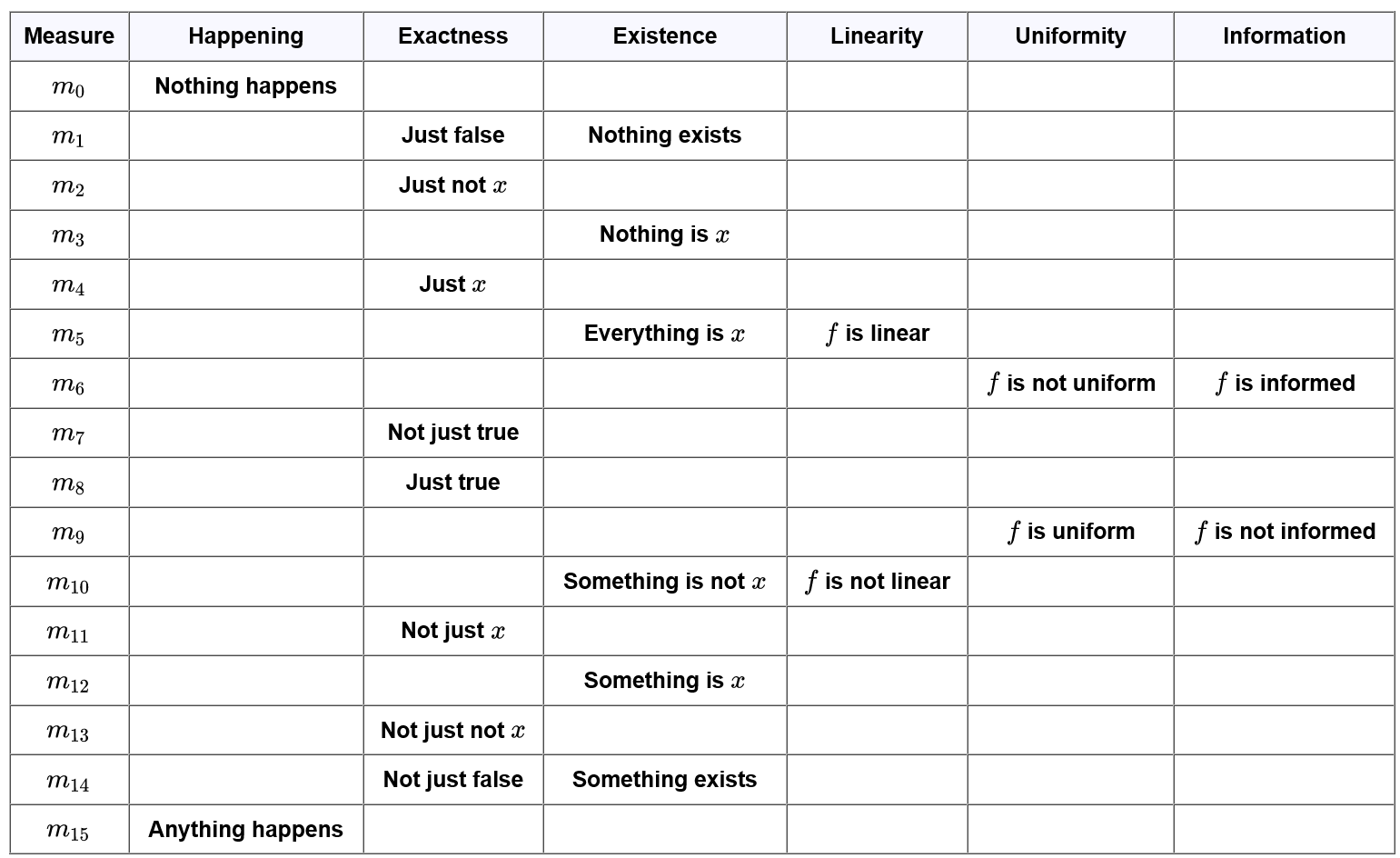
  Table 13 shows the first 24 of their number in the style of higher order truth table I used before. The column headed
  for
for  = 0 to 15. The arrangement of measures in the order indicated will be referred to as their standard ordering. In this scheme of things, the index
  of the measure

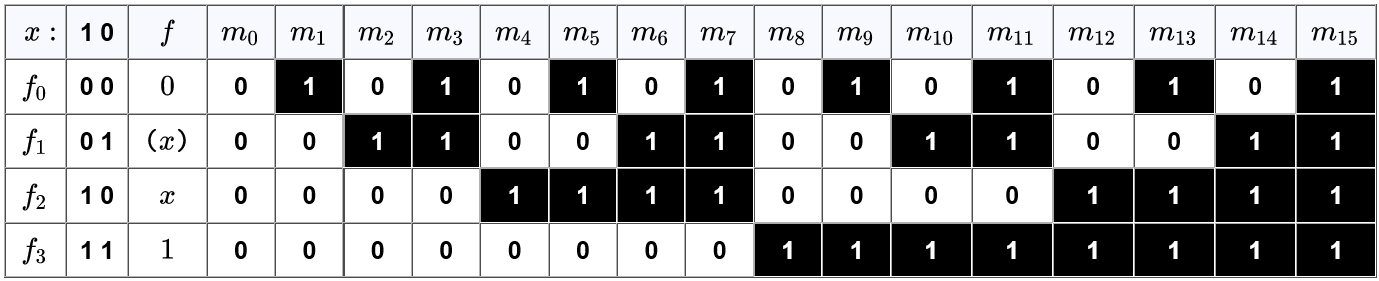
 then the next higher order of propositions consists of maps of type
 There are exactly four propositions one can make about the elements of
  Each proposition has the concrete type
  and the abstract type
  From that beginning there are exactly sixteen higher order propositions one can make about the initial set of four propositions. Each higher order proposition has the abstract type
 for
for 

 and
and  involves a subscription to such notions, as shown by the membership relations invoked in their indices.



 In the Current situation the Air is cool.
 Just Before it rains, the Air is cool.
 The Current situation is just Before it rains.
 Just Before it rains, a Dark cloud will appear.
 In the Current situation, a Dark cloud will appear.

 Inquiry Into Inquiry