Peirce’s 1870 “Logic of Relatives” • Selection 10

We continue with §3. Application of the Algebraic Signs to Logic.

Peirce’s 1870 “Logic of Relatives”Selection 10

The Signs for Multiplication (cont.)

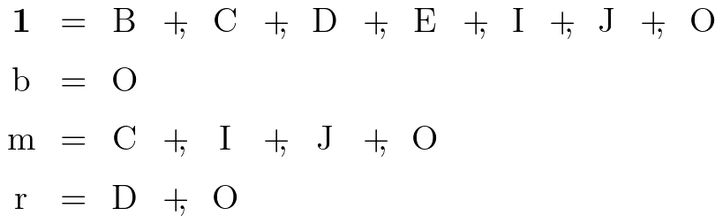
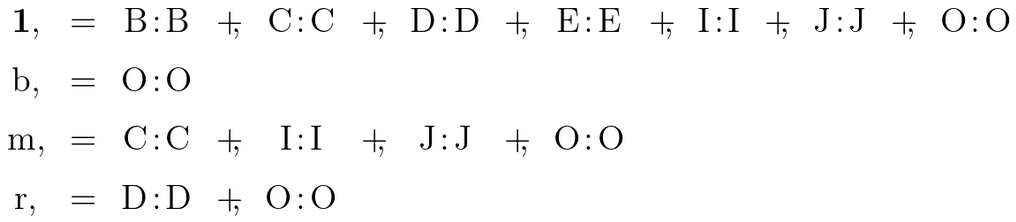
The sum x + x generally denotes no logical term.  But {x,}_\infty + \, {x,}_\infty may be considered as denoting some two x’s.  It is natural to write

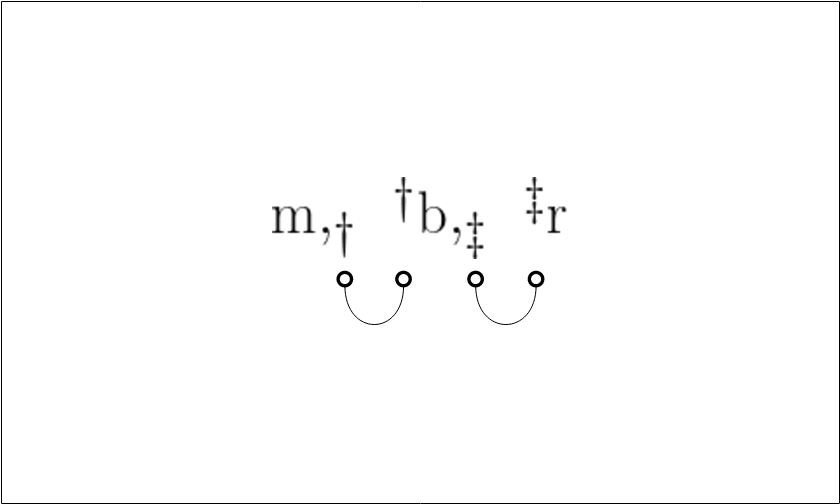
Display 1

where the dot shows that this multiplication is invertible.  We may also use the antique figures so that

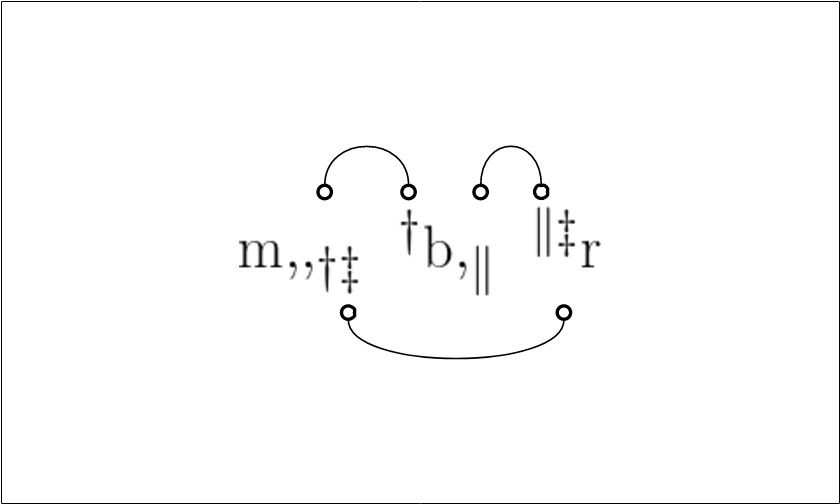
Display 2

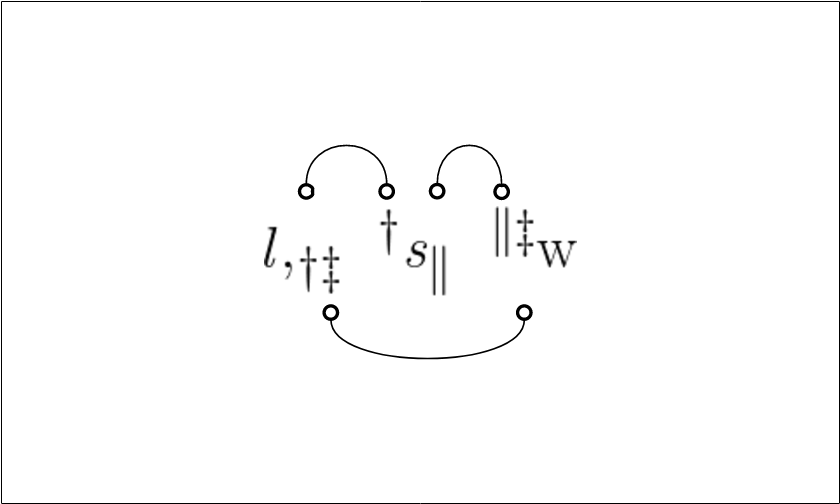
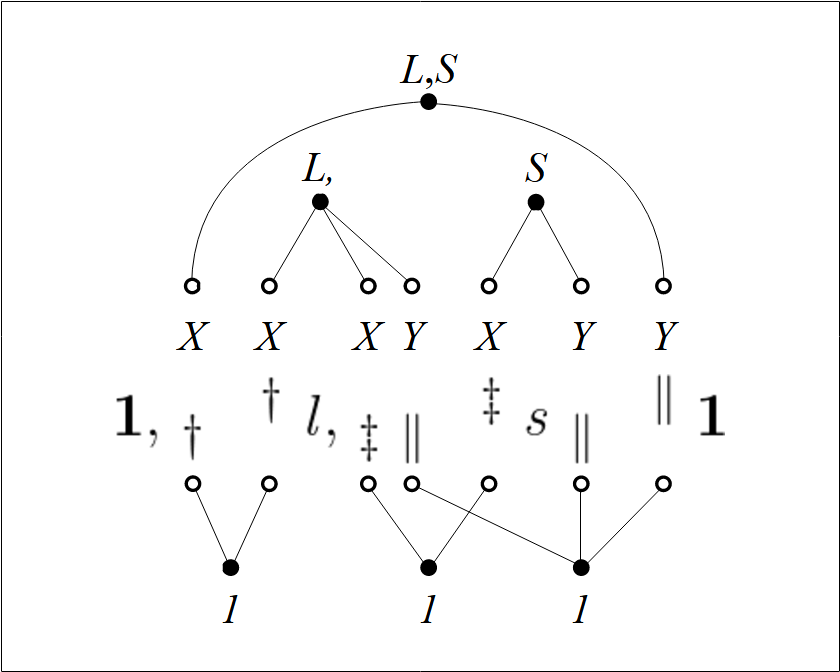
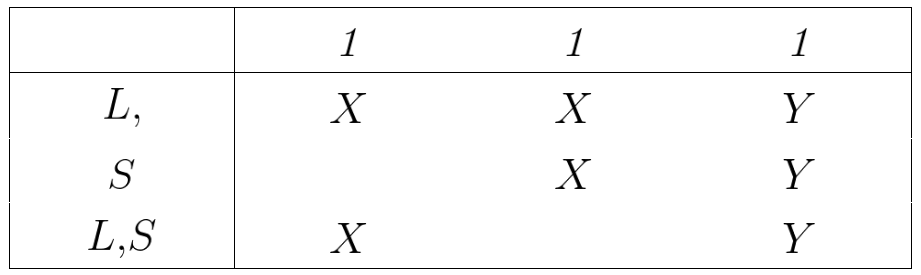
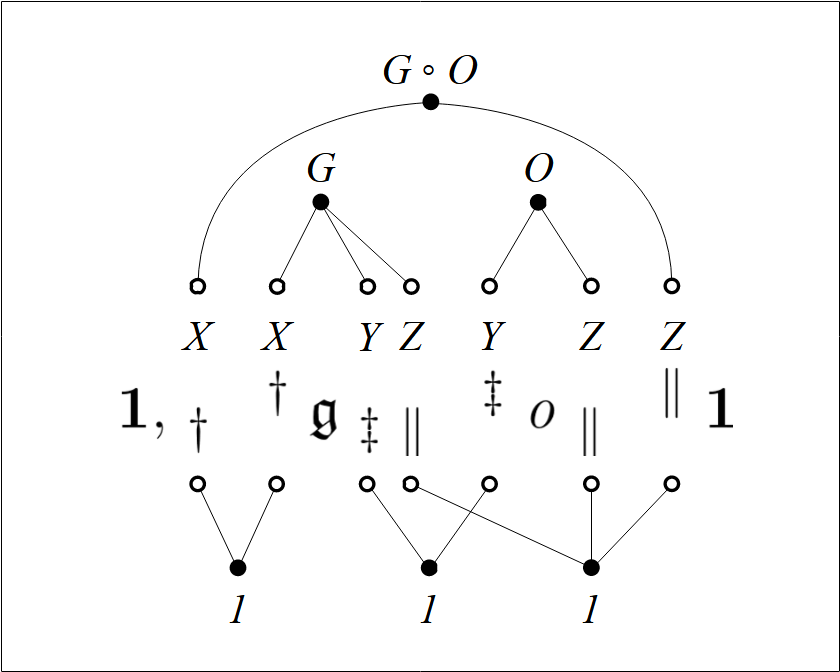
Then \mathfrak{2} alone will denote some two things.  But this multiplication is not in general commutative, and only becomes so when it affects a relative which imparts a relation such that a thing only bears it to one thing, and one thing alone bears it to a thing.  For instance, the lovers of two women are not the same as two lovers of women, that is,

Display 3

are unequal;  but the husbands of two women are the same as two husbands of women, that is,

Display 4

(Peirce, CP 3.75)

References

  • Peirce, C.S. (1870), “Description of a Notation for the Logic of Relatives, Resulting from an Amplification of the Conceptions of Boole’s Calculus of Logic”, Memoirs of the American Academy of Arts and Sciences 9, 317–378, 26 January 1870.  Reprinted, Collected Papers 3.45–149, Chronological Edition 2, 359–429.  Online (1) (2) (3).
  • Peirce, C.S., Collected Papers of Charles Sanders Peirce, vols. 1–6, Charles Hartshorne and Paul Weiss (eds.), vols. 7–8, Arthur W. Burks (ed.), Harvard University Press, Cambridge, MA, 1931–1935, 1958.
  • Peirce, C.S., Writings of Charles S. Peirce : A Chronological Edition, Peirce Edition Project (eds.), Indiana University Press, Bloomington and Indianapolis, IN, 1981–.

Resources

cc: CyberneticsOntolog ForumStructural ModelingSystems Science
cc: FB | Peirce MattersLaws of Form • Peirce List (1) (2) (3) (4) (5) (6) (7)

Posted in C.S. Peirce, Logic, Logic of Relatives, Logical Graphs, Mathematics, Relation Theory, Visualization | Tagged , , , , , , | 11 Comments

Peirce’s 1870 “Logic of Relatives” • Comment 9.7

Peirce’s 1870 “Logic of Relatives”Comment 9.7

From this point forward we may think of idempotents, selectives, and zero-one diagonal matrices as being roughly equivalent notions.  The only reason I say roughly is that we are comparing ideas at different levels of abstraction in proposing those connections.

We have covered the way Peirce uses his invention of the comma modifier to assimilate boolean multiplication, logical conjunction, and what we may think of as serial selection under his more general account of relative multiplication.

But the comma functor has its application to relative terms of any arity, not just the arity of absolute terms, and so there will be a lot more to explore on this point.  But now I must return to the anchorage of Peirce’s text and hopefully get a chance to revisit this topic later.

Resources

cc: CyberneticsOntolog ForumStructural ModelingSystems Science
cc: FB | Peirce MattersLaws of Form • Peirce List (1) (2) (3) (4) (5) (6) (7)

Posted in C.S. Peirce, Logic, Logic of Relatives, Logical Matrices, Mathematics, Relation Theory, Visualization | Tagged , , , , , , | 10 Comments

Peirce’s 1870 “Logic of Relatives” • Comment 9.6

Peirce’s 1870 “Logic of Relatives”Comment 9.6

By way of fixing the current array of relational concepts in our minds, let us work through a sample of products from our relational multiplication table that will serve to illustrate the application of a comma relative to an absolute term, presented in both matrix and bigraph pictures.

Example 1

Comma Product 1,1 = 1

Example 2

Comma Product 1,M = M

Example 3

Comma Product M,1 = M

Example 4

Comma Product M,N

Example 5

Comma Product N,M

Resources

cc: CyberneticsOntolog ForumStructural ModelingSystems Science
cc: FB | Peirce MattersLaws of Form • Peirce List (1) (2) (3) (4) (5) (6) (7)

Posted in C.S. Peirce, Logic, Logic of Relatives, Logical Matrices, Mathematics, Relation Theory, Visualization | Tagged , , , , , , | 10 Comments

Peirce’s 1870 “Logic of Relatives” • Comment 9.5

Peirce’s 1870 “Logic of Relatives”Comment 9.5

Peirce’s comma operation, in its application to an absolute term, is tantamount to the representation of that term’s denotation as an idempotent transformation, which is commonly represented as a diagonal matrix.  Hence the alternate name, diagonal extension.

An idempotent element x is given by the abstract condition that xx = x but elements like those are commonly encountered in more concrete circumstances, acting as operators or transformations on other sets or spaces, and in that action they will often be represented as matrices of coefficients.

Let’s see how this looks in the matrix and graph pictures of absolute and relative terms.

Absolute Terms

Absolute Terms 1 M N W

Previously, we represented absolute terms as column arrays.  The above four terms are given by the columns of the following Table.

Column Arrays

Column Arrays

The types of graphs known as bigraphs or bipartite graphs can be used to picture simple relative terms, dyadic relations, and their corresponding logical matrices.  One way to bring absolute terms and their corresponding sets of individuals into the bigraph picture is to mark the nodes in some way, for example, hollow nodes for non‑members and filled nodes for members of the indicated set, as shown below.

Dichromatic Nodes

Dichromatic Nodes 1 M N W

The diagonal extensions of our absolute terms are expressed by the following formulas.

Diagonal Extensions

Diagonal Extensions 1 M N W

Naturally enough, the diagonal extensions are represented by diagonal matrices.

Diagonal Matrices

Diagonal Matrices 1 M N W

Cast into the bigraph picture of dyadic relations, the diagonal extension of an absolute term takes on a very distinctive sort of “straight-laced” character, as shown below.

Idempotent Bigraphs

Idempotent Bigraphs 1 M N W

Resources

cc: CyberneticsOntolog ForumStructural ModelingSystems Science
cc: FB | Peirce MattersLaws of Form • Peirce List (1) (2) (3) (4) (5) (6) (7)

Posted in C.S. Peirce, Logic, Logic of Relatives, Logical Matrices, Mathematics, Relation Theory, Visualization | Tagged , , , , , , | 10 Comments

Peirce’s 1870 “Logic of Relatives” • Comment 9.4

Peirce’s 1870 “Logic of Relatives”Comment 9.4

Boole rationalizes the properties of what we now call boolean multiplication, roughly equivalent to logical conjunction, by means of his concept of selective operations.  Peirce, in his turn, taking a radical step of analysis which has seldom been recognized for what it would lead to, does not consider this multiplication a fundamental operation, but derives it as a by-product of relative multiplication by a comma relative.  In this way Peirce makes logical conjunction a special case of relative composition.

This opens up a wide field of inquiry, the operational significance of logical terms, but it will be best to advance bit by bit and to lean on simple examples.

Back to Venice and the close-knit party of absolutes and relatives we entertained when last stopping there.

Here is the list of absolute terms we had been considering before:

Absolute Terms 1 M N W

Here is the list of comma inflexions or diagonal extensions of those terms:

\begin{array}{lll}  \mathbf{1,} & = & \text{anything that is}\, \underline{~~~~}  \\[6pt]  & = & \mathrm{B\!:\!B} ~+\!\!,~ \mathrm{C\!:\!C} ~+\!\!,~ \mathrm{D\!:\!D} ~+\!\!,~ \mathrm{E\!:\!E} ~+\!\!,~ \mathrm{I\!:\!I} ~+\!\!,~ \mathrm{J\!:\!J} ~+\!\!,~ \mathrm{O\!:\!O}  \\[9pt]  \mathrm{m,} & = & \text{man that is}\, \underline{~~~~}  \\[6pt]  & = & \mathrm{C\!:\!C} ~+\!\!,~ \mathrm{I\!:\!I} ~+\!\!,~ \mathrm{J\!:\!J} ~+\!\!,~ \mathrm{O\!:\!O}  \\[9pt]  \mathrm{n,} & = & \text{noble that is}\, \underline{~~~~}  \\[6pt]  & = & \mathrm{C\!:\!C} ~+\!\!,~ \mathrm{D\!:\!D} ~+\!\!,~ \mathrm{O\!:\!O}  \\[9pt]  \mathrm{w,} & = & \text{woman that is}\, \underline{~~~~}  \\[6pt]  & = & \mathrm{B\!:\!B} ~+\!\!,~ \mathrm{D\!:\!D} ~+\!\!,~ \mathrm{E\!:\!E}  \end{array}

One observes the diagonal extension of \mathbf{1} is the same thing as the identity relation \mathit{1}.

Earlier we computed the following products, obtained by applying the diagonal extensions of absolute terms to the same set of absolute terms.

\begin{array}{lllll}  \mathrm{m},\!\mathrm{n}  & = & \text{man that is a noble}  & = & \mathrm{C} ~+\!\!,~ \mathrm{O}  \\[6pt]  \mathrm{n},\!\mathrm{m}  & = & \text{noble that is a man}  & = & \mathrm{C} ~+\!\!,~ \mathrm{O}  \\[6pt]  \mathrm{w},\!\mathrm{n}  & = & \text{woman that is a noble}  & = & \mathrm{D}  \\[6pt]  \mathrm{n},\!\mathrm{w}  & = & \text{noble that is a woman}  & = & \mathrm{D}  \end{array}

From that we take our first clue why the commutative law holds for logical conjunction.  More in the way of practical insight could be had by working systematically through the collection of products generated by the operational means at hand, namely, the products obtained by appending a comma to each of the terms \mathbf{1}, \mathrm{m}, \mathrm{n}, \mathrm{w} then applying the resulting relatives to those selfsame terms again.

Before we venture into that territory, however, let us equip our intuitions with the forms of graphical and matrical representation which served us so well in our previous adventures.

Resources

cc: CyberneticsOntolog ForumStructural ModelingSystems Science
cc: FB | Peirce MattersLaws of Form • Peirce List (1) (2) (3) (4) (5) (6) (7)

Posted in Boole, Boolean Algebra, C.S. Peirce, Logic, Logic of Relatives, Mathematics, Relation Theory, Visualization | Tagged , , , , , , , | 10 Comments

Peirce’s 1870 “Logic of Relatives” • Comment 9.3

Peirce’s 1870 “Logic of Relatives”Comment 9.3

An idempotent element x in an algebraic system is one which obeys the idempotent law, that is, it satisfies the equation xx = x.  Under most circumstances it is usual to write this as x^2 = x.

If the algebraic system in question falls under the additional laws necessary to carry out the required transformations then x^2 = x is convertible to x - x^2 = 0, and this in turn to x(1 - x) = 0.

If the algebraic system satisfies the requirements of a boolean algebra then the equation x(1 - x) = 0 amounts to saying x \land \lnot x is identically false, in effect, a statement of the classical principle of non‑contradiction.

We have already seen how Boole found rationales for the commutative law and the idempotent law by contemplating the properties of selective operations.

It is time to bring these threads together, which we can do by considering the so-called idempotent representation of sets.  This will give us one of the best ways to understand the significance Boole attaches to selective operations.  It will also link up with the statements Peirce makes regarding his dimension-raising comma operation.

Resources

cc: CyberneticsOntolog ForumStructural ModelingSystems Science
cc: FB | Peirce MattersLaws of Form • Peirce List (1) (2) (3) (4) (5) (6) (7)

Posted in Boole, Boolean Algebra, C.S. Peirce, Logic, Logic of Relatives, Mathematics, Relation Theory, Visualization | Tagged , , , , , , , | 11 Comments

Peirce’s 1870 “Logic of Relatives” • Comment 9.2

Peirce’s 1870 “Logic of Relatives”Comment 9.2

In setting up his discussion of selective operations and their corresponding selective symbols, Boole writes the following.

The operation which we really perform is one of selection according to a prescribed principle or idea.  To what faculties of the mind such an operation would be referred, according to the received classification of its powers, it is not important to inquire, but I suppose that it would be considered as dependent upon the two faculties of Conception or Imagination, and Attention.  To the one of these faculties might be referred the formation of the general conception;  to the other the fixing of the mental regard upon those individuals within the prescribed universe of discourse which answer to the conception.  If, however, as seems not improbable, the power of Attention is nothing more than the power of continuing the exercise of any other faculty of the mind, we might properly regard the whole of the mental process above described as referrible to the mental faculty of Imagination or Conception, the first step of the process being the conception of the Universe itself, and each succeeding step limiting in a definite manner the conception thus formed.  Adopting this view, I shall describe each such step, or any definite combination of such steps, as a definite act of conception.

(Boole, Laws of Thought, 43)

Resources

cc: CyberneticsOntolog ForumStructural ModelingSystems Science
cc: FB | Peirce MattersLaws of Form • Peirce List (1) (2) (3) (4) (5) (6) (7)

Posted in Boole, Boolean Algebra, C.S. Peirce, Logic, Logic of Relatives, Mathematics, Relation Theory, Visualization | Tagged , , , , , , , | 11 Comments

Peirce’s 1870 “Logic of Relatives” • Comment 9.1

Peirce’s 1870 “Logic of Relatives”Comment 9.1

Perspective on Peirce’s use of the comma operator at CP 3.73 and CP 3.74 can be gained by dropping back a few years and seeing how George Boole explained his twin conceptions of selective operations and selective symbols.

Let us then suppose that the universe of our discourse is the actual universe, so that words are to be used in the full extent of their meaning, and let us consider the two mental operations implied by the words “white” and “men”.  The word “men” implies the operation of selecting in thought from its subject, the universe, all men;  and the resulting conception, men, becomes the subject of the next operation.  The operation implied by the word “white” is that of selecting from its subject, “men”, all of that class which are white.  The final resulting conception is that of “white men”.

Now it is perfectly apparent that if the operations above described had been performed in a converse order, the result would have been the same.  Whether we begin by forming the conception of “men”, and then by a second intellectual act limit that conception to “white men”, or whether we begin by forming the conception of “white objects”, and then limit it to such of that class as are “men”, is perfectly indifferent so far as the result is concerned.  It is obvious that the order of the mental processes would be equally indifferent if for the words “white” and “men” we substituted any other descriptive or appellative terms whatever, provided only that their meaning was fixed and absolute.  And thus the indifference of the order of two successive acts of the faculty of Conception, the one of which furnishes the subject upon which the other is supposed to operate, is a general condition of the exercise of that faculty.  It is a law of the mind, and it is the real origin of that law of the literal symbols of Logic which constitutes its formal expression, [xy = yx]. 

It is equally clear that the mental operation above described is of such a nature that its effect is not altered by repetition.  Suppose that by a definite act of conception the attention has been fixed upon men, and that by another exercise of the same faculty we limit it to those of the race who are white.  Then any further repetition of the latter mental act, by which the attention is limited to white objects, does not in any way modify the conception arrived at, viz., that of white men.  This is also an example of a general law of the mind, and it has its formal expression in the law [x^2 = x] of the literal symbols.

(Boole, Laws of Thought, 44–45)

Resources

cc: CyberneticsOntolog ForumStructural ModelingSystems Science
cc: FB | Peirce MattersLaws of Form • Peirce List (1) (2) (3) (4) (5) (6) (7)

Posted in Boole, Boolean Algebra, C.S. Peirce, Logic, Logic of Relatives, Mathematics, Relation Theory, Visualization | Tagged , , , , , , , | 10 Comments

Peirce’s 1870 “Logic of Relatives” • Selection 9

We continue with §3. Application of the Algebraic Signs to Logic.

Peirce’s 1870 “Logic of Relatives”Selection 9

The Signs for Multiplication (cont.)

It is obvious that multiplication into a multiplicand indicated by a comma is commutative,1 that is,

\mathit{s},\!\mathit{l} ~=~ \mathit{l},\!\mathit{s}

This multiplication is effectively the same as that of Boole in his logical calculus.  Boole’s unity is my \mathbf{1}, that is, it denotes whatever is.

  1. It will often be convenient to speak of the whole operation of affixing a comma and then multiplying as a commutative multiplication, the sign for which is the comma.  But though this is allowable, we shall fall into confusion at once if we ever forget that in point of fact it is not a different multiplication, only it is multiplication by a relative whose meaning — or rather whose syntax — has been slightly altered;  and that the comma is really the sign of this modification of the foregoing term.

(Peirce, CP 3.74)

References

  • Peirce, C.S. (1870), “Description of a Notation for the Logic of Relatives, Resulting from an Amplification of the Conceptions of Boole’s Calculus of Logic”, Memoirs of the American Academy of Arts and Sciences 9, 317–378, 26 January 1870.  Reprinted, Collected Papers 3.45–149, Chronological Edition 2, 359–429.  Online (1) (2) (3).
  • Peirce, C.S., Collected Papers of Charles Sanders Peirce, vols. 1–6, Charles Hartshorne and Paul Weiss (eds.), vols. 7–8, Arthur W. Burks (ed.), Harvard University Press, Cambridge, MA, 1931–1935, 1958.
  • Peirce, C.S., Writings of Charles S. Peirce : A Chronological Edition, Peirce Edition Project (eds.), Indiana University Press, Bloomington and Indianapolis, IN, 1981–.

Resources

cc: CyberneticsOntolog ForumStructural ModelingSystems Science
cc: FB | Peirce MattersLaws of Form • Peirce List (1) (2) (3) (4) (5) (6) (7)

Posted in C.S. Peirce, Logic, Logic of Relatives, Logical Graphs, Mathematics, Relation Theory, Visualization | Tagged , , , , , , | 11 Comments

Peirce’s 1870 “Logic of Relatives” • Comment 8.6

Peirce’s 1870 “Logic of Relatives”Comment 8.6

The foregoing has hopefully filled in enough background that we can begin to make sense of the more mysterious parts of CP 3.73.

The Signs for Multiplication (cont.)

Thus far, we have considered the multiplication of relative terms only.  Since our conception of multiplication is the application of a relation, we can only multiply absolute terms by considering them as relatives.

Now the absolute term “man” is really exactly equivalent to the relative term “man that is ──”, and so with any other.  I shall write a comma after any absolute term to show that it is so regarded as a relative term.

Then “man that is black” will be written:

\mathrm{m},\!\mathrm{b}.

(CP 3.73)

In any system where elements are organized according to types there tend to be any number of ways in which elements of one type are naturally associated with elements of another type.  If the association is anything like a logical equivalence, but with the first type being lower and the second type being higher in some sense, then one may speak of a semantic ascent from the lower to the higher type.

For example, it is common in mathematics to associate an element a of a set A with the constant function f_a : X \to A which has f_a (x) = a for all x in X, where X is an arbitrary set which is fixed in the context of discussion.  Indeed, the correspondence is so close that one often uses the same name {}^{\backprime\backprime} a {}^{\prime\prime} to denote both the element a in A and the function a = f_a : X \to A, relying on context or an explicit type indication to tell them apart.

For another example, we have the tacit extension of a k-place relation L \subseteq X_1 \times \ldots \times X_k to a (k+1)-place relation L' \subseteq X_1 \times \ldots \times X_{k+1} which we get by letting L' = L \times X_{k+1}, that is, by maintaining the constraints of L on the first k variables and letting the last variable wander freely.

What we have here, if I understand Peirce correctly, is another such type of natural extension, sometimes called the diagonal extension.  This extension associates a k-adic relative or a k-adic relation, counting the absolute term and the set whose elements it denotes as the cases for k = 0, with a series of relatives and relations of higher adicities.

A few examples will suffice to anchor these ideas.

Absolute Terms

\begin{array}{*{11}{c}}  \mathrm{m} & = &  \text{man} & = &  \mathrm{C} & +\!\!, &  \mathrm{I} & +\!\!, &  \mathrm{J} & +\!\!, &  \mathrm{O}  \\[6pt]  \mathrm{n} & = &  \text{noble} & = &  \mathrm{C} & +\!\!, &  \mathrm{D} & +\!\!, &  \mathrm{O}  \\[6pt]  \mathrm{w} & = &  \text{woman} & = &  \mathrm{B} & +\!\!, &  \mathrm{D} & +\!\!, &  \mathrm{E}  \end{array}

Diagonal Extensions

\begin{array}{*{11}{c}}  \mathrm{m,} & = &  \text{man that is}\, \underline{~~~~} & = &  \mathrm{C\!:\!C} & +\!\!, &  \mathrm{I\!:\!I} & +\!\!, &  \mathrm{J\!:\!J} & +\!\!, &  \mathrm{O\!:\!O}  \\[6pt]  \mathrm{n,} & = &  \text{noble that is}\, \underline{~~~~} & = &  \mathrm{C\!:\!C} & +\!\!, &  \mathrm{D\!:\!D} & +\!\!, &  \mathrm{O\!:\!O}  \\[6pt]  \mathrm{w,} & = &  \text{woman that is}\, \underline{~~~~} & = &  \mathrm{B\!:\!B} & +\!\!, &  \mathrm{D\!:\!D} & +\!\!, &  \mathrm{E\!:\!E}  \end{array}

Sample Products

\begin{array}{lll}  \mathrm{m},\!\mathrm{n} & = & \text{man that is a noble} \\[6pt]  & = &  (\mathrm{C\!:\!C} ~+\!\!,~ \mathrm{I\!:\!I} ~+\!\!,~ \mathrm{J\!:\!J} ~+\!\!,~ \mathrm{O\!:\!O}) \\  & &  \times \\  & &  (\mathrm{C} ~+\!\!,~ \mathrm{D} ~+\!\!,~ \mathrm{O}) \\[6pt]  & = &  \mathrm{C} ~+\!\!,~ \mathrm{O}  \end{array}

\begin{array}{lll}  \mathrm{n},\!\mathrm{m} & = & \text{noble that is a man} \\[6pt]  & = &  (\mathrm{C\!:\!C} ~+\!\!,~ \mathrm{D\!:\!D} ~+\!\!,~ \mathrm{O\!:\!O}) \\  & &  \times \\  & &  (\mathrm{C} ~+\!\!,~ \mathrm{I} ~+\!\!,~ \mathrm{J} ~+\!\!,~ \mathrm{O}) \\[6pt]  & = &  \mathrm{C} ~+\!\!,~ \mathrm{O}  \end{array}

\begin{array}{lll}  \mathrm{w},\!\mathrm{n} & = & \text{woman that is a noble} \\[6pt]  & = &  (\mathrm{B\!:\!B} ~+\!\!,~ \mathrm{D\!:\!D} ~+\!\!,~ \mathrm{E\!:\!E}) \\  & &  \times \\  & &  (\mathrm{C} ~+\!\!,~ \mathrm{D} ~+\!\!,~ \mathrm{O}) \\[6pt]  & = &  \mathrm{D}  \end{array}

\begin{array}{lll}  \mathrm{n},\!\mathrm{w} & = & \text{noble that is a woman} \\[6pt]  & = &  (\mathrm{C\!:\!C} ~+\!\!,~ \mathrm{D\!:\!D} ~+\!\!,~ \mathrm{O\!:\!O}) \\  & &  \times \\  & &  (\mathrm{B} ~+\!\!,~ \mathrm{D} ~+\!\!,~ \mathrm{E}) \\[6pt]  & = &  \mathrm{D}  \end{array}

Resources

cc: CyberneticsOntolog ForumStructural ModelingSystems Science
cc: FB | Peirce MattersLaws of Form • Peirce List (1) (2) (3) (4) (5) (6) (7)

Posted in C.S. Peirce, Logic, Logic of Relatives, Logical Matrices, Mathematics, Relation Theory, Visualization | Tagged , , , , , , | 10 Comments