Peirce’s 1870 “Logic of Relatives” • Comment 10.4

Peirce’s 1870 “Logic of Relatives”Comment 10.4

Anything that is a Lover of a Servant of Anything

\text{Figure 15. Anything that is a Lover of a Servant of Anything}

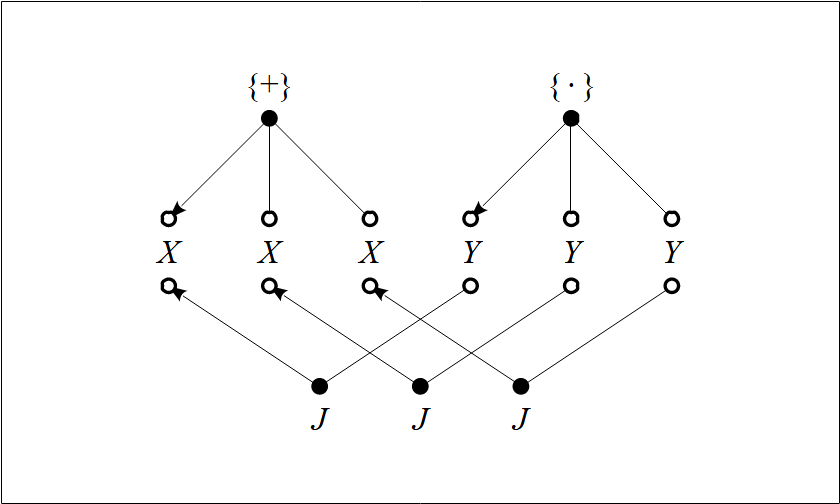
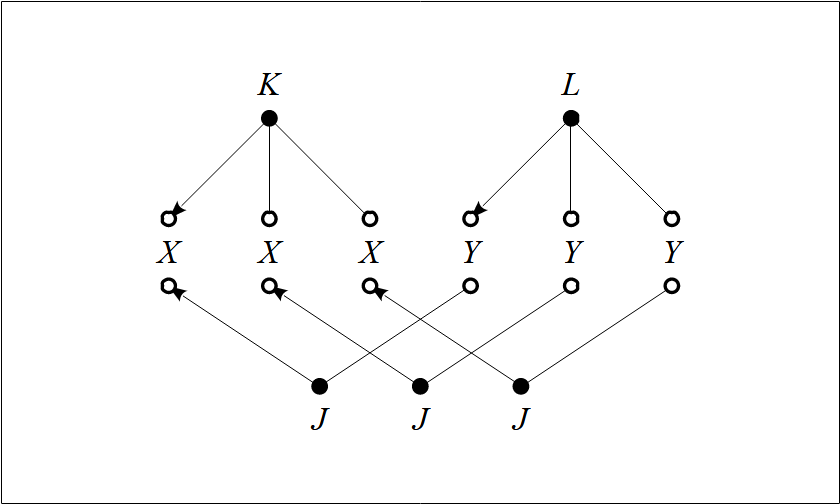
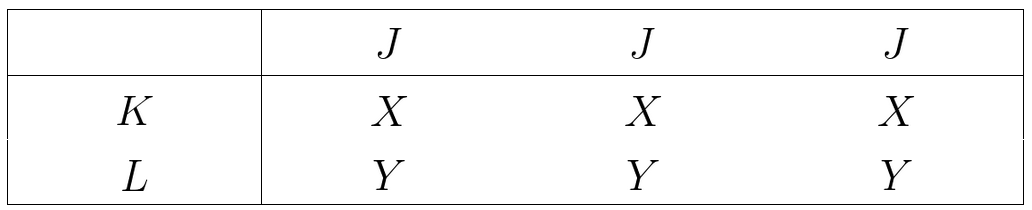
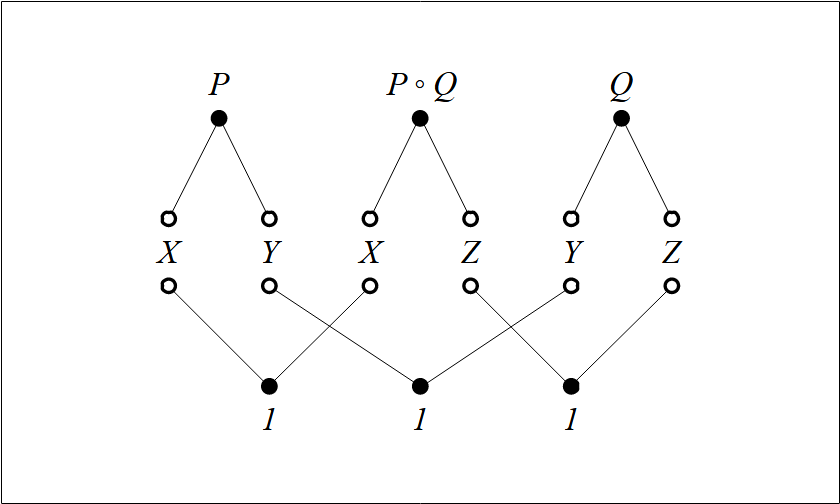
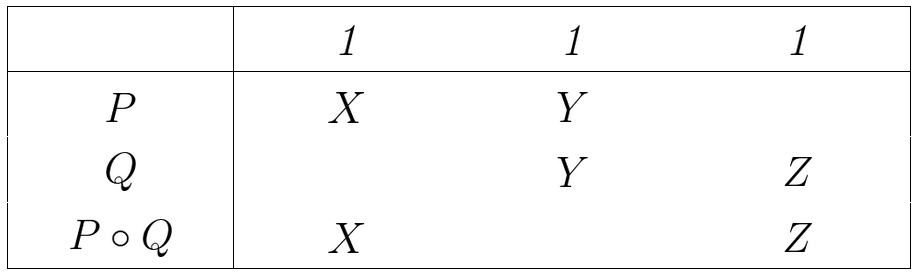
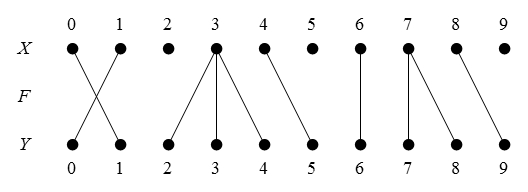
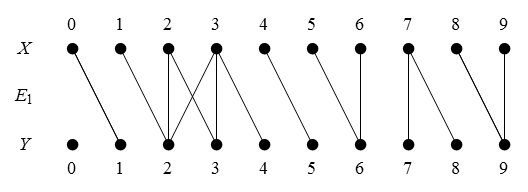
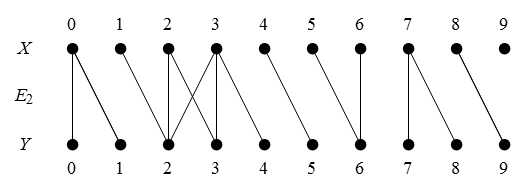
From now on the forms of analysis exemplified in the last set of Figures and Tables will serve as a convenient bridge between the logic of relative terms and the mathematics of relations themselves.  We may think of Table 13 as illustrating a spreadsheet model of relational composition while Figure 14 may be thought of as making a start toward a hypergraph model of generalized compositions.  I’ll explain the hypergraph model in more detail at a later point.  The transitional form of analysis represented by Figure 15 may be called the universal bracketing of relatives as relations.

Resources

cc: CyberneticsOntolog ForumStructural ModelingSystems Science
cc: FB | Peirce MattersLaws of Form • Peirce List (1) (2) (3) (4) (5) (6) (7)

Posted in C.S. Peirce, Logic, Logic of Relatives, Logical Graphs, Mathematics, Relation Theory, Visualization | Tagged , , , , , , | 10 Comments

Peirce’s 1870 “Logic of Relatives” • Comment 10.3

Peirce’s 1870 “Logic of Relatives”Comment 10.3

We have been using several styles of picture to illustrate relative terms and the relations they denote.  Let’s now examine the relationships which exist among the variety of visual schemes.  Two examples of relative multiplication we considered before are diagrammed again in Figures 11 and 12.

Lover of a Servant of a Woman

\text{Figure 11. Lover of a Servant of a Woman}

Giver of a Horse to a Lover of a Woman

\text{Figure 12. Giver of a Horse to a Lover of a Woman}

Figures 11 and 12 employ one of the styles of syntax Peirce used for relative multiplication, to which I added lines of identity to connect the corresponding marks of reference.  Forms like these show the anatomy of the relative terms themselves, while the forms in Table 13 and Figure 14 are adapted to show the structures of the objective relations they denote.

\text{Table 13. Relational Composition}~ L \circ S

Relational Composition Table L ◦ S

Relational Composition Figure L ◦ S

\text{Figure 14. Relational Composition}~ L \circ S

There are many ways Peirce might have gotten from his 1870 Notation for the Logic of Relatives to his more evolved systems of Logical Graphs.  It is interesting to speculate on how the metamorphosis might have been accomplished by way of transformations acting on these nascent forms of syntax and taking place not too far from the pale of its means, that is, as nearly as possible according to the rules and permissions of the initial system itself.

In Existential Graphs, a relation is represented by a node whose degree is the adicity of that relation, and which is adjacent via lines of identity to the nodes representing its correlative relations, including as a special case any of its terminal individual arguments.

In the 1870 Logic of Relatives, implicit lines of identity are invoked by the subjacent numbers and marks of reference only when a correlate of some relation is the rèlate of some relation.  Thus, the principal rèlate, which is not a correlate of any explicit relation, is not singled out in this way.

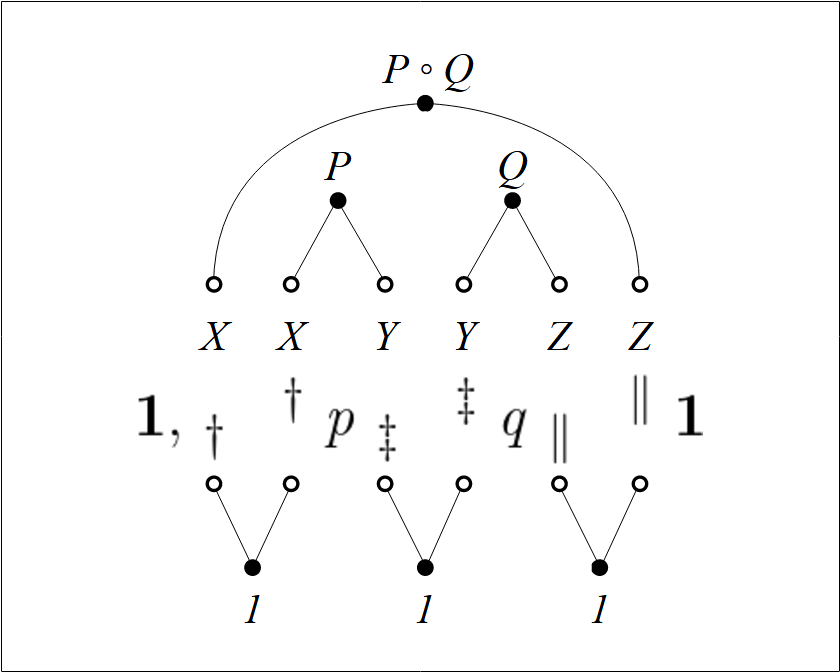
Remarkably enough, the comma modifier itself provides us with a mechanism to abstract the logic of relations from the logic of relatives, and thus to forge a possible link between the syntax of relative terms and the more graphical depiction of the objective relations themselves.

Figure 15 demonstrates this possibility, posing a transitional case between the style of syntax in Figure 11 and the picture of composition in Figure 14.

Anything that is a Lover of a Servant of Anything

\text{Figure 15. Anything that is a Lover of a Servant of Anything}

In this composite sketch the diagonal extension \mathit{1} of the universe \mathbf{1} is invoked up front to anchor an explicit line of identity for the leading rèlate of the composition, while the terminal argument \mathrm{w} is generalized to the whole universe \mathbf{1}.  Doing this amounts to an act of abstraction from the particular application to \mathrm{w}.  This form of universal bracketing isolates the serial composition of the relations L and S to form the composite L \circ S.

Resources

cc: CyberneticsOntolog ForumStructural ModelingSystems Science
cc: FB | Peirce MattersLaws of Form • Peirce List (1) (2) (3) (4) (5) (6) (7)

Posted in C.S. Peirce, Logic, Logic of Relatives, Logical Graphs, Mathematics, Relation Theory, Visualization | Tagged , , , , , , | 9 Comments

Peirce’s 1870 “Logic of Relatives” • Comment 10.2

Peirce’s 1870 “Logic of Relatives”Comment 10.2

To say a relative term “imparts a relation” is to say it conveys information about the space of tuples in a cartesian product, that is, it determines a particular subset of that space.  When we study the combinations of relative terms, from the most elementary forms of composition to the most complex patterns of correlation, we are considering the ways those constraints, determinations, and informations, as imparted by relative terms, are compounded in the formation of syntax.

Let us go back and look more carefully at just how it happens that Peirce’s adjacent terms and subjacent indices manage to impart their respective measures of information about relations.  Consider the examples shown in Figures 7 and 8, where connecting lines of identity have been drawn between the corresponding occurrences of the subjacent marks of reference:  \dagger\, \ddagger\, \parallel\, \S\, \P.

Lover of a Servant of a Woman

\text{Figure 7. Lover of a Servant of a Woman}

Giver of a Horse to a Lover of a Woman

\text{Figure 8. Giver of a Horse to a Lover of a Woman}

One way to approach the problem of “information fusion” in Peirce’s syntax is to soften the distinction between adjacent terms and subjacent signs and treat the types of constraints they separately signify more on a par with each other.  To that purpose, let us consider a way of thinking about relational composition that emphasizes the set-theoretic constraints involved in the construction of a composite relation.

For example, given the relations L \subseteq X \times Y and M \subseteq Y \times Z, Table 9 and Figure 10 present two ways of picturing the constraints involved in constructing the relational composition L \circ M \subseteq X \times Z.

\text{Table 9. Relational Composition}~ L \circ M

Relational Composition Table L ◦ M

The way to read Table 9 is to imagine you are playing a game which involves placing tokens on the squares of a board marked in just that way.  The rules are you have to place a single token on each marked square in the middle of the board in such a way that all the indicated constraints are satisfied.  That is, you have to place a token whose denomination is a value in the set X on each of the squares marked X, and similarly for the squares marked Y and Z, meanwhile leaving all the blank squares empty.

Furthermore, the tokens placed in each row and column have to obey the relational constraints indicated at the heads of the corresponding row and column.  Thus, the two tokens from X have to denote the very same value from X, and likewise for Y and Z, while the pairs of tokens on the rows marked L and M are required to denote elements in the relations L and M, respectively.

The upshot is, when all that has been done, when the L, M, and \mathit{1} relations are satisfied, then the row marked L \circ M will automatically bear the tokens of a pair of elements in the composite relation L \circ M.

Figure 10 shows a different way of viewing the same situation.

Relational Composition Figure L ◦ M

\text{Figure 10. Relational Composition}~ L \circ M

Resources

cc: CyberneticsOntolog ForumStructural ModelingSystems Science
cc: FB | Peirce MattersLaws of Form • Peirce List (1) (2) (3) (4) (5) (6) (7)

Posted in C.S. Peirce, Logic, Logic of Relatives, Logical Graphs, Mathematics, Relation Theory, Visualization | Tagged , , , , , , | 10 Comments

Peirce’s 1870 “Logic of Relatives” • Comment 10.1

Peirce’s 1870 “Logic of Relatives”Comment 10.1

What Peirce is attempting to do at CP 3.75 is absolutely amazing.  I did not run across anything on a par with it again until the mid 1980s when I began studying the application of mathematical category theory to computation and logic.  Gauging the success of Peirce’s attempt would take a return to his earlier paper “Upon the Logic of Mathematics” (1867) to pick up the ideas about arithmetic he sets out there.

Another branch of the investigation would require us to examine the syntactic mechanics of subjacent signs Peirce uses to establish linkages among relational domains.  The indices employed for this purpose amount to a category of diacritical and interpretive signs which includes, among other things, the comma functor we have just been discussing.

Combining the two branches of this investigation opens a wider context for the study of relational compositions, distilling the essence of what it takes to relate relations, possibly complex, to other relations, possibly simple.

Resources

cc: CyberneticsOntolog ForumStructural ModelingSystems Science
cc: FB | Peirce MattersLaws of Form • Peirce List (1) (2) (3) (4) (5) (6) (7)

Posted in C.S. Peirce, Logic, Logic of Relatives, Logical Graphs, Mathematics, Relation Theory, Visualization | Tagged , , , , , , | 10 Comments

Peirce’s 1870 “Logic of Relatives” • Selection 10

We continue with §3. Application of the Algebraic Signs to Logic.

Peirce’s 1870 “Logic of Relatives”Selection 10

The Signs for Multiplication (cont.)

The sum x + x generally denotes no logical term.  But {x,}_\infty + \, {x,}_\infty may be considered as denoting some two x’s.  It is natural to write

Display 1

where the dot shows that this multiplication is invertible.  We may also use the antique figures so that

Display 2

Then \mathfrak{2} alone will denote some two things.  But this multiplication is not in general commutative, and only becomes so when it affects a relative which imparts a relation such that a thing only bears it to one thing, and one thing alone bears it to a thing.  For instance, the lovers of two women are not the same as two lovers of women, that is,

Display 3

are unequal;  but the husbands of two women are the same as two husbands of women, that is,

Display 4

(Peirce, CP 3.75)

References

  • Peirce, C.S. (1870), “Description of a Notation for the Logic of Relatives, Resulting from an Amplification of the Conceptions of Boole’s Calculus of Logic”, Memoirs of the American Academy of Arts and Sciences 9, 317–378, 26 January 1870.  Reprinted, Collected Papers 3.45–149, Chronological Edition 2, 359–429.  Online (1) (2) (3).
  • Peirce, C.S., Collected Papers of Charles Sanders Peirce, vols. 1–6, Charles Hartshorne and Paul Weiss (eds.), vols. 7–8, Arthur W. Burks (ed.), Harvard University Press, Cambridge, MA, 1931–1935, 1958.
  • Peirce, C.S., Writings of Charles S. Peirce : A Chronological Edition, Peirce Edition Project (eds.), Indiana University Press, Bloomington and Indianapolis, IN, 1981–.

Resources

cc: CyberneticsOntolog ForumStructural ModelingSystems Science
cc: FB | Peirce MattersLaws of Form • Peirce List (1) (2) (3) (4) (5) (6) (7)

Posted in C.S. Peirce, Logic, Logic of Relatives, Logical Graphs, Mathematics, Relation Theory, Visualization | Tagged , , , , , , | 11 Comments

Peirce’s 1870 “Logic of Relatives” • Comment 9.7

Peirce’s 1870 “Logic of Relatives”Comment 9.7

From this point forward we may think of idempotents, selectives, and zero-one diagonal matrices as being roughly equivalent notions.  The only reason I say roughly is that we are comparing ideas at different levels of abstraction in proposing those connections.

We have covered the way Peirce uses his invention of the comma modifier to assimilate boolean multiplication, logical conjunction, and what we may think of as serial selection under his more general account of relative multiplication.

But the comma functor has its application to relative terms of any arity, not just the arity of absolute terms, and so there will be a lot more to explore on this point.  But now I must return to the anchorage of Peirce’s text and hopefully get a chance to revisit this topic later.

Resources

cc: CyberneticsOntolog ForumStructural ModelingSystems Science
cc: FB | Peirce MattersLaws of Form • Peirce List (1) (2) (3) (4) (5) (6) (7)

Posted in C.S. Peirce, Logic, Logic of Relatives, Logical Matrices, Mathematics, Relation Theory, Visualization | Tagged , , , , , , | 10 Comments

Peirce’s 1870 “Logic of Relatives” • Comment 9.6

Peirce’s 1870 “Logic of Relatives”Comment 9.6

By way of fixing the current array of relational concepts in our minds, let us work through a sample of products from our relational multiplication table that will serve to illustrate the application of a comma relative to an absolute term, presented in both matrix and bigraph pictures.

Example 1

Comma Product 1,1 = 1

Example 2

Comma Product 1,M = M

Example 3

Comma Product M,1 = M

Example 4

Comma Product M,N

Example 5

Comma Product N,M

Resources

cc: CyberneticsOntolog ForumStructural ModelingSystems Science
cc: FB | Peirce MattersLaws of Form • Peirce List (1) (2) (3) (4) (5) (6) (7)

Posted in C.S. Peirce, Logic, Logic of Relatives, Logical Matrices, Mathematics, Relation Theory, Visualization | Tagged , , , , , , | 10 Comments

Peirce’s 1870 “Logic of Relatives” • Comment 9.5

Peirce’s 1870 “Logic of Relatives”Comment 9.5

Peirce’s comma operation, in its application to an absolute term, is tantamount to the representation of that term’s denotation as an idempotent transformation, which is commonly represented as a diagonal matrix.  Hence the alternate name, diagonal extension.

An idempotent element x is given by the abstract condition that xx = x but elements like those are commonly encountered in more concrete circumstances, acting as operators or transformations on other sets or spaces, and in that action they will often be represented as matrices of coefficients.

Let’s see how this looks in the matrix and graph pictures of absolute and relative terms.

Absolute Terms

Absolute Terms 1 M N W

Previously, we represented absolute terms as column arrays.  The above four terms are given by the columns of the following Table.

Column Arrays

Column Arrays

The types of graphs known as bigraphs or bipartite graphs can be used to picture simple relative terms, dyadic relations, and their corresponding logical matrices.  One way to bring absolute terms and their corresponding sets of individuals into the bigraph picture is to mark the nodes in some way, for example, hollow nodes for non‑members and filled nodes for members of the indicated set, as shown below.

Dichromatic Nodes

Dichromatic Nodes 1 M N W

The diagonal extensions of our absolute terms are expressed by the following formulas.

Diagonal Extensions

Diagonal Extensions 1 M N W

Naturally enough, the diagonal extensions are represented by diagonal matrices.

Diagonal Matrices

Diagonal Matrices 1 M N W

Cast into the bigraph picture of dyadic relations, the diagonal extension of an absolute term takes on a very distinctive sort of “straight-laced” character, as shown below.

Idempotent Bigraphs

Idempotent Bigraphs 1 M N W

Resources

cc: CyberneticsOntolog ForumStructural ModelingSystems Science
cc: FB | Peirce MattersLaws of Form • Peirce List (1) (2) (3) (4) (5) (6) (7)

Posted in C.S. Peirce, Logic, Logic of Relatives, Logical Matrices, Mathematics, Relation Theory, Visualization | Tagged , , , , , , | 10 Comments

Peirce’s 1870 “Logic of Relatives” • Comment 9.4

Peirce’s 1870 “Logic of Relatives”Comment 9.4

Boole rationalizes the properties of what we now call boolean multiplication, roughly equivalent to logical conjunction, by means of his concept of selective operations.  Peirce, in his turn, taking a radical step of analysis which has seldom been recognized for what it would lead to, does not consider this multiplication a fundamental operation, but derives it as a by-product of relative multiplication by a comma relative.  In this way Peirce makes logical conjunction a special case of relative composition.

This opens up a wide field of inquiry, the operational significance of logical terms, but it will be best to advance bit by bit and to lean on simple examples.

Back to Venice and the close-knit party of absolutes and relatives we entertained when last stopping there.

Here is the list of absolute terms we had been considering before:

Absolute Terms 1 M N W

Here is the list of comma inflexions or diagonal extensions of those terms:

\begin{array}{lll}  \mathbf{1,} & = & \text{anything that is}\, \underline{~~~~}  \\[6pt]  & = & \mathrm{B\!:\!B} ~+\!\!,~ \mathrm{C\!:\!C} ~+\!\!,~ \mathrm{D\!:\!D} ~+\!\!,~ \mathrm{E\!:\!E} ~+\!\!,~ \mathrm{I\!:\!I} ~+\!\!,~ \mathrm{J\!:\!J} ~+\!\!,~ \mathrm{O\!:\!O}  \\[9pt]  \mathrm{m,} & = & \text{man that is}\, \underline{~~~~}  \\[6pt]  & = & \mathrm{C\!:\!C} ~+\!\!,~ \mathrm{I\!:\!I} ~+\!\!,~ \mathrm{J\!:\!J} ~+\!\!,~ \mathrm{O\!:\!O}  \\[9pt]  \mathrm{n,} & = & \text{noble that is}\, \underline{~~~~}  \\[6pt]  & = & \mathrm{C\!:\!C} ~+\!\!,~ \mathrm{D\!:\!D} ~+\!\!,~ \mathrm{O\!:\!O}  \\[9pt]  \mathrm{w,} & = & \text{woman that is}\, \underline{~~~~}  \\[6pt]  & = & \mathrm{B\!:\!B} ~+\!\!,~ \mathrm{D\!:\!D} ~+\!\!,~ \mathrm{E\!:\!E}  \end{array}

One observes the diagonal extension of \mathbf{1} is the same thing as the identity relation \mathit{1}.

Earlier we computed the following products, obtained by applying the diagonal extensions of absolute terms to the same set of absolute terms.

\begin{array}{lllll}  \mathrm{m},\!\mathrm{n}  & = & \text{man that is a noble}  & = & \mathrm{C} ~+\!\!,~ \mathrm{O}  \\[6pt]  \mathrm{n},\!\mathrm{m}  & = & \text{noble that is a man}  & = & \mathrm{C} ~+\!\!,~ \mathrm{O}  \\[6pt]  \mathrm{w},\!\mathrm{n}  & = & \text{woman that is a noble}  & = & \mathrm{D}  \\[6pt]  \mathrm{n},\!\mathrm{w}  & = & \text{noble that is a woman}  & = & \mathrm{D}  \end{array}

From that we take our first clue why the commutative law holds for logical conjunction.  More in the way of practical insight could be had by working systematically through the collection of products generated by the operational means at hand, namely, the products obtained by appending a comma to each of the terms \mathbf{1}, \mathrm{m}, \mathrm{n}, \mathrm{w} then applying the resulting relatives to those selfsame terms again.

Before we venture into that territory, however, let us equip our intuitions with the forms of graphical and matrical representation which served us so well in our previous adventures.

Resources

cc: CyberneticsOntolog ForumStructural ModelingSystems Science
cc: FB | Peirce MattersLaws of Form • Peirce List (1) (2) (3) (4) (5) (6) (7)

Posted in Boole, Boolean Algebra, C.S. Peirce, Logic, Logic of Relatives, Mathematics, Relation Theory, Visualization | Tagged , , , , , , , | 10 Comments

Peirce’s 1870 “Logic of Relatives” • Comment 9.3

Peirce’s 1870 “Logic of Relatives”Comment 9.3

An idempotent element x in an algebraic system is one which obeys the idempotent law, that is, it satisfies the equation xx = x.  Under most circumstances it is usual to write this as x^2 = x.

If the algebraic system in question falls under the additional laws necessary to carry out the required transformations then x^2 = x is convertible to x - x^2 = 0, and this in turn to x(1 - x) = 0.

If the algebraic system satisfies the requirements of a boolean algebra then the equation x(1 - x) = 0 amounts to saying x \land \lnot x is identically false, in effect, a statement of the classical principle of non‑contradiction.

We have already seen how Boole found rationales for the commutative law and the idempotent law by contemplating the properties of selective operations.

It is time to bring these threads together, which we can do by considering the so-called idempotent representation of sets.  This will give us one of the best ways to understand the significance Boole attaches to selective operations.  It will also link up with the statements Peirce makes regarding his dimension-raising comma operation.

Resources

cc: CyberneticsOntolog ForumStructural ModelingSystems Science
cc: FB | Peirce MattersLaws of Form • Peirce List (1) (2) (3) (4) (5) (6) (7)

Posted in Boole, Boolean Algebra, C.S. Peirce, Logic, Logic of Relatives, Mathematics, Relation Theory, Visualization | Tagged , , , , , , , | 11 Comments