
Systems of Interpretation • 6

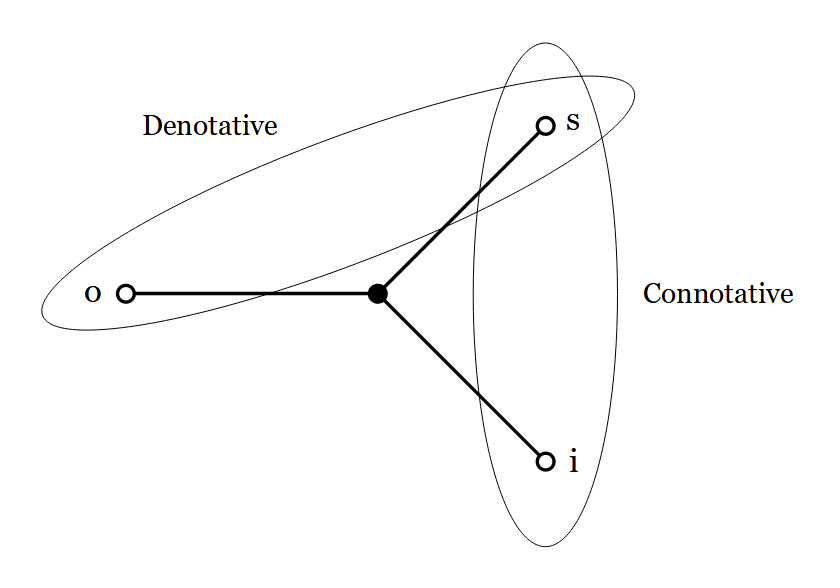
Elementary Sign Relation
\text{Figure 2. An Elementary Sign Relation}

Re: Peirce ListJon AwbreyJohn Collier

JA:
Questions about the meaning of the “central hub” in the “three‑spoked” picture of an elementary sign relation have often come up.  The central “spot”, as Peirce called it in his logical graphs, is located on a different logical plane, since it is really a place‑holder for the whole sign relation or possibly for the individual triple.  Normally I would have labeled it with a letter to indicate the whole sign relation, say L, or else the individual triple, say \ell = (o, s, i).
JC:
I strongly agree, Jon.  Reading meaning into artefacts of the representation is not typically transparent.  I would say that the whole symbol represents the sign with its threefold character and that the node is not some separate signifier.  To put it on this level is, as you suggest, a category error.

Precisely.  And “artefact” is a very choice word here, with all the right connotations.  It would be unfortunate if this trivial “triskelion” figure became a caltrop to our thought, blocking the way of inquiry.

Aside from the ellipses we added to call attention to a couple of derivative dyadic relations, somewhat loosely called denotative and connotative in our paper, it is merely typical of the 3‑spoke figures in common use when I was first learning Peirce’s theory of signs, often arising to point out the differences between Saussure’s dyadic semiology and Peirce’s triadic semiotics.

The intervening decades have taught me all the ways diagrams and figures of that sort can be misinterpreted when the conventions of interpretation needed to understand them are not up and running.  It can be instructive to carry out post mortems on the various maps of misreading but if one is not up for the morbidity of that, it is probably wiser to move on to more viable representations.

References

  • Awbrey, S.M., and Awbrey, J.L. (2001), “Conceptual Barriers to Creating Integrative Universities”, Organization : The Interdisciplinary Journal of Organization, Theory, and Society 8(2), Sage Publications, London, UK, 269–284.  AbstractOnline.
  • Awbrey, S.M., and Awbrey, J.L. (September 1999), “Organizations of Learning or Learning Organizations : The Challenge of Creating Integrative Universities for the Next Century”, Second International Conference of the Journal ‘Organization’, Re‑Organizing Knowledge, Trans‑Forming Institutions : Knowing, Knowledge, and the University in the 21st Century, University of Massachusetts, Amherst, MA.  Online.
  • Awbrey, J.L., and Awbrey, S.M. (1995), “Interpretation as Action : The Risk of Inquiry”, Inquiry : Critical Thinking Across the Disciplines 15(1), 40–52.  ArchiveJournal.  Online (doc) (pdf).

cc: Conceptual GraphsCyberneticsStructural ModelingSystems Science
cc: FB | SemeioticsMathstodonLaws of Form • Peirce List (1) (2) (3) (4) (5)

Posted in C.S. Peirce, Diagrammatic Reasoning, Interpretive Frameworks, Logic, Logical Graphs, Objective Frameworks, Relation Theory, Semiotics, Sign Relations, Systems of Interpretation, Triadic Relations, Visualization | Tagged , , , , , , , , , , , | 1 Comment

Definition and Determination • 11

Re: Peirce List (1) (2)
Re: Gary Fuhrman (1) (2)
Re: Jeffrey Downard (1) (2)

The subject of determination comes up from time to time.  Here is a link to an assortment of excerpts I collected when I was first trying to understand the meaning of determination as it figures in Peirce’s definition of a sign relation.

Looking back over previous discussions on the Peirce List, I think the most important and frequently missed point is that concepts like correspondence and determination in Peirce’s logic and semiotics refer to triadic forms of correspondence and determination and that these do not reduce to the dyadic structures endemic to the more reductionist paradigms.

In this more general perspective, the family of concepts including correspondence, determination, law, relation, structure, and so on all fall under the notion of constraint.  Constraint is present in a system to the extent that one set of choices is distinguished by some mark from a larger set of choices.  That mark may distinguish the actual from the possible, the desired from the conceivable, or any number of other possibilities depending on the subject in view.

Resources

cc: Inquiry List • Peirce List (1) (2) (3) (4) (5)

Posted in C.S. Peirce, Comprehension, Constraint, Definition, Determination, Extension, Form, Indication, Information = Comprehension × Extension, Inquiry, Intension, Logic, Logic of Science, Mathematics, Peirce, Semiotics, Structure | Tagged , , , , , , , , , , , , , , , , | 6 Comments

Systems of Interpretation • 5

Elementary Sign Relation
\text{Figure 2. An Elementary Sign Relation}

Re: Peirce ListJerry Chandler

An elementary sign relation is an ordered triple (o, s, i).  It is called elementary because it is one element of a sign relation L \subseteq O \times S \times I, where O is a set of objects, S is a set of signs, and I is a set of interpretant signs that are collectively called the domains of the relation.

But what is the significance of that ordering?

In any presentation of subject matter we have to distinguish the natural order of things from the order of consideration or presentation in which things are taken up on a given occasion.

The natural order of things comes to light through the discovery of invariants over a variety of presentations and representations.  That type of order tends to take a considerable effort to reveal.

The order of consideration or presentation is often more arbitrary, making some aspects of the subject matter more salient than others depending on the paradigm or perspective one has chosen.

In the case of sign relations, the order in which we take up the domains O, S, I or the components of a triple (o, s, i) is wholly arbitrary so long as we maintain the same order throughout the course of discussion.
References

  • Awbrey, S.M., and Awbrey, J.L. (2001), “Conceptual Barriers to Creating Integrative Universities”, Organization : The Interdisciplinary Journal of Organization, Theory, and Society 8(2), Sage Publications, London, UK, 269–284.  AbstractOnline.
  • Awbrey, S.M., and Awbrey, J.L. (September 1999), “Organizations of Learning or Learning Organizations : The Challenge of Creating Integrative Universities for the Next Century”, Second International Conference of the Journal ‘Organization’, Re‑Organizing Knowledge, Trans‑Forming Institutions : Knowing, Knowledge, and the University in the 21st Century, University of Massachusetts, Amherst, MA.  Online.
  • Awbrey, J.L., and Awbrey, S.M. (1995), “Interpretation as Action : The Risk of Inquiry”, Inquiry : Critical Thinking Across the Disciplines 15(1), 40–52.  ArchiveJournal.  Online (doc) (pdf).

cc: Conceptual GraphsCyberneticsStructural ModelingSystems Science
cc: FB | SemeioticsMathstodonLaws of Form • Peirce List (1) (2) (3) (4) (5)

Posted in C.S. Peirce, Diagrammatic Reasoning, Interpretive Frameworks, Logic, Logical Graphs, Objective Frameworks, Relation Theory, Semiotics, Sign Relations, Systems of Interpretation, Triadic Relations, Visualization | Tagged , , , , , , , , , , , | 3 Comments

Systems of Interpretation • 4

Re: Peirce ListMike BergmanValentine Daniel

For its pertinence to the present discussion, here again is what Peirce wrote about the mathematical way of using individual or particular cases to make general hypotheses or suppositions:

And just so we don’t forget that Peirce’s theory of individuals is not the run-of-the-mill absolute kind but makes the quality of individuality relative to the context of discussion — or the frame of reference as they say in physics — here is what he wrote about that:

cc: Conceptual GraphsCyberneticsStructural ModelingSystems Science
cc: FB | SemeioticsMathstodonLaws of Form • Peirce List (1) (2) (3) (4) (5)

Posted in C.S. Peirce, Diagrammatic Reasoning, Interpretive Frameworks, Logic, Logical Graphs, Objective Frameworks, Relation Theory, Semiotics, Sign Relations, Systems of Interpretation, Triadic Relations, Visualization | Tagged , , , , , , , , , , , | 1 Comment

Systems of Interpretation • 3

Re: Peirce ListMike BergmanValentine Daniel

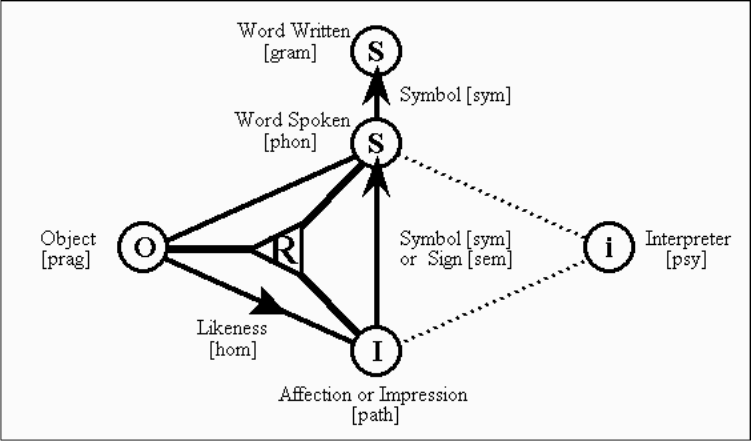
The “triskelion” figure in the previous post shows the bare essentials of an elementary sign relation or individual triple (o, s, i).  There’s a less skeletal figure Susan Awbrey and I used in an earlier paper, where our aim was to articulate the commonalities Peirce’s concept of a sign relation shares with its archetype in Aristotle.

Sign Relation in Aristotle
\text{Figure 1. The Sign Relation in Aristotle}

Here is the corresponding passage from “On Interpretation”.

Words spoken are symbols or signs (symbola) of affections or impressions (pathemata) of the soul (psyche);  written words are the signs of words spoken.  As writing, so also is speech not the same for all races of men.  But the mental affections themselves, of which these words are primarily signs (semeia), are the same for the whole of mankind, as are also the objects (pragmata) of which those affections are representations or likenesses, images, copies (homoiomata).  (De Interp. i. 16a4).

References

  • Awbrey, J.L., and Awbrey, S.M. (1995), “Interpretation as Action : The Risk of Inquiry”, Inquiry : Critical Thinking Across the Disciplines 15(1), 40–52.  ArchiveJournal.  Online (doc) (pdf).
  • Awbrey, S.M., and Awbrey, J.L. (2001), “Conceptual Barriers to Creating Integrative Universities”, Organization : The Interdisciplinary Journal of Organization, Theory, and Society 8(2), Sage Publications, London, UK, 269–284.  AbstractOnline.
  • Awbrey, S.M., and Awbrey, J.L. (September 1999), “Organizations of Learning or Learning Organizations : The Challenge of Creating Integrative Universities for the Next Century”, Second International Conference of the Journal ‘Organization’, Re‑Organizing Knowledge, Trans‑Forming Institutions : Knowing, Knowledge, and the University in the 21st Century, University of Massachusetts, Amherst, MA.  Online.

cc: Conceptual GraphsCyberneticsStructural ModelingSystems Science
cc: FB | SemeioticsMathstodonLaws of Form • Peirce List (1) (2) (3) (4) (5)

Posted in C.S. Peirce, Diagrammatic Reasoning, Interpretive Frameworks, Logic, Logical Graphs, Objective Frameworks, Relation Theory, Semiotics, Sign Relations, Systems of Interpretation, Triadic Relations, Visualization | Tagged , , , , , , , , , , , | 1 Comment

Systems of Interpretation • 2

Re: Peirce ListMike BergmanValentine Daniel

Let’s start as simply as possible.  The following Figure is typical of many I have used to illustrate sign relations from the time I first began studying Peirce’s theory of signs.

Elementary Sign Relation
\text{Figure 2. An Elementary Sign Relation}

The above variant comes from a paper Susan Awbrey and I presented at a conference in 1999, a revised version of which was published in 2001.

As the drafter of that drawing I can speak with authority about the artist’s intentions in drawing it and also about the conventions of interpretation forming the matrix of its conception and delivery.

Just by way of refreshing my own memory, here is how we set it up —

Figure 2 represents an “elementary sign relation”.  It is a single transaction taking place among three entities, the object o, the sign s, and the interpretant sign i, the association of which is typically represented by means of the ordered triple (o, s, i).

One of the interpretive conventions implied in that setup is hallowed by long tradition, going back to the earliest styles of presentation in mathematics.  In it one draws a figure intended as “representative” of many figures.  Regarded as a concrete drawing the figure is naturally imperfect, individual, peculiar, and special but it’s meant to be taken purely as a representative of its class — generic, ideal, and typical.  That is the main convention of interpretation which goes into giving diagrams and figures their significant power.

References

  • Awbrey, S.M., and Awbrey, J.L. (2001), “Conceptual Barriers to Creating Integrative Universities”, Organization : The Interdisciplinary Journal of Organization, Theory, and Society 8(2), Sage Publications, London, UK, 269–284.  AbstractOnline.
  • Awbrey, S.M., and Awbrey, J.L. (September 1999), “Organizations of Learning or Learning Organizations : The Challenge of Creating Integrative Universities for the Next Century”, Second International Conference of the Journal ‘Organization’, Re‑Organizing Knowledge, Trans‑Forming Institutions : Knowing, Knowledge, and the University in the 21st Century, University of Massachusetts, Amherst, MA.  Online.

cc: Conceptual GraphsCyberneticsStructural ModelingSystems Science
cc: FB | SemeioticsMathstodonLaws of Form • Peirce List (1) (2) (3) (4) (5)

Posted in C.S. Peirce, Diagrammatic Reasoning, Interpretive Frameworks, Logic, Logical Graphs, Objective Frameworks, Relation Theory, Semiotics, Sign Relations, Systems of Interpretation, Triadic Relations, Visualization | Tagged , , , , , , , , , , , | 2 Comments

Systems of Interpretation • 1

Re: Peirce ListMike BergmanValentine Daniel

Questions have arisen about the different styles of diagrams and figures used to represent triadic sign relations in Peircean semiotics.  What do they mean?  Which style is best?  Among the most popular pictures some use geometric triangles while others use the three‑pronged graphs Peirce used in his logical graphs to represent triadic relations.

Diagrams and figures, like any signs, can serve to communicate the intended interpretants and thus to coordinate the conduct of interpreters toward the intended objects — but only in communities of interpretation where the conventions of interpretation are understood.  Conventions of interpretation are by comparison far more difficult to communicate.

That brings us to the first question we have to ask about the possibility of communication in this area, namely, what conventions of interpretation are needed to make sense of these diagrams, figures, and graphs?

cc: Conceptual GraphsCyberneticsStructural ModelingSystems Science
cc: FB | SemeioticsMathstodonLaws of Form • Peirce List (1) (2) (3) (4) (5)

Posted in C.S. Peirce, Diagrammatic Reasoning, Interpretive Frameworks, Logic, Logical Graphs, Objective Frameworks, Relation Theory, Semiotics, Sign Relations, Systems of Interpretation, Triadic Relations, Visualization | Tagged , , , , , , , , , , , | 1 Comment

Abduction, Deduction, Induction, Analogy, Inquiry • 22

Cycle of Inquiry • First Two Steps

Re: Peirce ListJerry RheeTom GollierEdwina Taborsky

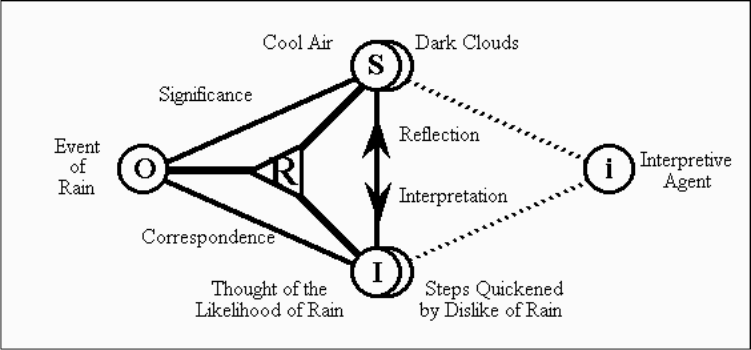
All through 1995 I worked on a graduate project in systems engineering at Oakland University developing my ideas about Inquiry Driven Systems.  I wrote a project report on Peirce’s treatments of analogy and inquiry incorporating a return to Dewey’s Sign of Rain story and I drew what I think is a slightly clearer picture of the logical inferences involved in the abductive and deductive steps.

The above Figure charts the progress of inquiry in Dewey’s Sign of Rain example according to the stages of reasoning identified by Peirce, focusing on the complex or mixed form of inference formed by the first two steps.

  • Step 1 is an Abduction that abstracts a Case from the consideration of a Fact and a Rule.
    • \begin{array}{lll} \texttt{Fact} & : & {C \Rightarrow A}, \end{array}     In the Current situation the Air is cool.

    • \begin{array}{lll} \texttt{Rule} & : & {B \Rightarrow A}, \end{array}     Just Before it rains, the Air is cool.
    • \begin{array}{lll} \texttt{Case} & : & {C \Rightarrow B}, \end{array}     The Current situation is just Before it rains.

  • Step 2 is a Deduction that admits this Case to another Rule and so arrives at a novel Fact.
    • \begin{array}{lll} \texttt{Case} & : & {C \Rightarrow B}, \end{array}     The Current situation is just Before it rains.
    • \begin{array}{lll} \texttt{Rule} & : & {B \Rightarrow D}, \end{array}     Just Before it rains, a Dark cloud will appear.
    • \begin{array}{lll} \texttt{Fact} & : & {C \Rightarrow D}, \end{array}     In the Current situation, a Dark cloud will appear.
What precedes is nowhere near a complete analysis of the Sign of Rain inquiry, even so far as it might be carried out within the constraints of the syllogistic framework, and it covers only the first two steps of the inquiry process, but maybe it will do for a start.

References

cc: Peirce List (1) (2) (3) (4) (5) (6) (7) (8)

Posted in Abduction, Analogy, Aristotle, Artificial Intelligence, C.S. Peirce, Deduction, Induction, Inquiry, Inquiry Driven Systems, Intelligent Systems Engineering, Logic, Mental Models, Peirce, Scientific Method, Semiotics, Systems | Tagged , , , , , , , , , , , , , , , | 14 Comments

Abduction, Deduction, Induction, Analogy, Inquiry • 21

Figure 2. Signs and Inquiry in Dewey

Re: Peirce ListJerry RheeTom GollierEdwina Taborsky

Given a working hypothesis, as abduced in the previous post, the next phase of inquiry uses deductive inference to expand the implied consequences of the abductive hypothesis, with the aim of testing its truth.  For this purpose, our inquirer must think of other things following from the consequent of his precipitate explanation.  Thus, he now reflects on the Case just assumed:

  • Case : {C \Rightarrow B},   The Current situation is just Before it rains.

He looks up to scan the sky, perhaps in a random search for further information, but since the sky is a logical place to look for details of an imminent rainstorm, symbolized in our story by the letter {B}, we may suppose our reasoner has already detached the consequent of the abduced Case, {C \Rightarrow B}, and has begun to expand on its further implications.  So let us imagine our up-looker has a more deliberate purpose in mind and his search for additional data is driven by the new-found, determinate Rule:

  • Rule : {B \Rightarrow D},   Just Before it rains, Dark clouds appear.

Contemplating the assumed Case in combination with this new Rule leads him by an immediate deduction to predict an additional Fact:

  • Fact : {C \Rightarrow D},   In the Current situation Dark clouds appear.

The reconstructed picture of reasoning assembled in this second phase of inquiry is true to the pattern of deductive inference.

References

cc: Peirce List (1) (2) (3) (4) (5) (6) (7) (8)

Posted in Abduction, Analogy, Aristotle, Artificial Intelligence, C.S. Peirce, Deduction, Induction, Inquiry, Inquiry Driven Systems, Intelligent Systems Engineering, Logic, Mental Models, Peirce, Scientific Method, Semiotics, Systems | Tagged , , , , , , , , , , , , , , , | 6 Comments

Abduction, Deduction, Induction, Analogy, Inquiry • 20

Figure 2. Signs and Inquiry in Dewey

Re: Peirce ListJerry RheeTom GollierEdwina Taborsky

In passing from a sign-relational account to a propositional analysis of Dewey’s story there is an old mathematical trick, analogous to the method of adding fractions by expressing them over a common denominator, that comes in handy.

The general idea is that we introduce a new term {C} to denote the Current situation.  In the example at hand, letting {A} be the proposition that the Air is cool, we can express our hero’s initial observation by means of the following premiss:

  • Fact : {C \Rightarrow A},   In the Current situation the Air is cool.

Responding to an intellectual reflex of puzzlement about the situation, his resource of common knowledge about the world is impelled to seize on an approximate Rule:

  • Rule : {B \Rightarrow A},   Just Before it rains, the Air is cool.

This Rule can be recognized as having a potential relevance to the situation because it matches the surprising Fact, {C \Rightarrow A}, in its consequential feature {A}.

All of this suggests that the present Case may be one in which it is just about to rain:

  • Case : {C \Rightarrow B},   The Current situation is just Before it rains.

The whole mental performance, however automatic and semi-conscious it may be, that leads from a problematic Fact and a previously settled knowledge base of Rules to the plausible suggestion of a Case description, is what we are calling an abductive inference.

The above is the first part of a “Zeroth Order” logical analysis of Dewey’s Sign of Rain story that I’ve posted a number of times around the web.  The rest of the analysis can be found at the following location.

Reference

cc: Peirce List (1) (2) (3) (4) (5) (6) (7) (8)

Posted in Abduction, Analogy, Aristotle, Artificial Intelligence, C.S. Peirce, Deduction, Induction, Inquiry, Inquiry Driven Systems, Intelligent Systems Engineering, Logic, Mental Models, Peirce, Scientific Method, Semiotics, Systems | Tagged , , , , , , , , , , , , , , , | 7 Comments
