Pragmatic Maxims • 4

Re: Peirce List • (1)(2)

I haven’t been able to do more than randomly sample the doings on the Peirce List for the last half year, being deeply immersed in other Peirce work that I hope to report on one of these days, but Jon Alan Schmidt’s remarks on the Pragmatic Maxim drew me back in for a bit.  He recited one of the places where Peirce declares the role of the Pragmatic Maxim in giving a rule to abduction, a point often missed by many of the most careful commentators.  There are aspects of the Pragmatic Maxim that come more naturally to engineers, workers in the applied sciences, therapeutic professions, and other practical categories than they do to specialists in spectator philosophies.

But I have lost track of that direction for the moment.  No doubt the occasion will arise again …

Reference

Posted in C.S. Peirce, Inquiry, Logic, Method, Peirce, Philosophy, Pragmatic Maxim, Pragmatism, References, Sources | Tagged , , , , , , , , , | Leave a comment

Pragmatic Maxims • 3

Re: Peirce ListJerry Rhee

Inquiry begins in doubt and aims for belief but the rush to get from doubt to belief and achieve mental peace can cause us to short the integrated circuits of inquiry that we need to compute better answers.

For one thing, we sometimes operate under the influence of fixed ideas and hidden assumptions that keep us from seeing the sense of fairly plain advice, and here I would simply recommend reading those versions of the Pragmatic Maxim again and again and trying to triangulate the points to which they point.

For another thing, not everything in logic is an argument.  A well-developed formal system will have:  (1) Primitives, the undefined terms that acquire meaning from their place in the whole system rather than from explicit definitions, (2) Definitions, that connect derived terms to primitives, (3) Axioms, propositions taken to be true for the sake of the theorems that can be derived from them by means of certain (4) Inference Rules.

But that’s just the formal underpinnings — there’s all sorts of informal heuristics, regulative principles, rules of thumb that go toward sustaining any system of significant practical use, and that’s where bits of practical advice like the Maxim in question come into play.

Reference

Posted in C.S. Peirce, Inquiry, Logic, Method, Peirce, Philosophy, Pragmatic Maxim, Pragmatism, References, Sources | Tagged , , , , , , , , , | 1 Comment

Pragmatic Maxims • 2

Re: Peirce ListJerry Rhee

I tend to think more in relative terms than absolute terms, so I would not expect to find an absolute best formulation of any core principle in philosophy, science, or even math.  But taken relative to specific interpreters and objectives we frequently find that symbolic expressions of meaningful principles can be improved almost indefinitely.

Reference

Posted in C.S. Peirce, Inquiry, Logic, Method, Peirce, Philosophy, Pragmatic Maxim, Pragmatism, References, Sources | Tagged , , , , , , , , , | Leave a comment

Pragmatic Maxims • 1

Re: Peirce List

Here is a set of variations on the Pragmatic Maxim that I collected a number of years ago, along with some commentary of my own as I last left it.  As I understand them, they all say essentially the same thing, merely differing in emphasis, point of view, or rhetorical style as befit the moment’s audience or occasion.

Posted in C.S. Peirce, Inquiry, Logic, Method, Peirce, Philosophy, Pragmatic Maxim, Pragmatism, References, Sources | Tagged , , , , , , , , , | Leave a comment

{ Information = Comprehension × Extension } • Comment 6

Note.  This is a placeholder, to be developed later.

Figure 2 shows the implication ordering of logical terms in the form of a lattice diagram.

Figure 2. Disjunctive Term u, Taken as Subject

Figure 2. Disjunctive Term u, Taken as Subject

Reference

  • Peirce, C.S. (1866), “The Logic of Science, or, Induction and Hypothesis”, Lowell Lectures of 1866, pp. 357–504 in Writings of Charles S. Peirce : A Chronological Edition, Volume 1, 1857–1866, Peirce Edition Project, Indiana University Press, Bloomington, IN, 1982.

Resources

Posted in Abduction, Belief Fixation, C.S. Peirce, Comprehension, Deduction, Extension, Hypothesis, Icon Index Symbol, Induction, Inference, Information, Information = Comprehension × Extension, Inquiry, Intension, Logic, Logic of Science, Peirce, Peirce's Categories, Pragmatism, Scientific Method, Semiotic Information, Semiotics, Sign Relations | Tagged , , , , , , , , , , , , , , , , , , , , , , | 12 Comments

{ Information = Comprehension × Extension } • Comment 5

Let’s stay with Peirce’s example of abductive inference a little longer and try to clear up the more troublesome confusions tending to arise.

Figure 1 shows the implication ordering of logical terms in the form of a lattice diagram.

Figure 1. Conjunctive Term z, Taken as Predicate

Figure 1. Conjunctive Term z, Taken as Predicate

One thing needs to be stressed at this point.  It is important to recognize the conjunctive term itself — namely, the syntactic string “spherical bright fragrant juicy tropical fruit” — is not an icon but a symbol.  It has its place in a formal system of symbols, for example, a propositional calculus, where it would normally be interpreted as a logical conjunction of six elementary propositions, denoting anything in the universe of discourse having all six of the corresponding properties.  The symbol denotes objects which may be taken as icons of oranges by virtue of bearing those six properties.  But there are no objects denoted by the symbol which aren’t already oranges themselves.  Thus we observe a natural reduction in the denotation of the symbol, consisting in the absence of cases outside of oranges that have all the properties indicated.

The above analysis provides another way to understand the abductive inference from the Fact x \Rightarrow z and the Rule y \Rightarrow z to the Case x \Rightarrow y.  The lack of any cases which are z and not y is expressed by the implication z \Rightarrow y.  Taking this together with the Rule y \Rightarrow z gives the logical equivalence y = z.  But this reduces the Case x \Rightarrow y to the Fact x \Rightarrow z and so the Case is justified.

Viewed in the light of the above analysis, Peirce’s example of abductive reasoning exhibits an especially strong form of inference, almost deductive in character.  Do all abductive arguments take this form, or may there be weaker styles of abductive reasoning which enjoy their own levels of plausibility?  That must remain an open question at this point.

Reference

  • Peirce, C.S. (1866), “The Logic of Science, or, Induction and Hypothesis”, Lowell Lectures of 1866, pp. 357–504 in Writings of Charles S. Peirce : A Chronological Edition, Volume 1, 1857–1866, Peirce Edition Project, Indiana University Press, Bloomington, IN, 1982.

Resources

Posted in Abduction, Belief Fixation, C.S. Peirce, Comprehension, Deduction, Extension, Hypothesis, Icon Index Symbol, Induction, Inference, Information, Information = Comprehension × Extension, Inquiry, Intension, Logic, Logic of Science, Peirce, Peirce's Categories, Pragmatism, Scientific Method, Semiotic Information, Semiotics, Sign Relations | Tagged , , , , , , , , , , , , , , , , , , , , , , | 10 Comments

So Many Modes Of Mathematical Thought

So many modes of mathematical thought,
So many are learned, so few are taught.
There are streams that flow beneath the sea,
There are waves that crash upon the strand,
Lateral thoughts that spread and meander —
Who knows what springs run under the sand?

Posted in Anthem, Mantra, Mathematics, Meditation, Poetry, Verse | Tagged , , , , , | Leave a comment

{ Information = Comprehension × Extension } • Comment 4

Many things still puzzle me about Peirce’s account at this point.  I indicated a few of them by means of question marks at several places in the last two Figures.  There is nothing for it but returning to the text and trying once more to follow the reasoning.

Let’s go back to Peirce’s example of abductive inference and try to get a clearer picture of why he connects it with conjunctive terms and iconic signs.

Figure 1 shows the implication ordering of logical terms in the form of a lattice diagram.

Figure 1. Conjunctive Term z, Taken as Predicate

Figure 1. Conjunctive Term z, Taken as Predicate

The relationship between conjunctive terms and iconic signs may be understood as follows.  If there is anything having all the properties described by the conjunctive term — spherical bright fragrant juicy tropical fruit — then sign users may use that thing as an icon of an orange, precisely by virtue of the fact it shares those properties with an orange.  But the only natural examples of things with all those properties are oranges themselves, so the only thing able to serve as a natural icon of an orange by virtue of those properties is that orange itself or another orange.

Reference

  • Peirce, C.S. (1866), “The Logic of Science, or, Induction and Hypothesis”, Lowell Lectures of 1866, pp. 357–504 in Writings of Charles S. Peirce : A Chronological Edition, Volume 1, 1857–1866, Peirce Edition Project, Indiana University Press, Bloomington, IN, 1982.

Resources

Posted in Abduction, Belief Fixation, C.S. Peirce, Comprehension, Deduction, Extension, Hypothesis, Icon Index Symbol, Induction, Inference, Information, Information = Comprehension × Extension, Inquiry, Intension, Logic, Logic of Science, Peirce, Peirce's Categories, Pragmatism, Scientific Method, Semiotic Information, Semiotics, Sign Relations | Tagged , , , , , , , , , , , , , , , , , , , , , , | 11 Comments

Iconoclast

Things thrown out from a center
Cooling signs of a central fire
Expiring cinders of life within
Sent from a star to start again
Posted in Anthem, Mantra, Meditation, Poetry, Semiotics, Verse | Tagged , , , , , | Leave a comment

{ Information = Comprehension × Extension } • Comment 3

Peirce identifies inference with a process he describes as symbolization.  Let us consider what that might imply.

I am going, next, to show that inference is symbolization and that the puzzle of the validity of scientific inference lies merely in this superfluous comprehension and is therefore entirely removed by a consideration of the laws of information(467).

Even if it were only a weaker analogy between inference and symbolization, a principle of logical continuity — what in physics is called a correspondence principle — would suggest parallels between steps of reasoning in the neighborhood of exact inferences and signs in the vicinity of genuine symbols.  This would lead us to expect a correspondence between degrees of inference and degrees of symbolization that extends from exact to approximate or non-demonstrative inferences and from genuine to approximate or degenerate symbols.

For this purpose, I must call your attention to the differences there are in the manner in which different representations stand for their objects.

In the first place there are likenesses or copies — such as statues, pictures, emblems, hieroglyphics, and the like.  Such representations stand for their objects only so far as they have an actual resemblance to them — that is agree with them in some characters.  The peculiarity of such representations is that they do not determine their objects — they stand for anything more or less;  for they stand for whatever they resemble and they resemble everything more or less.

The second kind of representations are such as are set up by a convention of men or a decree of God.  Such are tallies, proper names, &c.  The peculiarity of these conventional signs is that they represent no character of their objects.

Likenesses denote nothing in particular;  conventional signs connote nothing in particular.

The third and last kind of representations are symbols or general representations.  They connote attributes and so connote them as to determine what they denote.  To this class belong all words and all conceptions.  Most combinations of words are also symbols.  A proposition, an argument, even a whole book may be, and should be, a single symbol.  (467–468).

In addition to Aristotle, the influence of Kant on Peirce is very strongly marked in these earliest expositions.  The invocations of “conceptions of the understanding”, the “use of concepts” and thus of symbols in reducing the manifold of extension, and the not so subtle hint of the synthetic à priori in Peirce’s discussion, not only of natural kinds but also of the kinds of signs leading up to genuine symbols, can all be recognized as pervasive Kantian themes.

In order to draw out these themes and see how Peirce was led to develop their leading ideas, let us bring together our previous Figures, abstracting from their concrete details, and see if we can figure out what is going on here.

Figure 3 shows an abductive step of inquiry, as taken on the cue of an iconic sign.
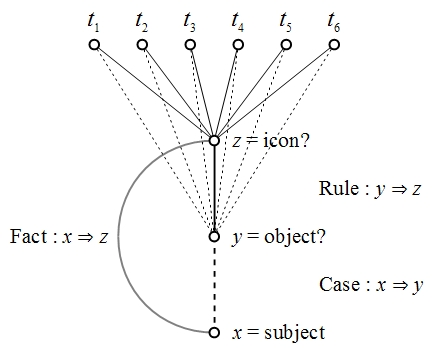
Figure 3. Conjunctive Predicate z, Abduction of Case x ⇒ y

Figure 3. Conjunctive Predicate z, Abduction of Case xy

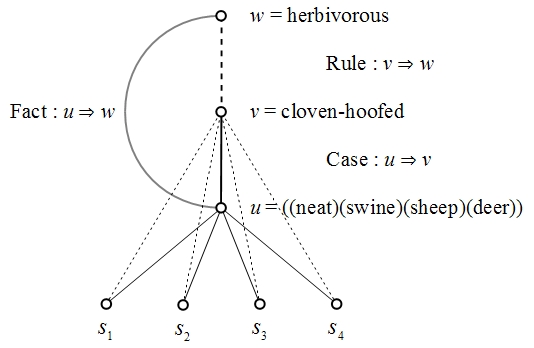
Figure 4 shows an inductive step of inquiry, as taken on the cue of an indicial sign.
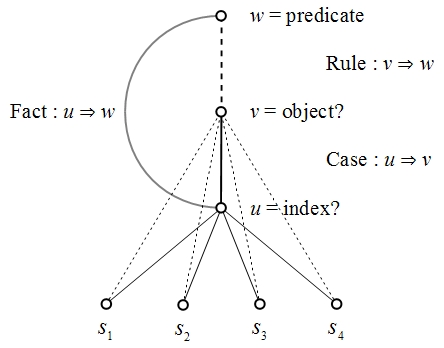
Figure 4. Disjunctive Subject u, Induction of Rule v ⇒ w

Figure 4. Disjunctive Subject u, Induction of Rule vw

To be continued …

Reference

  • Peirce, C.S. (1866), “The Logic of Science, or, Induction and Hypothesis”, Lowell Lectures of 1866, pp. 357–504 in Writings of Charles S. Peirce : A Chronological Edition, Volume 1, 1857–1866, Peirce Edition Project, Indiana University Press, Bloomington, IN, 1982.

Resources

Posted in Abduction, Belief Fixation, C.S. Peirce, Comprehension, Deduction, Extension, Hypothesis, Icon Index Symbol, Induction, Inference, Information, Information = Comprehension × Extension, Inquiry, Intension, Logic, Logic of Science, Peirce, Peirce's Categories, Pragmatism, Scientific Method, Semiotic Information, Semiotics, Sign Relations | Tagged , , , , , , , , , , , , , , , , , , , , , , | 12 Comments