Sign Relations • Comment 4

Re: John CorcoranSemiotic TriangleMy Comment

The following passage is very instructive on several points, illuminating especially the relationship between interpreters (sign‑using agents) and interpretant signs.

We are all, then, sufficiently familiar with the fact that many words have much implication;  but I think we need to reflect upon the circumstance that every word implies some proposition or, what is the same thing, every word, concept, symbol has an equivalent term — or one which has become identified with it, — in short, has an interpretant.

Consider, what a word or symbol is;  it is a sort of representation.  Now a representation is something which stands for something.  I will not undertake to analyze, this evening, this conception of standing for something — but, it is sufficiently plain that it involves the standing to something for something.  A thing cannot stand for something without standing to something for that something.  Now, what is this that a word stands to?  Is it a person?

We usually say that the word homme stands to a Frenchman for man.  It would be a little more precise to say that it stands to the Frenchman’s mind — to his memory.  It is still more accurate to say that it addresses a particular remembrance or image in that memory.  And what image, what remembrance?  Plainly, the one which is the mental equivalent of the word homme — in short, its interpretant.  Whatever a word addresses then or stands to, is its interpretant or identified symbol.  Conversely, every interpretant is addressed by the word;  for were it not so, did it not as it were overhear what the word says, how could it interpret what it says.

There are doubtless some who cannot understand this metaphorical argument.  I wish to show that the relation of a word to that which it addresses is the same as its relation to its equivalent or identified terms.  For that purpose, I first show that whatever a word addresses is an equivalent term, — its mental equivalent.  I next show that, since the intelligent reception of a term is the being addressed by that term, and since the explication of a term’s implication is the intelligent reception of that term, that the interpretant or equivalent of a term which as we have already seen explicates the implication of a term is addressed by the term.

The interpretant of a term, then, and that which it stands to are identical.  Hence, since it is of the very essence of a symbol that it should stand to something, every symbol — every word and every conception — must have an interpretant — or what is the same thing, must have information or implication.

(Peirce 1866, Lowell Lecture 7, CE 1, 466–467).

My study of Peirce’s information formula, “Information = Comprehension × Extension”, provides a measure of context for the above passage.

There’s additional discussion in the following article and section.

Reference

  • Peirce, C.S. (1866), “The Logic of Science, or, Induction and Hypothesis”, Lowell Lectures of 1866, pp. 357–504 in Writings of Charles S. Peirce : A Chronological Edition, Volume 1, 1857–1866, Peirce Edition Project, Indiana University Press, Bloomington, IN, 1982.

Resources

Posted in C.S. Peirce, Inquiry, Logic of Relatives, Peirce, Relation Theory, Semiotics, Sign Relations | Tagged , , , , , , | 17 Comments

Sign Relations • Comment 3

Re: Semiotic TriangleJohn Corcoran

A sign relation L \subseteq O \times S \times I is a formal structure that satisfies a very general definition, on the same order of generality as a mathematical group or geometry.  So any consideration of what a particular sign relation contains will be very context-dependent.

We can study sign relations in the abstract or in connection with particular applications.  In applications, sign relations describe structures of interpretation, for example, the conduct of sign-using interpreters.  Applications divide broadly into descriptive and normative types.

Descriptively, we could be describing the interpretive conduct of someone named “Socrates” who happens to speak English and who uses the word “I” to denote himself.  In that case, we would probably want to include the signs “Socrates” and “I” in both the sign domain and the interpretant domain of the sign relation that we use to describe the usage of that agent.

Posted in C.S. Peirce, Inquiry, Logic of Relatives, Peirce, Relation Theory, Semiotics, Sign Relations | Tagged , , , , , , | 16 Comments

Sign Relations • Comment 2

Re: Semiotic TriangleJohn Corcoran

In a typical sign relation where Socrates belongs to the object domain O, one sign in the sign domain S could be the name “Socrates” and one interpretant in the interpretant domain I could be the name “Socrates”.

Slightly more interesting examples are discussed in the following article and section.

Posted in C.S. Peirce, Inquiry, Logic of Relatives, Peirce, Relation Theory, Semiotics, Sign Relations | Tagged , , , , , , | 17 Comments

Sign Relations • Comment 1

Re: Semiotic TriangleJohn Corcoran

Peirce’s triadic sign relations are sets of ordered triples having the form (o, s, i), where o is the object, s is the sign, and i is the interpretant sign (usually shortened to interpretant).  In other words, a specific sign relation L is a subset of the cartesian product O \times S \times I, where O is the object domain, S is the sign domain, and I is the interpretant domain.

There is more discussion in the following papers.

Posted in C.S. Peirce, Inquiry, Logic of Relatives, Peirce, Relation Theory, Semiotics, Sign Relations | Tagged , , , , , , | 16 Comments

Differential Logic • Comment 3

In my previous comment on boundaries in object universes and venn diagrams, and always when I’m being careful about their mathematical senses, the definitions of “topology” and “boundary” I have in mind can be found in any standard textbook.  Here are links to basic definitions from J.L. Kelley, a veritable classic and my own first brush with the subject.

Excerpts from John L. Kelley, General Topology, Van Nostrand Reinhold, New York, NY, 1955

Posted in Amphecks, Boolean Functions, C.S. Peirce, Cactus Graphs, Computational Complexity, Diagrammatic Reasoning, Differential Analytic Turing Automata, Differential Logic, Discrete Dynamical Systems, Graph Theory, Hill Climbing, Hologrammautomaton, Laws of Form, Logic, Logical Graphs, Mathematics, Minimal Negation Operators, Painted Cacti, Peirce, Propositional Calculus, Propositional Equation Reasoning Systems, Spencer Brown, Visualization | Tagged , , , , , , , , , , , , , , , , , , , , , , | 10 Comments

Differential Logic • Comment 2

As always, we have to distinguish between the diagram itself, the representation or sign inscribed in some medium, and the formal object it represents under a given interpretation.

A venn diagram is an iconic sign we use to represent a formal object, namely, a universe of discourse, by virtue of properties the sign shares with the object.  But it is only the relevant properties that do the job — the icon has many properties the object lacks and the object has many properties the icon lacks.

As far as the universe of discourse goes, its regions do not necessarily have any boundaries defined.  In order to define boundaries for the regions we need to impose a particular topology on the object space.

However, even at the level of abstract logical properties, such as described by a propositional calculus, we can construct a differential extension of the calculus by attaching names to the qualitative changes involved in crossing from regions to their complements, and that is what leads to the simplest order of differential logic.

See the following articles for the basic intuitions.

Resources

Posted in Amphecks, Boolean Functions, C.S. Peirce, Cactus Graphs, Computational Complexity, Diagrammatic Reasoning, Differential Analytic Turing Automata, Differential Logic, Discrete Dynamical Systems, Graph Theory, Hill Climbing, Hologrammautomaton, Laws of Form, Logic, Logical Graphs, Mathematics, Minimal Negation Operators, Painted Cacti, Peirce, Propositional Calculus, Propositional Equation Reasoning Systems, Spencer Brown, Visualization | Tagged , , , , , , , , , , , , , , , , , , , , , , | 12 Comments

Differential Logic • Comment 1

Re: Gil KalaiPivotal Variables

Just a tangential association with respect to logical influence and pivotability.  I have been exploring questions related to pivotal variables (“Differences that Make a Difference” or “Difference In ⟹ Difference Out”) via logical analogues of partial and total differentials.

For example, letting \mathbb{B} = \{ 0, 1 \}, the partial differential operator \partial_{x_i} sends a function f : \mathbb{B}^k \to \mathbb{B} with fiber F = f^{-1}(1) \subseteq \mathbb{B}^k to a function g = \partial_{x_i}f whose fiber G = g^{-1}(1) \subseteq \mathbb{B}^k consists of all the places where a change in the value of x_i makes a change in the value of f.

Resources

Posted in Amphecks, Boolean Functions, C.S. Peirce, Cactus Graphs, Computational Complexity, Differential Analytic Turing Automata, Differential Logic, Discrete Dynamical Systems, Graph Theory, Hill Climbing, Hologrammautomaton, Logic, Logical Graphs, Logical Influence, Mathematics, Minimal Negation Operators, Painted Cacti, Peirce, Pivotal Variables, Propositional Calculus, Propositional Equation Reasoning Systems, Visualization, Zeroth Order Logic | Tagged , , , , , , , , , , , , , , , , , , , , , , | 10 Comments

Peirce’s 1903 Lowell Lectures • Comment 10

Re: Peirce List DiscussionJohn Sowa

JFS:
In the Lowell Lectures [1903] Peirce defined the Sheet of Assertion as the representation of a universe that was constructed during a discourse between Graphist and Grapheus.

But that is just one of many ways of using logic.  In 1911 he wrote about “whatever universe” and “the whole sheet”:

Every word makes an assertion.  Thus  ──man  means “There is a man” in whatever universe the whole sheet refers to.

This is less restrictive than the definition in the Lowell lectures.  For example, it would allow a logician to use a sheet of paper to write a proof by contradiction.  In that case, there would be no universe about which the statements on the paper could be true.

In that case we may say that a sign’s set of denoted objects is empty.  I think this tactic probably goes back to my earliest algebra courses, where our teachers cautioned us to remember that the “solution set” of a formula could be the empty set.  By apt analogy, then, we may well call “a sign’s set of denoted objects” its “denotation set”.  Of course an empty set is a subset of every set, but nothing about this requires the universe of discourse to be empty, much less not to exist.

Resources

Posted in C.S. Peirce, Diagrammatic Reasoning, Graph Theory, Laws of Form, Logic, Logical Graphs, Mathematics, Peirce, Peirce List, Propositional Calculus, Propositional Equation Reasoning Systems, Spencer Brown, Visualization | Tagged , , , , , , , , , , , , | Leave a comment

Peirce’s 1903 Lowell Lectures • Comment 9

Re: Peirce ListJohn Sowa

JFS:
In 1911, Peirce clarified [the] issues by using two distinct terms:  ‘the universe’ and ‘a sheet of paper’.  The sheet is no longer identified with the universe, and there is no reason why one couldn’t or shouldn’t shade a blank area of a sheet.

Extracting the moral John Sowa draws from Peirce, there is a difference between being a universe of discourse and representing a universe of discourse.

  • On the one hand we have an initial universe of discourse X.  This provides the basis for a prospective object domain O to be constructed out of its elements as our description of the universe develops.
  • On the other hand we have the various systems of signs that we use to represent aspects of the universe of discourse X.  These go to make up whatever sign domain S and interpretant domain I are needed for the ongoing discussion and inquiry.

With logic as formal semiotics and semiotics as the study of triadic sign relations, properly understanding how Peirce’s graphical symbol systems manage to represent universes of discourse requires us to consider the larger contexts of triadic sign relations in which they play their role.

Resources

cc: Peirce List

Posted in C.S. Peirce, Diagrammatic Reasoning, Graph Theory, Laws of Form, Logic, Logical Graphs, Mathematics, Peirce, Peirce List, Propositional Calculus, Propositional Equation Reasoning Systems, Spencer Brown, Visualization | Tagged , , , , , , , , , , , , | Leave a comment

Peirce’s 1903 Lowell Lectures • Comment 8

Cf: Laws Of Form DiscussionJA
Re: Laws Of Form DiscussionJB
Re: Peirce List DiscussionJA

Many aspects of Peirce’s alpha graphs can be clarified by seeing how they relate to the corresponding Venn diagrams.

In particular, there is a series of diagrams in this vein that I’ve found to be very illuminating with regard to understanding the properties of logical implications or material conditionals, under whatever name or notation they may be invoked.

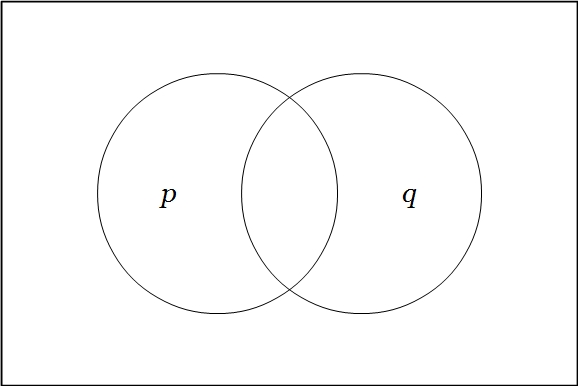
Figure 1 shows the frame of a Venn diagram for two features, predicates, propositions, properties, qualities, variables, or whatever they may be called, signified by the letters {}^{\backprime\backprime} p {}^{\prime\prime} and {}^{\backprime\backprime} q {}^{\prime\prime}, respectively.  The rectangular area represents a set or space X, usually called the universe of discourse, though viewed from the angle of Peircean semiotics it is really just the ground level of a more complex object domain O to be built on its base.
Venn Diagram Two Variables {P Q}

(1)

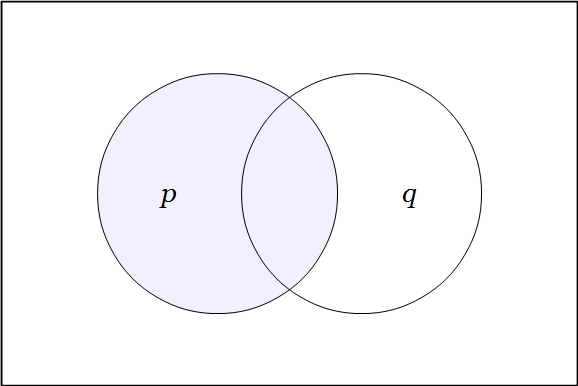
The circular area marked {}^{\backprime\backprime} p {}^{\prime\prime} represents the subset of X that has the property p.  Figure 2 shows this area shaded blue.  We may think of the shading in the diagram as indicating the corresponding subset of the universe, in other words, associating a distinctive value with it.
Venn Diagram Two Variables P

(2)

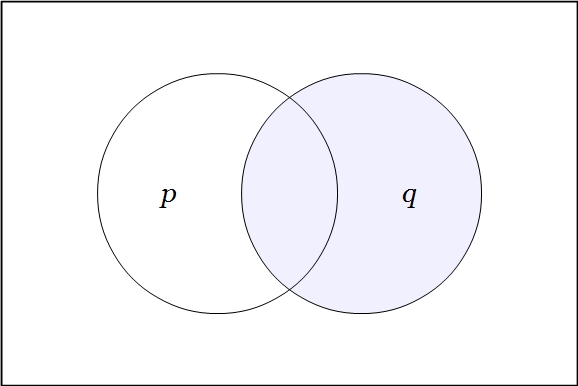
The circular area marked {}^{\backprime\backprime} q {}^{\prime\prime} represents the subset of X that has the property q.  Figure 3 shows this area shaded blue.  We may think of the shading in the diagram as indicating the corresponding subset of the universe, in other words, associating a distinctive value with it.
Venn Diagram Two Variables Q

(3)

The crescent-shaped area shaded blue in Figure 4 represents the subset of X that has the property p but not the property q.  We may think of this as the region where {}^{\backprime\backprime} p ~\text{without}~ q{}^{\prime\prime} is true.  Further, we may interpret either the propositional form {}^{\backprime\backprime} p \texttt{(} q \texttt{)} {}^{\prime\prime} or the corresponding logical graph as indicating the same subset of the universe as the shading in the Venn diagram.
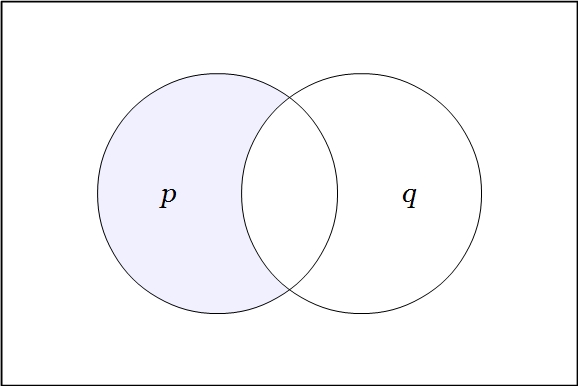
Venn Diagram Two Variables P (Q)

(4)

The shaded area in Figure 5 represents the subset of X that constitutes the set-theoretic complement of the subset represented in Figure 4.  We may think of this as the region where {}^{\backprime\backprime} \text{not}~ p ~\text{without}~ q {}^{\prime\prime} is true.  Finally, we may interpret either the propositional form {}^{\backprime\backprime} \texttt{(} p \texttt{(} q \texttt{))} {}^{\prime\prime} or the corresponding logical graph as indicating the same subset of the universe as the shading in the Venn diagram.
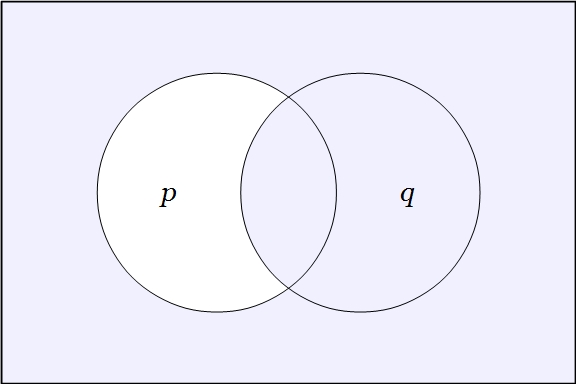
Venn Diagram Two Variables (P (Q)) 1

(5)

So far we are simply describing different regions of the universe X based on the coordinate frame mapped out by the properties p and q.  This amounts to the functional interpretation of the Venn diagrams, propositional formulas, and corresponding logical graphs, each one associating a subset of X with a distinctive logical value, say “true” or “1” or “looky here”, it doesn’t really matter so long as we know the subset it indicates.

But the same Venn diagrams, propositional forms, and logical graphs may be interpreted another way, as bearing information about constraints on the structure of the universe as a whole, specifying what sorts of things, that is, what combinations of properties p and q have or have not existence in it.  This marks an interpretive transition from the functional interpretation to the relational interpretation of all these styles of signs.

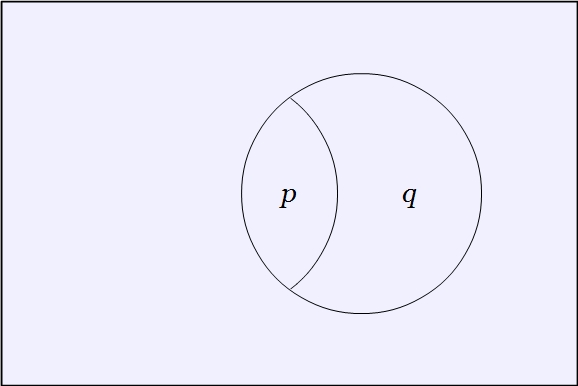
In my mind’s eye I see the rectangular space of the Venn diagram as a soap film suspended in a wire frame, with two circles of thread for the properties p and q, and various regions of soap film tinted with the indicative color.  I see the transformation from Figure 5 to Figure 6 as occurring when a pin pops the untinted space of the first and the region collapses to give the arrangement of extant regions in the final diagram.  This is the sort of diagram we usually draw to indicate a subset relation, in this case showing the set P where p is true being a subset of the set Q where q is true.

Venn Diagram Two Variables (P (Q)) 2

(6)

Reference

Posted in C.S. Peirce, Diagrammatic Reasoning, Graph Theory, Laws of Form, Logic, Logical Graphs, Mathematics, Peirce, Peirce List, Propositional Calculus, Propositional Equation Reasoning Systems, Spencer Brown, Visualization | Tagged , , , , , , , , , , , , | Leave a comment