Sign Relations, Triadic Relations, Relations • 1

To understand how signs work in Peirce’s theory of triadic sign relations, also known as “semiotics”, we have to understand, in order of increasing generality, sign relations, triadic relations, and relations in general, all as conceived in Peirce’s logic of relative terms and the corresponding mathematics of relations.

Toward that understanding, here are versions of articles I long ago contributed to Wikipedia and have more lately developed at a number of other places.

cc: Ontolog ForumPeirce List

Posted in C.S. Peirce, Icon Index Symbol, Knowledge Representation, Logic, Logic of Relatives, Mathematics, Ontology, Peirce, Pragmatism, Relation Theory, Semiosis, Semiotics, Sign Relations, Triadic Relations, Triadicity | Tagged , , , , , , , , , , , , , , | 16 Comments

Theme One • A Program Of Inquiry 15

An unexpected benefit of cleaning out our basement and putting our belongings in storage was finding a trove of work I thought I’d lost, in a stash of 3½ inch floppies, no less.  I uploaded a sample to a couple of folders on Google Drive.

The first contains a minimal set of files for running the program.
The second contains the example files mentioned in the User Guide.

Apologies in advance for Theme One being a bare prototype, a “test of concept” sort of program.  The user interface is pre-mouse and very finicky but I, its mother, was able to nurse it along far enough to learn a lot from it and many are lessons of still timely pertinence to our perennial issues.

cc: Ontolog Forum • Peirce List (1) (2) (3) (4)

Posted in Algorithms, Animata, Artificial Intelligence, Boolean Functions, C.S. Peirce, Cactus Graphs, Cognition, Computation, Constraint Satisfaction Problems, Data Structures, Differential Logic, Equational Inference, Formal Languages, Graph Theory, Inquiry Driven Systems, Laws of Form, Learning Theory, Logic, Logical Graphs, Mathematics, Minimal Negation Operators, Painted Cacti, Peirce, Propositional Calculus, Semiotics, Spencer Brown, Visualization | Tagged , , , , , , , , , , , , , , , , , , , , , , , , , , | 8 Comments

Theme One • A Program Of Inquiry 14

As an alternative to piling generalities on generalities, not that there’s anything wrong with that, it also helps to look at issues as they arise in concrete applications.

One of the most concrete applications I ever attempted was the program I worked on all through the 1980s designed to integrate a basic form of inductive (data‑driven) learning with a fundamental form of deductive (concept‑driven) reasoning.  Having recently begun a fresh attempt to essay all that on my blog I think it might serve our ends to share it here.

cc: Ontolog Forum

Posted in Algorithms, Animata, Artificial Intelligence, Boolean Functions, C.S. Peirce, Cactus Graphs, Cognition, Computation, Constraint Satisfaction Problems, Data Structures, Differential Logic, Equational Inference, Formal Languages, Graph Theory, Inquiry Driven Systems, Laws of Form, Learning Theory, Logic, Logical Graphs, Mathematics, Minimal Negation Operators, Painted Cacti, Peirce, Propositional Calculus, Semiotics, Spencer Brown, Visualization | Tagged , , , , , , , , , , , , , , , , , , , , , , , , , , | 8 Comments

Definition and Determination • 17

Re: Ontolog ForumRichard McCullough

RM:  We clearly have some differences in the “definition” of “definition”.

I suppose it all depends on the sorts of things one wants to define, something we might call the context of application.  I am not as much focused on using an ontology as a large online lexicon as I am on the task of acquiring scientific knowledge, so the sorts of things I need to define are complex systems of relationships, the formal or mathematical models we use as intermediate objects to deal with phenomena and the realities producing those phenomena.

Objects like that, intermediate and ultimate, typically have such high levels of complexity we are forced to approach them in stages, often beginning with “toy worlds” in the classic AI fashion.  Those are the sorts of definitions I am after.  We could call them specifications if it helps to use another word.

Resources

cc: Ontolog Forum

Posted in C.S. Peirce, Comprehension, Constraint, Definition, Determination, Extension, Form, Geometry, Graph Theory, Group Theory, Indication, Information = Comprehension × Extension, Inquiry, Inquiry Driven Systems, Intension, Logic, Logic of Relatives, Logical Graphs, Mathematics, Peirce, Relation Theory, Semiotics, Sign Relations, Topology | Tagged , , , , , , , , , , , , , , , , , , , , , , , | 5 Comments

Definition and Determination • 16

Re: Ontolog ForumRichard McCullough

RM:  What is your view of definitions?

A recurring question, always worth some thought, so I added my earlier comment to a long-running series on my blog concerned with Definition and Determination.

Those two concepts are closely related, almost synonyms in their etymologies, both of them having to do with setting bounds on variation.  And that brings to mind, a cybernetic mind at least, the overarching concept of constraint, which figures heavily in information theory, systems theory, and engineering applications of both.

As it happens, I have been working for as long as I can remember on a project now flying under the banner of “Inquiry Driven Systems” and in the early 90s I returned to grad school in a systems engineering program as a way of focusing more resolutely on the systems aspects of that project.

Here’s a budget of excerpts on Definition and Determination I collected around that time, mostly from C.S. Peirce, since his pragmatic paradigm for thinking about information, inquiry, logic, and signs forms the platform for my efforts, plus a few bits from sources before and after him.

cc: Ontolog Forum

Posted in C.S. Peirce, Comprehension, Constraint, Definition, Determination, Extension, Form, Geometry, Graph Theory, Group Theory, Indication, Information = Comprehension × Extension, Inquiry, Inquiry Driven Systems, Intension, Logic, Logic of Relatives, Logical Graphs, Mathematics, Peirce, Relation Theory, Semiotics, Sign Relations, Topology | Tagged , , , , , , , , , , , , , , , , , , , , , , , | 5 Comments

Definition and Determination • 15

Re: Ontolog ForumRichard McCullough

In some early math course I learned a fourfold scheme of Primitives (undefined terms), Definitions, Axioms, and Inference Rules.  But later excursions tended to run the axioms and definitions together, speaking for example of mathematical objects like geometries, graphs, groups, topologies, etc. ad infinitum as defined by so many axioms.  And later still I learned correspondences between axioms and inference rules that blurred even that line, making the distinction appear more a matter of application and interpretation than set in stone.

In any case, the pervasive theme running through all the variations remains (1) whether the formal system inaugurated by the ritual of choice is a system of consequence or not, (2) whether and how well it determines a category of mathematical objects and, (3) if you bear an applied mind, whether those objects serve the end of understanding that reality which does not cease to press on us.

Resource

cc: Ontolog Forum

Posted in C.S. Peirce, Comprehension, Constraint, Definition, Determination, Extension, Form, Geometry, Graph Theory, Group Theory, Indication, Information = Comprehension × Extension, Inquiry, Inquiry Driven Systems, Intension, Logic, Logic of Relatives, Logical Graphs, Mathematics, Peirce, Relation Theory, Semiotics, Sign Relations, Topology | Tagged , , , , , , , , , , , , , , , , , , , , , , , | 6 Comments

Theme One • A Program Of Inquiry 13

Logical Cacti (cont.)

The abstract character of the cactus language relative to its logical interpretations makes it possible to give abstract rules of equivalence for transforming cacti among themselves and partitioning the space of cacti into formal equivalence classes.  The transformation rules and equivalence classes are “purely formal” in the sense of being indifferent to the logical interpretation, entitative or existential, one happens to choose.

Two definitions are useful here:

  • A reduction is an equivalence transformation which applies in the direction of decreasing graphical complexity.
  • A basic reduction is a reduction which applies to a basic connective, either a node connective or a lobe connective.

The two kinds of basic reductions are described as follows.

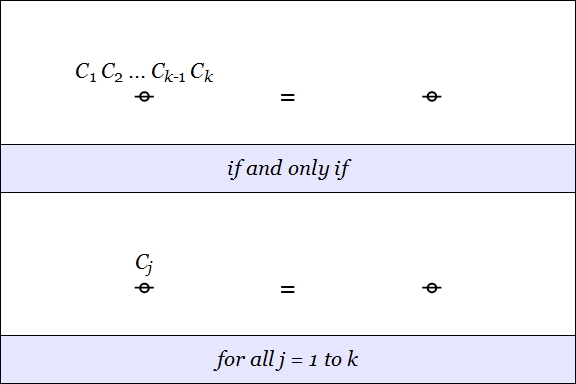
  • A node reduction is permitted if and only if every component cactus joined to a node itself reduces to a node.

Node Reduction

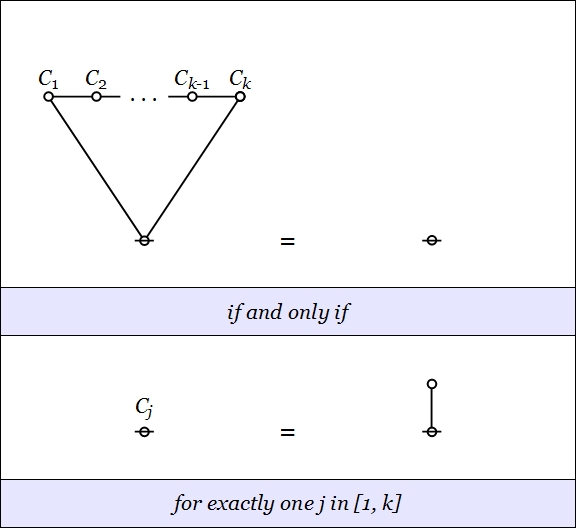
  • A lobe reduction is permitted if and only if exactly one component cactus listed in a lobe reduces to an edge.

Lobe Reduction

That is roughly the gist of the rules.  More formal definitions can wait for the day when we have to explain all this to a computer.

Resources

cc: Peirce List • (1)(2)(3)

Posted in Algorithms, Animata, Artificial Intelligence, Boolean Functions, C.S. Peirce, Cactus Graphs, Cognition, Computation, Constraint Satisfaction Problems, Data Structures, Differential Logic, Equational Inference, Formal Languages, Graph Theory, Inquiry Driven Systems, Laws of Form, Learning Theory, Logic, Logical Graphs, Mathematics, Minimal Negation Operators, Painted Cacti, Peirce, Propositional Calculus, Semiotics, Spencer Brown, Visualization | Tagged , , , , , , , , , , , , , , , , , , , , , , , , , , | 8 Comments

Theme One • A Program Of Inquiry 12

Logical Cacti (cont.)

The main things to take away from the previous post are the following two ideas, one syntactic and one semantic.

  • The compositional structures of cactus graphs and cactus expressions are constructed from two kinds of connective operations.
  • There are two ways of mapping these compositional structures into the compositional structures of propositional sentences.

The two kinds of connective operations are described as follows.

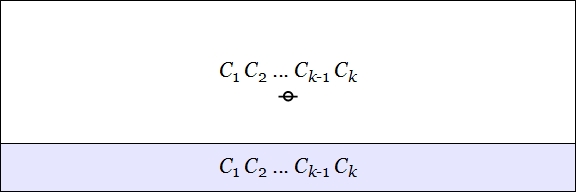
  • The node connective joins a number of component cacti C_1, \ldots, C_k to a node:

Node Connective

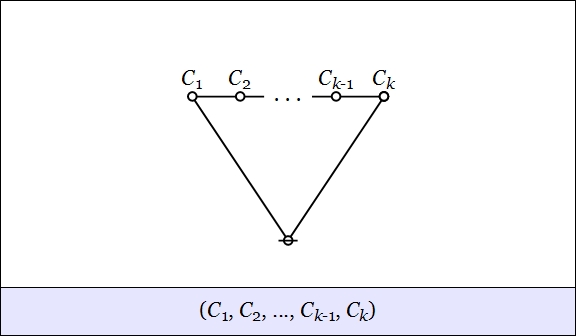
  • The lobe connective joins a number of component cacti C_1, \ldots, C_k to a lobe:

Lobe Connective

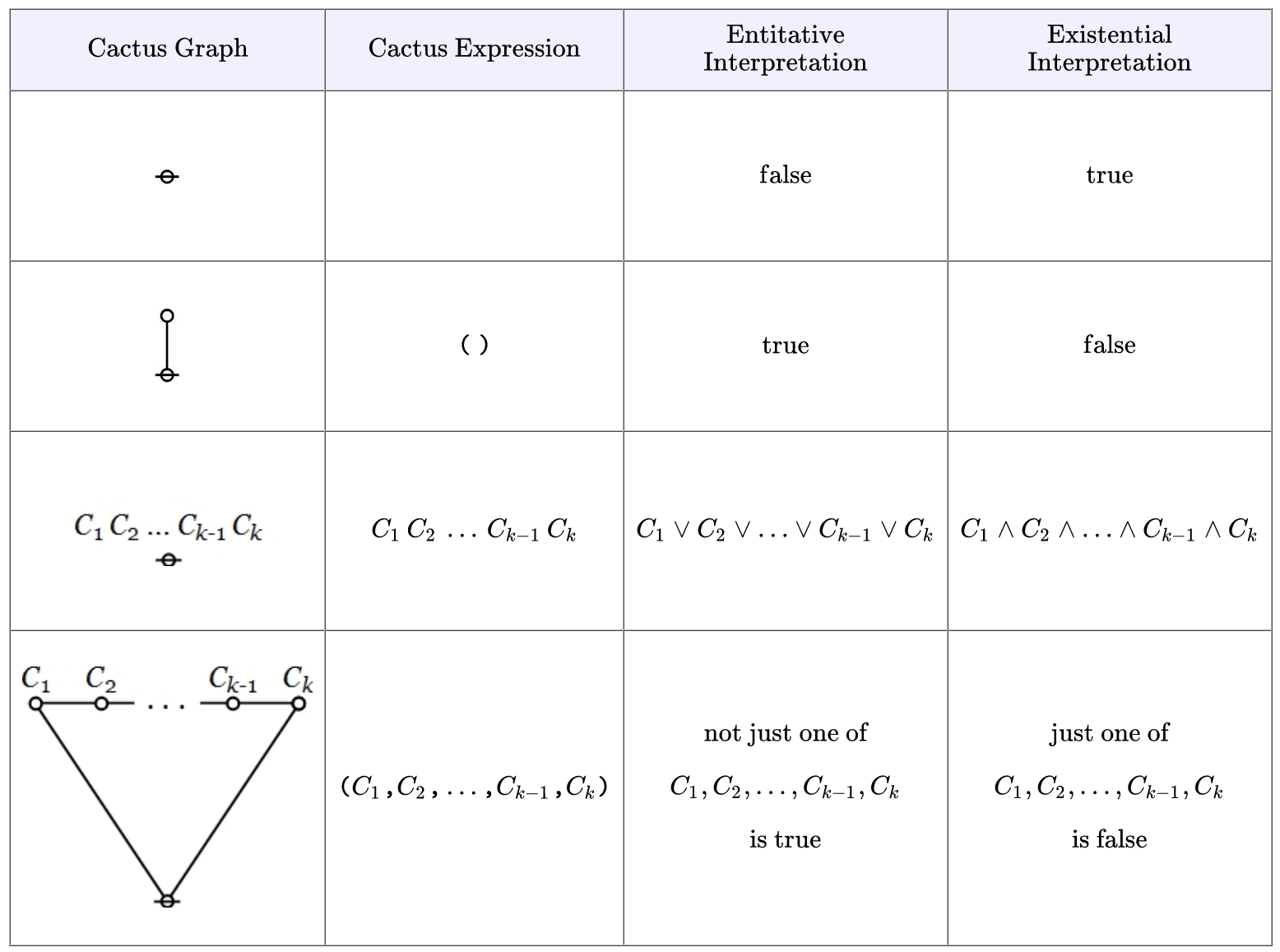
The two ways of mapping cactus structures to logical meanings are summarized in Table 3, which compares the entitative and existential interpretations of the basic cactus structures, in effect, the graphical constants and connectives.

\text{Table 3. Logical Interpretations of Cactus Structures}
Logical Interpretations of Cactus Structures

Resources

cc: Peirce List • (1)(2)(3)

Posted in Algorithms, Animata, Artificial Intelligence, Boolean Functions, C.S. Peirce, Cactus Graphs, Cognition, Computation, Constraint Satisfaction Problems, Data Structures, Differential Logic, Equational Inference, Formal Languages, Graph Theory, Inquiry Driven Systems, Laws of Form, Learning Theory, Logic, Logical Graphs, Mathematics, Minimal Negation Operators, Painted Cacti, Peirce, Propositional Calculus, Semiotics, Spencer Brown, Visualization | Tagged , , , , , , , , , , , , , , , , , , , , , , , , , , | 8 Comments

Theme One • A Program Of Inquiry 11

The portions of exposition just skipped over covered the use of cactus graphs in the program’s learning module to learn sequences of characters called “words” or “strings” and sequences of words called “sentences” or “strands”.  Leaving the matter of grammar to another time we turn to the use of cactus graphs in the program’s reasoning module to represent logical propositions on the order of Peirce’s alpha graphs and Spencer Brown’s calculus of indications.

Logical Cacti

Up till now we’ve been working to hammer out a two-edged sword of syntax, honing the syntax of cactus graphs and cactus expressions and turning it to use in taming the syntax of two-level formal languages.

But the purpose of a logical syntax is to support a logical semantics, which means, for starters, to bear interpretation as sentential signs capable of denoting objective propositions about a universe of objects.

One of the difficulties we face is that the words interpretation, meaning, semantics, and their ilk take on so many different meanings from one moment to the next of their use.  A dedicated neologician might be able to think up distinctive names for all the aspects of meaning and all the approaches to them that concern us, but I will do the best I can with the common lot of ambiguous terms, leaving it to context and intelligent interpreters to sort it out as much as possible.

The formal language of cacti is formed at such a high level of abstraction that its graphs bear at least two distinct interpretations as logical propositions.  The two interpretations concerning us here are descended from the ones C.S. Peirce called the entitative and the existential interpretations of his systems of graphical logics.

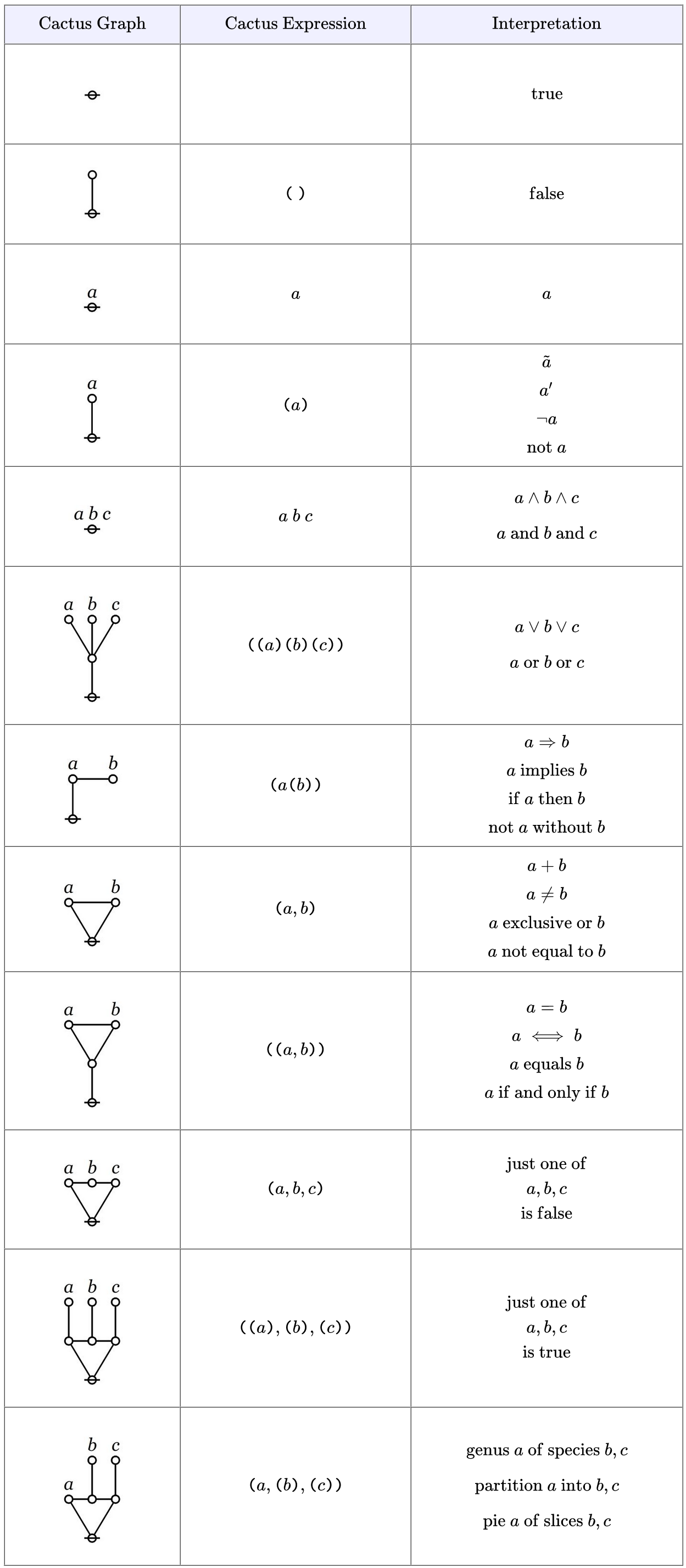
Existential Interpretation

Table 1 illustrates the existential interpretation of cactus graphs and cactus expressions by providing English translations for a few of the most basic and commonly occurring forms.

\text{Table 1. Existential Interpretation}
Existential Interpretation

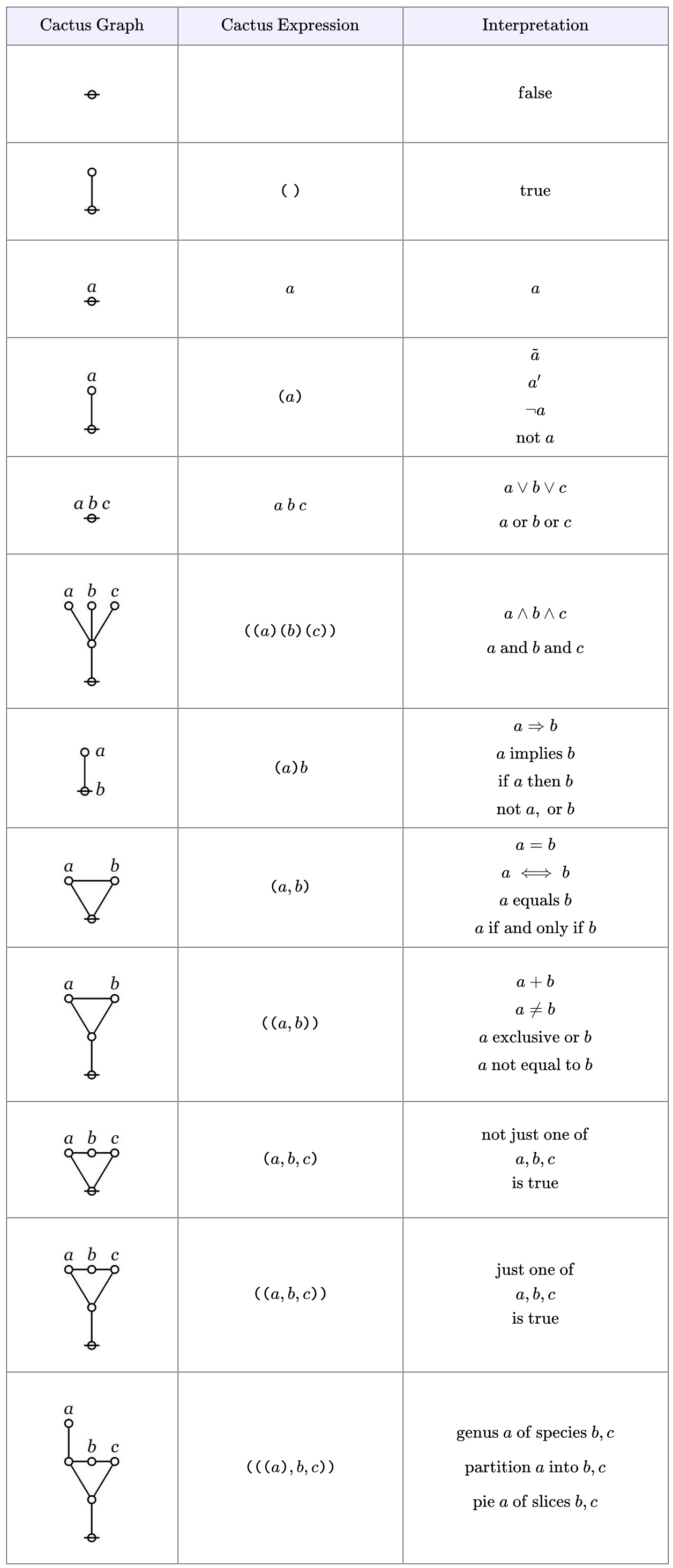
Entitative Interpretation

Table 2 illustrates the entitative interpretation of cactus graphs and cactus expressions by providing English translations for a few of the most basic and commonly occurring forms.

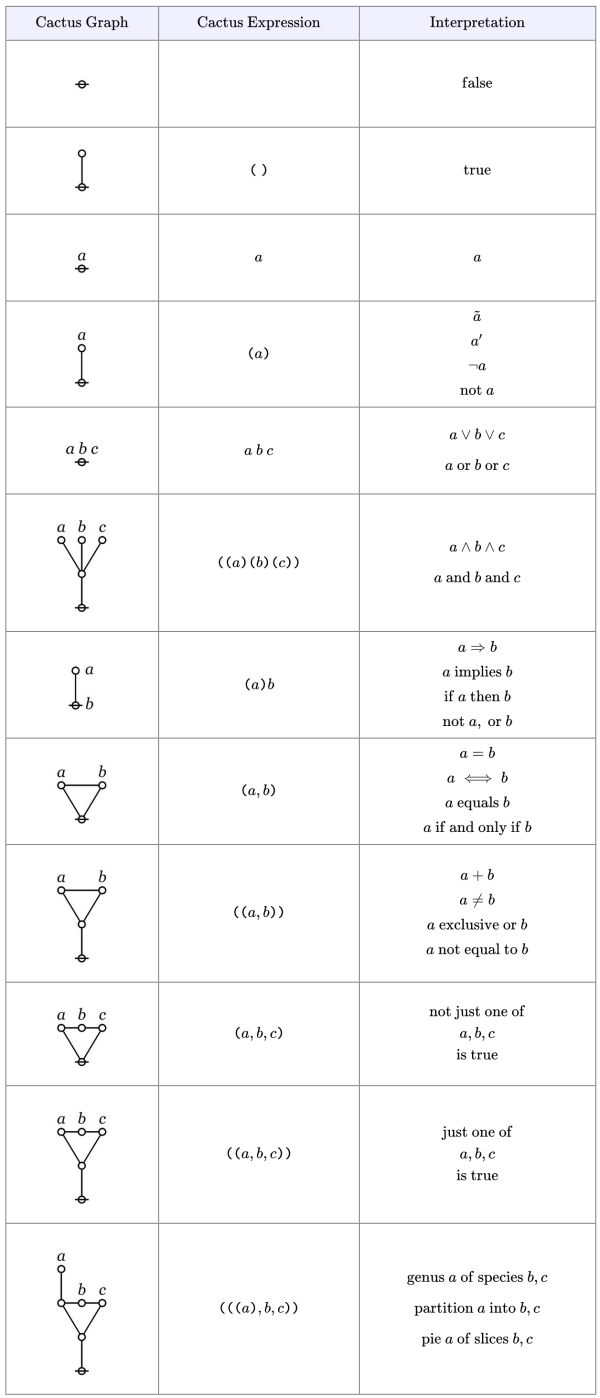
\text{Table 2. Entitative Interpretation}
Entitative Interpretation

Resources

cc: Peirce List • (1)(2)

Posted in Algorithms, Animata, Artificial Intelligence, Boolean Functions, C.S. Peirce, Cactus Graphs, Cognition, Computation, Constraint Satisfaction Problems, Data Structures, Differential Logic, Equational Inference, Formal Languages, Graph Theory, Inquiry Driven Systems, Laws of Form, Learning Theory, Logic, Logical Graphs, Mathematics, Minimal Negation Operators, Painted Cacti, Peirce, Propositional Calculus, Semiotics, Spencer Brown, Visualization | Tagged , , , , , , , , , , , , , , , , , , , , , , , , , , | 12 Comments

Theme One Program • Discussion 1

Re: Laws Of Form • Armahedi Mahzar

AM:  Why do you need XOR in your inquiry system?

Clearly we need a way to represent exclusive disjunction, along with its dual, logical equivalence, in any calculus capable of covering propositional logic, so I assume this is a question about why I chose to represent those two operations more compactly with cactus graphs instead of using trees and defining them in terms of conjunctions and negations.

The generalization from trees to cacti presented itself at the point where multiple lines of problem-solving effort converged.  Some of the problems were conceptual, arising from a desire to include the types of operator-variables Peirce considered.  Other problems were computational, provoked by a need to avoid combinatorial explosions in the evaluation of logical formulas.

But, as I remarked earlier, “the genesis of that generalization is a tale worth telling another time”, after we’ve gotten a better handle on the basic logical issues.

Resources

cc: Cybernetics • Ontolog Forum (1) (2) • Systems Science (1) (2)
cc: Peirce List (12-12) (18-02) (18-03) (20-09) (20-10) (21-10)
cc: FB | Theme One Program • Laws of Form (1) (2)

Posted in Algorithms, Animata, Artificial Intelligence, Boolean Functions, C.S. Peirce, Cactus Graphs, Cognition, Computation, Constraint Satisfaction Problems, Data Structures, Differential Logic, Equational Inference, Formal Languages, Graph Theory, Inquiry Driven Systems, Laws of Form, Learning Theory, Logic, Logical Graphs, Mathematics, Minimal Negation Operators, Painted Cacti, Peirce, Propositional Calculus, Semiotics, Spencer Brown, Visualization | Tagged , , , , , , , , , , , , , , , , , , , , , , , , , , | 6 Comments