
One other feature of syntactic recursion deserves to be brought into higher relief. Evidence of it can be found in the recursion diagram by examining the places where three paths meet. On the descending side there is the point where three paths diverge. On the ascending side there is the point where the middlemost of the three divergent paths joins the upshot arrow in medias res.
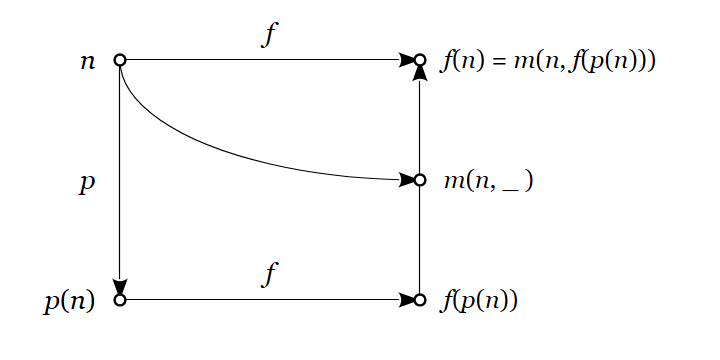
The arrows of the diagram represent functions, a species of dyadic relations, but nodes of degree three signify aspects of triadic relations somewhere in the mix.
- The three arrows from the initial node represent a function
such that
- The three arrows at the penultimate node represent a function
such that


For the sake of a first approach, many questions about triadic relations which might arise at this point can be safely left to later discussions, since the current level of generality is comprehensible enough in functional terms.
Resources
- Inquiry Driven Systems • Inquiry Into Inquiry
- Reflective Interpretive Frameworks
- The Phenomenology of Reflection
- Higher Order Sign Relations
cc: Academia.edu • Cybernetics • Laws of Form • Mathstodon
cc: Research Gate • Structural Modeling • Systems Science • Syscoi


Pingback: Survey of Inquiry Driven Systems • 7 | Inquiry Into Inquiry
Pingback: Survey of Inquiry Driven Systems • 7 | Systems Community of Inquiry