Differential Logic • 12

Transforms Expanded over Ordinary and Differential Variables

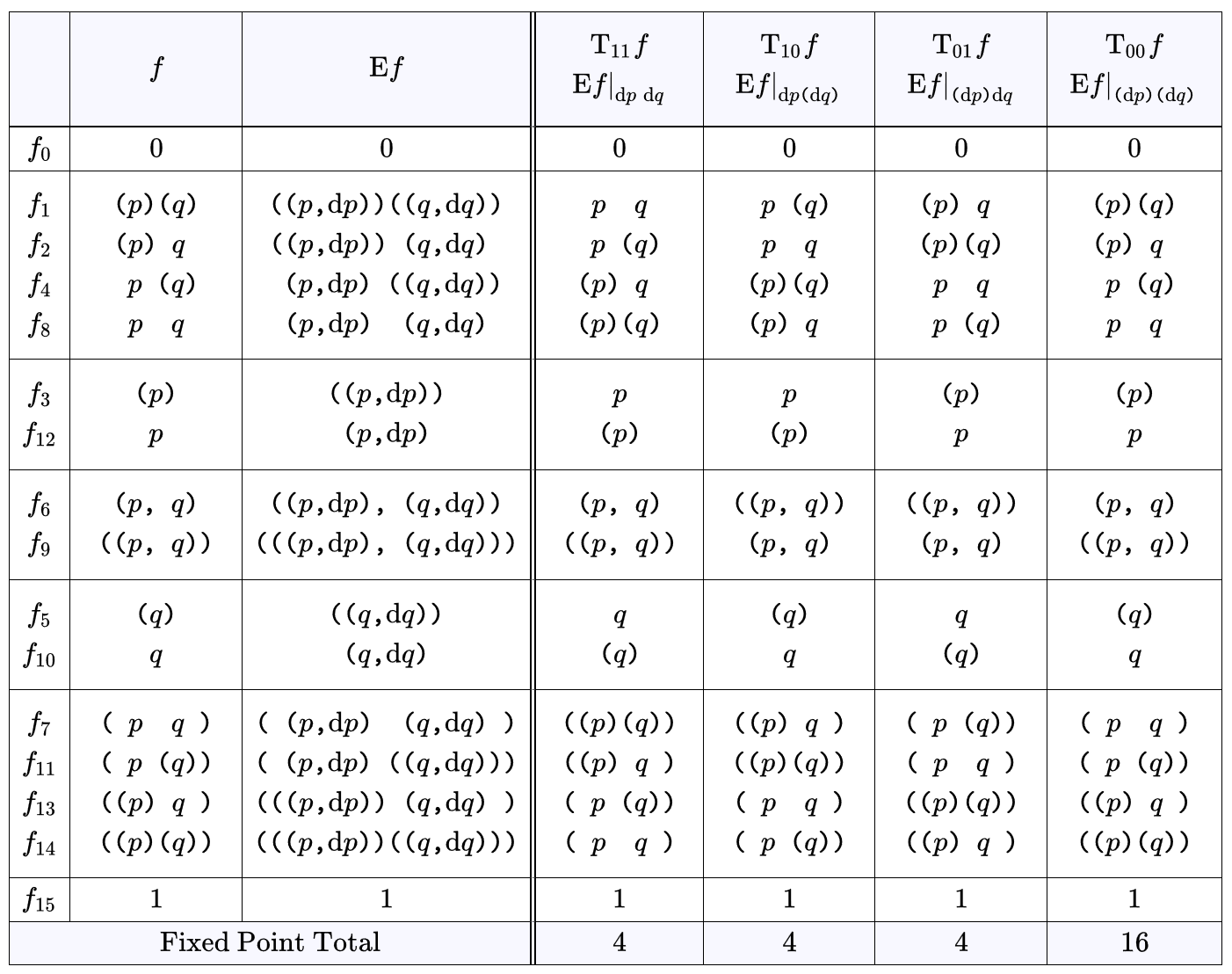
A first view of how the shift operator \mathrm{E} acts on the set of sixteen functions f : \mathbb{B} \times \mathbb{B} \to \mathbb{B} was provided by Table A3 in the previous post, expanding the expressions of \mathrm{E}f over the set \{ p, q \} of ordinary variables.

A complementary view of the same material is provided by Table 4 below, this time expanding the expressions of \mathrm{E}f over the set \{ \mathrm{d}p, \mathrm{d}q \} of differential variables.

Enlargement Map Expanded over Differential Variables

\text{Table A4.}~ \mathrm{E}f ~\text{Expanded over Differential Variables}~ \{ \mathrm{d}p, \mathrm{d}q \}

Ef Expanded over Differential Variables {dp, dq}

Resources

cc: Academia.eduCyberneticsLaws of Form • Mathstodon (1) (2)
cc: Research GateStructural ModelingSystems ScienceSyscoi

This entry was posted in Amphecks, Animata, Boolean Algebra, Boolean Functions, C.S. Peirce, Cactus Graphs, Change, Cybernetics, Differential Calculus, Differential Logic, Discrete Dynamics, Equational Inference, Functional Logic, Gradient Descent, Graph Theory, Inquiry Driven Systems, Logic, Logical Graphs, Mathematics, Minimal Negation Operators, Propositional Calculus, Time, Visualization and tagged , , , , , , , , , , , , , , , , , , , , , , . Bookmark the permalink.

1 Response to Differential Logic • 12

  1. Pingback: Survey of Differential Logic • 8 | Inquiry Into Inquiry

Leave a comment

This site uses Akismet to reduce spam. Learn how your comment data is processed.