Animated Logical Graphs • 58

Re: Laws of FormLyle Anderson
Re: Brading, K., Castellani, E., and Teh, N., (2017), “Symmetry and Symmetry Breaking”, The Stanford Encyclopedia of Philosophy (Winter 2017), Edward N. Zalta (ed.).  Online.

Dear Lyle,

Thanks for the link to the article on symmetry and symmetry breaking.  I did once take a Master’s in Mathematics, specializing in combinatorics, graph theory, and group theory.  When it comes to the bearing of symmetry groups on logical graphs and the calculus of indications, it will take careful attention to the details of the relationship between the two interpretations singled out by Peirce and Spencer Brown.

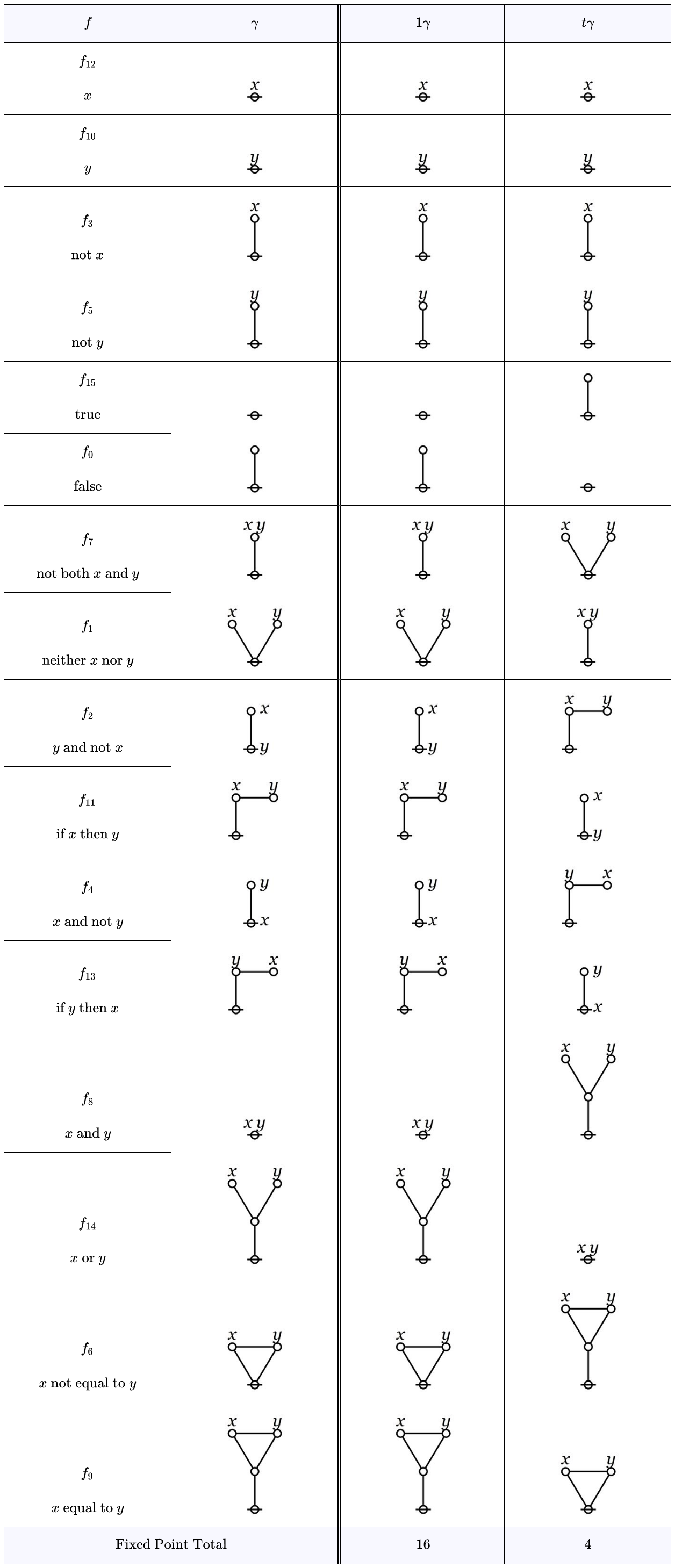
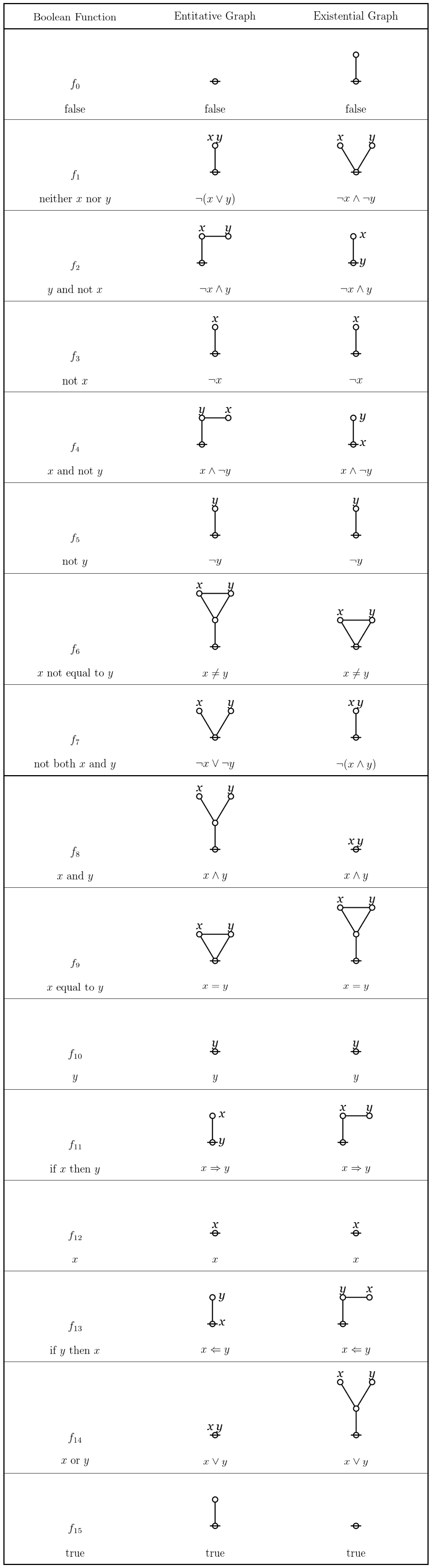
Both Peirce and Spencer Brown recognized the relevant duality, if they differed in what they found most convenient to use in their development and exposition, and most of us will emphasize one interpretation or the other as a matter of taste or facility in a chosen application, so it requires a bit of effort to keep the underlying unity in focus.  I recently made another try at taking a more balanced view, drawing up a series of tables in parallel columns the way one commonly does with dual theorems in projective geometry, so I will shortly share more of that work.

Resources

cc: Cybernetics (1) (2)Laws of FormFB | Logical Graphs • Ontolog Forum (1) (2)
• Peirce List (1) (2) (3) (4) (5) (6) (7) (8) (9) (10) (11) (12) • Structural Modeling (1) (2)
• Systems Science (1) (2)

Posted in Amphecks, Animata, Boolean Algebra, Boolean Functions, C.S. Peirce, Cactus Graphs, Constraint Satisfaction Problems, Deduction, Diagrammatic Reasoning, Duality, Equational Inference, Graph Theory, Laws of Form, Logic, Logical Graphs, Mathematics, Minimal Negation Operators, Model Theory, Painted Cacti, Peirce, Proof Theory, Propositional Calculus, Propositional Equation Reasoning Systems, Spencer Brown, Theorem Proving, Visualization | Tagged , , , , , , , , , , , , , , , , , , , , , , , , , | 21 Comments

Animated Logical Graphs • 57

All other sciences without exception depend upon the principles of mathematics;  and mathematics borrows nothing from them but hints.

C.S. Peirce • “Logic of Number”

A principal intention of this essay is to separate what are known as algebras of logic from the subject of logic, and to re-align them with mathematics.

G. Spencer Brown • Laws of Form

The duality between entitative and existential interpretations of logical graphs tells us something important about the relation between logic and mathematics.  It tells us the mathematical forms giving structure to reasoning are deeper and more abstract at once than their logical interpretations.

A formal duality points to a more encompassing unity, founding a calculus of forms whose expressions can be read in alternate ways by switching the meanings assigned to a pair of primitive terms.  Spencer Brown’s mathematical approach to Laws of Form and the whole of Peirce’s work on the mathematics of logic shows both thinkers were deeply aware of this principle.

Peirce explored a variety of dualities in logic which he treated on analogy with the dualities in projective geometry.  This gave rise to formal systems where the initial constants, and thus their geometric and graph-theoretic representations, had no uniquely fixed meanings but could be given dual interpretations in logic.

It was in this context that Peirce’s systems of logical graphs developed, issuing in dual interpretations of the same formal axioms which Peirce referred to as entitative graphs and existential graphs, respectively.  He developed only the existential interpretation to any great extent, since the extension from propositional to relational calculus appeared more natural in that case, but whether there is any logical or mathematical reason for the symmetry to break at that point is a good question for further research.

Resources

References

  • Peirce, C.S., [Logic of Number — Le Fevre] (MS 229), in Carolyn Eisele (ed., 1976),
    The New Elements of Mathematics by Charles S. Peirce, vol. 2, 592–595.  Excerpt.
  • Spencer Brown, G. (1969), Laws of Form, George Allen and Unwin, London, UK.

cc: Cybernetics (1) (2)Laws of FormFB | Logical Graphs • Ontolog Forum (1) (2)
• Peirce List (1) (2) (3) (4) (5) (6) (7) (8) (9) (10) (11) (12) • Structural Modeling (1) (2)
• Systems Science (1) (2)

Posted in Amphecks, Animata, Boolean Algebra, Boolean Functions, C.S. Peirce, Cactus Graphs, Constraint Satisfaction Problems, Deduction, Diagrammatic Reasoning, Duality, Equational Inference, Graph Theory, Laws of Form, Logic, Logical Graphs, Mathematics, Minimal Negation Operators, Model Theory, Painted Cacti, Peirce, Proof Theory, Propositional Calculus, Propositional Equation Reasoning Systems, Spencer Brown, Theorem Proving, Visualization | Tagged , , , , , , , , , , , , , , , , , , , , , , , , , | 23 Comments

Pragmatic Semiotic Information • Discussion 21

Re: FB | Medieval LogicKollbjorn OldtheynEdward Buckner

On the question of which later developments in logic Peirce anticipated, I’ve been more focused on the points where he saw through to features we would not see again until the theories of categories, computation, and information began to make their impact on our conceptions of logic.  I’ll dig up some links along those lines …

Resources

cc: CyberneticsLaws of FormOntolog ForumStructural ModelingSystems Science

Posted in Abduction, Aristotle, C.S. Peirce, Comprehension, Deduction, Definition, Determination, Extension, Hypothesis, Induction, Inference, Information, Information = Comprehension × Extension, Inquiry, Intension, Intention, Logic, Logic of Science, Mathematics, Measurement, Observation, Peirce, Perception, Phenomenology, Physics, Pragmatic Semiotic Information, Pragmatism, Probability, Quantum Mechanics, Scientific Method, Semiotics, Sign Relations | Tagged , , , , , , , , , , , , , , , , , , , , , , , , , , , , , , , | 5 Comments

Animated Logical Graphs • 56

Re: Animated Logical Graphs • 55
Re: Laws of FormWilliam Bricken

WB:

Weird how we’ve been doing this for so many years!  I look forward to what you have to say.  Dunno if you’ve seen this, may be of interest.

We built some stuff similar to logic graphs, we called distinction networks (d-nets), in the deep past.  Here’s some implementation details (1995) for asynchronous d-net computation.  Ran it first on an Intel Hypercube with 16 nodes (ugh, course-grain parallelism — a technical abstract (1987) at “The Losp Parallel Deduction Engine” (PDF)) and eventually migrated to a distributed network architecture in which each node was an independent operating system, more for the convenience of doing VR than for the elegance of fine-grain logic parallelism.

Distinction Networks

Abstract.  Intelligent systems can be modeled by organizationally closed networks of interacting agents.  An interesting step in the evolution from agents to systems of agents is to approach logic itself as a system of autonomous elementary processes called distinctions.  Distinction networks are directed acyclic graphs in which links represent logical implication and nodes are autonomous agents which act in response to changes in their local environment of connectivity.  Asynchronous communication of local decisions produces global computational results without global coordination.  Biological/environmental programming uses environmental semantics, spatial syntax, and boundary transformation to produce strongly parallel logical deduction.

Reference

  • Bricken, W. (July 1995), “Distinction Networks” (PDF).

Dear William,

Thanks for the readings.  Maybe I’ve just got McCulloch on the brain right now but the things I’m reading in several groups lately keep flashing me back to themes from his work.  What you wrote on distinction networks took me back to the beginnings of my interest in AI, especially as approached from logical directions.  There’s a couple of posts on my blog where I made an effort to point up what I regard as critical issues.  I’ll reshare those next and see if I can throw more light on what’s at stake.

cc: Cybernetics (1) (2)Laws of FormFB | Logical Graphs • Ontolog Forum (1) (2)
• Structural Modeling (1) (2) • Systems Science (1) (2)

Posted in Amphecks, Animata, Boolean Algebra, Boolean Functions, C.S. Peirce, Cactus Graphs, Constraint Satisfaction Problems, Deduction, Diagrammatic Reasoning, Duality, Equational Inference, Graph Theory, Laws of Form, Logic, Logical Graphs, Mathematics, Minimal Negation Operators, Model Theory, Painted Cacti, Peirce, Proof Theory, Propositional Calculus, Propositional Equation Reasoning Systems, Spencer Brown, Theorem Proving, Visualization | Tagged , , , , , , , , , , , , , , , , , , , , , , , , , | 7 Comments

Charles Sanders Peirce, George Spencer Brown, and Me • 15

Re: C.S. Peirce, Spencer Brown, and Me • 11
Re: Ontolog ForumMichael DeBellis

MDB:
I’ve just started taking Peirce seriously in the last year or so and some of his more complex ideas still aren’t completely clear to me but here goes:  Has anyone come up with an OWL upper model (i.e., something like the upper models in Cyc and BFO) based on Peirce’s work?  I’ve come to appreciate Peirce as a major figure in the history of logic, information theory, semiotics, etc. but I’ve never quite been able to map his ideas into a logical model in OWL.  I’m not sure if this is because trying to do so isn’t consistent with what Peirce is trying to do or just that I still haven’t grasped his ideas completely.  Or perhaps the subset of FOL that OWL supports isn’t powerful enough to map to Peirce.  At an initial reading it seems like there should be a good fit because (at least as I understand it) one of Peirce’s core ideas of symbols (as opposed to icons or indexes) seems like a perfect fit to the triple model (Subject Predicate Object) that is the foundation (RDF/RDFS) for OWL.  Would like to know your opinions on this.

Dear Michael,

Google still reminds me I spent some time on the RDF-Logic List back around the turn of the millennium (January 2001).  I was especially intrigued by the prospect of using triples as a fundamental data structure.  Now the (subject, verb, object) triples of RDF and the (object, sign, interpretant) triples of Peirce’s semiotics are ostensibly different data types in their concrete descriptions but that may not obstruct integration too much if the triples are defined abstractly enough and implemented polymorphically enough.  As far as I can remember, though, the concrete connotations tended to get in the way of cross-cultural or trans-silo communication at that time.

That is not, however, the largest obstacle to harmonizing the logic of Peirce with the ways of FOL as she is spoke today.  I’ll take that up when I next get a chance …

Regards,

Jon

cc: CyberneticsLaws of FormOntolog ForumStructural ModelingSystems Science

Posted in Abstraction, Amphecks, Analogy, Animata, Boolean Algebra, Boolean Functions, C.S. Peirce, Cactus Graphs, Cybernetics, Deduction, Differential Logic, Duality, Form, Graph Theory, Inquiry, Inquiry Driven Systems, Laws of Form, Logic, Logical Graphs, Mathematics, Minimal Negation Operators, Model Theory, Peirce, Proof Theory, Propositional Calculus, Semiotics, Sign Relational Manifolds, Sign Relations, Spencer Brown, Theorem Proving, Time, Topology | Tagged , , , , , , , , , , , , , , , , , , , , , , , , , , , , , , , | 6 Comments

Charles Sanders Peirce, George Spencer Brown, and Me • 14

Re: C.S. Peirce, Spencer Brown, and Me • 11
Re: Laws of FormDirk Baecker

DB:
Watzlawick’s request for a pragmatic calculus of communication up to now was never appropriately answered.  W. Barnett Pearce and Vernon E. Cronen (Communication, Action, and Meaning : The Creation of Social Realities, 1980) did important studies on this as did Anthony Wilden (System and Structure : Essays in Communication and Exchange, 1972), but we still lack it.

Dear Dirk,

Watzlawick’s request for a pragmatic calculus of communication recalls McCulloch’s earlier question whether the human capacity for insightful learning and reasoning demands a grasp of trans-dyadic relations, or not.

But the problem of insight, or intuition, or invention — call it what you will — we do not understand, although many of us are having a go at it.  […]  Tarski thinks that what we lack is a fertile calculus of relations of more than two relata.  I am inclined to agree with him, and if I were now the age I was in 1917, that is the problem I would tackle.

That process of insight by which a child learns at least one logical particle, neither or not both, when it is given only ostensively — and one must be so learned — is still a little beyond us.  It may perhaps have to wait for a potent logic of triadic relations, but I now doubt it.  (McCulloch, p. 15).

The way I see things today, my motto would be Context Precedes Calculus if I had to sum it up as briefly as possible.  In other words, the first order of business is finding the right context for understanding the phenomena and problems at hand.  As far as the human capacity for conversing with nature and our fellows goes, pragmatic thinkers informed by Peirce would no doubt point to the context of triadic sign relations and declare, “Eureka!  This Must Be The Place.” 

References

  • McCulloch, Warren S. (1961), “What Is a Number that a Man May Know It, and a Man, that He May Know a Number?”, Ninth Alfred Korzybski Memorial Lecture, General Semantics Bulletin, Numbers 26 and 27, pp. 7–18, Institute of General Semantics, Lakeville, CT.  Reprinted in Embodiments of Mind, pp. 1–18.  Online (1) (2).
  • McCulloch, Warren S. (1965), Embodiments of Mind, MIT Press, Cambridge, MA.

cc: CyberneticsLaws of FormOntolog ForumStructural ModelingSystems Science

Posted in Abstraction, Amphecks, Analogy, Animata, Boolean Algebra, Boolean Functions, C.S. Peirce, Cactus Graphs, Cybernetics, Deduction, Differential Logic, Duality, Form, Graph Theory, Inquiry, Inquiry Driven Systems, Laws of Form, Logic, Logical Graphs, Mathematics, Minimal Negation Operators, Model Theory, Peirce, Proof Theory, Propositional Calculus, Semiotics, Sign Relational Manifolds, Sign Relations, Spencer Brown, Theorem Proving, Time, Topology | Tagged , , , , , , , , , , , , , , , , , , , , , , , , , , , , , , , | 6 Comments

Animated Logical Graphs • 55

Re: Laws of FormWilliam Bricken

WB:
Kauffman’s 2001 piece on “Peirce” (title is “The Mathematics of Charles Sanders Peirce” [PDF]) is IMO fundamental to this discussion.
Here’s a brief excerpt from a piece I did in 2005:
“Boundary Logic and Alpha Existential Graphs (AEG)”

4.3  LoF and Alpha Graphs Compared

AEG applies the diagrammatic structure of enclosure specifically to logic. The representations of LoF and AEG are isomorphic, while the systems of transformation rules are remarkably close to being the same.  …

Dear William,

Many thanks for your excerpt.  It highlights many of the most critical points in comparing the systems of Peirce and Spencer Brown so I’ll take up the topic of duality first.  Over the years I’ve always found that to be one of the stickier wickets in the whole field.  I’ll discuss it in my Animated Logical Graphs series as that’s where I’ve recently redoubled my efforts to explain the issue and why it’s important.

Regards,

Jon

cc: Cybernetics (1) (2)Laws of FormFB | Logical Graphs • Ontolog Forum (1) (2)
• Structural Modeling (1) (2) • Systems Science (1) (2)

Posted in Amphecks, Animata, Boolean Algebra, Boolean Functions, C.S. Peirce, Cactus Graphs, Constraint Satisfaction Problems, Deduction, Diagrammatic Reasoning, Duality, Equational Inference, Graph Theory, Laws of Form, Logic, Logical Graphs, Mathematics, Minimal Negation Operators, Model Theory, Painted Cacti, Peirce, Proof Theory, Propositional Calculus, Propositional Equation Reasoning Systems, Spencer Brown, Theorem Proving, Visualization | Tagged , , , , , , , , , , , , , , , , , , , , , , , , , | 9 Comments

Animated Logical Graphs • 54

Re: Peter CameronDoing Research
Re: Gil KalaiChomskian Linguistics

Oneirocritical Interlude

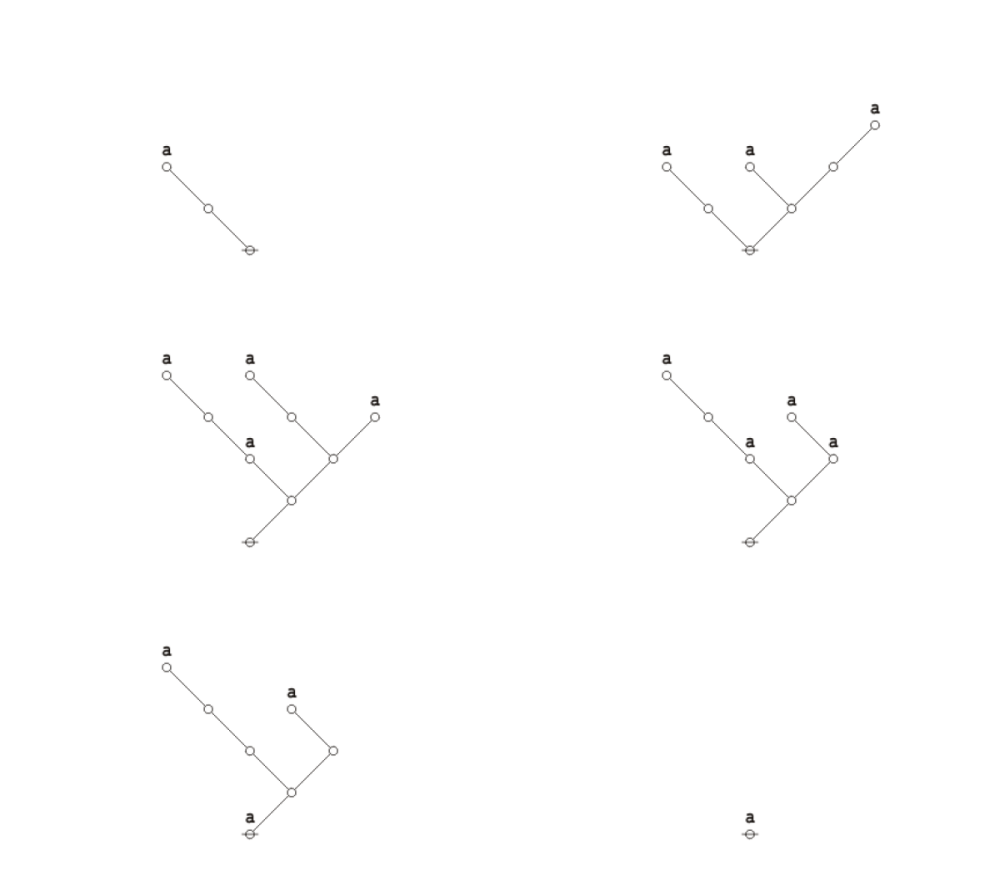
Speaking of dreams, the night before last I had a dream where I was listening to a lecturer and something he said brought to mind a logical formula having the form ``\text{if if if } a, b, c, d", which I visualized as the Peircean logical graph shown below.

If If If

I knew I had seen something the day before prompting that fragment and a search through my browser history turned up Gil Kalai’s post on Chomskian Linguistics where I’d read the phrase “anti anti anti missile missile missile missile”.

cc: Cybernetics (1) (2)Laws of FormFB | Logical Graphs • Ontolog Forum (1) (2)
• Peirce List (1) (2) (3) (4) (5) (6) (7) (8) (9) (10) (11) • Structural Modeling (1) (2)
• Systems Science (1) (2)

Posted in Amphecks, Animata, Boolean Algebra, Boolean Functions, C.S. Peirce, Cactus Graphs, Constraint Satisfaction Problems, Deduction, Diagrammatic Reasoning, Duality, Equational Inference, Graph Theory, Laws of Form, Logic, Logical Graphs, Mathematics, Minimal Negation Operators, Model Theory, Painted Cacti, Peirce, Proof Theory, Propositional Calculus, Propositional Equation Reasoning Systems, Spencer Brown, Theorem Proving, Visualization | Tagged , , , , , , , , , , , , , , , , , , , , , , , , , | 8 Comments

Charles Sanders Peirce, George Spencer Brown, and Me • 13

Re: Laws of FormDirk Baecker

DB:
I guess you know Fernando Zalamea’s work on Peirce.  He thinks that all of GSB’s important ideas are already in Peirce’s Existential Graphs.
I think he may be right, but then there is the issue of elegance, beauty, and clarity, and here, GSB leads the field.

Dear Dirk,

As you may have gleaned from the bio-graphical narrative I’ve been salvaging from the old LoF group, I started down the intertwining Logical Graph / Laws of Form road sometime in the late 60s, all of which took me pretty far along my own eigenvectors before I hit on the work of Zalamea and others of that persuasion in the present millennium.

In most of the things I’ve written in the past about the relative contributions of Peirce and those who came after, Spencer Brown in particular, I tended to give Peirce a lot of credit for anticipating the developments others clarified or brought to fruition.  More lately I’ve observed just how bewildered the untutored reader can become when faced with Peirce’s writings on logical graphs and logic generally, so I’ve been rethinking my apportionment of credit.  At any rate, I commented on what I thought was added by whom all through my bio essay and I will continue doing that as I go.

Regards,

Jon

cc: CyberneticsLaws of FormOntologPeirceStructural ModelingSystems Science

Posted in Abstraction, Amphecks, Analogy, Animata, Boolean Algebra, Boolean Functions, C.S. Peirce, Cactus Graphs, Cybernetics, Deduction, Differential Logic, Duality, Form, Graph Theory, Inquiry, Inquiry Driven Systems, Laws of Form, Logic, Logical Graphs, Mathematics, Minimal Negation Operators, Model Theory, Peirce, Proof Theory, Propositional Calculus, Semiotics, Sign Relational Manifolds, Sign Relations, Spencer Brown, Theorem Proving, Time, Topology | Tagged , , , , , , , , , , , , , , , , , , , , , , , , , , , , , , , | 6 Comments

Charles Sanders Peirce, George Spencer Brown, and Me • 12

Re: Laws of FormDirk Baecker

DB:
Thanks to James Bowery for inviting me to this group.  Maybe it is not exactly what I am looking for, since I am interested in a sociological reading of LoF.  Which means that I am searching for a mathematics more akin to semantics than to physics.  I am still not sure whether in this respect LoF is a wonderful metaphor to understand basic features of an oscillating communication or whether chapter 11 opens up possibilities to compute semantic values starting with imaginary states.

Dear Dirk,

Thanks for this comment and all the links.  I’ve been working along the lines of Peirce’s logical graphs and Spencer Brown’s calculus of indications in parallel since those heady early days of the late 60s and Peirce’s semiotics or theory of triadic sign relations is very much a piece of how I understand both.  In that light I’ll feel encouraged to share bits of that along with my work on LoF — and now everyone knows who to blame!  😉

Regards,

Jon

cc: CyberneticsLaws of FormOntologPeirceStructural ModelingSystems Science

Posted in Abstraction, Amphecks, Analogy, Animata, Boolean Algebra, Boolean Functions, C.S. Peirce, Cactus Graphs, Cybernetics, Deduction, Differential Logic, Duality, Form, Graph Theory, Inquiry, Inquiry Driven Systems, Laws of Form, Logic, Logical Graphs, Mathematics, Minimal Negation Operators, Model Theory, Peirce, Proof Theory, Propositional Calculus, Semiotics, Sign Relational Manifolds, Sign Relations, Spencer Brown, Theorem Proving, Time, Topology | Tagged , , , , , , , , , , , , , , , , , , , , , , , , , , , , , , , | 6 Comments