Relations & Their Relatives • 4

From Dyadic to Triadic to Sign Relations

Peirce’s notation for elementary relatives was illustrated earlier by a dyadic relation from number theory, namely, the relation written ``{i|j}" for ``{i} ~\text{divides}~ {j}".

Cf: Relations & Their Relatives • 3

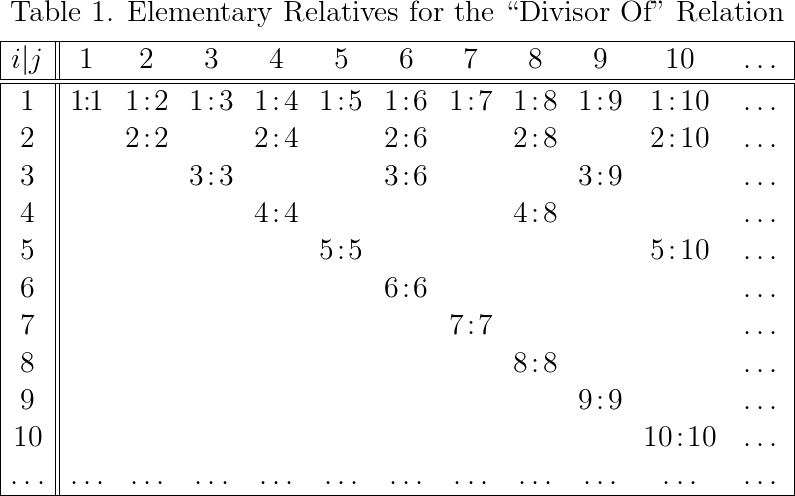
Table 1 shows the first few ordered pairs of the relation on positive integers corresponding to the relative term, “divisor of”.  Thus, the ordered pair {i\!:\!j} appears in the relation if and only if {i} divides {j}, for which the usual mathematical notation is ``{i|j}".

Elementary Relatives for the “Divisor Of” Relation

Table 2 shows the same information in the form of a logical matrix.  This has a coefficient of {1} in row {i} and column {j} when {i|j}, otherwise it has a coefficient of {0}.  (The zero entries have been omitted for ease of reading.)

Logical Matrix for the “Divisor Of” Relation

Just as matrices of real coefficients in linear algebra represent linear transformations, matrices of boolean coefficients represent logical transformations.  The capacity of dyadic relations to generate transformations gives us part of what we need to know about the dynamics of semiosis inherent in sign relations.

Cf: Relations & Their Relatives • Discussion 1

The “divisor of” relation x|y is a dyadic relation on the set of positive integers \mathbb{M} and thus may be understood as a subset of the cartesian product \mathbb{M} \times \mathbb{M}.  It forms an example of a partial order relation, while the “less than or equal to” relation x \le y is an example of a total order relation.

The mathematics of relations can be applied most felicitously to semiotics but there we must bump the adicity or arity up to three.  We take any sign relation L to be subset of a cartesian product O \times S \times I, where O is the set of objects under consideration in a given discussion, S is the set of signs, and I is the set of interpretant signs involved in the same discussion.

One thing we need to understand is the sign relation L \subseteq O \times S \times I relevant to a given level of discussion may be rather more abstract than what we would call a sign process proper, that is, a structure extended through a dimension of time.  Indeed, many of the most powerful sign relations generate sign processes through iteration or recursion or similar operations.  In that event, the most penetrating analysis of the sign process or semiosis in view is achieved through grasping the generative sign relation at its core.

Resources

cc: Category TheoryCyberneticsOntologStructural ModelingSystems Science
cc: FB | Relation TheoryLaws of Form • Peirce List (1) (2) (3)

Posted in C.S. Peirce, Category Theory, Dyadic Relations, Logic, Logic of Relatives, Logical Graphs, Mathematics, Nominalism, Peirce, Pragmatism, Realism, Relation Theory, Semiotics, Sign Relations, Triadic Relations, Visualization | Tagged , , , , , , , , , , , , , , , | 8 Comments

Semiotics, Semiosis, Sign Relations • Discussion 10

Re: Semiotics, Semiosis, Sign Relations • Discussion 8
Re: Category TheoryMorgan Rogers

MR:  Please clearly state at least one “distinctive quality of sign relations”.

Sign relations are triadic relations.

Can any triadic relation be a sign relation?

I don’t know.  I have pursued the question myself whether any triadic relation could be used somehow or other in a context of communication, information, inquiry, learning, reasoning, and so on where concepts of signs and their meanings are commonly invoked — there’s the rub — it’s not about what a relation is, “in itself”, intrinsically or ontologically, but a question of “suitability for a particular purpose”, as they say in all the standard disclaimers.

What Peirce has done is to propose a definition intended to capture an intuitive, pre-theoretical, traditional concept of signs and their uses.  To put it on familiar ground, it’s like Turing’s proposal of his namesake machine to capture the intuitive concept of computation.  That is not a matter to be resolved by à priori dictates but by trying out candidate models in the intended applications.

I gave you what I consider Peirce’s best definition of a sign in relational terms and I pointed out where it needs filling out to qualify as a proper mathematical definition, most pointedly in the further definitions of correspondence and determination.

That is the current state of the inquiry as it stands on this site …

cc: Category Theory • Cybernetics (1) (2)
cc: Ontolog ForumStructural ModelingSystems Science
cc: FB | SemeioticsLaws of Form • Peirce List (1) (2) (3) (4) (5) (6)

Posted in C.S. Peirce, Category Theory, Logic, Relation Theory, Semiosis, Semiotics, Sign Relations, Triadic Relations | Tagged , , , , , , , | 9 Comments

Semiotics, Semiosis, Sign Relations • Discussion 9

Re: Category TheoryMorgan Rogers

MR:
Okay, I may have mixed up the meanings of “object” and “interpretant” in my plain language translations above?  Re determination, I read “B is determined by A” as meaning the conjunction of

\forall a \in A, \, \exists b \in B, \, \exists c \in C, \, R(a,b,c)

and

\forall a \in A, \, \forall c \in C, \, R(a,b,c) \wedge R(a,b',c) \Rightarrow b = b'   ?

Whether this is right depends on the answers to my previous questions.

Dear Morgan,

Let’s look at the gloss I gave for Determination under the Definition of a Sign Relation.

Determination.  Peirce’s concept of determination is broader in several directions than the sense of the word referring to strictly deterministic causal-temporal processes.  First, and especially in this context, he is invoking a more general concept of determination, what is called formal or informational determination, as in saying “two points determine a line”, rather than the more special cases of causal and temporal determinisms.  Second, he characteristically allows for what is called determination in measure, that is, an order of determinism admitting a full spectrum of more and less determined relationships.

Other words for this general order of determination are structure, pattern, law, form, and the one arising especially in cybernetics and systems theory, constraint.  It’s what happens when not everything that might happen actually does.  (The stochastic mechanic or the quantum technician will probably quip at this point, At least, not with equal probability.)

Regards,

Jon

cc: Category Theory • Cybernetics (1) (2)
cc: Ontolog ForumStructural ModelingSystems Science
cc: FB | SemeioticsLaws of Form • Peirce List (1) (2) (3) (4) (5) (6)

Posted in C.S. Peirce, Category Theory, Logic, Relation Theory, Semiosis, Semiotics, Sign Relations, Triadic Relations | Tagged , , , , , , , | 8 Comments

Semiotics, Semiosis, Sign Relations • Discussion 8

Re: Peirce ListRobert Marty

RM:
Thank you for reminding me of the definition of a group that I have taught for 45 years … I think you work with the permutations of symmetrical groups that do not fit well with the interdependence of categories and which make us go out of the Peircian theory, which is not forbidden as long as we point it out.  I’ll look at the use you make of them when you’ve answered my previous questions with something other than a stream of links and the definition of a group!  (my Ph.D. Math is on Abelian Groups) … formulating my questions correctly takes me time, especially to grasp your thought … I would like a reciprocal … I always thought that you had the capacity to do it without giving up your certainties, but I must say that today I am disappointed …

Dear Robert,

Auld acquaintance is not forgot 🍻 I will convey your thanks to one who reminded me.

My reason for encoring mathematical groups as a class of triadic relations and elsewhere casting divisibility in the role of a dyadic relation was not so much for their own sakes as for the critical exercise my English Lit teachers used to style as “Compare and Contrast”.  For the sake of our immediate engagement, then, we tackle that exercise all the better to highlight the distinctive qualities of triadic relations and sign relations.

A critical point of the comparison is to grasp sign relations as collections of ordered triples — collections endowed with collective properties extending well beyond the properties of individual triples and their components.

Regards,

Jon

cc: Category Theory • Cybernetics (1) (2)
cc: Ontolog ForumStructural ModelingSystems Science
cc: FB | SemeioticsLaws of Form • Peirce List (1) (2) (3) (4) (5) (6)

Posted in C.S. Peirce, Category Theory, Logic, Relation Theory, Semiosis, Semiotics, Sign Relations, Triadic Relations | Tagged , , , , , , , | 9 Comments

Semiotics, Semiosis, Sign Relations • Discussion 7

Re: Category TheoryMorgan Rogers

MR:
Okay, this is hard to parse, but I’ve looked at it a few times now framed with discussion from a few different sources, and it seems that if we fix some sets A of signs, B of interpretants and C of objects, and treating the sign relation as R \subseteq A \times B \times C, there are some reasonable restrictions/assumptions we could place on R.  For example:

1a.
\forall a \in A, \, \forall b \in B, \, \exists c \in C, \, (a,b,c) \in R,
“every sign means something to every interpretant”,
1b.
\forall a \in A, \, \exists b \in B, \, \exists c \in C, \, (a,b,c) \in R, a weaker alternative,
“every sign means something to some interpretant”,
2a.
\forall c \in C, \, \forall b \in B, \, \exists a \in A, \, (a,b,c) \in R,
“every interpretant has a name for every object”,
2b.
\forall c \in C, \, \exists b \in B, \, \exists a \in A, \, (a,b,c) \in R, a weaker alternative,
“every object has at least one name assigned to it by each interpretant,”

and so on.

However, none of these seem strictly necessary to me;  there could be meaningless symbols or nameless objects.  Does Peirce assume any of these things or similar?  If not, I suspect the answer to my question regarding mathematical distinguishing features of sign relations is that there aren’t any:  that any ternary relation can be understood as a sign relation if one squints hard enough.

As far as meaningless signs go, we do encounter them in theoretical analysis (“resolving conundra” and “steering around nonsense”) and empirical or computational applications (“missing data” and “error types”).  The defect of meaning can affect either denotative objects or connotative interpretants or both.  In those events we have to generalize sign relations to what are called sign relational complexes.

Signless objects are a different matter since cognitions and concepts count as signs in pragmatic semiotics and Peirce maintains we have no concept of inconceivable objects.

If you fancy indulging in a bit of cosmological speculation you could imagine the whole physical universe to be a sign of itself to itself, making O = S = I, but this far downstream from the Big Bang we mortals usually have more pressing business to worry about.

In short, what we need sign relations for is not for settling big questions about cosmology or metaphysics but for organizing our thinking about object domains and constructing models of what goes on and what might go better in practical affairs like communication, inquiry, learning, and reasoning.

cc: Category Theory • Cybernetics (1) (2)
cc: Ontolog ForumStructural ModelingSystems Science
cc: FB | SemeioticsLaws of Form • Peirce List (1) (2) (3) (4) (5) (6)

Posted in C.S. Peirce, Category Theory, Logic, Relation Theory, Semiosis, Semiotics, Sign Relations, Triadic Relations | Tagged , , , , , , , | 8 Comments

Semiotics, Semiosis, Sign Relations • Comment 3

It helps me to compare sign relations with my other favorite class of triadic relations, namely, groups.  Applications of mathematical groups came up just recently in the Laws of Form discussion group, so it will save a little formatting time to adapt the definition used there.

Cf: Animated Logical Graphs • 60

Definition 1.  A group (G, *) is a set G together with a binary operation * : G \times G \to G satisfying the following three conditions.

  1. Associativity.  For any x, y, z \in G,
    we have (x * y) * z = x * (y * z).
  2. Identity.  There is an identity element 1 \in G such that \forall g \in G,
    we have 1 * g = g * 1 = g.
  3. Inverses.  Each element has an inverse, that is, for each g \in G,
    there is some h \in G such that g * h = h * g = 1.

cc: Category Theory • Cybernetics (1) (2)
cc: Ontolog ForumStructural ModelingSystems Science
cc: FB | SemeioticsLaws of Form • Peirce List (1) (2) (3) (4) (5) (6)

Posted in C.S. Peirce, Category Theory, Logic, Relation Theory, Semiosis, Semiotics, Sign Relations, Triadic Relations | Tagged , , , , , , , | 8 Comments

Semiotics, Semiosis, Sign Relations • Comment 2

Re: Semiotics, Semiosis, Sign Relations • Comment 1

Definitions tend to call on other terms in need of their own definitions, and so on till the process terminates at the level of primitive terms.  The main two concepts requiring supplementation in Peirce’s definition of a sign relation are the ideas of correspondence and determination.  We can figure out fairly well what Peirce had in mind from things he wrote elsewhere, as I explained in the Sign Relation article I added to Wikipedia 15 years ago.  Not daring to look at what’s left of that, here’s the relevant section from the OEIS Wiki fork.

cc: Category Theory • Cybernetics (1) (2)
cc: Ontolog ForumStructural ModelingSystems Science
cc: FB | SemeioticsLaws of Form • Peirce List (1) (2) (3) (4) (5) (6)

Posted in C.S. Peirce, Category Theory, Logic, Relation Theory, Semiosis, Semiotics, Sign Relations, Triadic Relations | Tagged , , , , , , , | 8 Comments

Semiotics, Semiosis, Sign Relations • Comment 1

I opened a topic on Sign Relations in the Logic stream of Category Theory Zulipchat to work on Peirce’s theory of triadic sign relations in a category-theoretic framework.

I had been reading Peirce for a decade or more before I found a math-strength definition of signs and sign relations.  A lot of the literature on semiotics takes almost any aperçu Peirce penned about signs as a “definition” but barely a handful of those descriptions are consequential enough to support significant theory.  For my part, the definition of a sign relation coming closest to the mark is one Peirce gave in the process of defining logic itself.  Two variants of that definition are linked and copied below.

C.S. Peirce • On the Definition of Logic

Selections from C.S. Peirce, “Carnegie Application” (1902)

No. 12.  On the Definition of Logic

Logic will here be defined as formal semiotic.  A definition of a sign will be given which no more refers to human thought than does the definition of a line as the place which a particle occupies, part by part, during a lapse of time.  Namely, a sign is something, A, which brings something, B, its interpretant sign determined or created by it, into the same sort of correspondence with something, C, its object, as that in which itself stands to C.  It is from this definition, together with a definition of “formal”, that I deduce mathematically the principles of logic.  I also make a historical review of all the definitions and conceptions of logic, and show, not merely that my definition is no novelty, but that my non-psychological conception of logic has virtually been quite generally held, though not generally recognized.  (NEM 4, 20–21).

No. 12.  On the Definition of Logic [Earlier Draft]

Logic is formal semiotic.  A sign is something, A, which brings something, B, its interpretant sign, determined or created by it, into the same sort of correspondence (or a lower implied sort) with something, C, its object, as that in which itself stands to C.  This definition no more involves any reference to human thought than does the definition of a line as the place within which a particle lies during a lapse of time.  It is from this definition that I deduce the principles of logic by mathematical reasoning, and by mathematical reasoning that, I aver, will support criticism of Weierstrassian severity, and that is perfectly evident.  The word “formal” in the definition is also defined.  (NEM 4, 54).

Reference

  • Charles S. Peirce (1902), “Parts of Carnegie Application” (L 75), published in Carolyn Eisele (ed., 1976), The New Elements of Mathematics by Charles S. Peirce, vol. 4, 13–73.  Online.

cc: Category Theory • Cybernetics (1) (2)
cc: Ontolog ForumStructural ModelingSystems Science
cc: FB | SemeioticsLaws of Form • Peirce List (1) (2) (3) (4) (5) (6)

Posted in C.S. Peirce, Category Theory, Logic, Relation Theory, Semiosis, Semiotics, Sign Relations, Triadic Relations | Tagged , , , , , , , | 8 Comments

Relations & Their Relatives • Comment 3

Here’s a couple of selections from Peirce’s 1870 Logic of Relatives bearing on the proper use of individuals in mathematics, and thus on the choice between nominal thinking and real thinking. 😸

  • Mathematical Demonstration & the Doctrine of Individuals • (1)(2)

Resources

cc: Category TheoryCyberneticsOntologStructural ModelingSystems Science
cc: FB | Relation TheoryLaws of FormPeirce List

Posted in C.S. Peirce, Category Theory, Dyadic Relations, Logic, Logic of Relatives, Logical Graphs, Mathematics, Nominalism, Peirce, Pragmatism, Realism, Relation Theory, Semiotics, Sign Relations, Triadic Relations, Visualization | Tagged , , , , , , , , , , , , , , , | 9 Comments

Relations & Their Relatives • Comment 2

Before I forget how I got myself into this particular briar patch — I mean the immediate occasion, not the long ago straying from the beaten path — it was largely in discussions with Henry Story where he speaks of links between Peirce’s logical graphs and current thinking about string diagrams and bicategories of relations.  Now that certainly sounds like something I ought to get into, if not already witting or otherwise engaged in it, but there are a few notes of reservation I know I will eventually have to explain, so I’ve been working my way up to those.

First I need to set the stage for any properly Peircean discussion of logic and mathematics, and that is the context of triadic sign relations.  I know what you’re thinking, “How can we talk about triadic sign relations before we have a theory of relations in general?”  The only way I know to answer that is by putting my programmer hard‑hat on and taking recourse in that practice which starts from the simplest thinkable species of a sort and builds its way back up to the genus, step by step.

Resource

cc: Category TheoryCyberneticsOntologStructural ModelingSystems Science
cc: FB | Relation TheoryLaws of FormPeirce List

Posted in C.S. Peirce, Category Theory, Dyadic Relations, Logic, Logic of Relatives, Logical Graphs, Mathematics, Nominalism, Peirce, Pragmatism, Realism, Relation Theory, Semiotics, Sign Relations, Triadic Relations, Visualization | Tagged , , , , , , , , , , , , , , , | 9 Comments