Differential Logic, Dynamic Systems, Tangent Functors • Comment 2

Re: Differential Logic, Dynamic Systems, Tangent Functors • 1

Seeing as how quasi-neural models and the recurring issues of symbolic vs. connectionist paradigms have come round again, I thought I might revisit work I began initially in that context, investigating logical, qualitative, and symbolic analogues of systems studied by McClelland, Rumelhart, and the Parallel Distributed Processing Group, and especially Stephen Grossberg’s competition-cooperation models.

Note.  I posted on this topic three years ago but the lion’s share of links got broken when the InterSciWiki went offline.  I’m relinking those, revising the text, and I’ll start fixing the graphics mangled by previous platform changes.

People interested in category theory as applied to systems may wish to check out the following article, reporting work I carried out while engaged in a systems engineering program at Oakland University.

The problem addressed is a longstanding one, namely, building bridges to negotiate the gap between qualitative and quantitative descriptions of complex phenomena, like those we meet in analyzing and engineering systems, especially intelligent systems endowed with a capacity for processing information and acquiring knowledge of objective reality.

One way the problem arises has to do with describing change in logical, qualitative, and symbolic terms, long before we grasp the reality beneath the appearances firmly enough to cast it in measured, quantitative, real-number form.

Development on the quantitative shore got no further than a Sisyphean beachhead until the invention of differential calculus by Leibniz and Newton, after which things advanced by leaps and bounds.  And there’s our clue what we need to do on the qualitative shore, namely, develop the missing logical analogue of differential calculus.

With that preamble …

Differential Logic and Dynamic Systems

This article develops a differential extension of propositional calculus and applies it to a context of problems arising in dynamic systems.  The work pursued here is coordinated with a parallel application that focuses on neural network systems, but the dependencies are arranged to make the present article the main and the more self-contained work, to serve as a conceptual frame and a technical background for the network project.

The reading continues at Differential Logic and Dynamic Systems

Resources

cc: Category Theory • Cybernetics (1) (2) (3) • Ontolog Forum (1) (2)
cc: Structural Modeling (1) (2) • Systems Science (1) (2)
cc: FB | Differential LogicLaws of FormPeirce List

Posted in Amphecks, Animata, Boolean Functions, C.S. Peirce, Cactus Graphs, Category Theory, Cybernetics, Differential Calculus, Differential Logic, Discrete Dynamical Systems, Dynamical Systems, Graph Theory, Information & Control, Inquiry Driven Systems, Intelligent Systems, Laws of Form, Logic, Logical Graphs, Mathematics, Minimal Negation Operators, Propositional Calculus, Propositional Equation Reasoning Systems, Spencer Brown, Visualization | Tagged , , , , , , , , , , , , , , , , , , , , , , , | 7 Comments

Relation Theory • 6

Relation TheorySpecies of Dyadic Relations

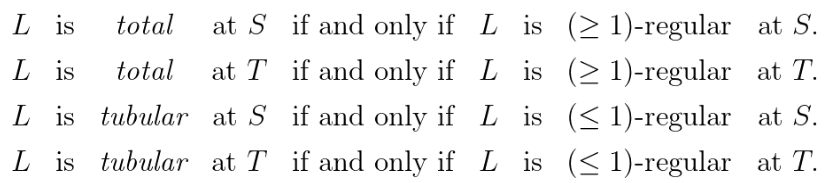
Returning to 2‑adic relations, it is useful to describe several familiar classes of objects in terms of their local and numerical incidence properties.  Let L \subseteq S \times T be an arbitrary 2‑adic relation.  The following properties of L can be defined.

Dyadic Relations • Total • Tubular

If L \subseteq S \times T is tubular at S then L is called a partial function or a prefunction from S to T.  This is sometimes indicated by giving L an alternate name, for example, {}^{\backprime\backprime} p {}^{\prime\prime}, and writing L = p : S \rightharpoonup T.  Thus we have the following definition.

\begin{matrix}  L & = & p : S \rightharpoonup T  & \text{if and only if} &  L & \text{is} & \text{tubular} & \text{at}~ S.  \end{matrix}

If L is a prefunction p : S \rightharpoonup T which happens to be total at S, then L is called a function from S to T, indicated by writing L = f : S \to T.  To say a relation L \subseteq S \times T is totally tubular at S is to say it is 1-regular at S.  Thus, we may formalize the following definition.

\begin{matrix}  L & = & f : S \to T  & \text{if and only if} &  L & \text{is} & 1\text{-regular} & \text{at}~ S.  \end{matrix}

In the case of a function f : S \to T, we have the following additional definitions.

Dyadic Relations • Surjective, Injective, Bijective

Resources

cc: Category Theory • Cybernetics (1) (2) • Ontolog Forum (1) (2)
cc: Structural Modeling (1) (2) • Systems Science (1) (2)
cc: FB | Relation TheoryLaws of FormPeirce List

Posted in C.S. Peirce, Category Theory, Dyadic Relations, Logic, Logic of Relatives, Logical Graphs, Mathematics, Nominalism, Peirce, Pragmatism, Realism, Relation Theory, Semiotics, Sign Relations, Triadic Relations, Visualization | Tagged , , , , , , , , , , , , , , , | 9 Comments

Relation Theory • Discussion 3

Re: Relation Theory • (1)(2)(3)(4)(5)
Re: Laws of FormJames Bowery

JB:
Thanks for that very rigorous definition of “relation theory”.

Its “trick” of including the name of the k-relation in a (k+1)-relation’s tuples reminds me Etter’s paper “Three-Place Identity” which was the result of some of our work at HP on dealing with identity (starting with the very practical need to identify individuals/corporations, etc. for the purpose of permitting meta-data that attributed assertions of fact to certain identities aka “provenance” of data).

The result of that effort threatens to up-end set theory itself and was to be fully fleshed out in “Membership and Identity” […]

We were able to get a preliminary review of Three-Place Identity by a close associate of Ray Smullyan.  It came back with a positive verdict.  I believe I may still have that letter somewhere in my archives.

Dear James,

The article on Relation Theory represents my attempt to bridge the two cultures of weak typing and strong typing approaches to functions and relations.  Weak typing was taught in those halcyon Halmos days when functions and relations were nothing but subsets of cartesian products.  Strong typing came to the fore with category theory, its arrows from source to target domains, and the need for closely watched domains in computer science.

Peirce recognizes a fundamental triadic relation he calls “teridentity” where three variables a, b, c denote the same object, represented in his logical graphs as a node of degree three, and at first I thought you might be talking about that.

But I see x(y = z) read as {}^{\backprime\backprime} x ~\text{regards}~ y ~\text{as the same as}~ z {}^{\prime\prime} is more like the expressions I use to discuss “equivalence relations from a particular point of view”, following one of Peirce’s more radical innovations from his 1870 “Logic of Relatives”.

  • C.S. Peirce • On the Doctrine of Individuals (1) (2)

Using square brackets in the form [a]_e for the equivalence class of an element a in an equivalence relation e we can express the above idea in one of the following forms.

\begin{matrix}  [y = z]_x & \text{or} & [y]_x = [z]_x & \text{or} & y =_x z  \end{matrix}

I wrote this up in general somewhere but there’s a fair enough illustration of the main idea in the following application to “semiotic equivalence relations”.

  • Semiotic Equivalence Relations • (1) (2)

The rest of your remarks bring up a wealth of associations for me, as seeing the triadic unity in the multiplicity of dyadic appearances is a lot of what the Peircean perspective is all about.  I’ll have to dig up a few old links to fill that out …

Regards,

Jon

cc: Category Theory • Cybernetics (1) (2) • Ontolog Forum (1) (2)
cc: Structural Modeling (1) (2) • Systems Science (1) (2)
cc: FB | Relation TheoryLaws of FormPeirce List

Posted in Algebra, Algebra of Logic, C.S. Peirce, Category Theory, Combinatorics, Discrete Mathematics, Duality, Dyadic Relations, Foundations of Mathematics, Graph Theory, Logic, Logic of Relatives, Mathematics, Peirce, Relation Theory, Semiotics, Set Theory, Sign Relational Manifolds, Sign Relations, Triadic Relations, Type Theory, Visualization | Tagged , , , , , , , , , , , , , , , , , , , , , | 9 Comments

Relation Theory • Discussion 2

Re: Relation Theory • (1)(2)(3)(4)
Re: FB | Charles S. Peirce SocietyJoseph Harry

JH:
These are iconic representations dealing with logical symbolic relations, and so of course are semiotic in Peirce’s sense, since logic is semiotic.  But couldn’t a logician do all of this meticulous formalization and understand all of the discrete logical consequences of it without having any inkling of semiotics or of Peirce?

Dear Joseph,

As I noted at the top of the article and blog series —

This article treats relations from the perspective of combinatorics, in other words, as a subject matter in discrete mathematics, with special attention to finite structures and concrete set-theoretic constructions, many of which arise quite naturally in applications.  This approach to relation theory, or the theory of relations, is distinguished from, though closely related to, its study from the perspectives of abstract algebra on the one hand and formal logic on the other.

Of course one can always pull a logical formalism out of thin air, with no inkling of its historical sources, and proceed in a blithely syntactic and deductive fashion.  But if we hew more closely to applications, original or potential, and even regard logic and math as springing from practice, we must take care for the semantic and pragmatic grounds of their use.  From that perspective, models come first, well before the deductive theories whose consistency they establish.

Regards,

Jon

cc: Category Theory • Cybernetics (1) (2) • Ontolog Forum (1) (2)
cc: Structural Modeling (1) (2) • Systems Science (1) (2)
cc: FB | Relation TheoryLaws of FormPeirce List

Posted in Algebra, Algebra of Logic, C.S. Peirce, Category Theory, Combinatorics, Discrete Mathematics, Duality, Dyadic Relations, Foundations of Mathematics, Graph Theory, Logic, Logic of Relatives, Mathematics, Peirce, Relation Theory, Semiotics, Set Theory, Sign Relational Manifolds, Sign Relations, Triadic Relations, Type Theory, Visualization | Tagged , , , , , , , , , , , , , , , , , , , , , | 9 Comments

Relation Theory • 5

Relation Theory

Two further classes of incidence properties will prove to be of great utility.

Regional Incidence Properties

The definition of a local flag can be broadened from a point to a subset of a relational domain, arriving at the definition of a regional flag in the following way.

Let L be a k-place relation L \subseteq X_1 \times \ldots \times X_k.

Choose a relational domain X_j and a subset M \subseteq X_j.

Then L_{M\,@\,j} is a subset of L called the flag of L with M at j, or the (M\,@\,j)-flag of L, a mathematical object with the following definition.

L_{M\,@\,j} ~ = ~ \{ (x_1, \ldots, x_j, \ldots, x_k) \in L ~ : ~ x_j \in M \}.

Numerical Incidence Properties

A numerical incidence property of a relation is a local incidence property predicated on the cardinalities of its local flags.

For example, L is said to be c-regular at j if and only if the cardinality of the local flag L_{x\,@\,j} is c for all x in {X_j} — to write it in symbols, if and only if |L_{x\,@\,j}| = c for all {x \in X_j}.

In a similar fashion, one may define the numerical incidence properties, (<\!c)-regular at j, (>\!c)-regular at j, and so on.  For ease of reference, a few definitions are recorded below.

Numerical Incidence Properties

Resources

cc: Category Theory • Cybernetics (1) (2) • Ontolog Forum (1) (2)
cc: Structural Modeling (1) (2) • Systems Science (1) (2)
cc: FB | Relation TheoryLaws of FormPeirce List

Posted in C.S. Peirce, Category Theory, Dyadic Relations, Logic, Logic of Relatives, Logical Graphs, Mathematics, Nominalism, Peirce, Pragmatism, Realism, Relation Theory, Semiotics, Sign Relations, Triadic Relations, Visualization | Tagged , , , , , , , , , , , , , , , | 10 Comments

Relation Theory • 4

Relation TheoryLocal Incidence Properties

The next few definitions of local incidence properties of relations are given at a moderate level of generality in order to show how they apply to k-place relations.  In the sequel we’ll see what light they throw on a number of more familiar two-place relations and functions.

A local incidence property of a relation L is a property which depends in turn on the properties of special subsets of L known as its local flags.  The local flags of a relation are defined in the following way.

Let L be a k-place relation L \subseteq X_1 \times \ldots \times X_k.

Select a relational domain {X_j} and one of its elements x.

Then L_{x\,@\,j} is a subset of L called the flag of L with x at j, or the (x\,@\,j)-flag of L, a mathematical object with the following definition.

L_{x\,@\,j} ~ = ~ \{ (x_1, \ldots, x_j, \ldots, x_k) \in L ~ : ~ x_j = x \}.

Any property C of the local flag L_{x\,@\,j} is said to be a local incidence property of L with respect to the locus x\,@\,j.

A k-adic relation L \subseteq X_1 \times \ldots \times X_k is said to be C-regular at j if and only if every flag of L with x at j has the property C, where x is taken to vary over the theme of the fixed domain X_j.

Expressed in symbols, L is C-regular at j if and only if C(L_{x\,@\,j}) is true for all x in X_j.

Resources

cc: Category Theory • Cybernetics (1) (2) • Ontolog Forum (1) (2)
cc: Structural Modeling (1) (2) • Systems Science (1) (2)
cc: FB | Relation TheoryLaws of FormPeirce List

Posted in C.S. Peirce, Category Theory, Dyadic Relations, Logic, Logic of Relatives, Logical Graphs, Mathematics, Nominalism, Peirce, Pragmatism, Realism, Relation Theory, Semiotics, Sign Relations, Triadic Relations, Visualization | Tagged , , , , , , , , , , , , , , , | 11 Comments

Relation Theory • 3

Relation TheoryDefinition

It is convenient to begin with the definition of a k-place relation, where k is a positive integer.

Definition.  A k-place relation L \subseteq X_1 \times \ldots \times X_k over the nonempty sets X_1, \ldots, X_k is
a (k+1)-tuple (X_1, \ldots, X_k, L) where L is a subset of the cartesian product X_1 \times \ldots \times X_k.

Several items of terminology are useful in discussing relations.

  • The sets X_1, \ldots, X_k are called the domains of the relation L \subseteq X_1 \times \ldots \times X_k, with {X_j} being the j^\text{th} domain.
  • If all the {X_j} are the same set X then L \subseteq X_1 \times \ldots \times X_k is more simply described as a
    k-place relation over X.
  • The set L is called the graph of the relation L \subseteq X_1 \times \ldots \times X_k, on analogy with the graph of a function.
  • If the sequence of sets X_1, \ldots, X_k is constant throughout a given discussion or is otherwise determinate in context then the relation L \subseteq X_1 \times \ldots \times X_k is determined by its graph L, making it acceptable to denote the relation by referring to its graph.
  • Other synonyms for the adjective k-place are k-adic and k-ary, all of which leads to the integer k being called the dimension, adicity, or arity of the relation L.

Resources

cc: Category Theory • Cybernetics (1) (2) • Ontolog Forum (1) (2)
cc: Structural Modeling (1) (2) • Systems Science (1) (2)
cc: FB | Relation TheoryLaws of FormPeirce List

Posted in C.S. Peirce, Category Theory, Dyadic Relations, Logic, Logic of Relatives, Logical Graphs, Mathematics, Nominalism, Peirce, Pragmatism, Realism, Relation Theory, Semiotics, Sign Relations, Triadic Relations, Visualization | Tagged , , , , , , , , , , , , , , , | 11 Comments

Relation Theory • 2

Relation TheoryPreliminaries

Two definitions of the relation concept are common in the literature.  Although it is usually clear in context which definition is being used at a given time, it tends to become less clear as contexts collide, or as discussion moves from one context to another.

The same sort of ambiguity arose in the development of the function concept and it may save a measure of effort to follow the pattern of resolution that worked itself out there.

When we speak of a function f : X \to Y we are thinking of a mathematical object whose articulation requires three pieces of data, specifying the set X, the set Y, and a particular subset of their cartesian product {X \times Y}.  So far so good.

Let us write f = (\mathrm{obj_1}f, \mathrm{obj_2}f, \mathrm{obj_{12}}f) to express what has been said so far.

When it comes to parsing the notation {}^{\backprime\backprime} f : X \to Y {}^{\prime\prime}, everyone takes the part {}^{\backprime\backprime} X \to Y {}^{\prime\prime} as indicating the type of the function, in effect defining \mathrm{type}(f) as the pair (\mathrm{obj_1}f, \mathrm{obj_2}f), but {}^{\backprime\backprime} f {}^{\prime\prime} is used equivocally to denote both the triple (\mathrm{obj_1}f, \mathrm{obj_2}f, \mathrm{obj_{12}}f) and the subset \mathrm{obj_{12}}f forming one part of it.

One way to resolve the ambiguity is to formalize a distinction between the function f = (\mathrm{obj_1}f, \mathrm{obj_2}f, \mathrm{obj_{12}}f) and its graph, defining \mathrm{graph}(f) = \mathrm{obj_{12}}f.

Another tactic treats the whole notation {}^{\backprime\backprime} f : X \to Y {}^{\prime\prime} as a name for the triple, letting {}^{\backprime\backprime} f {}^{\prime\prime} denote \mathrm{graph}(f).

In categorical and computational contexts, at least initially, the type is regarded as an essential attribute or integral part of the function itself.  In other contexts we may wish to use a more abstract concept of function, treating a function as a mathematical object capable of being viewed under many different types.

Following the pattern of the functional case, let the notation {}^{\backprime\backprime} L \subseteq X \times Y {}^{\prime\prime} bring to mind a mathematical object specified by three pieces of data, the set X, the set Y, and a particular subset of their cartesian product {X \times Y}.  As before we have two choices, either let L be the triple (X, Y, \mathrm{graph}(L)) or let {}^{\backprime\backprime} L {}^{\prime\prime} denote \mathrm{graph}(L) and choose another name for the triple.

Resources

cc: Category Theory • Cybernetics (1) (2) • Ontolog Forum (1) (2)
cc: Structural Modeling (1) (2) • Systems Science (1) (2)
cc: FB | Relation TheoryLaws of FormPeirce List

Posted in C.S. Peirce, Category Theory, Dyadic Relations, Logic, Logic of Relatives, Logical Graphs, Mathematics, Nominalism, Peirce, Pragmatism, Realism, Relation Theory, Semiotics, Sign Relations, Triadic Relations, Visualization | Tagged , , , , , , , , , , , , , , , | 11 Comments

Relation Theory • 1

Here’s an introduction to Relation Theory geared to applications and taking a moderately general view at least as far as finite numbers of relational domains are concerned (k-adic or k-ary relations).

Relation Theory

This article treats relations from the perspective of combinatorics, in other words, as a subject matter in discrete mathematics, with special attention to finite structures and concrete set‑theoretic constructions, many of which arise quite naturally in applications.  This approach to relation theory, or the theory of relations, is distinguished from, though closely related to, its study from the perspectives of abstract algebra on the one hand and formal logic on the other.

Resources

cc: Category Theory • Cybernetics (1) (2) • Ontolog Forum (1) (2)
cc: Structural Modeling (1) (2) • Systems Science (1) (2)
cc: FB | Relation TheoryLaws of FormPeirce List

Posted in C.S. Peirce, Category Theory, Dyadic Relations, Logic, Logic of Relatives, Logical Graphs, Mathematics, Nominalism, Peirce, Pragmatism, Realism, Relation Theory, Semiotics, Sign Relations, Triadic Relations, Visualization | Tagged , , , , , , , , , , , , , , , | 11 Comments

Zeroth Law Of Semiotics • Discussion 1

Re: Zeroth Law Of Semiotics • Comment 2
Re: Laws of FormJohn Mingers

JM:
Hmmm
Sounds terribly like analytic philosophy to me.
There are not real philosophical problems, it’s all just a matter of misuse of words.
Have you seen the world out there — there really are problems that philosophy ought to try and help with!!!

Dear John,

If I have a philosophy it would be pragmatism.  A pragmatist — or pragmatician as I sometimes prefer — is more like a type of reflective practitioner, one who applies the pragmatic maxim to clarify ideas, all the better to apply ideas to pressing realities.

Pragmatic Maxim
The pragmatic maxim is a guideline for the practice of inquiry formulated by Charles Sanders Peirce.  Serving as a normative recommendation or regulative principle in the normative science of logic, its function is to guide the conduct of thought toward the achievement of its aims, advising the addressee on an optimal way of “attaining clearness of apprehension”.

In pragmatic ways of thinking, semiotics is a discipline of critical reflection charged with sorting out the respective roles of signs, ideas, and objects (including objects in the sense of aims, ends, goals, objectives, and purposes) in the activities of communication, learning, and reasoning.

That is what I’m about here.

Regards,

Jon

cc: CyberneticsOntolog ForumStructural ModelingSystems Science
cc: FB | Semeiotics • Laws of Form (1) (2) • Peirce List (1) (2) (3)

Posted in C.S. Peirce, Denotation, Extension, Information = Comprehension × Extension, Liar Paradox, Logic, Nominalism, Peirce, Pragmatics, Rhetoric, Semantics, Semiositis, Semiotics, Sign Relations, Syntax, Zeroth Law Of Semiotics | Tagged , , , , , , , , , , , , , , , | 6 Comments