
The fault, dear Brutus, is not in our stars,
But in ourselves …
Julius Caesar • 1.2.141–142
Signs have a power to inform, to lead our thoughts and thus our actions in accord with reality, to make reality our friend. And signs have a power to misinform, to corrupt our thoughts and thus our actions and lead us to despair of all our ends.
Excerpt from Bertrand Russell • “The Philosophy of Logical Atomism” (1918)
4. Propositions and Facts with More than One Verb: Beliefs, Etc.
4.3. How shall we describe the logical form of a belief?
I want to try to get an account of the way that a belief is made up. That is not an easy question at all. You cannot make what I should call a map-in-space of a belief. You can make a map of an atomic fact but not of a belief, for the simple reason that space-relations always are of the atomic sort or complications of the atomic sort. I will try to illustrate what I mean.
The point is in connexion with there being two verbs in the judgment and with the fact that both verbs have got to occur as verbs, because if a thing is a verb it cannot occur otherwise than as a verb.
Suppose I take ‘A believes that B loves C’. ‘Othello believes that Desdemona loves Cassio’. There you have a false belief. You have this odd state of affairs that the verb ‘loves’ occurs in that proposition and seems to occur as relating Desdemona to Cassio whereas in fact it does not do so, but yet it does occur as a verb, it does occur in the sort of way that a verb should do.
I mean that when A believes that B loves C, you have to have a verb in the place where ‘loves’ occurs. You cannot put a substantive in its place. Therefore it is clear that the subordinate verb (i.e. the verb other than believing) is functioning as a verb, and seems to be relating two terms, but as a matter of fact does not when a judgment happens to be false. That is what constitutes the puzzle about the nature of belief.
You will notice that whenever one gets to really close quarters with the theory of error one has the puzzle of how to deal with error without assuming the existence of the non-existent.
I mean that every theory of error sooner or later wrecks itself by assuming the existence of the non-existent. As when I say ‘Desdemona loves Cassio’, it seems as if you have a non-existent love between Desdemona and Cassio, but that is just as wrong as a non-existent unicorn. So you have to explain the whole theory of judgment in some other way.
I come now to this question of a map. Suppose you try such a map as this:
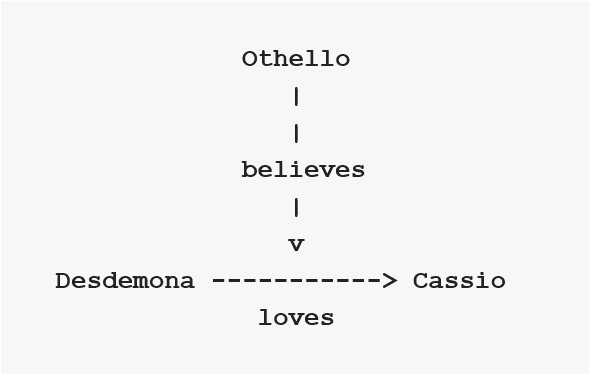
This question of making a map is not so strange as you might suppose because it is part of the whole theory of symbolism. It is important to realize where and how a symbolism of that sort would be wrong: Where and how it is wrong is that in the symbol you have this relationship relating these two things and in the fact it doesn’t really relate them. You cannot get in space any occurrence which is logically of the same form as belief.
When I say ‘logically of the same form’ I mean that one can be obtained from the other by replacing the constituents of the one by the new terms.
If I say ‘Desdemona loves Cassio’ that is of the same form as ‘A is to the right of B’. Those are of the same form, and I say that nothing that occurs in space is of the same form as belief.
I have got on here to a new sort of thing, a new beast for our zoo, not another member of our former species but a new species. The discovery of this fact is due to Mr. Wittgenstein. (Russell, POLA, 89–91).
Reference
- Bertrand Russell, “The Philosophy of Logical Atomism”, pp. 35–155 in The Philosophy of Logical Atomism, edited with an introduction by David Pears, Open Court, La Salle, IL, 1985. First published 1918.
Resources
cc: Conceptual Graphs • Cybernetics • Laws of Form • Ontolog Forum
cc: FB | Inquiry Driven Systems • Structural Modeling • Systems Science
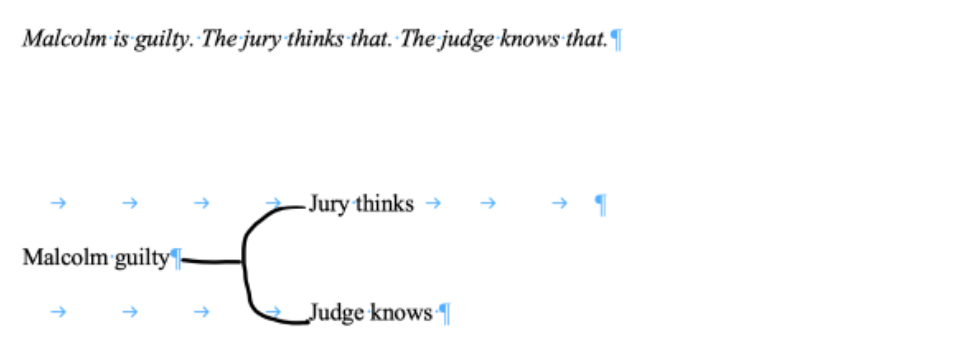

 there is no assumption on my part the relational domains
  are necessarily disjoint. They may intersect or even be identical, as
  Of course we rarely need to contemplate limiting cases of that type but I find it useful to keep them in our categorical catalogue. (Other writers will differ on that score.) On the other hand, we very often consider cases where
  as in the following two examples of sign relations discussed in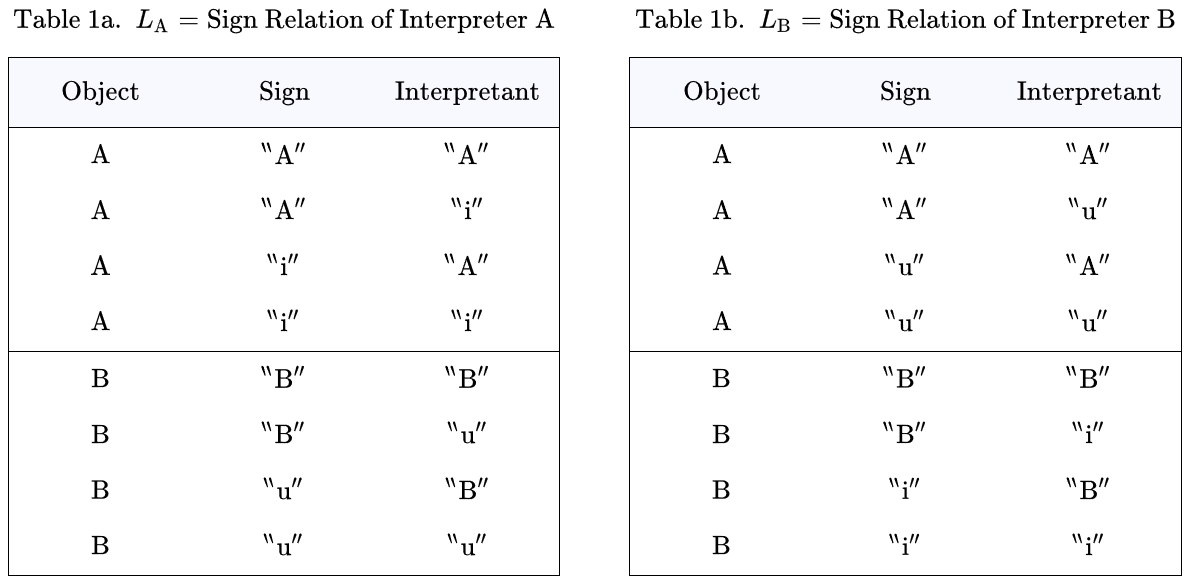
![\begin{array}{ccl} O & = & \{ \mathrm{A}, \mathrm{B} \} \\[6pt] S & = & \{ ``\mathrm{A}", ``\mathrm{B}", ``\mathrm{i}", ``\mathrm{u}" \} \\[6pt] I & = & \{ ``\mathrm{A}", ``\mathrm{B}", ``\mathrm{i}", ``\mathrm{u}" \} \end{array}](https://s0.wp.com/latex.php?latex=%5Cbegin%7Barray%7D%7Bccl%7D++O+%26+%3D+%26+%5C%7B+%5Cmathrm%7BA%7D%2C+%5Cmathrm%7BB%7D+%5C%7D++%5C%5C%5B6pt%5D++S+%26+%3D+%26+%5C%7B+%60%60%5Cmathrm%7BA%7D%22%2C+%60%60%5Cmathrm%7BB%7D%22%2C+%60%60%5Cmathrm%7Bi%7D%22%2C+%60%60%5Cmathrm%7Bu%7D%22+%5C%7D++%5C%5C%5B6pt%5D++I+%26+%3D+%26+%5C%7B+%60%60%5Cmathrm%7BA%7D%22%2C+%60%60%5Cmathrm%7BB%7D%22%2C+%60%60%5Cmathrm%7Bi%7D%22%2C+%60%60%5Cmathrm%7Bu%7D%22+%5C%7D++%5Cend%7Barray%7D&bg=ffffff&fg=000000&s=0&c=20201002)
 (let’s say that
 and
and  are all finite, non‑empty sets), I’m interested to understand what additional axioms you’re saying are necessary and sufficient to make
  a sign relation. I checked
  on any set
  might be capable of capturing aspects of objective structure immanent in the conduct of logical reasoning. At least I can think of no reason to exclude the possibility à priori.
 is an equivalence relation on a set
  of
of ![[x]_E](https://s0.wp.com/latex.php?latex=%5Bx%5D_E&bg=ffffff&fg=000000&s=0&c=20201002) or the simpler form
or the simpler form ![[x]](https://s0.wp.com/latex.php?latex=%5Bx%5D&bg=ffffff&fg=000000&s=0&c=20201002) when the subscript
when the subscript  are equivalent under
 ![\begin{array}{clc} (x, y) & \in & E \\[4pt] x & \in & [y]_E \\[4pt] y & \in & [x]_E \\[4pt] [x]_E & = & [y]_E \\[4pt] x & =_E & y \end{array}](https://s0.wp.com/latex.php?latex=%5Cbegin%7Barray%7D%7Bclc%7D++%28x%2C+y%29+%26+%5Cin+%26+E++%5C%5C%5B4pt%5D++x+%26+%5Cin+%26+%5By%5D_E++%5C%5C%5B4pt%5D++y+%26+%5Cin+%26+%5Bx%5D_E++%5C%5C%5B4pt%5D++%5Bx%5D_E+%26+%3D+%26+%5By%5D_E++%5C%5C%5B4pt%5D++x+%26+%3D_E+%26+y++%5Cend%7Barray%7D&bg=ffffff&fg=000000&s=0&c=20201002)
![\begin{array}{ccc} [x]_E & = & \{ y \in X : (x, y) \in E \} \\[6pt] x =_E y & \Leftrightarrow & (x, y) \in E \end{array}](https://s0.wp.com/latex.php?latex=%5Cbegin%7Barray%7D%7Bccc%7D++%5Bx%5D_E+%26+%3D+%26+%5C%7B+y+%5Cin+X+%3A+%28x%2C+y%29+%5Cin+E+%5C%7D++%5C%5C%5B6pt%5D++x+%3D_E+y+%26+%5CLeftrightarrow+%26+%28x%2C+y%29+%5Cin+E++%5Cend%7Barray%7D&bg=ffffff&fg=000000&s=0&c=20201002)
 is an equivalence relation on
 ![[s]_L](https://s0.wp.com/latex.php?latex=%5Bs%5D_L&bg=ffffff&fg=000000&s=0&c=20201002) be the equivalence class of
be the equivalence class of  under
under  In short,
 ![[s]_L = [s]_{L_{SI}}.](https://s0.wp.com/latex.php?latex=%5Bs%5D_L+%3D+%5Bs%5D_%7BL_%7BSI%7D%7D.&bg=ffffff&fg=000000&s=0&c=20201002) A statement that the signs
A statement that the signs ![\begin{array}{clc} [x]_L & = & [y]_L \\[6pt] x & =_L & y \end{array}](https://s0.wp.com/latex.php?latex=%5Cbegin%7Barray%7D%7Bclc%7D++%5Bx%5D_L+%26+%3D+%26+%5By%5D_L++%5C%5C%5B6pt%5D++x+%26+%3D_L+%26+y++%5Cend%7Barray%7D&bg=ffffff&fg=000000&s=0&c=20201002)
 in a sign relation
  it is permissible to let
 ![[o]_L](https://s0.wp.com/latex.php?latex=%5Bo%5D_L&bg=ffffff&fg=000000&s=0&c=20201002) be defined as
be defined as ![[s]_L.](https://s0.wp.com/latex.php?latex=%5Bs%5D_L.&bg=ffffff&fg=000000&s=0&c=20201002) This lets the notation for semiotic equivalence classes harmonize more smoothly with the frequent use of similar devices for the denotations of signs and expressions.
This lets the notation for semiotic equivalence classes harmonize more smoothly with the frequent use of similar devices for the denotations of signs and expressions. and
and  will serve to illustrate their use and utility.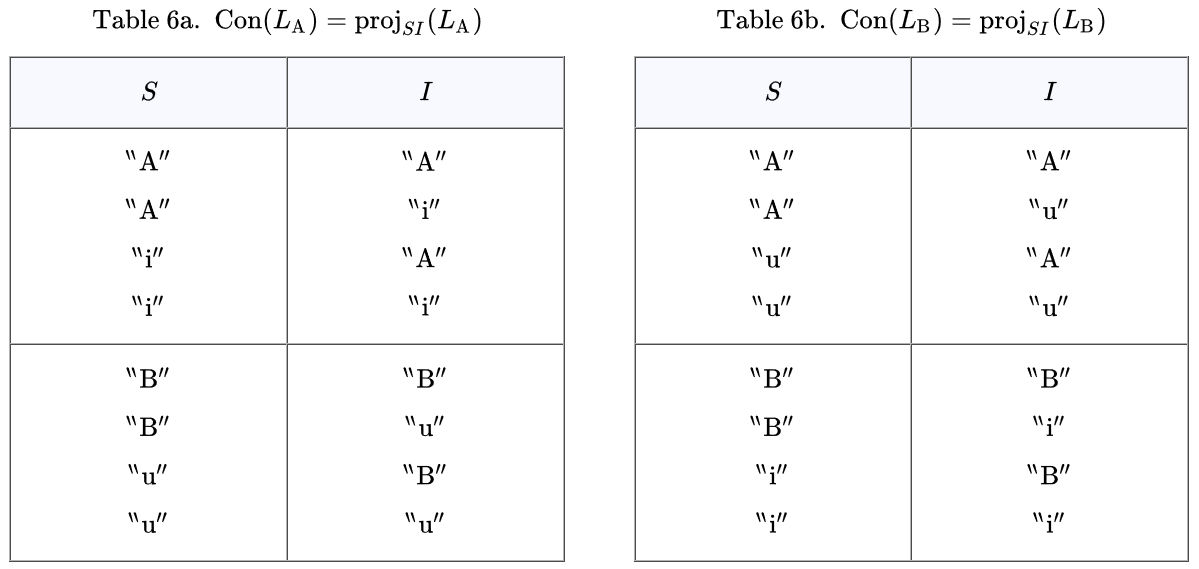
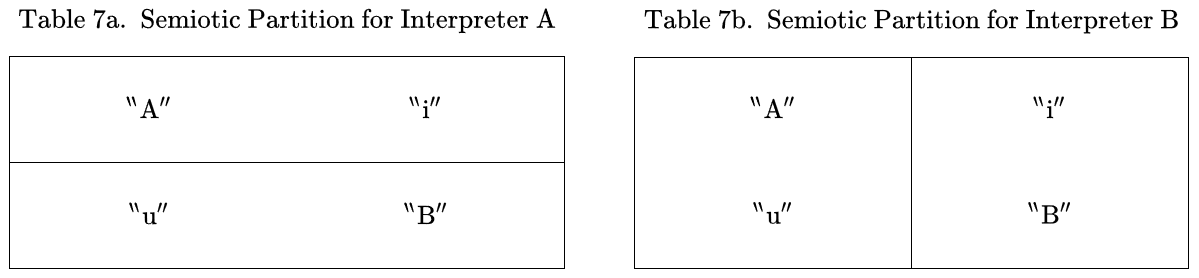
 yields the following semiotic equations.
![\begin{matrix} [ {}^{\backprime\backprime} \mathrm{A} {}^{\prime\prime} ]_{L_\mathrm{A}} & = & [ {}^{\backprime\backprime} \mathrm{i} {}^{\prime\prime} ]_{L_\mathrm{A}} \\[6pt] [ {}^{\backprime\backprime} \mathrm{B} {}^{\prime\prime} ]_{L_\mathrm{A}} & = & [ {}^{\backprime\backprime} \mathrm{u} {}^{\prime\prime} ]_{L_\mathrm{A}} \end{matrix}](https://s0.wp.com/latex.php?latex=%5Cbegin%7Bmatrix%7D++%5B+%7B%7D%5E%7B%5Cbackprime%5Cbackprime%7D+%5Cmathrm%7BA%7D+%7B%7D%5E%7B%5Cprime%5Cprime%7D+%5D_%7BL_%5Cmathrm%7BA%7D%7D++%26+%3D+%26++%5B+%7B%7D%5E%7B%5Cbackprime%5Cbackprime%7D+%5Cmathrm%7Bi%7D+%7B%7D%5E%7B%5Cprime%5Cprime%7D+%5D_%7BL_%5Cmathrm%7BA%7D%7D++%5C%5C%5B6pt%5D++%5B+%7B%7D%5E%7B%5Cbackprime%5Cbackprime%7D+%5Cmathrm%7BB%7D+%7B%7D%5E%7B%5Cprime%5Cprime%7D+%5D_%7BL_%5Cmathrm%7BA%7D%7D++%26+%3D+%26++%5B+%7B%7D%5E%7B%5Cbackprime%5Cbackprime%7D+%5Cmathrm%7Bu%7D+%7B%7D%5E%7B%5Cprime%5Cprime%7D+%5D_%7BL_%5Cmathrm%7BA%7D%7D++%5Cend%7Bmatrix%7D&bg=ffffff&fg=000000&s=0&c=20201002)
![\begin{matrix} {}^{\backprime\backprime} \mathrm{A} {}^{\prime\prime} & =_{L_\mathrm{A}} & {}^{\backprime\backprime} \mathrm{i} {}^{\prime\prime} \\[6pt] {}^{\backprime\backprime} \mathrm{B} {}^{\prime\prime} & =_{L_\mathrm{A}} & {}^{\backprime\backprime} \mathrm{u} {}^{\prime\prime} \end{matrix}](https://s0.wp.com/latex.php?latex=%5Cbegin%7Bmatrix%7D++%7B%7D%5E%7B%5Cbackprime%5Cbackprime%7D+%5Cmathrm%7BA%7D+%7B%7D%5E%7B%5Cprime%5Cprime%7D++%26+%3D_%7BL_%5Cmathrm%7BA%7D%7D+%26++%7B%7D%5E%7B%5Cbackprime%5Cbackprime%7D+%5Cmathrm%7Bi%7D+%7B%7D%5E%7B%5Cprime%5Cprime%7D++%5C%5C%5B6pt%5D++%7B%7D%5E%7B%5Cbackprime%5Cbackprime%7D+%5Cmathrm%7BB%7D+%7B%7D%5E%7B%5Cprime%5Cprime%7D++%26+%3D_%7BL_%5Cmathrm%7BA%7D%7D+%26++%7B%7D%5E%7B%5Cbackprime%5Cbackprime%7D+%5Cmathrm%7Bu%7D+%7B%7D%5E%7B%5Cprime%5Cprime%7D++%5Cend%7Bmatrix%7D&bg=ffffff&fg=000000&s=0&c=20201002)

 yields the following semiotic equations.
![\begin{matrix} [ {}^{\backprime\backprime} \mathrm{A} {}^{\prime\prime} ]_{L_\mathrm{B}} & = & [ {}^{\backprime\backprime} \mathrm{u} {}^{\prime\prime} ]_{L_\mathrm{B}} \\[6pt] [ {}^{\backprime\backprime} \mathrm{B} {}^{\prime\prime} ]_{L_\mathrm{B}} & = & [ {}^{\backprime\backprime} \mathrm{i} {}^{\prime\prime} ]_{L_\mathrm{B}} \end{matrix}](https://s0.wp.com/latex.php?latex=%5Cbegin%7Bmatrix%7D++%5B+%7B%7D%5E%7B%5Cbackprime%5Cbackprime%7D+%5Cmathrm%7BA%7D+%7B%7D%5E%7B%5Cprime%5Cprime%7D+%5D_%7BL_%5Cmathrm%7BB%7D%7D++%26+%3D+%26++%5B+%7B%7D%5E%7B%5Cbackprime%5Cbackprime%7D+%5Cmathrm%7Bu%7D+%7B%7D%5E%7B%5Cprime%5Cprime%7D+%5D_%7BL_%5Cmathrm%7BB%7D%7D++%5C%5C%5B6pt%5D++%5B+%7B%7D%5E%7B%5Cbackprime%5Cbackprime%7D+%5Cmathrm%7BB%7D+%7B%7D%5E%7B%5Cprime%5Cprime%7D+%5D_%7BL_%5Cmathrm%7BB%7D%7D++%26+%3D+%26++%5B+%7B%7D%5E%7B%5Cbackprime%5Cbackprime%7D+%5Cmathrm%7Bi%7D+%7B%7D%5E%7B%5Cprime%5Cprime%7D+%5D_%7BL_%5Cmathrm%7BB%7D%7D++%5Cend%7Bmatrix%7D&bg=ffffff&fg=000000&s=0&c=20201002)
![\begin{matrix} {}^{\backprime\backprime} \mathrm{A} {}^{\prime\prime} & =_{L_\mathrm{B}} & {}^{\backprime\backprime} \mathrm{u} {}^{\prime\prime} \\[6pt] {}^{\backprime\backprime} \mathrm{B} {}^{\prime\prime} & =_{L_\mathrm{B}} & {}^{\backprime\backprime} \mathrm{i} {}^{\prime\prime} \end{matrix}](https://s0.wp.com/latex.php?latex=%5Cbegin%7Bmatrix%7D++%7B%7D%5E%7B%5Cbackprime%5Cbackprime%7D+%5Cmathrm%7BA%7D+%7B%7D%5E%7B%5Cprime%5Cprime%7D++%26+%3D_%7BL_%5Cmathrm%7BB%7D%7D+%26++%7B%7D%5E%7B%5Cbackprime%5Cbackprime%7D+%5Cmathrm%7Bu%7D+%7B%7D%5E%7B%5Cprime%5Cprime%7D++%5C%5C%5B6pt%5D++%7B%7D%5E%7B%5Cbackprime%5Cbackprime%7D+%5Cmathrm%7BB%7D+%7B%7D%5E%7B%5Cprime%5Cprime%7D++%26+%3D_%7BL_%5Cmathrm%7BB%7D%7D+%26++%7B%7D%5E%7B%5Cbackprime%5Cbackprime%7D+%5Cmathrm%7Bi%7D+%7B%7D%5E%7B%5Cprime%5Cprime%7D++%5Cend%7Bmatrix%7D&bg=ffffff&fg=000000&s=0&c=20201002)

 and
and  have many interesting properties over and above those possessed by sign relations in general. Some of those properties have to do with the relation between signs and their interpretant signs, as reflected in the projections of
  ‑plane, notated as
  and
and  respectively. The dyadic relations on
  induced by those projections are also referred to as the connotative components of the corresponding sign relations, notated as
  and
and  respectively. Tables 6a and 6b show the corresponding connotative components.
 form a pair of equivalence relations on their common syntactic domain
  This type of equivalence relation is called a semiotic equivalence relation (SER) because it equates signs having the same meaning to some interpreter.
 partitions the collection of signs into semiotic equivalence classes. This constitutes a strong form of representation in that the structure of the interpreters’ common object domain
  is reflected or reconstructed, part for part, in the structure of each one’s semiotic partition of the syntactic domain

 Inquiry Into Inquiry