Theme One Program • Exposition 3

Coding Logical Graphs

My earliest experiments coding logical graphs as dynamic “pointer” data structures taught me that conceptual and computational efficiencies of a critical sort could be achieved by generalizing their abstract graphs from trees to the variety graph theorists know as cacti.  The genesis of that generalization is a tale worth telling another time, but for now it’s best to jump right in and proceed by way of generic examples.

Figure 1 shows a typical example of a painted and rooted cactus.
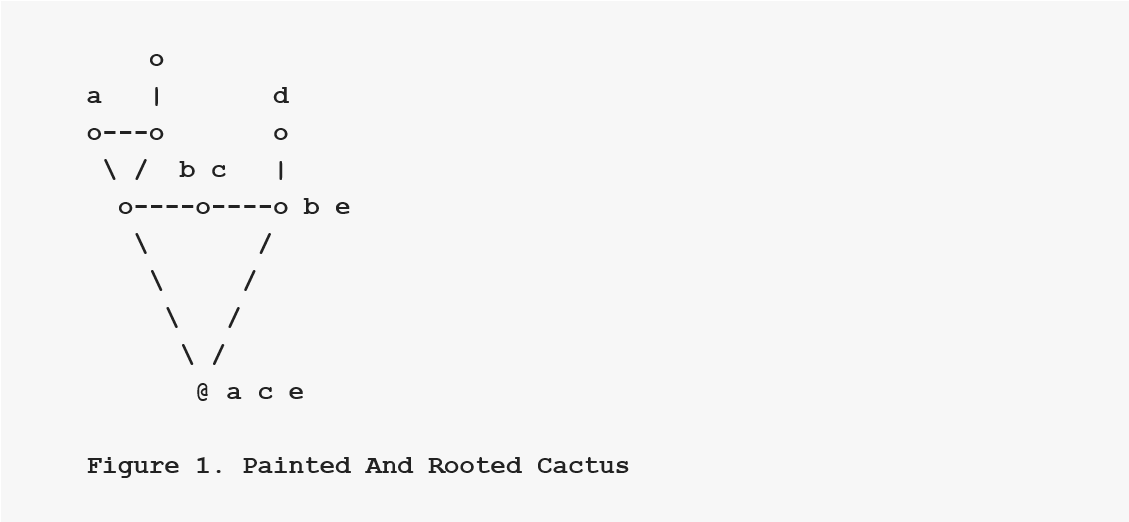
Painted And Rooted Cactus

Figure 2 shows a way to visualize the correspondence between cactus graphs and cactus strings, demonstrated on the cactus from Figure 1.  By way of convenient terminology, the polygons of a cactus graph are called its lobes.  An edge not part of a larger polygon is called a 2‑gon or a bi‑gon.  A terminal bi‑gon is called a spike.

Cactus Graph and Cactus Expression

The correspondence between a cactus graph and a cactus string is obtained by an operation called traversing the graph in question.

  • One traverses a cactus graph by beginning at the left hand side of the root node, reading off the list of paints one encounters at that point.  Since the order of elements at any node is not significant, one may start the cactus string with that list of paints or save them for the end.  We have done the latter in this case.
  • One continues by climbing up the left hand side of the leftmost lobe, marking the ascent by means of a left parenthesis, traversing whatever cactus one happens to reach at the first node above the root, that done, proceeding from left to right along the top side of the lobe, marking each interlobal span by means of a comma, traversing each cactus in turn one meets along the way, on completing the last of them climbing down the right hand side of the lobe, marking the descent by means of a right parenthesis, and then traversing each cactus in turn, in left to right order, that is incident with the root node.

The string of letters, parentheses, and commas one obtains by this procedure is called the traversal string of the graph, in this case, a cactus string.

Resources

cc: FB | Theme One ProgramLaws of FormMathstodonAcademia.edu
cc: Conceptual GraphsCyberneticsStructural ModelingSystems Science

Posted in Algorithms, Animata, Artificial Intelligence, Boolean Functions, C.S. Peirce, Cactus Graphs, Cognition, Computation, Constraint Satisfaction Problems, Data Structures, Differential Logic, Equational Inference, Formal Languages, Graph Theory, Inquiry Driven Systems, Laws of Form, Learning Theory, Logic, Logical Graphs, Mathematics, Minimal Negation Operators, Painted Cacti, Peirce, Propositional Calculus, Semiotics, Spencer Brown, Visualization | Tagged , , , , , , , , , , , , , , , , , , , , , , , , , , | 4 Comments

Theme One Program • Exposition 2

The previous post described the elementary data structure used to represent nodes of graphs in the Theme One program.  This post describes the specific family of graphs employed by the program.

Painted And Rooted Cacti

Figure 1 shows a typical example of a painted and rooted cactus.

Painted And Rooted Cactus

The graph itself is a mathematical object and does not inhabit the page or other medium before our eyes, and it must not be confused with any picture or other representation of it, anymore than we’d want someone to confuse us with a picture of ourselves, but it’s a fair enough picture, once we understand the conventions of representation involved.

Let V(G) be the set of nodes in a graph G and let L be a set of identifiers.  We often find ourselves in situations where we have to consider many different ways of associating the nodes of G with the identifiers in L.  Various manners of associating nodes with identifiers have been given conventional names by different schools of graph theorists.  I will give one way of describing a few of the most common patterns of association.

  • A graph is painted if there is a relation between its node set and a set of identifiers, in which case the relation is called a painting and the identifiers are called paints.
  • A graph is colored if there is a function from its node set to a set of identifiers, in which case the function is called a coloring and the identifiers are called colors.
  • A graph is labeled if there is a one-to-one mapping between its node set and a set of identifiers, in which case the mapping is called a labeling and the identifiers are called labels.
  • A graph is said to be rooted if it has a unique distinguished node, in which case the distinguished node is called the root of the graph.  The graph in Figure 1 has a root node marked by the “at” sign or amphora symbol “\texttt{@}”.

The graph in Figure 1 has eight nodes plus the five paints in the set \{ a, b, c, d, e \}.  The painting of nodes is indicated by drawing the paints of each node next to the node they paint.  Observe that some nodes may be painted with an empty set of paints.

The structure of a painted and rooted cactus can be encoded in the form of a character string called a painted and rooted cactus expression.  For the remainder of this discussion the terms cactus and cactus expression will be used to mean the painted and rooted varieties.  A cactus expression is formed on an alphabet consisting of the relevant set of identifiers, the paints, together with three punctuation marks:  the left parenthesis, the comma, and the right parenthesis.

Resources

cc: FB | Theme One ProgramLaws of FormMathstodonAcademia.edu
cc: Conceptual GraphsCyberneticsStructural ModelingSystems Science

Posted in Algorithms, Animata, Artificial Intelligence, Boolean Functions, C.S. Peirce, Cactus Graphs, Cognition, Computation, Constraint Satisfaction Problems, Data Structures, Differential Logic, Equational Inference, Formal Languages, Graph Theory, Inquiry Driven Systems, Laws of Form, Learning Theory, Logic, Logical Graphs, Mathematics, Minimal Negation Operators, Painted Cacti, Peirce, Propositional Calculus, Semiotics, Spencer Brown, Visualization | Tagged , , , , , , , , , , , , , , , , , , , , , , , , , , | 4 Comments

Theme One Program • Exposition 1

Theme One is a program for constructing and transforming a particular species of graph‑theoretic data structures, forms designed to support a variety of fundamental learning and reasoning tasks.

The program evolved over the course of an exploration into the integration of contrasting types of activities involved in learning and reasoning, especially the types of algorithms and data structures capable of supporting all sorts of inquiry processes, from everyday problem solving to scientific investigation.  In its current state, Theme One integrates over a common data structure fundamental algorithms for one type of inductive learning and one type of deductive reasoning.

We begin by describing the class of graph‑theoretic data structures used by the program, as determined by their local and global features.  It will be the usual practice to shift around and view these graphs at many different levels of detail, from their abstract definition to their concrete implementation, and many points in between.

The main work of the Theme One program is achieved by building and transforming a single species of graph‑theoretic data structures.  In their abstract form these structures are closely related to the graphs called cacti and conifers in graph theory, so we’ll generally refer to them under those names.

The Idea↑Form Flag

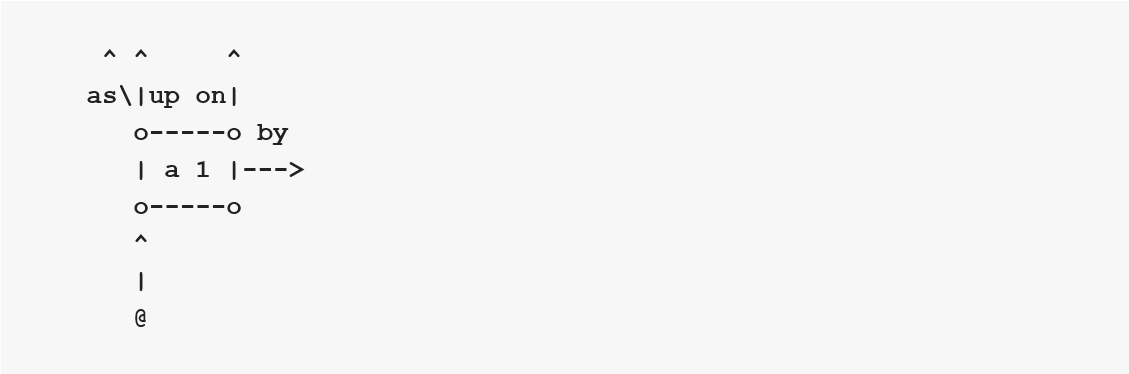
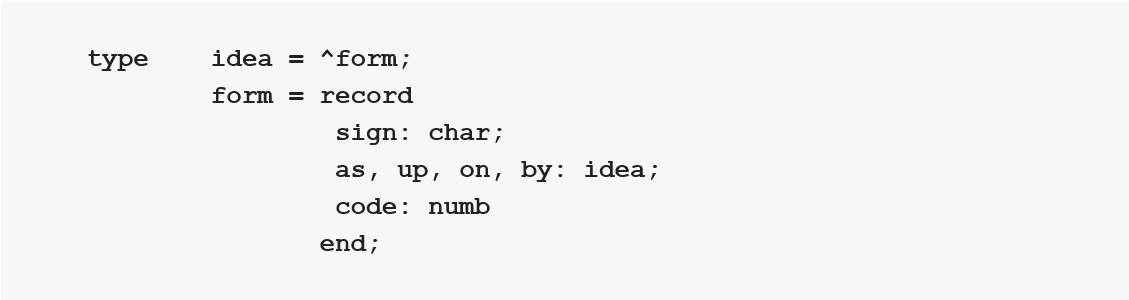
The graph‑theoretic data structures used by the program are built up from a basic data structure called an idea‑form flag.  That structure is defined as a pair of Pascal data types by means of the following specifications.

Type Idea = ^Form

  • An idea is a pointer to a form.
  • A form is a record consisting of:
    • A sign of type char;
    • Four pointers, as, up, on, by, of type idea;
    • A code of type numb, that is, an integer in [0, max integer].

Represented in terms of digraphs, or directed graphs, the combination of an idea pointer and a form record is most easily pictured as an arc, or directed edge, leading to a node labeled with the other data, in this case, a letter and a number.

At the roughest but quickest level of detail, an idea of a form can be drawn as follows.

Idea^Form Node

When it is necessary to fill in more detail, the following schematic pattern can be used.

Idea^Form Flag

The idea‑form type definition determines the local structure of the whole host of graphs used by the program, including a motley array of ephemeral buffers, temporary scratch lists, and other graph‑theoretic data structures used for their transient utilities at specific points in the program.

I will put off discussing the more incidental graph structures until the points where they actually arise, focusing here on the particular varieties of cactoid graphs making up the main formal media of the program’s operation.

Resources

cc: FB | Theme One ProgramLaws of FormMathstodonAcademia.edu
cc: Conceptual GraphsCyberneticsStructural ModelingSystems Science

Posted in Algorithms, Animata, Artificial Intelligence, Boolean Functions, C.S. Peirce, Cactus Graphs, Cognition, Computation, Constraint Satisfaction Problems, Data Structures, Differential Logic, Equational Inference, Formal Languages, Graph Theory, Inquiry Driven Systems, Laws of Form, Learning Theory, Logic, Logical Graphs, Mathematics, Minimal Negation Operators, Painted Cacti, Peirce, Propositional Calculus, Semiotics, Spencer Brown, Visualization | Tagged , , , , , , , , , , , , , , , , , , , , , , , , , , | 4 Comments

Theme One Program • Motivation 6

Comments I made in reply to a correspondent’s questions about delimiters and tokenizing in the Learner module may be worth sharing here.

In one of the projects I submitted toward a Master’s in psychology I used the Theme One program to analyze samples of data from my advisor’s funded research study on family dynamics.  In one phase of the study observers viewed video‑taped sessions of family members (parent and child) interacting in various modes (“play” or “work”) and coded qualitative features of each moment’s activity over a period of time.

The following page describes the application in more detail and reflects on its implications for the conduct of scientific inquiry in general.

In this application a “phrase” or “string” is a fixed‑length sequence of qualitative features and a “clause” or “strand” is a sequence of such phrases delimited by what the observer judges to be a significant pause in the action.

In the qualitative research phases of the study one is simply attempting to discern any significant or recurring patterns in the data one possibly can.

In this case the observers tokenize their observations according to a codebook which has passed enough intercoder reliability studies to afford a measure of confidence it captures meaningful aspects of whatever reality is passing before their eyes and ears.

Resources

cc: FB | Theme One ProgramLaws of FormMathstodonAcademia.edu
cc: Conceptual GraphsCyberneticsStructural ModelingSystems Science

Posted in Algorithms, Animata, Artificial Intelligence, Boolean Functions, C.S. Peirce, Cactus Graphs, Computation, Computational Complexity, Cybernetics, Data Structures, Differential Logic, Form, Formal Languages, Graph Theory, Inquiry, Inquiry Driven Systems, Intelligent Systems, Laws of Form, Learning, Logic, Logical Graphs, Mathematics, Minimal Negation Operators, Painted Cacti, Peirce, Pragmatics, Programming, Propositional Calculus, Propositional Equation Reasoning Systems, Reasoning, Semantics, Semiotics, Sign Relations, Spencer Brown, Syntax, Visualization | Tagged , , , , , , , , , , , , , , , , , , , , , , , , , , , , , , , , , , , | 3 Comments

Theme One Program • Motivation 5

Since I’m working from decades‑old memories of first inklings I thought I might peruse the web for current information about Zipf’s Law.  I see there is now something called the Zipf–Mandelbrot (and sometimes –Pareto) Law and that was interesting because my wife Susan Awbrey made use of Mandelbrot’s ideas about self‑similarity in her dissertation and communicated with him about it.  So there’s more to read up on.

Just off‑hand, though, I think my Learner is dealing with a different problem.  It has more to do with the savings in effort a learner gets by anticipating future experiences based on its record of past experiences than the savings it gets by minimizing bits of storage as far as mechanically possible.  There is still a type of compression involved but it’s more like Korzybski’s “time‑binding” than space‑savings proper.  Speaking of old memories …

The other difference I see is that Zipf’s Law applies to an established and preferably large corpus of linguistic material, while my Learner has to start from scratch, accumulating experience over time, making the best of whatever data it has at the outset and every moment thereafter.

Resources

cc: FB | Theme One ProgramLaws of FormMathstodonAcademia.edu
cc: Conceptual GraphsCyberneticsStructural ModelingSystems Science

Posted in Algorithms, Animata, Artificial Intelligence, Boolean Functions, C.S. Peirce, Cactus Graphs, Computation, Computational Complexity, Cybernetics, Data Structures, Differential Logic, Form, Formal Languages, Graph Theory, Inquiry, Inquiry Driven Systems, Intelligent Systems, Laws of Form, Learning, Logic, Logical Graphs, Mathematics, Minimal Negation Operators, Painted Cacti, Peirce, Pragmatics, Programming, Propositional Calculus, Propositional Equation Reasoning Systems, Reasoning, Semantics, Semiotics, Sign Relations, Spencer Brown, Syntax, Visualization | Tagged , , , , , , , , , , , , , , , , , , , , , , , , , , , , , , , , , , , | 3 Comments

Theme One Program • Motivation 4

From Zipf’s Law and the category of “things that vary inversely with frequency” I got my first brush with the idea that keeping track of usage frequencies is part and parcel of building efficient codes.

In its first application the environment the Learner has to learn is the usage behavior of its user, as given by finite sequences of characters from a finite alphabet, which sequences of characters might as well be called “words”, together with finite sequences of those words which might as well be called “phrases” or “sentences”.  In other words, Job One for the Learner is the job of constructing a “user model”.

In that frame of mind we are not seeking anything so grand as a Universal Induction Algorithm but simply looking for any approach to give us a leg up, complexity wise, in Interactive Real Time.

Resources

cc: FB | Theme One ProgramLaws of FormMathstodonAcademia.edu
cc: Conceptual GraphsCyberneticsStructural ModelingSystems Science

Posted in Algorithms, Animata, Artificial Intelligence, Boolean Functions, C.S. Peirce, Cactus Graphs, Computation, Computational Complexity, Cybernetics, Data Structures, Differential Logic, Form, Formal Languages, Graph Theory, Inquiry, Inquiry Driven Systems, Intelligent Systems, Laws of Form, Learning, Logic, Logical Graphs, Mathematics, Minimal Negation Operators, Painted Cacti, Peirce, Pragmatics, Programming, Propositional Calculus, Propositional Equation Reasoning Systems, Reasoning, Semantics, Semiotics, Sign Relations, Spencer Brown, Syntax, Visualization | Tagged , , , , , , , , , , , , , , , , , , , , , , , , , , , , , , , , , , , | 3 Comments

Theme One Program • Motivation 3

Sometime around 1970 John B. Eulenberg came from Stanford to direct Michigan State’s Artificial Language Lab, where I would come to spend many interesting hours hanging out all through the 70s and 80s.  Along with its research program the lab did a lot of work on augmentative communication technology for limited mobility users and the observations I made there prompted the first inklings of my Learner program.

Early in that period I visited John’s course in mathematical linguistics, which featured Laws of Form among its readings, along with the more standard fare of Wall, Chomsky, Jackendoff, and the Unified Science volume by Charles Morris which credited Peirce with pioneering the pragmatic theory of signs.  I learned about Zipf’s Law relating the lengths of codes to their usage frequencies and I named the earliest avatar of my Learner program XyPh, partly after Zipf and playing on the xylem and phloem of its tree data structures.

Resources

cc: FB | Theme One ProgramLaws of FormMathstodonAcademia.edu
cc: Conceptual GraphsCyberneticsStructural ModelingSystems Science

Posted in Algorithms, Animata, Artificial Intelligence, Boolean Functions, C.S. Peirce, Cactus Graphs, Computation, Computational Complexity, Cybernetics, Data Structures, Differential Logic, Form, Formal Languages, Graph Theory, Inquiry, Inquiry Driven Systems, Intelligent Systems, Laws of Form, Learning, Logic, Logical Graphs, Mathematics, Minimal Negation Operators, Painted Cacti, Peirce, Pragmatics, Programming, Propositional Calculus, Propositional Equation Reasoning Systems, Reasoning, Semantics, Semiotics, Sign Relations, Spencer Brown, Syntax, Visualization | Tagged , , , , , , , , , , , , , , , , , , , , , , , , , , , , , , , , , , , | 3 Comments

Theme One Program • Motivation 2

A side‑effect of working on the Theme One program over the course of a decade was the measure of insight it gave me into the reasons why empiricists and rationalists have so much trouble understanding each other, even when those two styles of thinking inhabit the very same soul.

The way it came about was this.  The code from which the program is currently assembled initially came from two distinct programs, ones I developed in alternate years, at first only during the summers.

In the Learner program I sought to implement a Humean empiricist style of learning algorithm for the adaptive uptake of coded sequences of occurrences in the environment, say, as codified in a formal language.  I knew all the theorems from formal language theory telling how limited any such strategy must ultimately be in terms of its generative capacity, but I wanted to explore the boundaries of that capacity in concrete computational terms.

In the Modeler program I aimed to implement a variant of Peirce’s graphical syntax for propositional logic, making use of graph‑theoretic extensions I had developed over the previous decade.

As I mentioned, work on those two projects proceeded in a parallel series of fits and starts through interwoven summers for a number of years, until one day it dawned on me how the Learner, one of whose aliases was Index, could be put to work helping with sundry substitution tasks the Modeler needed to carry out.

So I began integrating the functions of the Learner and the Modeler, at first still working on the two component modules in an alternating manner, but devoting a portion of effort to amalgamating their principal data structures, bringing them into convergence with each other, and unifying them over a common basis.

Another round of seasons and many changes of mind and programming style, I arrived at a unified graph‑theoretic data structure, strung like a wire through the far‑flung pearls of my programmed wit.  But the pearls I polished in alternate years maintained their shine along axes of polarization whose grains remained skew in regard to each other.  To put it more plainly, the strategies I imagined were the smartest tricks to pull from the standpoint of optimizing the program’s performance on the Learning task I found the next year were the dumbest moves to pull from the standpoint of its performance on the Reasoning task.  I gradually came to appreciate that trade‑off as a discovery.

Resources

cc: FB | Theme One ProgramLaws of FormMathstodonAcademia.edu
cc: Conceptual GraphsCyberneticsStructural ModelingSystems Science

Posted in Algorithms, Animata, Artificial Intelligence, Boolean Functions, C.S. Peirce, Cactus Graphs, Computation, Computational Complexity, Cybernetics, Data Structures, Differential Logic, Form, Formal Languages, Graph Theory, Inquiry, Inquiry Driven Systems, Intelligent Systems, Laws of Form, Learning, Logic, Logical Graphs, Mathematics, Minimal Negation Operators, Painted Cacti, Peirce, Pragmatics, Programming, Propositional Calculus, Propositional Equation Reasoning Systems, Reasoning, Semantics, Semiotics, Sign Relations, Spencer Brown, Syntax, Visualization | Tagged , , , , , , , , , , , , , , , , , , , , , , , , , , , , , , , , , , , | 3 Comments

Theme One Program • Motivation 1

The main idea behind the Theme One program is the efficient use of graph-theoretic data structures for the tasks of “learning” and “reasoning”.

I am thinking of learning in the sense of learning about an environment, in essence, gaining information about the nature of an environment and being able to apply the information acquired to a specific purpose.

Under the heading of reasoning I am simply lumping together all the ordinary sorts of practical activities which would probably occur to most people under that name.

There is a natural relation between the tasks.  Learning the character of an environment leads to the recognition of laws which govern the environment and making full use of that recognition requires the ability to reason logically about those laws in abstract terms.

Resources

cc: FB | Theme One ProgramLaws of FormMathstodonAcademia.edu
cc: Conceptual GraphsCyberneticsStructural ModelingSystems Science

Posted in Algorithms, Animata, Artificial Intelligence, Boolean Functions, C.S. Peirce, Cactus Graphs, Computation, Computational Complexity, Cybernetics, Data Structures, Differential Logic, Form, Formal Languages, Graph Theory, Inquiry, Inquiry Driven Systems, Intelligent Systems, Laws of Form, Learning, Logic, Logical Graphs, Mathematics, Minimal Negation Operators, Painted Cacti, Peirce, Pragmatics, Programming, Propositional Calculus, Propositional Equation Reasoning Systems, Reasoning, Semantics, Semiotics, Sign Relations, Spencer Brown, Syntax, Visualization | Tagged , , , , , , , , , , , , , , , , , , , , , , , , , , , , , , , , , , , | 3 Comments

Precursors Of Category Theory • 6

Hilbert and Ackermann • Principles of Mathematical Logic (1928)

For the intuitive interpretation on which we have hitherto based the predicate calculus, it was essential that the sentences and predicates should be sharply differentiated from the individuals, which occur as the argument values of the predicates.  Now, however, there is nothing to prevent us from considering the predicates and sentences themselves as individuals which may serve as arguments of predicates.

Consider, for example, a logical expression of the form (x)(A \rightarrow F(x)).  This may be interpreted as a predicate P(A, F) whose first argument place is occupied by a sentence A, and whose second argument place is occupied by a monadic predicate F.

A false sentence A is related to every F by the relation P(A, F);   a true sentence A only to those F for which (x)F(x) holds.

Further examples are given by the properties of reflexivity, symmetry, and transitivity of dyadic predicates.  To these correspond three predicates:  \mathrm{Ref}(R), \mathrm{Sym}(R), and \mathrm{Tr}(R), whose argument R is a dyadic predicate.  These three properties are expressed in symbols as follows:

\begin{array}{l}  \mathrm{Ref}(R) \colon (x)R(x, x),  \\[6pt]  \mathrm{Sym}(R) \colon (x)(y)(R(x, y) \rightarrow R(y, x)),  \\[6pt]  \mathrm{Tr}(R) \colon (x)(y)(z)(R(x, y) \And R(y, z) \rightarrow R(x, z)).  \end{array}

All three properties are possessed by the predicate \equiv(x, y)   (x is identical with y).  The predicate <(x, y), on the other hand, possesses only the property of transitivity.  Thus the formulas \mathrm{Ref}(\equiv), \mathrm{Sym}(\equiv), \mathrm{Tr}(\equiv), and \mathrm{Tr}(<) are true sentences, whereas \mathrm{Ref}(<) and \mathrm{Sym}(<) are false.

Such predicates of predicates will be called predicates of second level.  (p. 135).

We have, first, predicates of individuals, and these are classified into predicates of different categories, or types, according to the number of their argument places.  Such predicates are called predicates of first level.

By a predicate of second level, we understand one whose argument places are occupied by names of individuals or by predicates of first level, where a predicate of first level must occur at least once as an argument.  The categories, or types, of predicates second level are differentiated according to the number and kind of their argument places.  (p. 152).

Reference

  • Hilbert, D. and Ackermann, W., Principles of Mathematical Logic, Robert E. Luce (trans.), Chelsea Publishing Company, New York, NY, 1950.  1st published, Grundzüge der Theoretischen Logik, 1928.  2nd edition, 1938.  English translation with revisions, corrections, and added notes by Robert E. Luce, 1950.

Resources

cc: FB | Peirce MattersLaws of FormMathstodonOntologAcademia.edu
cc: Conceptual GraphsCyberneticsStructural ModelingSystems Science

Posted in Abstraction, Ackermann, Aristotle, C.S. Peirce, Carnap, Category Theory, Hilbert, Kant, Logic, Logic of Relatives, Mathematics, Peirce, Peirce's Categories, Relation Theory, Saunders Mac Lane, Sign Relations, Type Theory | Tagged , , , , , , , , , , , , , , , , | 3 Comments