Praeclarum Theorema

Introduction

The praeclarum theorema, or splendid theorem, is a theorem of propositional calculus noted and named by G.W. Leibniz, who stated and proved it in the following manner.

If a is b and d is c, then ad will be bc.
This is a fine theorem, which is proved in this way:
a is b, therefore ad is bd (by what precedes),
d is c, therefore bd is bc (again by what precedes),
ad is bd, and bd is bc, therefore ad is bc.  Q.E.D.

— Leibniz • Logical Papers, p. 41.

Expressed in contemporary logical notation, the theorem may be written as follows.

((a \Rightarrow b) \land (d \Rightarrow c)) \Rightarrow ((a \land d) \Rightarrow (b \land c))

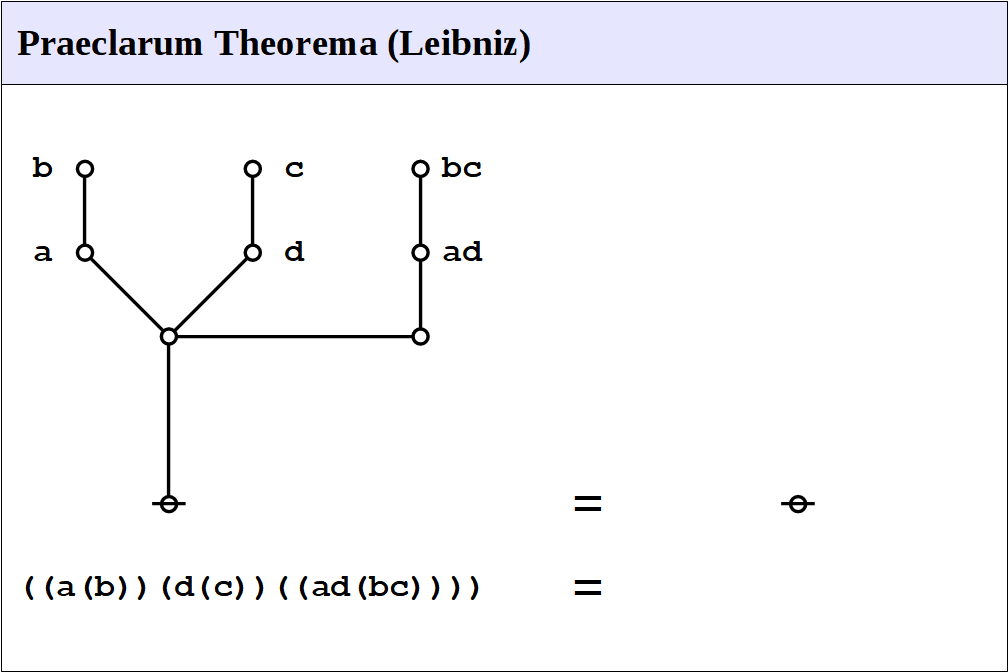
Expressed as a logical graph under the existential interpretation, the theorem takes the shape of the following formal equivalence or propositional equation.

Praeclarum Theorema (Leibniz)

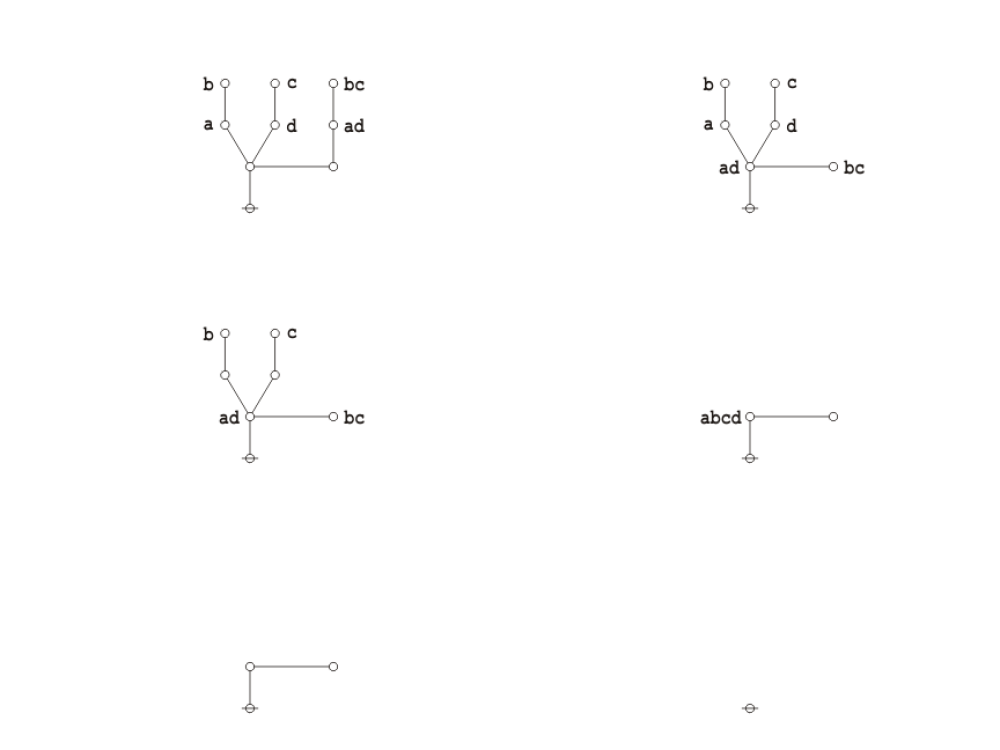
And here’s a neat proof of that nice theorem —

Praeclarum Theorema • Proof

The steps of the proof are replayed in the following animation.

Praeclarum Theorema • Proof Animation

Reference

  • Leibniz, Gottfried W. (1679–1686?), “Addenda to the Specimen of the Universal Calculus”, pp. 40–46 in G.H.R. Parkinson (ed., trans., 1966), Leibniz : Logical Papers, Oxford University Press, London, UK.

Readings

Resources

cc: FB | Logical Graphs • Laws of Form • Mathstodon • Academia.edu
cc: Conceptual Graphs • Cybernetics • Structural Modeling • Systems Science

Posted in Abstraction, Animata, C.S. Peirce, Cactus Graphs, Deduction, Equational Inference, Form, Graph Theory, Laws of Form, Leibniz, Logic, Logical Graphs, Mathematics, Model Theory, Painted Cacti, Peirce, Praeclarum Theorema, Proof Theory, Propositional Calculus, Propositional Equation Reasoning Systems, Semiotics, Spencer Brown | Tagged , , , , , , , , , , , , , , , , , , , , , | 17 Comments

Logical Graphs • Formal Development

Logical graphs are next presented as a formal system by going back to the initial elements and developing their consequences in a systematic manner.

Formal Development

Logical Graphs • First Impressions gives an informal introduction to the initial elements of logical graphs and hopefully supplies the reader with an intuitive sense of their motivation and rationale.

The next order of business is to give the precise axioms used to develop the formal system of logical graphs.  The axioms derive from C.S. Peirce’s various systems of graphical syntax via the calculus of indications described in Spencer Brown’s Laws of Form.  The formal proofs to follow will use a variation of Spencer Brown’s annotation scheme to mark each step of the proof according to which axiom is called to license the corresponding step of syntactic transformation, whether it applies to graphs or to strings.

Axioms

The formal system of logical graphs is defined by a foursome of formal equations, called initials when regarded purely formally, in abstraction from potential interpretations, and called axioms when interpreted as logical equivalences.  There are two arithmetic initials and two algebraic initials, as shown below.

Arithmetic Initials

Axiom I₁

Axiom I₂

Algebraic Initials

Axiom J₁

Axiom J₂

Logical Interpretation

One way of assigning logical meaning to the initial equations is known as the entitative interpretation (En).  Under En, the axioms read as follows.

\begin{array}{ccccc}  \mathrm{I_1}  & : & \text{true} ~ \text{or} ~ \text{true}  & = & \text{true}  \\[4pt]  \mathrm{I_2}  & : & \text{not} ~ \text{true}  & = & \text{false}  \\[4pt]  \mathrm{J_1}  & : & a ~ \text{or} ~ \text{not} ~ a  & = & \text{true}  \\[4pt]  \mathrm{J_2}  & : & (a ~ \text{or} ~ b) ~ \text{and} ~ (a ~ \text{or} ~ c)  & = & a ~ \text{or} ~ (b ~ \text{and} ~ c)  \end{array}

Another way of assigning logical meaning to the initial equations is known as the existential interpretation (Ex).  Under Ex, the axioms read as follows.

\begin{array}{ccccc}  \mathrm{I_1}  & : & \text{false} ~ \text{and} ~ \text{false}  & = & \text{false}  \\[4pt]  \mathrm{I_2}  & : & \text{not} ~ \text{false}  & = & \text{true}  \\[4pt]  \mathrm{J_1}  & : & a ~ \text{and} ~ \text{not} ~ a   & = & \text{false}  \\[4pt]  \mathrm{J_2}  & : & (a ~ \text{and} ~ b) ~ \text{or} ~ (a\ \text{and}\ c)  & = & a ~ \text{and} ~ (b ~ \text{or} ~ c)  \end{array}

Equational Inference

All the initials I_1, I_2, J_1, J_2 have the form of equations.  This means the inference steps they license are reversible.  The proof annotation scheme employed below makes use of double bars =\!=\!=\!=\!=\!= to mark this fact, though it will often be left to the reader to decide which of the two possible directions is the one required for applying the indicated axiom.

The actual business of proof is a far more strategic affair than the routine cranking of inference rules might suggest.  Part of the reason for this lies in the circumstance that the customary types of inference rules combine the moving forward of a state of inquiry with the losing of information along the way that doesn’t appear immediately relevant, at least, not as viewed in the local focus and short run of the proof in question.  Over the long haul, this has the pernicious side‑effect that one is forever strategically required to reconstruct much of the information one had strategically thought to forget at earlier stages of proof, where “before the proof started” can be counted as an earlier stage of the proof in view.

This is just one of the reasons it can be very instructive to study equational inference rules of the sort our axioms have just provided.  Although equational forms of reasoning are paramount in mathematics, they are less familiar to the student of the usual logic textbooks, who may find a few surprises here.

Frequently Used Theorems

To familiarize ourselves with equational proofs in logical graphs let’s run though the proofs of a few basic theorems in the primary algebra.

C1.  Double Negation Theorem

The first theorem goes under the names of Consequence 1 (C1), the double negation theorem (DNT), or Reflection.

Double Negation Theorem

The proof that follows is adapted from the one George Spencer Brown gave in his book Laws of Form and credited to two of his students, John Dawes and D.A. Utting.

Double Negation Theorem • Proof

C2.  Generation Theorem

One theorem of frequent use goes under the nickname of the weed and seed theorem (WAST). The proof is just an exercise in mathematical induction, once a suitable basis is laid down, and it will be left as an exercise for the reader. What the WAST says is that a label can be freely distributed or freely erased anywhere in a subtree whose root is labeled with that label. The second in our list of frequently used theorems is in fact the base case of this weed and seed theorem. In LOF it goes by the names of Consequence 2 (C2) or Generation.

Logical Graph Figure 27 (27)

Here is a proof of the Generation Theorem.

Logical Graph Figure 28 (28)

C3.  Dominant Form Theorem

The third of the frequently used theorems of service to this survey is one that Spencer-Brown annotates as Consequence 3 (C3) or Integration. A better mnemonic might be dominance and recession theorem (DART), but perhaps the brevity of dominant form theorem (DFT) is sufficient reminder of its double-edged role in proofs.

Logical Graph Figure 29 (29)

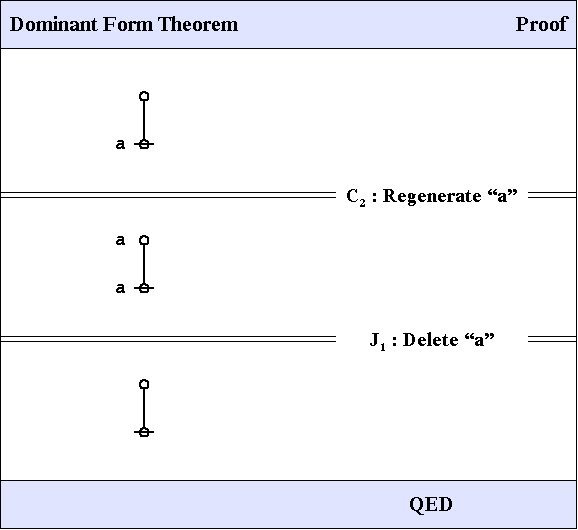
Here is a proof of the Dominant Form Theorem.

Logical Graph Figure 30 (30)

Exemplary Proofs

Using no more than the axioms and theorems recorded so far, it is possible to prove a multitude of much more complex theorems. A couple of all-time favorites are listed below.

Posted in Animata, Boolean Algebra, Boolean Functions, C.S. Peirce, Cactus Graphs, Deduction, Equational Inference, Graph Theory, Laws of Form, Logic, Logical Graphs, Mathematics, Propositional Calculus, Propositional Equation Reasoning Systems, Semiotics, Spencer Brown, Visualization | Tagged , , , , , , , , , , , , , , , , | 41 Comments

Hypostatic Abstraction

The Care and Breeding of Abstract Objects

Hypostatic Abstraction is a formal operation on a subject–predicate form which preserves its information while introducing a new subject and upping the “arity” of its predicate.  To cite a notorious example, hypostatic abstraction turns “Opium is drowsifying” into “Opium has dormitive virtue”.

Introduction

Hypostatic abstraction is a formal operation which takes an element of information, as expressed in a proposition X ~\text{is}~ Y, and conceives its information to consist in the relation between that subject and another subject, as expressed in the proposition X ~\text{has}~ Y\!\text{-ness}.  The existence of the abstract subject Y\!\text{-ness} consists solely in the truth of those propositions containing the concrete predicate Y.  Hypostatic abstraction is known under many names, for example, hypostasis, objectification, reification, and subjectal abstraction.  The object of discussion or thought thus introduced is termed a hypostatic object.

The above definition is adapted from the one given by Charles Sanders Peirce (CP 4.235, “The Simplest Mathematics” (1902), in Collected Papers, CP 4.227–323).

The way that Peirce describes it, the main thing about the formal operation of hypostatic abstraction, insofar as it can be observed to operate on formal linguistic expressions, is that it converts some part of a predicate into a number of additional subjects, at the same time creating a new predicate that tells how all of the subjects are related, at least, according to the information in the original proposition.

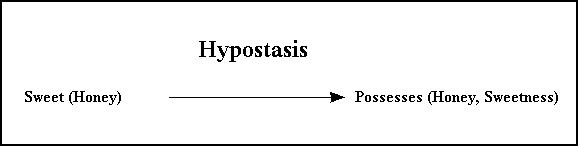
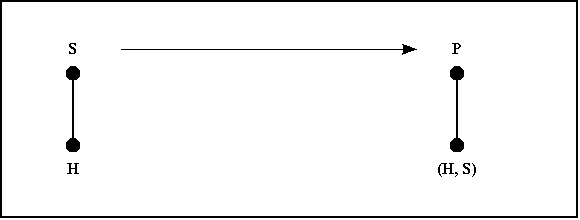
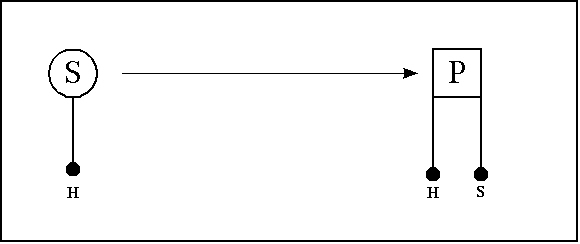
For example, a typical case of hypostatic abstraction occurs in the grammatical transformation which turns “honey is sweet” into “honey possesses sweetness”.  This transformation may be visualized in the following variety of ways.

Hypostatic Abstraction Figure 1

Hypostatic Abstraction Figure 2

Hypostatic Abstraction Figure 3

Hypostatic Abstraction Figure 4

The grammatical trace of the hypostatic transformation occurring in this case articulates a process that abstracts the adjective “sweet” from the main predicate “is sweet”, thus arriving at a new, increased-arity predicate “possesses”, and as a by-product of the reaction, as it were, precipitating out the substantive “sweetness” as a second subject of the new 2-place predicate, “possesses”.

References

  • Peirce, C.S., Collected Papers of Charles Sanders Peirce, vols. 1–6, Charles Hartshorne and Paul Weiss (eds.), vols. 7–8, Arthur W. Burks (ed.), Harvard University Press, Cambridge, MA, 1931–1935, 1958.

Resources

Posted in Abstraction, Article, C.S. Peirce, Hypostatic Abstraction, Logic, Logic of Relatives, Logical Graphs, Mathematics, Molière, Peirce, Reification, Relation Theory | Tagged , , , , , , , , , , , | 5 Comments

Pragmatic Maxim

The pragmatic maxim is a guideline for the practice of inquiry formulated by Charles Sanders Peirce.  Serving as a practical recommendation or regulative principle in the normative science of logic, its function is to guide the conduct of thought toward the achievement of its purpose, advising the addressee on an optimal way of “attaining clearness of apprehension”.

Introduction

The “pragmatic maxim”, also known as the “maxim of pragmatism” or the “maxim of pragmaticism”, is a maxim of logic formulated by Charles Sanders Peirce.  Serving as a practical recommendation or regulative principle in the normative science of logic, its function is to guide the conduct of thought toward the achievement of its purpose, advising the addressee on an optimal way of “attaining clearness of apprehension”.

Seven Ways of Looking at a Pragmatic Maxim

Peirce stated the pragmatic maxim in many different ways over the years, each of which adds its own bit of clarity or correction to their collective corpus.

  • The first excerpt appears in the form of a dictionary entry, intended as a definition of pragmatism.

    Pragmatism.  The opinion that metaphysics is to be largely cleared up by the application of the following maxim for attaining clearness of apprehension:

    “Consider what effects, that might conceivably have practical bearings, we conceive the object of our conception to have.  Then, our conception of these effects is the whole of our conception of the object.”  (Peirce, CP 5.2, 1878/1902).

  • The second excerpt gives another version of the pragmatic maxim, a recommendation about a way of clarifying meaning that can be taken to stake out the general philosophy of pragmatism.

    Pragmaticism was originally enounced in the form of a maxim, as follows:  Consider what effects that might conceivably have practical bearings you conceive the objects of your conception to have.  Then, your conception of those effects is the whole of your conception of the object.

    I will restate this in other words, since ofttimes one can thus eliminate some unsuspected source of perplexity to the reader. This time it shall be in the indicative mood, as follows: The entire intellectual purport of any symbol consists in the total of all general modes of rational conduct which, conditionally upon all the possible different circumstances and desires, would ensue upon the acceptance of the symbol.  (Peirce, CP 5.438, 1878/1905).

  • The third excerpt puts a gloss on the meaning of a practical bearing and provides an alternative statement of the maxim.

    Such reasonings and all reasonings turn upon the idea that if one exerts certain kinds of volition, one will undergo in return certain compulsory perceptions.  Now this sort of consideration, namely, that certain lines of conduct will entail certain kinds of inevitable experiences is what is called a “practical consideration”.  Hence is justified the maxim, belief in which constitutes pragmatism;  namely:

    In order to ascertain the meaning of an intellectual conception one should consider what practical consequences might conceivably result by necessity from the truth of that conception;  and the sum of these consequences will constitute the entire meaning of the conception.  (Peirce, CP 5.9, 1905).

  • The fourth excerpt illustrates one of Peirce’s many attempts to get the sense of the pragmatic philosophy across by rephrasing the pragmatic maxim in an alternative way.  In introducing this version, he addresses an order of prospective critics who do not deem a simple heuristic maxim, much less one that concerns itself with a routine matter of logical procedure, as forming a sufficient basis for a full-grown philosophy.

    On their side, one of the faults that I think they might find with me is that I make pragmatism to be a mere maxim of logic instead of a sublime principle of speculative philosophy.  In order to be admitted to better philosophical standing I have endeavored to put pragmatism as I understand it into the same form of a philosophical theorem.  I have not succeeded any better than this:

    Pragmatism is the principle that every theoretical judgment expressible in a sentence in the indicative mood is a confused form of thought whose only meaning, if it has any, lies in its tendency to enforce a corresponding practical maxim expressible as a conditional sentence having its apodosis in the imperative mood.  (Peirce, CP 5.18, 1903).

  • The fifth excerpt is useful by way of additional clarification, and was aimed to correct a variety of historical misunderstandings that arose over time with regard to the intended meaning of the pragmatic maxim.

    The doctrine appears to assume that the end of man is action — a stoical axiom which, to the present writer at the age of sixty, does not recommend itself so forcibly as it did at thirty.  If it be admitted, on the contrary, that action wants an end, and that that end must be something of a general description, then the spirit of the maxim itself, which is that we must look to the upshot of our concepts in order rightly to apprehend them, would direct us towards something different from practical facts, namely, to general ideas, as the true interpreters of our thought.  (Peirce, CP 5.3, 1902).

  • A sixth excerpt is useful in stating the bearing of the pragmatic maxim on the topic of reflection, namely, that it makes all of pragmatism boil down to nothing more or less than a method of reflection.

    The study of philosophy consists, therefore, in reflexion, and pragmatism is that method of reflexion which is guided by constantly holding in view its purpose and the purpose of the ideas it analyzes, whether these ends be of the nature and uses of action or of thought. … It will be seen that pragmatism is not a Weltanschauung but is a method of reflexion having for its purpose to render ideas clear.  (Peirce, CP 5.13 note 1, 1902).

  • The seventh excerpt is a late reflection on the reception of pragmatism.  With a sense of exasperation that is almost palpable, Peirce tries to justify the maxim of pragmatism and to correct its misreadings by pinpointing a number of false impressions that the intervening years have piled on it, and he attempts once more to prescribe against the deleterious effects of these mistakes.  Recalling the very conception and birth of pragmatism, he reviews its initial promise and its intended lot in the light of its subsequent vicissitudes and its apparent fate.  Adopting the style of a post mortem analysis, he presents a veritable autopsy of the ways that the main idea of pragmatism, for all its practicality, can be murdered by a host of misdissecting disciplinarians, by what are ostensibly its most devoted followers.

    This employment five times over of derivates of concipere must then have had a purpose.  In point of fact it had two.  One was to show that I was speaking of meaning in no other sense than that of intellectual purport.  The other was to avoid all danger of being understood as attempting to explain a concept by percepts, images, schemata, or by anything but concepts.  I did not, therefore, mean to say that acts, which are more strictly singular than anything, could constitute the purport, or adequate proper interpretation, of any symbol.  I compared action to the finale of the symphony of thought, belief being a demicadence.  Nobody conceives that the few bars at the end of a musical movement are the purpose of the movement.  They may be called its upshot.  (Peirce, CP 5.402 note 3, 1906).

References

  • Peirce, C.S., Collected Papers of Charles Sanders Peirce, vols. 1–6, Charles Hartshorne and Paul Weiss (eds.), vols. 7–8, Arthur W. Burks (ed.), Harvard University Press, Cambridge, MA, 1931–1935, 1958.  Cited as CP n.m for volume n, paragraph m.

Readings

  • Awbrey, J.L., and Awbrey, S.M. (1995), “Interpretation as Action : The Risk of Inquiry”, Inquiry : Critical Thinking Across the Disciplines 15(1), 40–52.  ArchiveJournal.  Online (doc) (pdf).

Resources

cc: Peirce MattersLaws of FormMathstodonStructural Modeling
cc: Academia.eduConceptual GraphsCyberneticsSystems Science

Posted in C.S. Peirce, Logic, Method, Peirce, Philosophy, Pragmatic Maxim, Pragmatism, References, Sources | Tagged , , , , , , , , | 29 Comments

Logic of Relatives

Relations Via Relative Terms

The logic of relatives is the study of relations as represented in symbolic forms known as rhemes, rhemata, or relative terms.

Introduction

The logic of relatives, more precisely, the logic of relative terms, is the study of relations as represented in symbolic forms called rhemes, rhemata, or relative terms.  The treatment of relations by way of their corresponding relative terms affords a distinctive perspective on the subject, even though all angles of approach must ultimately converge on the same formal subject matter.

The consideration of relative terms has its roots in antiquity but it entered a radically new phase of development with the work of Charles Sanders Peirce, beginning with his paper “Description of a Notation for the Logic of Relatives, Resulting from an Amplification of the Conceptions of Boole’s Calculus of Logic” (1870).

References

  • Peirce, C.S., “Description of a Notation for the Logic of Relatives, Resulting from an Amplification of the Conceptions of Boole’s Calculus of Logic”, Memoirs of the American Academy of Arts and Sciences 9, 317–378, 1870. Reprinted, Collected Papers CP 3.45–149. Reprinted, Chronological Edition CE 2, 359–429.
    Online (1) (2) (3).

Readings

  • Aristotle, “The Categories”, Harold P. Cooke  (trans.), pp. 1–109 in Aristotle, Vol. 1, Loeb Classical Library, William Heinemann, London, UK, 1938.
  • Aristotle, “On Interpretation”, Harold P. Cooke (trans.), pp. 111–179 in Aristotle, Vol. 1, Loeb Classical Library, William Heinemann, London, UK, 1938.
  • Aristotle, “Prior Analytics”, Hugh Tredennick (trans.), pp. 181–531 in Aristotle, Vol. 1, Loeb Classical Library, William Heinemann, London, UK, 1938.
  • Boole, George, An Investigation of the Laws of Thought on Which are Founded the Mathematical Theories of Logic and Probabilities, Macmillan, 1854. Reprinted with corrections, Dover Publications, New York, NY, 1958.
  • Peirce, C.S., Collected Papers of Charles Sanders Peirce, Vols. 1–6, Charles Hartshorne and Paul Weiss (eds.), Vols. 7–8, Arthur W. Burks (ed.), Harvard University Press, Cambridge, MA, 1931–1935, 1958. Cited as CP volume.paragraph.
  • Peirce, C.S., Writings of Charles S. Peirce : A Chronological Edition, Volume 2, 1867–1871, Peirce Edition Project (eds.), Indiana University Press, Bloomington, IN, 1984. Cited as CE 2.

Resources

Posted in C.S. Peirce, Logic, Logic of Relatives, Mathematical Logic, Mathematics, Relation Theory, Semiotics | Tagged , , , , , , | 5 Comments

Semeiotic

Theory of Signs

Semeiotic is one of the terms C.S. Peirce used for his theory of triadic sign relations and it serves to distinguish his theory of signs from other approaches to the same subject matter, more generally referred to as semiotics.

Types of Signs

There are three principal ways a sign may denote its objects.  The modes of representation are often referred to as kinds, species, or types of signs, but it is important to recognize they are not ontological species, that is, they are not mutually exclusive features of description, since the same thing can be a sign in several different ways.

Beginning very roughly, the three main ways of being a sign can be described as follows.

  • An icon denotes its objects by virtue of a quality it shares with its objects.
  • An index denotes its objects by virtue of an existential connection it has to its objects.
  • A symbol denotes its objects solely by virtue of being interpreted to do so.

One of Peirce’s early delineations of the three types of signs is still quite useful as a first approach to understanding their differences and their relationships to each other.

In the first place there are likenesses or copies — such as statues, pictures, emblems, hieroglyphics, and the like.  Such representations stand for their objects only so far as they have an actual resemblance to them — that is agree with them in some characters.  The peculiarity of such representations is that they do not determine their objects — they stand for anything more or less;  for they stand for whatever they resemble and they resemble everything more or less.

The second kind of representations are such as are set up by a convention of men or a decree of God.  Such are tallies, proper names, &c.  The peculiarity of these conventional signs is that they represent no character of their objects.  Likenesses denote nothing in particular;  conventional signs connote nothing in particular.

The third and last kind of representations are symbols or general representations.  They connote attributes and so connote them as to determine what they denote.  To this class belong all words and all conceptions.  Most combinations of words are also symbols.  A proposition, an argument, even a whole book may be, and should be, a single symbol.

C.S. Peirce, Lowell Lecture № 7, Writings 1, 467–468.

References

  • Peirce, C.S., Writings of Charles S. Peirce : A Chronological Edition, Volume 1, 1857–1866, Peirce Edition Project (eds.), Indiana University Press, Bloomington, IN, 1982.
  • Peirce, C.S. (1865), “On the Logic of Science”, Harvard University Lectures, Writings 1, 161–302.
  • Peirce, C.S. (1866), “The Logic of Science, or, Induction and Hypothesis”, Lowell Institute Lectures, Writings 1, 357–504.

Readings

  • Awbrey, J.L., and Awbrey, S.M. (1995), “Interpretation as Action : The Risk of Inquiry”, Inquiry : Critical Thinking Across the Disciplines 15(1), 40–52. Archive. Journal.
    Online (doc) (pdf).

Resources

Posted in C.S. Peirce, Icon Index Symbol, Logic, Logic of Relatives, Logic of Science, Mathematics, Peirce, Pragmatics, Relation Theory, Semantics, Semeiosis, Semeiotic, Semiosis, Semiotics, Sign Relations, Syntax, Triadic Relations | Tagged , , , , , , , , , , , , , , , , | 9 Comments

Logical Graphs • Introduction

Moving Pictures of Thought

A logical graph is a graph-theoretic structure in one of the styles of graphical syntax that Charles Sanders Peirce developed for logic.

Introduction

A logical graph is a special type of graph-theoretic structure in any one of several systems of graphical syntax that Charles Sanders Peirce developed for logic.

In his papers on qualitative logic, entitative graphs, and existential graphs, Peirce developed several versions of a graphical formalism, or a graph-theoretic formal language, designed to be interpreted for logic.

In the century since Peirce initiated this line of development, a variety of formal systems have branched out from what is abstractly the same formal base of graph-theoretic structures.  This article examines the common basis of these formal systems from a bird’s eye view, focusing on the aspects of form shared by the entire family of algebras, calculi, or languages, however they happen to be viewed in a given application.

Abstract Point of View

The bird’s eye view in question is more formally known as the perspective of formal equivalence, from which remove one overlooks many distinctions that appear momentous in more concrete settings.  Expressions inscribed in different formalisms whose syntactic structures are algebraically or topologically isomorphic are not recognized as being different from each other in any significant sense.  An eye to historical detail will note in passing that C.S. Peirce used a streamer-cross symbol where Spencer Brown used a carpenter’s square marker to roughly the same formal purpose, for instance, but the main theme of interest at the level of pure form is indifferent to variations of that order.

In Lieu of a Beginning

Consider the following two formal equations:
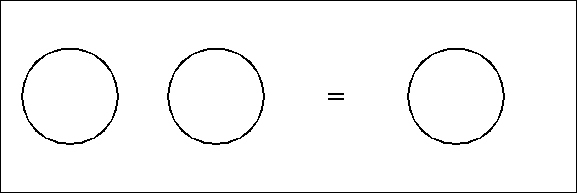

Logical Graph Figure 1
(1)

Logical Graph Figure 2
(2)

Duality : Logical and Topological

There are two types of duality that have to be kept separately mind in the use of logical graphs, logical duality and topological duality.

There is a standard way that graphs of the order that Peirce considered, those embedded in a continuous manifold like that commonly represented by a plane sheet of paper — with or without the paper bridges that Peirce used to augment its topological genus — can be represented in linear text as what are called parse strings or traversal strings and parsed into pointer structures in computer memory.

A blank sheet of paper can be represented in linear text as a blank space, but that way of doing it tends to be confusing unless the logical expression under consideration is set off in a separate display.

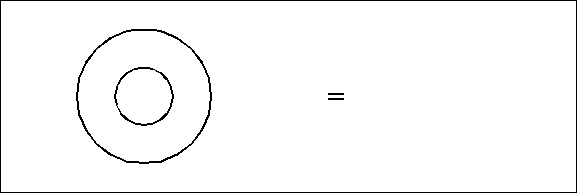
For example, consider the axiom or initial equation that is shown below:
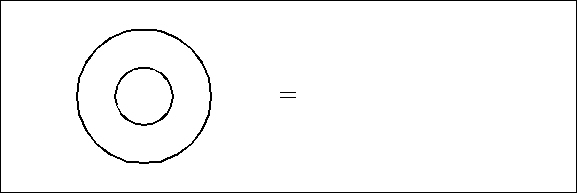

Logical Graph Figure 3
(3)

This can be written inline as “( ( ) ) =    ” or set off in a text display:

( ( ) ) =    

When we turn to representing the corresponding expressions in computer memory, where they can be manipulated with the greatest of ease, we begin by transforming the planar graphs into their topological duals. The planar regions of the original graph correspond to nodes (or points) of the dual graph, and the boundaries between planar regions in the original graph correspond to edges (or lines) between the nodes of the dual graph.

For example, overlaying the corresponding dual graphs on the plane-embedded graphs shown above, we get the following composite picture:
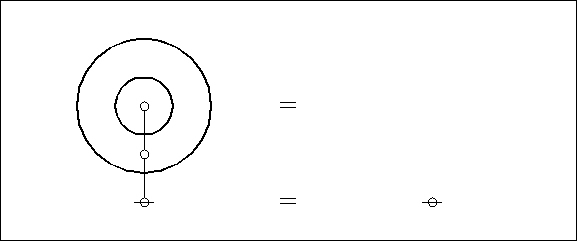

Logical Graph Figure 4
(4)

Though it’s not really there in the most abstract topology of the matter, for all sorts of pragmatic reasons we find ourselves compelled to single out the outermost region of the plane in a distinctive way and to mark it as the root node of the corresponding dual graph.  In the present style of Figure the root nodes are marked by horizontal strike-throughs.

Extracting the dual graphs from their composite matrix, we get this picture:
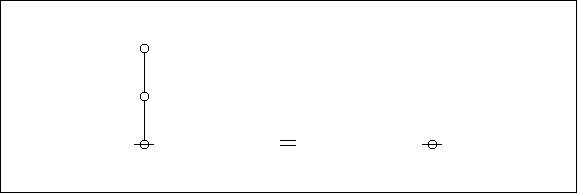

Logical Graph Figure 5
(5)

It is easy to see the relationship between the parenthetical representations of Peirce’s logical graphs, that somewhat clippedly picture the ordered containments of their formal contents, and the associated dual graphs, that form a species of rooted trees to be described in greater detail below.

In the case of our last example, a moment’s contemplation of the following picture will lead us to see that we can get the corresponding parenthesis string by starting at the root of the tree, climbing up the left side of the tree until we reach the top, then climbing back down the right side of the tree until we return to the root, all the while reading off the symbols, in this case either “(” or “)”, that we happen to encounter in our travels.


Logical Graph Figure 6
(6)

This ritual is called traversing the tree, and the string read off is often called the traversal string of the tree. The reverse ritual, that passes from the string to the tree, is called parsing the string, and the tree constructed is often called the parse graph of the string. The users of this jargon tend to use it loosely, often using parse string to mean the string that gets parsed into the associated graph.

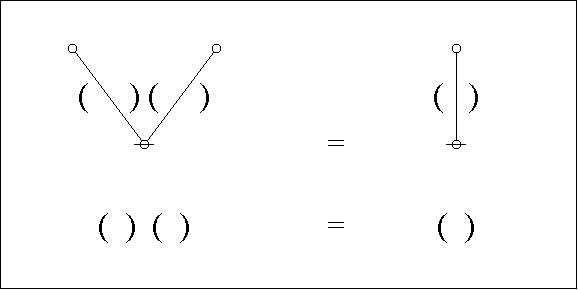
We have now treated in some detail various forms of the axiom or initial equation that is formulated in string form as “( ( ) ) =    ”. For the sake of comparison, let’s record the planar and dual forms of the axiom that is formulated in string form as “( )( ) = ( )”.

First the plane-embedded maps:
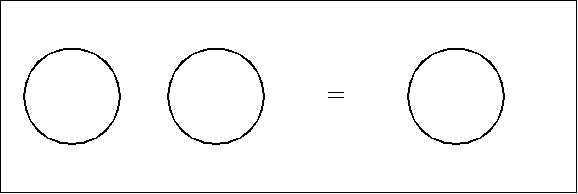

Logical Graph Figure 7
(7)

Next the plane maps and their dual trees superimposed:


Logical Graph Figure 8
(8)

Finally the rooted trees by themselves:
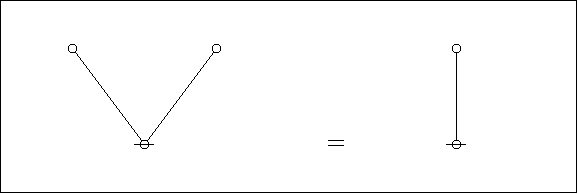

Logical Graph Figure 9
(9)

And here are the parse trees with their traversal strings indicated:


Logical Graph Figure 10
(10)

We have at this point enough material to begin thinking about the forms of analogy, iconicity, metaphor, morphism, whatever you want to call them, that are pertinent to the use of logical graphs in their various logical interpretations, for instance, those that Peirce described as entitative graphs and existential graphs.

Computational Representation

The parse graphs that we’ve been looking at so far bring us one step closer to the pointer graphs that it takes to make these maps and trees live in computer memory, but they are still a couple of steps too abstract to detail the concrete species of dynamic data structures that we need. The time has come to flesh out the skeletons that we have drawn up to this point.

Nodes in a graph represent records in computer memory. A record is a collection of data that can be conceived to reside at a specific address. The address of a record is analogous to a demonstrative pronoun, a word like this or that, on which account programmers commonly describe it as a pointer and semioticians recognize it as a type of sign called an index.

At the next level of concreteness, a pointer→record data structure can be represented as follows:


Logical Graph Figure 11
(11)

This portrays index0 as the address of a record that contains the following data:

datum1, datum2, datum3, …, and so on.

What makes it possible to represent graph-theoretical structures as data structures in computer memory is the fact that an address is just another datum, and so we may have a state of affairs like the following:
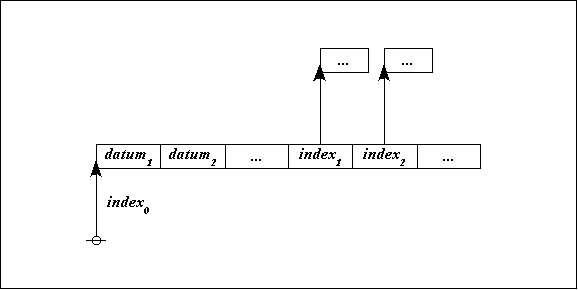
Logical Graph Figure 12 (12)

Returning to the abstract level, it takes three nodes to represent the three data records illustrated above: one root node connected to a couple of adjacent nodes. The items of data that do not point any further up the tree are then treated as labels on the record-nodes where they reside, as shown below:


Logical Graph Figure 13
(13)

Notice that drawing the arrows is optional with rooted trees like these, since singling out a unique node as the root induces a unique orientation on all the edges of the tree, with up being the same direction as away from the root.

Quick Tour of the Neighborhood

This much preparation allows us to take up the founding axioms or initial equations that determine the entire system of logical graphs.

Primary Arithmetic as Semiotic System

Though it may not seem too exciting, logically speaking, there are many reasons to make oneself at home with the system of forms that is represented indifferently, topologically speaking, by rooted trees, by balanced strings of parentheses, and by finite sets of non-intersecting simple closed curves in the plane.

  • One reason is that it gives us a respectable example of a sign domain on which to cut our semiotic teeth, non-trivial in the sense that it contains a countable infinity of signs.
  • Another reason is that it allows us to study a simple form of computation that is recognizable as a species of semiosis, or sign-transforming process.

This space of forms, along with the two axioms that induce its partition into exactly two equivalence classes, is what George Spencer Brown called the primary arithmetic.

The axioms of the primary arithmetic are shown below, as they appear in both graph and string forms, along with pairs of names that come in handy for referring to the two opposing directions of applying the axioms.
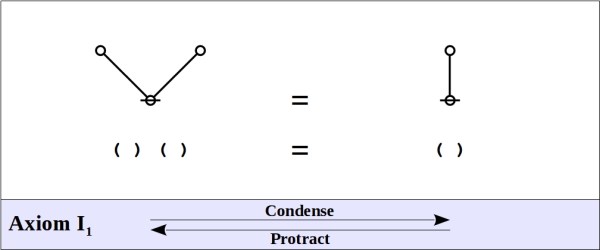
Axiom I1

Axiom I2

Let S be the set of rooted trees and let S0 be the 2-element subset consisting of a rooted node and a rooted edge. Simple intuition, or a simple inductive proof, will assure us that any rooted tree can be reduced by means of the axioms of the primary arithmetic either to a root node \ominus or else to a rooted edge \vert\, .

For example, consider the reduction that proceeds as follows:


Logical Graph Figure 16
(16)

Regarded as a semiotic process, this amounts to a sequence of signs, every one after the first serving as the interpretant of its predecessor, ending in a final sign that may be taken as the canonical sign for their common object, in the upshot being the result of the computation process. Simple as it is, this exhibits the main features of any computation, namely, a semiotic process that proceeds from an obscure sign to a clear sign of the same object, being in its aim and effect an action on behalf of clarification.

Primary Algebra as Pattern Calculus

Experience teaches that complex objects are best approached in a gradual, laminar, modular fashion, one step, one layer, one piece at a time, and it’s just as much the case when the complexity of the object is irreducible, that is, when the articulations of the representation are necessarily at joints that are cloven disjointedly from nature, with some assembly required in the synthetic integrity of the intuition.

That’s one good reason for spending so much time on the first half of zeroth order logic, represented here by the primary arithmetic, a level of formal structure C.S. Peirce verged on intuiting at numerous points and times in his work on logical graphs but Spencer Brown named and brought more completely to life.

There is one other reason for lingering a while longer in these primitive forests, and this is that an acquaintance with “bare trees”, those as yet unadorned with literal or numerical labels, will provide a firm basis for understanding what’s really at issue in such problems as the “ontological status of variables”.

It is probably best to illustrate this theme in the setting of a concrete case, which we can do by reviewing the previous example of reductive evaluation shown in Figure 16.

The observation of several semioses, or sign-transformations, of roughly this shape will most likely lead an observer with any observational facility whatever to notice that it doesn’t really matter what sorts of branches happen to sprout from the side of the root aside from the lone edge that also grows there — the end result will always be the same.

Our observer might think to summarize the results of many such observations by introducing a label or variable to signify any shape of branch whatever, writing something like the following:


Logical Graph Figure 17
(17)

Observations like that, made about an arithmetic of any variety and germinated by their summarizations, are the root of all algebra.

Speaking of algebra, and having just encountered one example of an algebraic law, we might as well introduce the axioms of the primary algebra, once again deriving their substance and their name from the works of Charles Sanders Peirce and George Spencer Brown, respectively.

Axiom J1

Axiom J2

The choice of axioms for any formal system is to some degree a matter of aesthetics, as it is commonly the case that many different selections of formal rules will serve as axioms to derive all the rest as theorems. As it happens, the example of an algebraic law that we noticed first, “a (  ) = (  )”, as simple as it appears, proves to be provable as a theorem on the grounds of the foregoing axioms.

We might also notice at this point a subtle difference between the primary arithmetic and the primary algebra with respect to the grounds of justification that we have naturally if tacitly adopted for their respective sets of axioms.

The arithmetic axioms were introduced by fiat, in a quasi-apriori fashion, though of course it is only long prior experience with the practical uses of comparably developed generations of formal systems that would actually induce us to such a quasi-primal move. The algebraic axioms, in contrast, can be seen to derive both their motive and their justification from the observation and summarization of patterns that are visible in the arithmetic spectrum.

Formal Development

Discussion of this topic continues at Logical Graphs • Formal Development.

Resources
Posted in Animata, Boolean Algebra, Boolean Functions, C.S. Peirce, Cactus Graphs, Deduction, Diagrammatic Reasoning, Equational Inference, Graph Theory, Laws of Form, Logic, Logical Graphs, Mathematics, Painted Cacti, Peirce, Propositional Calculus, Propositional Equation Reasoning Systems, Semiotics, Spencer Brown, Visualization | Tagged , , , , , , , , , , , , , , , , , , , | 43 Comments

Differential Logic

The Logic of Change and Difference

Differential logic is the logic of variation — the logic of change and difference.

Differential logic is the component of logic whose object is the description of variation, for example, the aspects of change, difference, distribution, and diversity, in universes of discourse subject to qualitative logical description.  In its formalization, differential logic treats the principles governing the use of a “differential logical calculus”, in other words, a formal system with the expressive capacity to describe change and diversity in logical universes of discourse.

A simple case of a differential logical calculus is furnished by a differential propositional calculus.  This augments ordinary propositional calculus in the same way the differential calculus of Leibniz and Newton augments the analytic geometry of Descartes.

Resources

cc: FB | Differential LogicLaws of FormMathstodonAcademia.edu
cc: Conceptual GraphsCyberneticsStructural ModelingSystems Science

Posted in Differential Logic, Discrete Dynamical Systems, Logic, Logical Graphs, Mathematics, Visualization | Tagged , , , , , | 14 Comments

Inquiry Into Inquiry

Inquiry Into Inquiry

Posted in Anthem, Inquiry, Inquiry Into Inquiry | Tagged , , | Leave a comment