Comments on Gowers’s Weblog
Comment 1.1
Having spent a good part of the 1990s writing about what the New Millennium would bring to our intellectual endeavours, it is only fair that I should have spent the last dozen years wondering why the New Millennium is so late in arriving. With all due reflection I think it is time to face the fact that the fault, Dear Gowers, is not in our technology, but in ourselves.
Here is one of my last, best attempts to get at the root of the matter:
- Journal Version
- Awbrey, S.M., and Awbrey, J.L. (2001), “Conceptual Barriers to Creating Integrative Universities”, Organization : The Interdisciplinary Journal of Organization, Theory, and Society 8(2), Sage Publications, London, UK, 269–284. Abstract. Online.
- Conference Version
- Awbrey, S.M., and Awbrey, J.L. (1999), “Organizations of Learning or Learning Organizations : The Challenge of Creating Integrative Universities for the Next Century”, Second International Conference of the Journal ‘Organization’, Re‑Organizing Knowledge, Trans‑Forming Institutions : Knowing, Knowledge, and the University in the 21st Century, University of Massachusetts, Amherst, MA. Online.
Comment 1.2
Prestige = Prestidigitation
Comment 1.3
There are indeed Big Picture questions that open up here — the future of knowledge and inquiry, the extent to which their progress will be catalyzed or inhibited by collaborative versus corporate-controlled information technologies, the stance of knowledge workers, vigilant or acquiescent, against the ongoing march of global corporate feudalism — and maybe this is not the place or time to pursue these questions, but in my experience discussion, like love and gold, is where you find it. Being questions of this magnitude, they will of course arise again. The question is — who will settle them, and to whose satisfaction?
Comment 2.1
What is inquiry? And how can we tell if a potential contribution makes an actual contribution to it? Questions like these often arise, as far as mathematical inquiry goes, in trying to build heuristic problem solvers, theorem-provers, and other sorts of mathematical amanuenses.
Charles S. Peirce, who pursued the ways of inquiry more doggedly than any thinker I have ever read, sifted the methods of “fixing belief” into four main types — Tenacity, Authority, Plausibility (à priori pleasingness), and full-fledged Scientific Inquiry.
I posed the question — “What part do arguments from authority play in mathematical reasoning?” — on MathOverFlow some time ago and received a number of interesting answers.
Comment 2.2
The late Joseph Ransdell (1931–2010), who did more to keep C.S. Peirce’s thought alive on the Web than anyone else I know, had a particular interest in the issues surrounding open peerage and publication. Synchronicity being what it is, the members of the Peirce List have been conducting a slow reading of one of Joe’s papers on the subject, where he examined the work of Paul Ginsparg on open access and Peter Skagestad on intelligence augmentation in the light of Peirce’s theory of signs, a.k.a. semiotic. Here is the paper:
Comment 2.3
Re: Eric Zaslow
In order to have an error-correcting system, or be capable of changing the mission statement in other than a random way, one has to have an independent sense of the objective. In practice, this usually means a number of independent but converging operations that tell you when and how far your system has gone off course.
Comment 2.4
Re: Edward Cree
There is a very instructive post about the difference between measures and targets (means and ends) on Peter Cameron’s Blog —
Goodhart’s law asserts:
When a measure becomes a target, it ceases to be a good measure.
Comment 2.5
Re: Edward Cree
This enters on a wide-ranging subject — one that tears me between rushing in and fearing to tread …
I didn’t get around to finishing this comment, but I think I meant to introduce a few extra readings by way of establishing the scope of this wide-ranging subject.
Readings —
Comment 3.1
As I said before, the problem is not Elsevier, but Elsewhere.
Participants in a particular paradigm of publishing or perishing are currently feeling the pinch of a proprietary system that served them in the past, feeling they have become its serfs not its lords. Will these angelic doctors look homeward, to the prisons of prestige and priority they have served to build around themselves? — Ay, there’s the rub.
On jugera …
Comment 4.1
Re: “This deserves a post to itself, despite my intention to reclaim this blog for its core purpose.”
On the other hand, we could try thinking like mathematicians about the problem before us. What are the elements of the problem, and what does it mean to think like a mathematician, anyway?
Experience tells me that private interests like publishers, and those who increasingly serve private interests on the public’s payroll, will continue to define the problem to their satisfaction and keep trying to enforce solutions that suit those interests, but we may find matter that touches our core purpose by standing back and taking a fresh look at the whole system involved.
A good start has been made —
Since I’m trying to discuss the fundamentals here, let me briefly address the question of whether the notion of the “quality” of a piece of mathematics makes sense. We certainly talk as though it makes sense, but is there something objective that underlies the seemingly subjective judgments that we make the whole time?
— Timothy Gowers • Abstract thoughts about online review systems
But it’s only a start …
Comments on John Baez’s “Azimuth”
Comment 5.1
I think that all of the world’s citizens need to start paying more attention to the push by private interests to private-profitize the entire public sector, including control over education, research, and the social media. The stakes for society and the planet cannot be overestimated.
Comments on Peter Cameron’s Blog
Comment 6.1
By nature and training a whole systems thinker, I tend to view the architecture of commerce, the architecture of government, and the architecture of inquiry as participants in a larger system.
When it comes to the desiderata of inquiry, I find myself constantly returning to the guidance of Charles S. Peirce, so elegantly maximized in the following words:
My last best expression of how I saw the problem of sustaining the soul of inquiry within the body of the post*modern millennial university is contained in the following paper:
One out of three is all I can do today …
* Yes, that’s a Kleene star. You do the math.
Comment 6.2
As far as the interaction between the dynamics of commerce and the dynamics of inquiry goes, there may always be a tension between the two value systems, the one that is coming to value short-term monetary profit above all else, and the one that orients itself toward sustainable truth over the long haul.
But I think we are passing a critical point, where the party of gold is now insisting on a right to control the whole, or else crush the party of green out of existence.
Back when this discussion starting hitting the air webs, I collected a few of my impressions on this blog page:
Comment 6.3
Re: Dratman
Peer review as a measure of quality can be replaced — and in these times there is no austerity of forces pushing to replace it with something far worse. Wherever you find a measure of quality that is too one-dimensional and simple-minded to be true, you will find that someone is getting filthy rich selling the custodians of quality a clockwork broom.
Comment 6.4
Re: James Street
We may continue to criticize establishment ways of doing everything, as I, for one, have always done, but my point is that far worse ways are now in the offing, and being pushed by forces that are resolutely alien to the common ideals of our many-splintered communities of inquiry.
Comment 6.5
Re: James Street
Strictly speaking, “peer” means “equal”. When a question cannot be settled among equals, “an umpire”, whose name derives by false division from “a non-peer“, must be called into play. However imperfect a given peer system may be in practice, nothing destroys the community and its ideals so much as umpires who insinuate themselves in the process of inquiry when there is no call for them to do so.
Comment 6.6
Re: James Street
Having said a little about the dynamics of inquiry in its own right and the impact of commerce and inquiry on each other, it was my intention to make at least tangential remarks on the other sides of the tri-umpirate: {Commerce, Government, Inquiry}.
We have quite naturally come to the lambda point of all three, but there very little but chaos reigns, so let me back up and offshore a fraction of the excess tension to a brant on my own blog —
Comment 7.1
The difference between the devil and the divinity may lie in the details, but it’s not unusual for the devil to decoy us with detail after detail, when the unexamined premiss is the screen behind which the real deil lies.
Comment 7.2
The tests themselves — good, bad, but mostly ugly — are a diversionary maneuver. The end-run we should be watching is the sneaking shift in the locus of evaluation and therefore control.
A couple of articles pertaining to the Great Education Deformation on the U.S. scene —
Naturally, Neyman blames Pearson.
Comments on Bridging Differences
Comment 8.1
The difference between the devil and the divinity may lie in the details, but it’s not unusual for the devil to decoy us with detail after detail, when the unexamined premiss is the screen behind which the real deil lies.
A bit more prosaically —
The tests themselves — good, bad, but mostly ugly — are a diversionary maneuver. The end-run we should be watching is the sneaking shift in the locus of evaluation and therefore control.
Comment 8.2
Yes, it’s all about the Locusts of Control —
Being by nature and training a whole systems thinker, I tend to view the War on Democracy, the War on Education, and the War on Science as just three fronts in a full-scale war on the ability of free societies to chart their own ships of state with information, knowledge, and wisdom about all aspects of the realities that face them.
So I think there is a lot at stake, to say the least.




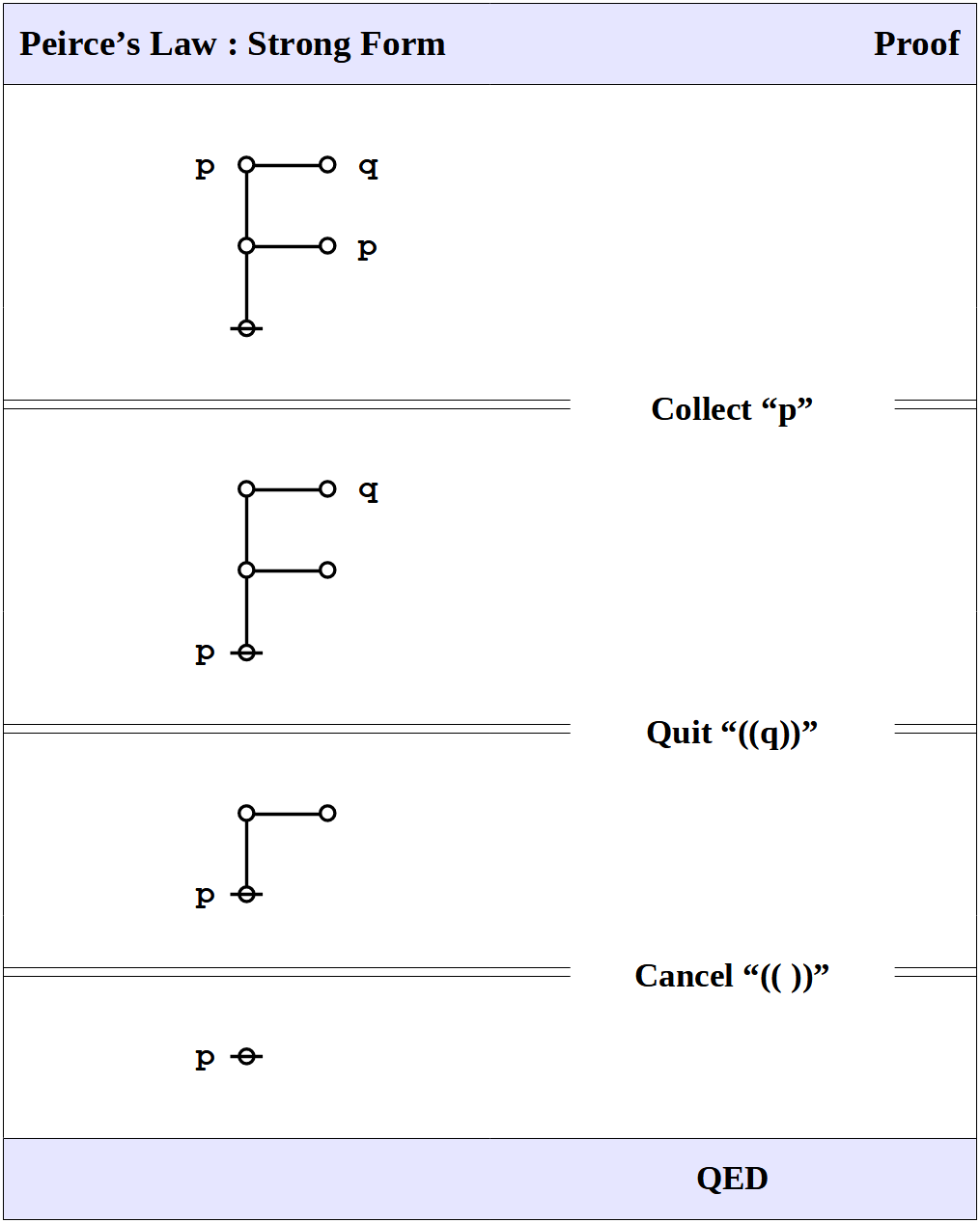
 being false while its antecedent
  is true. If this is true, either its consequent,
  is true, when the whole formula would be true, or its antecedent
  is false. But in the last case the antecedent of
  that is
 is used in such a sense that
  means that from
  every proposition follows. With that understanding, the formula states the principle of excluded middle, that from the falsity of the denial of
  (Peirce, CP 3.384).
 for implication. In one place he explains
  for less than or equal to; in another place he suggests that
  is an iconic way of representing a state of affairs where
  in every way that it can be, is



 is clear enough on general principles, since
  holds for any proposition



 Inquiry Into Inquiry
Knowledge Workers of the World, Unite❢
Comments on Gowers’s Weblog
Post 1. What’s wrong with electronic journals?
Comment 1.1
Having spent a good part of the 1990s writing about what the New Millennium would bring to our intellectual endeavours, it is only fair that I should have spent the last dozen years wondering why the New Millennium is so late in arriving. With all due reflection I think it is time to face the fact that the fault, Dear Gowers, is not in our technology, but in ourselves.
Here is one of my last, best attempts to get at the root of the matter:
Comment 1.2
Prestige = Prestidigitation
Comment 1.3
There are indeed Big Picture questions that open up here — the future of knowledge and inquiry, the extent to which their progress will be catalyzed or inhibited by collaborative versus corporate-controlled information technologies, the stance of knowledge workers, vigilant or acquiescent, against the ongoing march of global corporate feudalism — and maybe this is not the place or time to pursue these questions, but in my experience discussion, like love and gold, is where you find it. Being questions of this magnitude, they will of course arise again. The question is — who will settle them, and to whose satisfaction?
Post 2. Abstract thoughts about online review systems
Comment 2.1
What is inquiry? And how can we tell if a potential contribution makes an actual contribution to it? Questions like these often arise, as far as mathematical inquiry goes, in trying to build heuristic problem solvers, theorem-provers, and other sorts of mathematical amanuenses.
Charles S. Peirce, who pursued the ways of inquiry more doggedly than any thinker I have ever read, sifted the methods of “fixing belief” into four main types — Tenacity, Authority, Plausibility (à priori pleasingness), and full-fledged Scientific Inquiry.
I posed the question — “What part do arguments from authority play in mathematical reasoning?” — on MathOverFlow some time ago and received a number of interesting answers.
Comment 2.2
The late Joseph Ransdell (1931–2010), who did more to keep C.S. Peirce’s thought alive on the Web than anyone else I know, had a particular interest in the issues surrounding open peerage and publication. Synchronicity being what it is, the members of the Peirce List have been conducting a slow reading of one of Joe’s papers on the subject, where he examined the work of Paul Ginsparg on open access and Peter Skagestad on intelligence augmentation in the light of Peirce’s theory of signs, a.k.a. semiotic. Here is the paper:
Comment 2.3
Re: Eric Zaslow
In order to have an error-correcting system, or be capable of changing the mission statement in other than a random way, one has to have an independent sense of the objective. In practice, this usually means a number of independent but converging operations that tell you when and how far your system has gone off course.
Comment 2.4
Re: Edward Cree
There is a very instructive post about the difference between measures and targets (means and ends) on Peter Cameron’s Blog —
Goodhart’s law asserts:
Comment 2.5
Re: Edward Cree
This enters on a wide-ranging subject — one that tears me between rushing in and fearing to tread …
I didn’t get around to finishing this comment, but I think I meant to introduce a few extra readings by way of establishing the scope of this wide-ranging subject.
Readings —
Post 3. Elsevier’s open letter point by point, and some further arguments
Comment 3.1
As I said before, the problem is not Elsevier, but Elsewhere.
Participants in a particular paradigm of publishing or perishing are currently feeling the pinch of a proprietary system that served them in the past, feeling they have become its serfs not its lords. Will these angelic doctors look homeward, to the prisons of prestige and priority they have served to build around themselves? — Ay, there’s the rub.
On jugera …
Post 4. Elsevier Withdraws Support for Research Works Act
Comment 4.1
Re: “This deserves a post to itself, despite my intention to reclaim this blog for its core purpose.”
On the other hand, we could try thinking like mathematicians about the problem before us. What are the elements of the problem, and what does it mean to think like a mathematician, anyway?
Experience tells me that private interests like publishers, and those who increasingly serve private interests on the public’s payroll, will continue to define the problem to their satisfaction and keep trying to enforce solutions that suit those interests, but we may find matter that touches our core purpose by standing back and taking a fresh look at the whole system involved.
A good start has been made —
But it’s only a start …
Comments on John Baez’s “Azimuth”
Post 5. The Education of a Scientist
Comment 5.1
I think that all of the world’s citizens need to start paying more attention to the push by private interests to private-profitize the entire public sector, including control over education, research, and the social media. The stakes for society and the planet cannot be overestimated.
Comments on Peter Cameron’s Blog
Post 6. Open Access Publishing
Comment 6.1
By nature and training a whole systems thinker, I tend to view the architecture of commerce, the architecture of government, and the architecture of inquiry as participants in a larger system.
When it comes to the desiderata of inquiry, I find myself constantly returning to the guidance of Charles S. Peirce, so elegantly maximized in the following words:
My last best expression of how I saw the problem of sustaining the soul of inquiry within the body of the post*modern millennial university is contained in the following paper:
One out of three is all I can do today …
* Yes, that’s a Kleene star. You do the math.
Comment 6.2
As far as the interaction between the dynamics of commerce and the dynamics of inquiry goes, there may always be a tension between the two value systems, the one that is coming to value short-term monetary profit above all else, and the one that orients itself toward sustainable truth over the long haul.
But I think we are passing a critical point, where the party of gold is now insisting on a right to control the whole, or else crush the party of green out of existence.
Back when this discussion starting hitting the air webs, I collected a few of my impressions on this blog page:
Comment 6.3
Re: Dratman
Peer review as a measure of quality can be replaced — and in these times there is no austerity of forces pushing to replace it with something far worse. Wherever you find a measure of quality that is too one-dimensional and simple-minded to be true, you will find that someone is getting filthy rich selling the custodians of quality a clockwork broom.
Comment 6.4
Re: James Street
We may continue to criticize establishment ways of doing everything, as I, for one, have always done, but my point is that far worse ways are now in the offing, and being pushed by forces that are resolutely alien to the common ideals of our many-splintered communities of inquiry.
Comment 6.5
Re: James Street
Strictly speaking, “peer” means “equal”. When a question cannot be settled among equals, “an umpire”, whose name derives by false division from “a non-peer“, must be called into play. However imperfect a given peer system may be in practice, nothing destroys the community and its ideals so much as umpires who insinuate themselves in the process of inquiry when there is no call for them to do so.
Comment 6.6
Re: James Street
Having said a little about the dynamics of inquiry in its own right and the impact of commerce and inquiry on each other, it was my intention to make at least tangential remarks on the other sides of the tri-umpirate: {Commerce, Government, Inquiry}.
We have quite naturally come to the lambda point of all three, but there very little but chaos reigns, so let me back up and offshore a fraction of the excess tension to a brant on my own blog —
Post 7. Student Questionnaires
Comment 7.1
The difference between the devil and the divinity may lie in the details, but it’s not unusual for the devil to decoy us with detail after detail, when the unexamined premiss is the screen behind which the real deil lies.
Comment 7.2
The tests themselves — good, bad, but mostly ugly — are a diversionary maneuver. The end-run we should be watching is the sneaking shift in the locus of evaluation and therefore control.
A couple of articles pertaining to the Great Education Deformation on the U.S. scene —
Naturally, Neyman blames Pearson.
Comments on Bridging Differences
Post 8. The Pearsonizing of the American Mind
Comment 8.1
The difference between the devil and the divinity may lie in the details, but it’s not unusual for the devil to decoy us with detail after detail, when the unexamined premiss is the screen behind which the real deil lies.
A bit more prosaically —
The tests themselves — good, bad, but mostly ugly — are a diversionary maneuver. The end-run we should be watching is the sneaking shift in the locus of evaluation and therefore control.
Comment 8.2
Yes, it’s all about the Locusts of Control —
Being by nature and training a whole systems thinker, I tend to view the War on Democracy, the War on Education, and the War on Science as just three fronts in a full-scale war on the ability of free societies to chart their own ships of state with information, knowledge, and wisdom about all aspects of the realities that face them.
So I think there is a lot at stake, to say the least.
Share this: