Objects, Models, Theories : 4

Aristotle's Paradigm

I need to stay with this problem a while …

What are objects, models, theories, and how do they relate to one another?

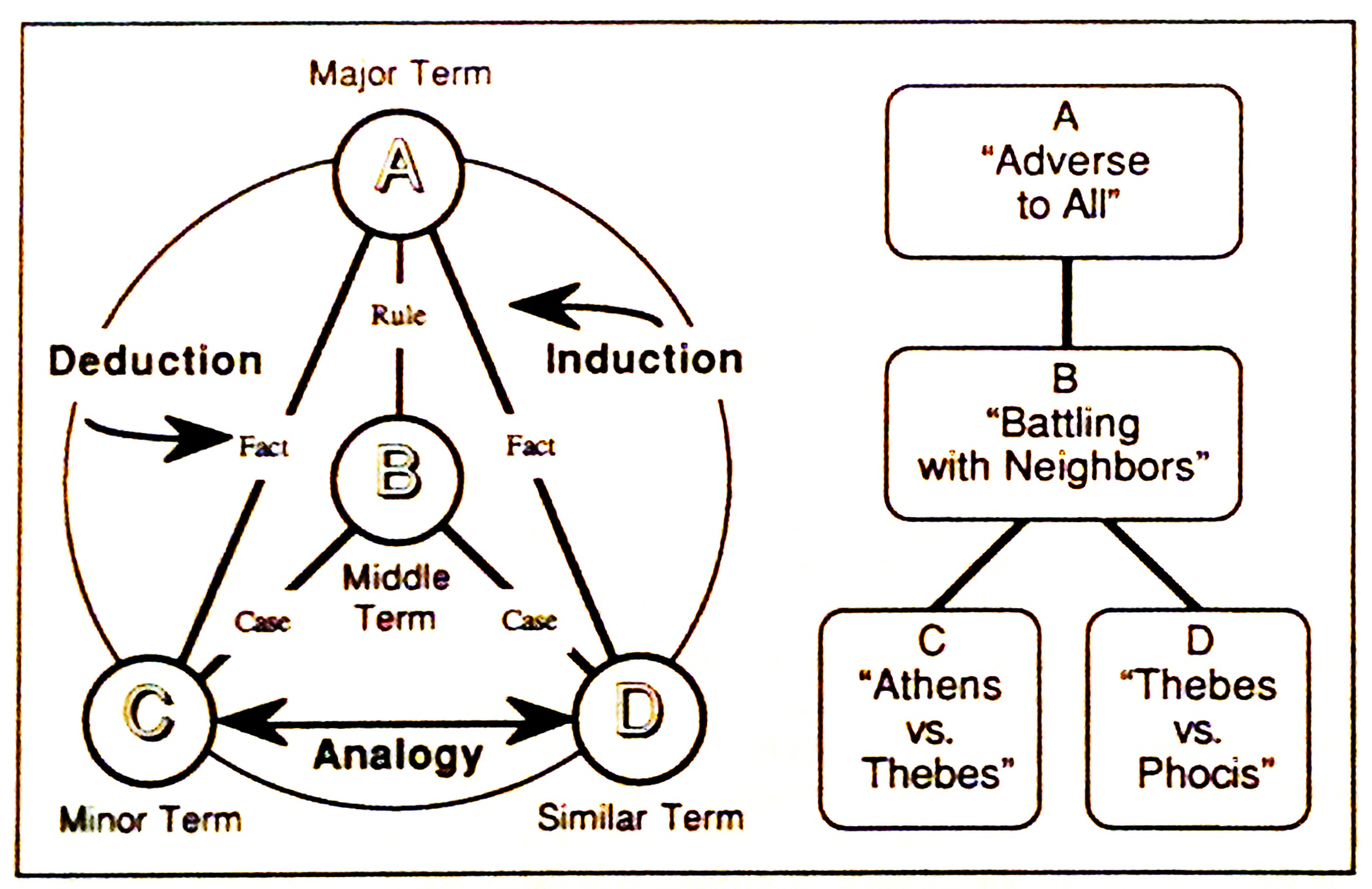
In contemplating this problem I always find it helpful to ruminate on the diagram shown above — I might even call it a mandala for its wealth of symbolic features and its aid in organizing the pro-&-con-fusion of mental impressions.

Here is the corresponding text from Aristotle and the context that leads on to Peirce:

Previous Discussions

  1. Games, Evolution, TheoryThree Types Of Mathematical Models
  2. Gödel’s Lost LetterThe Graph Of Math
  3. Peirce ListTom Gollier
  4. Peirce ListTom Gollier

Previous Posts

Related Resources

Posted in Adaptive Systems, Analogy, Aristotle, Artificial Intelligence, Biological Systems, C.S. Peirce, Computational Complexity, Evolution, Gödel, Information, Information Theory, Inquiry, Inquiry Driven Systems, Learning Theory, Logic, Logic of Science, Mathematical Models, Mental Models, Model Theory, Natural Intelligence, Paradigms, Peirce, Pragmata, Semiotics, Sign Relations | Tagged , , , , , , , , , , , , , , , , , , , , , , , , | 2 Comments

Objects, Models, Theories : 3

Re: Peirce List DiscussionTom Gollier

Here my task is to build bridges between several different classical and contemporary uses of the word model, so I don’t have the luxury of complete control over the words in play but have to start from the customary senses in the various communities of interpretation.  Of course I’m slyly working from a sign-relational backdrop, but I have to be sleight-handed about that and not hit people over the head with it.

You can probably guess that I’m using object to cover sign-relational objects, and theories are clearly syntacked together from complexes of sign-relational signs, so all we have left to pin down is where the various kinds of model sit at the table set with the labels of Object, Sign, Interpretant.

In its theoretical sense, a model of a theory is anything the theory is true of, anything that satisfies the theory.  In that sense, a model is very like an object.  It is whatever the theory is talking about.  In the order of nature, indeed, models come before theories.  But there is another order, the order of art, and one may construct artificial models out of almost any stuff, even the stuff of signs.  So you see the kind of wiggle room we have to work with.

Things are easier outside of logic, in applied mathematics and the special sciences, where models are just things like analogues, icons, simulations, and similar representations of objects.  But that makes them objects serving as signs of other objects, and so you may find some semiotic subtlety lurking there.

Previous Posts

Related Resources

Posted in Adaptive Systems, Analogy, Aristotle, Artificial Intelligence, Biological Systems, C.S. Peirce, Computational Complexity, Evolution, Gödel, Information, Inquiry, Inquiry Driven Systems, Learning Theory, Logic, Logic of Science, Mathematical Models, Mental Models, Model Theory, Natural Intelligence, Peirce, Pragmata, Semiotics, Sign Relations | Tagged , , , , , , , , , , , , , , , , , , , , , , | 4 Comments

Objects, Models, Theories : 2

Re: K.W. ReganThe Graph Of Math
Re: Artem KaznatcheevThree Types Of Mathematical Models

What — if anything — is the common sense that connects the different senses of the word model, as it has been used over the years in logic, mathematics, and the special sciences?  It’s a problem I’ve been running into for several decades now and I think I can trace the roots of it going back as far as Aristotle’s treatment of analogy.  Just by way of creating a bit of trans-disciple-ary interaction, here’s a link to a link of the issue’s most recent arising in my own roll of blogs.

Posted in Adaptive Systems, Analogy, Aristotle, Artificial Intelligence, Biological Systems, C.S. Peirce, Computational Complexity, Evolution, Gödel, Information, Inquiry, Inquiry Driven Systems, Learning Theory, Logic, Logic of Science, Mathematical Models, Mental Models, Model Theory, Natural Intelligence, Peirce, Pragmata, Semiotics | Tagged , , , , , , , , , , , , , , , , , , , , , | 8 Comments

Alpha Now, Omega Later • 1

I am still in the middle of trying to catch up on some long put-off work but recent discussions of logical graphs and physics and the like on the Peirce List have bestirred me from my grindstone long enough to pass on a few links to the things I’ve been doing along those lines.  This is all “Alpha” as far as Peirce’s graphology goes but one of the things we’ve learned in recent decades from computational complexity theory is just how key a role problems like propositional calculus play in solving many other problems of practical interest, so I won’t make any further apology for focusing attention on this “zeroth order” level of logic.  I don’t have much to say about physics per se, but if we generalize our concept of dynamics and speak of systems theory as a study of media and populations that move through their state spaces over spans of time, then I think it is useful to take up that perspective on the time evolution of logical media informed by logical signs.

Posted in C.S. Peirce, Differential Logic, Dynamical Systems, Equational Inference, Laws of Form, Logic, Logical Graphs, Mathematics, Propositional Calculus, Semiotics, Sign Relations, Spencer Brown | Tagged , , , , , , , , , , , | 8 Comments

“What we’ve got here is (a) failure to communicate” • 6

Excerpt from Warren S. McCulloch, “What Is a Number, that a Man May Know It, and a Man, that He May Know a Number?” (1960)

Please remember that we are not now concerned with the physics and chemistry, the anatomy and physiology, of man.  They are my daily business.  They do not contribute to the logic of our problem.  Despite Ramon Lull’s combinatorial analysis of logic and all of his followers, including Leibniz with his universal characteristic and his persistent effort to build logical computing machines, from the death of William of Ockham logic decayed.  There were, of course, teachers of logic.  The forms of the syllogism and the logic of classes were taught, and we shall use some of their devices, but there was a general recognition of their inadequacy to the problems in hand.  […]  The difficulty is that they had no knowledge of the logic of relations, and almost none of the logic of propositions.  These logics really began in the latter part of the last century with Charles Peirce as their great pioneer.  As with most pioneers, many of the trails he blazed were not followed for a score of years.  For example, he discovered the amphecks — that is, “not both … and …” and “neither … nor …”, which Sheffer rediscovered and are called by his name for them, “stroke functions”.

It was Peirce who broke the ice with his logic of relatives, from which springs the pitiful beginnings of our logic of relations of two and more than two arguments.  So completely had the traditional Aristotelian logic been lost that Peirce remarks that when he wrote the Century Dictionary he was so confused concerning abduction, or apagoge, and induction that he wrote nonsense.  Thus Aristotelian logic, like the skeleton of Tom Paine, was lost to us from the world it had engendered.  Peirce had to go back to Duns Scotus to start again the realistic logic of science.  Pragmatism took hold, despite its misinterpretation by William James.  The world was ripe for it.  Frege, Peano, Whitehead, Russell, Wittgenstein, followed by a host of lesser lights, but sparked by many a strange character like Schroeder, Sheffer, Gödel, and company, gave us a working logic of propositions.  By the time I had sunk my teeth into these questions, the Polish school was well on its way to glory.

In 1923 I gave up the attempt to write a logic of transitive verbs and began to see what I could do with the logic of propositions.  My object, as a psychologist, was to invent a kind of least psychic event, or “psychon”, that would have the following properties:  First, it was to be so simple an event that it either happened or else it did not happen.  Second, it was to happen only if its bound cause had happened — shades of Duns Scotus! — that is, it was to imply its temporal antecedent.  Third, it was to propose this to subsequent psychons.  Fourth, these were to be compounded to produce the equivalents of more complicated propositions concerning their antecedents.

In 1929 it dawned on me that these events might be regarded as the all-or-none impulses of neurons, combined by convergence upon the next neuron to yield complexes of propositional events.  (McCulloch 1965, 7–9).

References

  • McCulloch, Warren S. (1961), “What Is a Number that a Man May Know It, and a Man, that He May Know a Number?”, Ninth Alfred Korzybski Memorial Lecture, General Semantics Bulletin, Numbers 26 and 27, pp. 7–18, Institute of General Semantics, Lakeville, CT.  Reprinted in Embodiments of Mind, pp. 1–18.  Online (1) (2).
  • McCulloch, Warren S. (1965), Embodiments of Mind, MIT Press, Cambridge, MA.
Posted in Abduction, Amphecks, Aristotle, Automata, Boolean Algebra, Boolean Functions, C.S. Peirce, Combinatorics, Deduction, Duns Scotus, Induction, Leibniz, Logic, Logic of Relatives, Mathematics, Neural Models, Ockham, Peirce, Propositional Logic, Psychons, Relation Theory, Sources, Triadic Relations, Warren S. McCulloch, William James | Tagged , , , , , , , , , , , , , , , , , , , , , , , , | 1 Comment

“What we’ve got here is (a) failure to communicate” • 5

Excerpt from C.S. Peirce, “Minute Logic” (1902), CP 2.144–148

2.2. Why Study Logic?

2.2.5. Reasoning and Expectation

144.   But since you propose to study logic, you have more or less faith in reasoning, as affording knowledge of the truth. Now reasoning is a very different thing indeed from the percept, or even from perceptual facts. For reasoning is essentially a voluntary act, over which we exercise control. If it were not so, logic would be of no use at all. For logic is, in the main, criticism of reasoning as good or bad. Now it is idle so to criticize an operation which is beyond all control, correction, or improvement.

145.   You have, therefore, to inquire, first, in what sense you have any faith in reasoning, seeing that its conclusions cannot in the least resemble the percepts, upon which alone implicit reliance is warranted. Conclusions of reasoning can little resemble even the perceptual facts. For besides being involuntary, these latter are strictly memories of what has taken place in the recent past, while all conclusions of reasoning partake of the general nature of expectations of the future. What two things can be more disparate than a memory and an expectation?

147.   The second branch of the question, when you have decided in what your faith in reasoning consists, will inquire just what it is that justifies that faith. The simulation of doubt about things indubitable or not really doubted is no more wholesome than is any other humbug; yet the precise specification of the evidence for an undoubted truth often in logic throws a brilliant light in one direction or in another, now pointing to a corrected formulation of the proposition, now to a better comprehension of its relations to other truths, again to some valuable distinctions, etc.

148.   As to the former branch of this question, it will be found upon consideration that it is precisely the analogy of an inferential conclusion to an expectation which furnishes the key to the matter. An expectation is a habit of imagining. A habit is not an affection of consciousness; it is a general law of action, such that on a certain general kind of occasion a man will be more or less apt to act in a certain general way. An imagination is an affection of consciousness which can be directly compared with a percept in some special feature, and be pronounced to accord or disaccord with it. Suppose for example that I slip a cent into a slot, and expect on pulling a knob to see a little cake of chocolate appear. My expectation consists in, or at least involves, such a habit that when I think of pulling the knob, I imagine I see a chocolate coming into view. When the perceptual chocolate comes into view, my imagination of it is a feeling of such a nature that the percept can be compared with it as to size, shape, the nature of the wrapper, the color, taste, flavor, hardness and grain of what is within. Of course, every expectation is a matter of inference. What an inference is we shall soon see more exactly than we need just now to consider. For our present purpose it is sufficient to say that the inferential process involves the formation of a habit. For it produces a belief, or opinion; and a genuine belief, or opinion, is something on which a man is prepared to act, and is therefore, in a general sense, a habit. A belief need not be conscious.

Peirce, C.S., Collected Papers of Charles Sanders Peirce, vols. 1–6, Charles Hartshorne and Paul Weiss (eds.), vols. 7–8, Arthur W. Burks (ed.), Harvard University Press, Cambridge, MA, 1931–1935, 1958. Volume 2 : Elements of Logic, 1932. Reprinted with corrections, 1960.

Posted in Anthem, C.S. Peirce, Communication, Meditation, Peirce, References, Sources | Tagged , , , , , , | 2 Comments

“What we’ve got here is (a) failure to communicate” • 4

Excerpt from Sigmund Freud, “Project for a Scientific Psychology” (1895)

The Experience of Satisfaction

The filling of the nuclear neurones in Ψ has as its consequence an effort to discharge, an impetus which is released along motor pathways. Experience shows that the first path to be followed is that leading to internal change (e.g., emotional expression, screaming, or vascular innervation). But, as we showed at the beginning of the discussion, no discharge of this kind can bring about any relief of tension, because endogenous stimuli continue to be received in spite of it and the Ψ-tension is re-established. Here a removal of the stimulus can only be effected by an intervention which will temporarily stop the release of quantity (Qἠ) in the interior of the body, and an intervention of this kind requires an alteration in the external world (e.g., the supply of nourishment or the proximity of the sexual object), and this, as a “specific action”, can only be brought about in particular ways. At early stages the human organism is incapable of achieving this specific action. It is brought about by extraneous help, when the attention of an experienced person has been drawn to the child’s condition by a discharge taking place along the path of internal change [e.g., by the child’s screaming]. This path of discharge thus acquires an extremely important secondary function — viz., of bringing about an understanding with other people; and the original helplessness of human beings is thus the primal source of all moral motives.

When the extraneous helper has carried out the specific action in the external world on behalf of the helpless subject, the latter is in a position, by means of reflex contrivances, immediately to perform what is necessary in the interior of his body in order to remove the endogenous stimulus. This total event then constitutes an “experience of satisfaction”, which has the most momentous consequences in the functional development of the individual.

Thus the experience of satisfaction leads to a facilitation between the two memory-images [of the object wished-for and of the reflex movement] and the nuclear neurones which had been cathected during the state of urgency. (No doubt, during [the actual course of] the discharge brought about by the satisfaction, the quantity (Qἠ) flows out of the memory-images as well.) Now, when the state of urgency or wishing re-appears, the cathexis will pass also to the two memories and will activate them. And in all probability the memory-image of the object will be the first to experience this wishful activation.

I have no doubt that the wishful activation will in the first instance produce something similar to a perception — namely, a hallucination. And if this leads to the performance of the reflex action, disappointment will inevitably follow. (Freud, 379–381).

Sigmund Freud, “Project for a Scientific Psychology” (1895), pp. 347–445 in The Origins of Psycho-Analysis : Letters to Wilhelm Fliess, Drafts and Notes, 1887–1902, Marie Bonaparte, Anna Freud, Ernst Kris (eds.), Eric Mosbacher and James Strachey (trans.), Basic Books, New York, NY, 1954.

Posted in Anthem, Communication, Freud, Meditation, References, Sources | Tagged , , , , , | 3 Comments

“What we’ve got here is (a) failure to communicate” • 3

Communication, as you may have guessed, is one of those areas where I more often mis- than hit, so I always have lots of chances to reflect on the trials of communication, its ways and waylays.

Communication works if the signs I make call others to the cause that made me make those signs.

Posted in Anthem, Communication, Meditation | Tagged , , | 1 Comment

“What we’ve got here is (a) failure to communicate” • 2

There are areas of human concern and conduct where I have a lot of personal experience but very little positive knowledge — my experiences are rich in disappointment, failure, frustration, very spare in success.  What knowledge I gain is the unkind kind that defines a domain in relief, from outside its pale.

Posted in Anthem, Communication, Meditation | Tagged , , | 1 Comment

“What we’ve got here is (a) failure to communicate” • 1

A figure rises, in bas relief, as the ground slips away …

Posted in Anthem, Communication, Meditation | Tagged , , | 6 Comments