Let us make a few preliminary observations about the operation of logical involution which Peirce introduces in the following words.
In ordinary arithmetic the involution  or the exponentiation of
  to the power
  is the repeated application of the multiplier for as many times as there are ones making up the exponent
In analogous fashion, the logical involution  is the repeated application of the term
  for as many times as there are individuals under the term
  On Peirce’s interpretive rules, the repeated applications of the base term are distributed across the individuals of the exponent term In particular, the base term is not applied successively in the manner that would give something on the order of “a lover of a lover of … a lover of a woman”.
By way of example, suppose a universe of discourse numbers among its elements just three women,  In Peirce’s notation the fact may be written as follows.

In that case the following equation would hold.

The equation says a lover of every woman in the aggregate  is a lover of
  that is a lover of
  that is a lover of
  In other words, a lover of every woman in the universe at hand is a lover of and a lover of and a lover of
The denotation of the term is a subset of  which may be obtained by the following procedure. For each flag of the form
  with
with  collect the subset
  of elements which appear as the first components of the pairs in and then take the intersection of all those subsets. Putting it all together, we have the following equation.

It is instructive to examine the matrix representation of at this point, not the least because it effectively dispels the mystery of the name involution. First, we make the following observation. To say  is a lover of every woman is to say loves
  if is a woman. That can be rendered in symbols as follows.

Reading the formula as “ loves if is a woman” highlights the operation of converse implication inherent in it, and this in turn reveals the analogy between implication and involution which accounts for the aptness of the latter name.
The operations defined by the formulas  in the boolean domain
  are tabulated as follows.

It is clear the two operations are isomorphic, being effectively the same operation of type  All that remains is to see how operations like these on values in
  induce the corresponding operations on sets and terms.
The term determines a selection of individuals from the universe of discourse which may be computed via the corresponding operation on coefficient matrices. If the terms and  are represented by the matrices
  and
and  respectively, then the operation on terms which produces the term must be represented by a corresponding operation on matrices,
  which produces the matrix
  In short, the involution operation on matrices must be defined in such a way that the following equation holds.

The fact that denotes individuals in a subset of tells us its matrix representation  is a 1‑dimensional array of coefficients in indexed by the elements of
  The value of the matrix at the index
  in is written
  and computed as follows.

Resources
cc: Cybernetics • Ontolog Forum • Structural Modeling • Systems Science
cc: FB | Peirce Matters • Laws of Form • Peirce List (1) (2) (3) (4) (5) (6) (7)

 can be verified by establishing the corresponding equation in matrices.
 and
and  are two 1-dimensional matrices over the same index set
  if and only if
  for every
  Thus, a routine way to check the validity of
  is to check whether the following equation holds for arbitrary
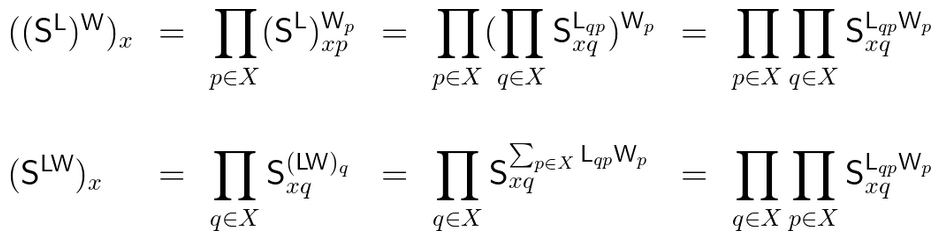
 in ordinary arithmetic holds when the values
  are restricted to the boolean domain
  Interpreted as a logical statement, the law of exponents
 ![\begin{matrix} (a \Leftarrow b) \Leftarrow c & = & a \Leftarrow b \land c \\[8pt] c \Rightarrow (b \Rightarrow a) & = & c \land b \Rightarrow a \end{matrix}](https://s0.wp.com/latex.php?latex=%5Cbegin%7Bmatrix%7D++%28a+%5CLeftarrow+b%29+%5CLeftarrow+c+%26+%3D+%26+a+%5CLeftarrow+b+%5Cland+c++%5C%5C%5B8pt%5D++c+%5CRightarrow+%28b+%5CRightarrow+a%29+%26+%3D+%26+c+%5Cland+b+%5CRightarrow+a++%5Cend%7Bmatrix%7D&bg=ffffff&fg=000000&s=1&c=20201002)

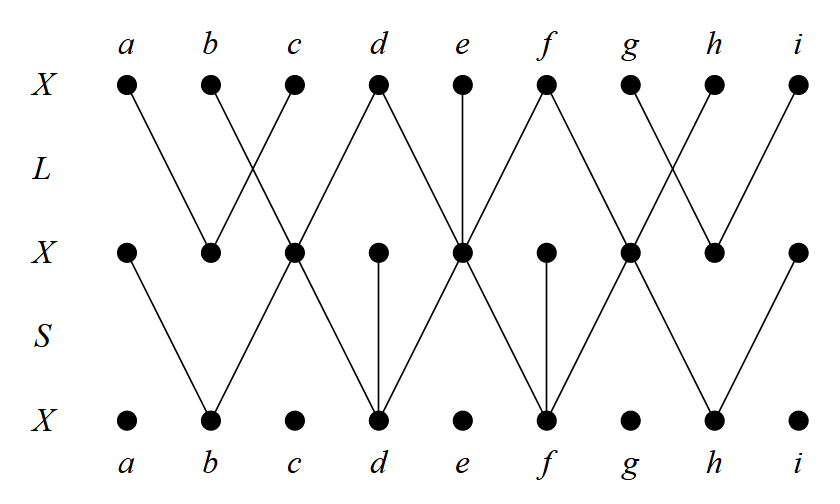
 will denote whatever stands to every woman in the relation of servant of every lover of hers; and
  will denote whatever is a servant of everything that is lover of a woman. So that

![\begin{array}{*{15}{c}} X & = & \{ & a, & b, & c, & d, & e, & f, & g, & h, & i\ & \} \\[6pt] L & = & \{ & b\!:\!a, & b\!:\!c, & c\!:\!b, & c\!:\!d, & e\!:\!d, & e\!:\!e, & e\!:\!f, & g\!:\!f, & g\!:\!h, & h\!:\!g, & h\!:\!i & \} \\[6pt] S & = & \{ & b\!:\!a, & b\!:\!c, & d\!:\!c, & d\!:\!d, & d\!:\!e, & f\!:\!e, & f\!:\!f, & f\!:\!g, & h\!:\!g, & h\!:\!i\ & \} \end{array}](https://s0.wp.com/latex.php?latex=%5Cbegin%7Barray%7D%7B%2A%7B15%7D%7Bc%7D%7D++X+%26+%3D+%26+%5C%7B+%26+a%2C+%26+b%2C+%26+c%2C+%26+d%2C+%26+e%2C+%26+f%2C+%26+g%2C+%26+h%2C+%26+i%5C+%26+%5C%7D++%5C%5C%5B6pt%5D++L+%26+%3D+%26+%5C%7B+%26+b%5C%21%3A%5C%21a%2C+%26+b%5C%21%3A%5C%21c%2C+%26+c%5C%21%3A%5C%21b%2C+%26+c%5C%21%3A%5C%21d%2C+%26+e%5C%21%3A%5C%21d%2C+%26+e%5C%21%3A%5C%21e%2C+%26+e%5C%21%3A%5C%21f%2C+%26+g%5C%21%3A%5C%21f%2C+%26+g%5C%21%3A%5C%21h%2C+%26+h%5C%21%3A%5C%21g%2C+%26+h%5C%21%3A%5C%21i+%26+%5C%7D++%5C%5C%5B6pt%5D++S+%26+%3D+%26+%5C%7B+%26+b%5C%21%3A%5C%21a%2C+%26+b%5C%21%3A%5C%21c%2C+%26+d%5C%21%3A%5C%21c%2C+%26+d%5C%21%3A%5C%21d%2C+%26+d%5C%21%3A%5C%21e%2C+%26+f%5C%21%3A%5C%21e%2C+%26+f%5C%21%3A%5C%21f%2C+%26+f%5C%21%3A%5C%21g%2C+%26+h%5C%21%3A%5C%21g%2C+%26+h%5C%21%3A%5C%21i%5C+%26+%5C%7D++%5Cend%7Barray%7D&bg=ffffff&fg=000000&s=1&c=20201002)

 if and only if
  But the vacuous inclusions, that is, the cases where
  have the effect of adding non‑intuitive links to the mix.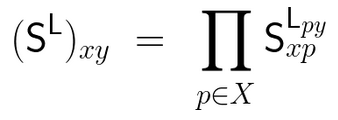
 if and only if there exists a
  such that
  and
and 
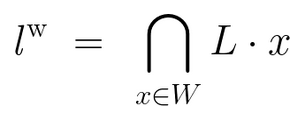

![\begin{array}{*{15}{c}} X & = & \{ & a, & b, & c, & d, & e, & f, & g, & h, & i & \} \\[6pt] W & = & \{ & d, & f & \} \\[6pt] L & = & \{ & b\!:\!a, & b\!:\!c, & c\!:\!b, & c\!:\!d, & e\!:\!d, & e\!:\!e, & e\!:\!f, & g\!:\!f, & g\!:\!h, & h\!:\!g, & h\!:\!i & \} \end{array}](https://s0.wp.com/latex.php?latex=%5Cbegin%7Barray%7D%7B%2A%7B15%7D%7Bc%7D%7D++X+%26+%3D+%26+%5C%7B+%26+a%2C+%26+b%2C+%26+c%2C+%26+d%2C+%26+e%2C+%26+f%2C+%26+g%2C+%26+h%2C+%26+i+%26+%5C%7D++%5C%5C%5B6pt%5D++W+%26+%3D+%26+%5C%7B+%26+d%2C+%26+f+%26+%5C%7D++%5C%5C%5B6pt%5D++L+%26+%3D+%26+%5C%7B+%26+b%5C%21%3A%5C%21a%2C+%26+b%5C%21%3A%5C%21c%2C+%26+c%5C%21%3A%5C%21b%2C+%26+c%5C%21%3A%5C%21d%2C+%26+e%5C%21%3A%5C%21d%2C+%26+e%5C%21%3A%5C%21e%2C+%26+e%5C%21%3A%5C%21f%2C+%26+g%5C%21%3A%5C%21f%2C+%26+g%5C%21%3A%5C%21h%2C+%26+h%5C%21%3A%5C%21g%2C+%26+h%5C%21%3A%5C%21i+%26+%5C%7D++%5Cend%7Barray%7D&bg=ffffff&fg=000000&s=1&c=20201002)
 within
  within
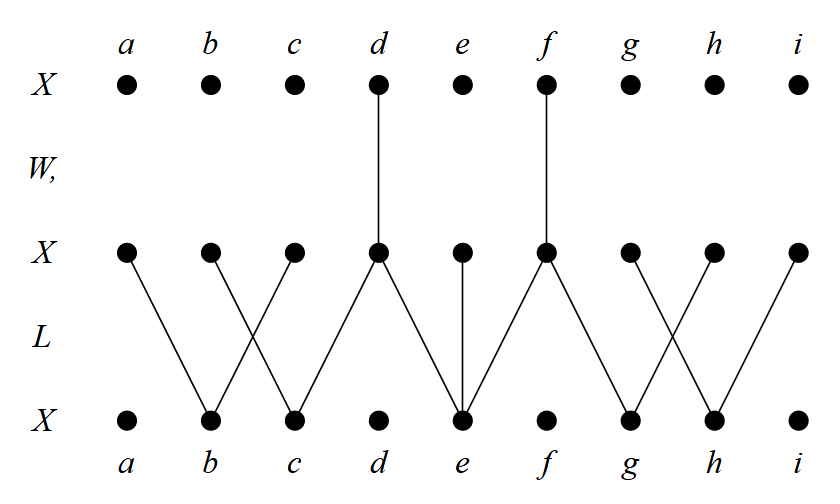

 by means of the relative term
  which conveys the same information.
 as follows.
 otherwise
 otherwise
 for each
  is
is  then the product
  is
is  otherwise it is
 such that
  and
and  but
but  If there is no such
 the only case producing a non-zero result is
  That portion of the work can be sketched as follows.
 will denote everything which is an


 is the monadic relation, or set, whose elements fall under the absolute term
  The elements of
  is the dyadic relation associated with the relative term
 is the dyadic relation associated with the relative term
 is the 1-dimensional matrix representation of the set
  is the 2-dimensional matrix representation of the relation
 is the 2-dimensional matrix representation of the relation
  and the relative term
![\begin{array}{lll} u \star L & = & L_{u\,@\,1} \\[6pt] & = & \{ (u, x) \in L \} \\[6pt] & = & \text{ordered pairs in}~ L ~\text{with}~ u ~\text{in the 1st place}. \\[9pt] L \star v & = & L_{v\,@\,2} \\[6pt] & = & \{ (x, v) \in L \} \\[6pt] & = & \text{ordered pairs in}~ L ~\text{with}~ v ~\text{in the 2nd place}. \end{array}](https://s0.wp.com/latex.php?latex=%5Cbegin%7Barray%7D%7Blll%7D++u+%5Cstar+L++%26+%3D+%26+L_%7Bu%5C%2C%40%5C%2C1%7D++%5C%5C%5B6pt%5D++%26+%3D+%26+%5C%7B+%28u%2C+x%29+%5Cin+L+%5C%7D++%5C%5C%5B6pt%5D++%26+%3D+%26+%5Ctext%7Bordered+pairs+in%7D%7E+L+%7E%5Ctext%7Bwith%7D%7E+u+%7E%5Ctext%7Bin+the+1st+place%7D.++%5C%5C%5B9pt%5D++L+%5Cstar+v++%26+%3D+%26+L_%7Bv%5C%2C%40%5C%2C2%7D++%5C%5C%5B6pt%5D++%26+%3D+%26+%5C%7B+%28x%2C+v%29+%5Cin+L+%5C%7D++%5C%5C%5B6pt%5D++%26+%3D+%26+%5Ctext%7Bordered+pairs+in%7D%7E+L+%7E%5Ctext%7Bwith%7D%7E+v+%7E%5Ctext%7Bin+the+2nd+place%7D.++%5Cend%7Barray%7D&bg=ffffff&fg=000000&s=0&c=20201002)
![\begin{array}{lll} u \cdot L & = & \mathrm{proj}_2 (u \star L) \\[6pt] & = & \{ x \in X : (u, x) \in L \} \\[6pt] & = & \text{loved by}~ u. \\[9pt] L \cdot v & = & \mathrm{proj}_1 (L \star v) \\[6pt] & = & \{ x \in X : (x, v) \in L \} \\[6pt] & = & \text{lover of}~ v. \end{array}](https://s0.wp.com/latex.php?latex=%5Cbegin%7Barray%7D%7Blll%7D++u+%5Ccdot+L++%26+%3D+%26+%5Cmathrm%7Bproj%7D_2+%28u+%5Cstar+L%29++%5C%5C%5B6pt%5D++%26+%3D+%26+%5C%7B+x+%5Cin+X+%3A+%28u%2C+x%29+%5Cin+L+%5C%7D++%5C%5C%5B6pt%5D++%26+%3D+%26+%5Ctext%7Bloved+by%7D%7E+u.++%5C%5C%5B9pt%5D++L+%5Ccdot+v++%26+%3D+%26+%5Cmathrm%7Bproj%7D_1+%28L+%5Cstar+v%29++%5C%5C%5B6pt%5D++%26+%3D+%26+%5C%7B+x+%5Cin+X+%3A+%28x%2C+v%29+%5Cin+L+%5C%7D++%5C%5C%5B6pt%5D++%26+%3D+%26+%5Ctext%7Blover+of%7D%7E+v.++%5Cend%7Barray%7D&bg=ffffff&fg=000000&s=0&c=20201002)


