Icon Index Symbol • 3

Questions Concerning Certain Faculties Claimed For Signs

Re: Peirce List (1) (2) (3)Kirsti Määttänen

KM:  Seems valid to me.  But it does not answer the quest for understanding.

The setup described in the previous post is the barest of beginnings.  It is the grounds from which our understanding must grow, if it is to be sustained by the following two provisions:

  • MAT.  We take the Methods and Tools Peirce provides us seriously.
  • COR.  We take the Context of Research in scientific inquiry seriously.

In practice, of course, we do not take the whole actual universe U as our starting point but begin by constructing concrete examples of systems, say, a system defined by its state space X, and we try to determine what sorts of conditions X must satisfy in order for X to possess any sort of representation at all of its own structure.

Questions like that have been thoroughly investigated in the case of axiom systems and computational systems, where people speak of a system having a “reflective property”, but there is room to do a lot more work on reflection in full-fledged semiotic systems, those built on triadic sign relations and taking full advantage of their power.

Resources

cc: Peirce List (1) (2) (3)

Posted in Abduction, Algorithms, Animata, Artificial Intelligence, Automated Research Tools, C.S. Peirce, Cognition, Computation, Data Structures, Deduction, Icon Index Symbol, Induction, Inquiry, Inquiry Driven Systems, Inquiry Into Inquiry, Interpretive Frameworks, Knowledge Representation, Logic, Logic of Relatives, Logic of Science, Logical Graphs, Objective Frameworks, Peirce, Relation Theory, Semiotics, Sign Relations, Triadic Relations, Visualization | Tagged , , , , , , , , , , , , , , , , , , , , , , , , , , , | 16 Comments

Icon Index Symbol • 2

Questions Concerning Certain Faculties Claimed For Signs

Re: Peirce List (1) (2) (3)Jon Alan Schmidt

JAS:  What class of Sign is a law of nature?

I’ve mentioned the following possibility several times before, but maybe not too recently.

A sign relation L is a subset of a cartesian product O \times S \times I, where O, S, I are the object, sign, interpretant domains, respectively.  In a systems-theoretic framework we may think of these domains as dynamical systems.

We often work with sign relations where S = I but it is entirely possible to consider sign relations where all three domains are one and the same.  Indeed, it could be the case that O = S = I = U, where the system U is the entire universe.  This would make the entire universe a sign of itself to itself.

A general way to understand a system-theoretic law is in terms of a constraint — the fact that not everything that might happen actually does.  And that is nothing but a subset relation.

So the law embodying how the universe represents itself to itself could be nothing other than a sign relation L \subseteq U \times U \times U.

Resources

cc: Peirce List (1) (2) (3)

Posted in Abduction, Algorithms, Animata, Artificial Intelligence, Automated Research Tools, C.S. Peirce, Cognition, Computation, Data Structures, Deduction, Icon Index Symbol, Induction, Inquiry, Inquiry Driven Systems, Inquiry Into Inquiry, Interpretive Frameworks, Knowledge Representation, Logic, Logic of Relatives, Logic of Science, Logical Graphs, Objective Frameworks, Peirce, Relation Theory, Semiotics, Sign Relations, Triadic Relations, Visualization | Tagged , , , , , , , , , , , , , , , , , , , , , , , , , , , | 17 Comments

Icon Index Symbol • 1

Questions Concerning Certain Faculties Claimed For Signs

Re: Peirce ListJerry Rhee

With regard to the main three types of signs — Icons, Indices, Symbols — Jerry Rhee asks:

How best do you distinguish between these terms?  What settles it?

Those very questions arose at the outset of my venture into Inquiry Driven Systems, obliging me to undertake a parallel “Inquiry Into Inquiry”.  Here’s a few links on how I began to get a handle on the issues, with an eye as always to real-world practical applications:

To get the spirit of what is going on here, imagine yourself designing a software application for assisting with inquiry, one able to begin with the earliest stages of qualitative research and continue helping with the most complex quantitative analyses and statistical inferences.

One of the first things you’ll discover is that you can’t really decide ahead of time all the sorts of things you’ll need to refer to over time.  You’ll need a dynamic database, able to evolve as the need arises, to track the growing collection of objects you’ll need to reference as inquiry progresses, plus the inventory of instances you’ll need to analyze and connect the objects, and last but not least the assortment of properties you’ll need to collect and describe the objects, as time goes by.

I began discussing one sort of organizational structure flexible enough to handle these tasks, introducing the concept of an Objective Framework (OF), at this point:

In accounting for the special characters of icons and indices that arose in previous discussions, it was necessary to open the domain of objects coming under formal consideration to include unspecified numbers of properties and instances of whatever objects were initially set down.  This is a general phenomenon, affecting every motion toward explanation whether pursued by analytic or synthetic means.  What it calls for in practice is a way of organizing growing domains of objects, without having to specify in advance all the objects there are.

The next several sections discuss how we might apply these very general principles of organization to the more specific task of analyzing iconic and indexical sign relations:

Resources

An earlier version of this material can be found at the Arisbe Gateway.

There’s a bit more discussion of the Objective Framework architecture here:

cc: Peirce List

Posted in Abduction, Algorithms, Animata, Artificial Intelligence, Automated Research Tools, C.S. Peirce, Cognition, Computation, Data Structures, Deduction, Icon Index Symbol, Induction, Inquiry, Inquiry Driven Systems, Inquiry Into Inquiry, Interpretive Frameworks, Knowledge Representation, Logic, Logic of Relatives, Logic of Science, Logical Graphs, Objective Frameworks, Peirce, Relation Theory, Semiotics, Sign Relations, Triadic Relations, Visualization | Tagged , , , , , , , , , , , , , , , , , , , , , , , , , , , | 16 Comments

Pragmatic Truth • Discussion 12

Re: Peirce List Discussion • JFSJFSJASGFJASGF

I realize that iconolatry — just one of many forms of dyadic reductionism — runs too deep at present for most folks to appreciate this, but it happens to be one of the consequences of Triadic Relation Irreducibility (TRI) that symbols — signs that denote their objects solely by virtue of being interpreted to do so — are the genus of all signs, while icons and indices are species under that genus.  An icon is an icon only because interpreted as an icon, by dint of a property singled out from all possible properties shared with its object.

Thus symbols are the fons et origo of all other signs — they do not in the first instance grow from icons so much as icons crystallize from the primordial matrix of symbols.

Resources

Posted in Aristotle, C.S. Peirce, Coherence, Concordance, Congruence, Consensus, Convergence, Correspondence, Dewey, Fixation of Belief, Information, Inquiry, John Dewey, Kant, Logic, Logic of Science, Method, Peirce, Philosophy, Pragmatic Maxim, Pragmatism, Semiotics, Sign Relations, Triadic Relations, Truth, Truth Theory, William James | Tagged , , , , , , , , , , , , , , , , , , , , , , , , , , | 5 Comments

Pragmatic Truth • Discussion 11

Re: Peirce List Discussion • CGJACGJACGJACG

One of the points I’ve been trying to make all along is that a person doesn’t normally need to make a working assumption explicit when it’s understood by all practitioners in a given practical setting as being implicit in that practice.  It becomes necessary and pertinent to do so only when a working assumption stops working or when one needs to lay out the rationales of that practice to others who may not be familiar with it.

As long as Peirce was writing for readers with relevant backgrounds in the practice of math and science it wasn’t really necessary and would’ve even been considered impertinent for him to waste words on points that everyone in that audience would regard as routine.

Does that have any bearing on questions about the reality of generals?  It’s hard to say.  I guess it’s bound up with the reasons I think the only real realists I know and the only practicing pragmatists I know are all mathematicians, or at least scientists who use mathematics, for the moments they are immersed in doing so.

Referring again to the figure I drew for Peirce’s classification of sciences, many if not most of our theories on the mathematical side will have both individual terms and general terms, categorized not absolutely but in relation to each other in a given context.  So the distinction between individual and general does not align with the distinction between phenomena and theory.  The whole theory is judged (by us arbiters) according to how well it guides our transactions with the whole phenomenal domain in question.


Peirce Syllabus

We do not know whether anything like predicates and subjects, generals and particulars, waves and particles, or whatever, exists in the reality that generates the phenomenal world.  It is entirely conceivable that none of those terms will appear in the final account of things.  All we have to decide, as Gandalf says, is what to do with the time that is given to us.

Resources

Posted in Aristotle, C.S. Peirce, Coherence, Concordance, Congruence, Consensus, Convergence, Correspondence, Dewey, Fixation of Belief, Information, Inquiry, John Dewey, Kant, Logic, Logic of Science, Method, Peirce, Philosophy, Pragmatic Maxim, Pragmatism, Semiotics, Sign Relations, Triadic Relations, Truth, Truth Theory, William James | Tagged , , , , , , , , , , , , , , , , , , , , , , , , , , | 5 Comments

Pragmatic Truth • Discussion 10

A paragraph from Kant and associated discussion I added to the Wikipedia article on the Correspondence Theory of Truth in June 2006 is useful at this point, and it serves to set up a corresponding statement from Peirce that we’ll take up in due course.  A version of this material survives on the InterSciWiki site:

Immanuel Kant discussed the correspondence theory of truth in the following manner:

Truth is said to consist in the agreement of knowledge with the object.  According to this mere verbal definition, then, my knowledge, in order to be true, must agree with the object.  Now, I can only compare the object with my knowledge by this means, namely, by taking knowledge of it.  My knowledge, then, is to be verified by itself, which is far from being sufficient for truth.  For as the object is external to me, and the knowledge is in me, I can only judge whether my knowledge of the object agrees with my knowledge of the object.  Such a circle in explanation was called by the ancients Diallelos.  And the logicians were accused of this fallacy by the sceptics, who remarked that this account of truth was as if a man before a judicial tribunal should make a statement, and appeal in support of it to a witness whom no one knows, but who defends his own credibility by saying that the man who had called him as a witness is an honourable man.  (Kant, 45).

According to Kant, the definition of truth as correspondence is a “mere verbal definition”, here making use of Aristotle’s distinction between a nominal definition, a definition in name only, and a real definition, a definition that shows the true cause or essence of the thing whose term is being defined.  From Kant’s account of the history, the definition of truth as correspondence was already in dispute from classical times, the “skeptics” criticizing the “logicians” for a form of circular reasoning, though the extent to which the “logicians” actually held such a theory is not evaluated in this account.

A careful analysis of what Kant is saying here can help to explain why there are so many theories of truth on the contemporary scene.  In other words, why would thinkers who examine the question of truth not be satisfied to rest with this very first theory that usually comes to mind?

Reference

  • Kant, Immanuel (1800), Introduction to Logic.  Reprinted, Thomas Kingsmill Abbott (trans.), Dennis Sweet (intro.), Barnes and Noble, New York, NY, 2005.

Resources

Posted in Aristotle, C.S. Peirce, Coherence, Concordance, Congruence, Consensus, Convergence, Correspondence, Dewey, Fixation of Belief, Information, Inquiry, John Dewey, Kant, Logic, Logic of Science, Method, Peirce, Philosophy, Pragmatic Maxim, Pragmatism, Semiotics, Sign Relations, Triadic Relations, Truth, Truth Theory, William James | Tagged , , , , , , , , , , , , , , , , , , , , , , , , , , | 5 Comments

Pragmatic Truth • Discussion 9

Re: Peirce ListClark GobleJon AwbreyClark GobleJon AwbreyClark Goble

To put things more plainly, it’s a routine observation we have no need for moods and tenses in actually doing mathematics, that is, in developing the consequences of given axioms, constructing formal models, or applying models and theories to the applicable phenomena.  Theories of change, intention, and possibility can all be stated in present tense indicative mood.  Regarding change, intention, and possibilities as real or not is independent of the linguistic forms we happen to use in their description.

Audiences, interpreters, receivers are neither right nor wrong.  It simply happens that one audience may require us to articulate what goes without saying, what is taken for granted, “understood” in another context.  It may be useful exercise to unfold the implicatures and presuppositions taken for granted in a particular discourse situation, but giving a name to one’s habitual position is not the same thing as a change of address.

So, yes, I’d say Peirce is a realist about possibilities, and patterns of possibilities, from the start.  That much is simply implicit in his mathematical approach to logic, probability, and information.

Resources

Posted in Aristotle, C.S. Peirce, Coherence, Concordance, Congruence, Consensus, Convergence, Correspondence, Dewey, Fixation of Belief, Information, Inquiry, John Dewey, Kant, Logic, Logic of Science, Method, Peirce, Philosophy, Pragmatic Maxim, Pragmatism, Semiotics, Sign Relations, Triadic Relations, Truth, Truth Theory, William James | Tagged , , , , , , , , , , , , , , , , , , , , , , , , , , | 5 Comments

Pragmatic Truth • Discussion 8

Re: Peirce ListClark GobleJon AwbreyClark GobleJon Awbrey

With respect to the issues surrounding “modal realism” — what stance Peirce took and when he took it — let me refer to a figure I constantly have in mind, one I drew to map the first few principalities in Peirce’s classification of sciences.
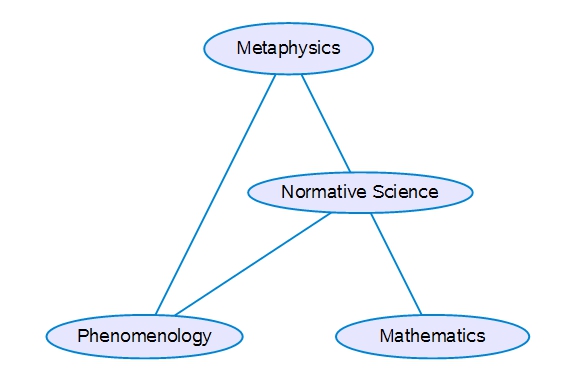
Peirce Syllabus

Normative science rests largely on phenomenology and on mathematics;
metaphysics on phenomenology and on normative science.

❧ Charles Sanders Peirce • Collected Papers, CP 1.186 (1903)
Syllabus • Classification of Sciences (CP 1.180–202, G-1903-2b)

There is more discussion of the figure and its legend here.

The picture reminds us of both the analogy and the disparity between phenomenology and mathematics, between our observation of actual appearances in phenomenology and our observation of possible existence in mathematics, with “possible” in this case meaning no more than not inconsistent.  The disparity is something we come to know as the fallibility, partiality, or subjectivity of all our models, representations, and theories of reality.

The most astute physicists appreciate the significance of this disparity or gap, and there is a famous quip by Einstein that testifies to it, but more often than not they tend to get by like the rest of us, with a variety of naive realism.

In contrast, doing mathematics requires a more constant awareness of the distance between the two footings, the terra firma of actuality and Plato’s heaven of possibilities.  This means that the standpoint known as “modal realism” is really the modus operandi or standard operating philosophy within the realm of mathematics, so taken for granted that its marching orders need no banners or fanfare in the ordinary course of work.

Being one who sees more continuity of development than radical reconstruction in Peirce’s thought over his lifetime, what I do see changing through the years is the greater diversity of his audiences as the river of his work flows from its constant sources to the alluvial delta he left later generations to sift.  The greatest share of emphatic variance in what he writes is explained more by variations in whom he addresses than what he is trying to communicate.

Drawing the conclusion for the present case, my initial guess would be that any apparent conversion to modal realism is more likely explained by an increasing need to underscore attitudes of mind that are simply tacit in the scientific application of formal logic, mathematics, probability, and statistics.

Resources

Posted in Aristotle, C.S. Peirce, Coherence, Concordance, Congruence, Consensus, Convergence, Correspondence, Dewey, Fixation of Belief, Information, Inquiry, John Dewey, Kant, Logic, Logic of Science, Method, Peirce, Philosophy, Pragmatic Maxim, Pragmatism, Semiotics, Sign Relations, Triadic Relations, Truth, Truth Theory, William James | Tagged , , , , , , , , , , , , , , , , , , , , , , , , , , | 7 Comments

Pragmatic Truth • Discussion 7

Re: Peirce List DiscussionVal Daniel

Viewing the normative science of logic and its object, truth, in the medium of a triadic sign relation, the first cut among notions of truth divides those that take the object domain into account in a fundamental way from those that regard truth as a predicate of signs alone.

At first sight, then, it appears we can usefully contrast the pragmatic and correspondence conceptions of truth from the motley crew of intuitions about truth based on coherence, consensus, and truth by logical consistency alone.

That is the perspective Susan Awbrey and I adopted in our work on “Universities as Learning Organizations” and “Conceptual Barriers to Creating Integrated Universities”, where we applied a sign-relational framework to the problem of integrating knowledge across the walls of intellectual silos that have come to shape the disciplinary architectures of our modern universities.

References

  • Awbrey, S.M., and Awbrey, J.L. (2001), “Conceptual Barriers to Creating Integrative Universities”, Organization : The Interdisciplinary Journal of Organization, Theory, and Society 8(2), Sage Publications, London, UK, pp. 269–284.  Abstract.
  • Awbrey, S.M., and Awbrey, J.L. (1999), “Organizations of Learning or Learning Organizations : The Challenge of Creating Integrative Universities for the Next Century”, Second International Conference of the Journal ‘Organization’, Re-Organizing Knowledge, Trans-Forming Institutions : Knowing, Knowledge, and the University in the 21st Century, University of Massachusetts, Amherst, MA.  Online.
  • Haack, Susan (1993), Evidence and Inquiry : Towards Reconstruction in Epistemology, Blackwell Publishers, Oxford, UK.
  • Misak, Cheryl J. (1991), Truth and the End of Inquiry : A Peircean Account of Truth, Oxford University Press, Oxford, UK.

Resources

Posted in Aristotle, C.S. Peirce, Coherence, Concordance, Congruence, Consensus, Convergence, Correspondence, Dewey, Fixation of Belief, Information, Inquiry, John Dewey, Kant, Logic, Logic of Science, Method, Peirce, Philosophy, Pragmatic Maxim, Pragmatism, Semiotics, Sign Relations, Triadic Relations, Truth, Truth Theory, William James | Tagged , , , , , , , , , , , , , , , , , , , , , , , , , , | 5 Comments

Pragmatic Truth • Discussion 6

Re: Peirce List Discussion • CGJAJAJAJASJACGJAJBDJA

Working on what is worth saving in old Wikipedia articles requires me to rummage through their edit histories, which raises a host of annoying ghosts from bygone days.  In this review I’d like to avoid rehashing old skirmishes and use what I’ve learned in the mean time to give a better account of pragmatic truth.

Resources

Posted in Aristotle, C.S. Peirce, Coherence, Concordance, Congruence, Consensus, Convergence, Correspondence, Dewey, Fixation of Belief, Information, Inquiry, John Dewey, Kant, Logic, Logic of Science, Method, Peirce, Philosophy, Pragmatic Maxim, Pragmatism, Semiotics, Sign Relations, Triadic Relations, Truth, Truth Theory, William James | Tagged , , , , , , , , , , , , , , , , , , , , , , , , , , | 5 Comments