Riffs and Rotes are two species of graph-theoretic structure in a mathematical framework which establishes a bijective Gödel numbering between the positive integers 

The Core Concept: From Primes to Functions
Every positive integer has a unique factorization as a product of primes (The Fundamental Theorem of Arithmetic). Because every prime number has a unique index, e.g. 


By mapping these recursive index structures, a natural number is transformed into a set of ordered pairs — effectively a finite partial function

Riffs vs. Rotes
The finite partial functions may be visualized using two distinct graph-theoretic structures:
- Riffs (Rooted Index-Functional Forests): Represented as directed graphs (digraphs) where nodes reflect the exact recursive assignment of a prime index to its exponent.
- Rotes (Rooted Odd Trees with only Exponent Symmetries): Represented as undirected, rooted trees that embed the same structural information but map it into a simplified graphic form.
How the Mapping Works (Examples)
Using the basic rule where a prime factor 


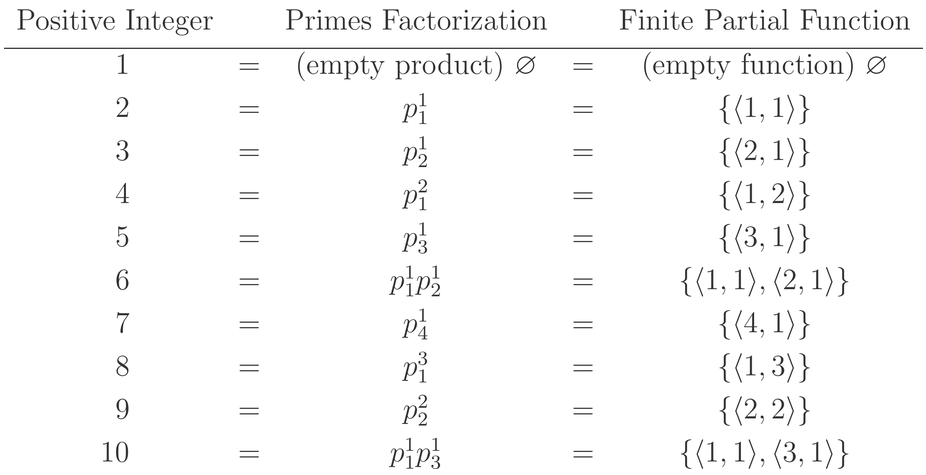
Because this construction is a strict bijection, every single positive integer maps to exactly one unique finite partial function, and every finite partial function has a unique integer address (Gödel number). Detailed combinatorial properties and sequence data for these graphs are documented on the OEIS Wiki “Riffs and Rotes” page.
Reference
- The above text is adapted from the Google AI Overview for “Riffs and Rotes” “Finite Partial Functions” (Nov 8, 2026).
Resource
cc: Academia.edu • Cybernetics • Laws of Form • Mathstodon • SeqFan
cc: Research Gate • Structural Modeling • Systems Science • Syscoi


