
Propositional Forms on Two Variables
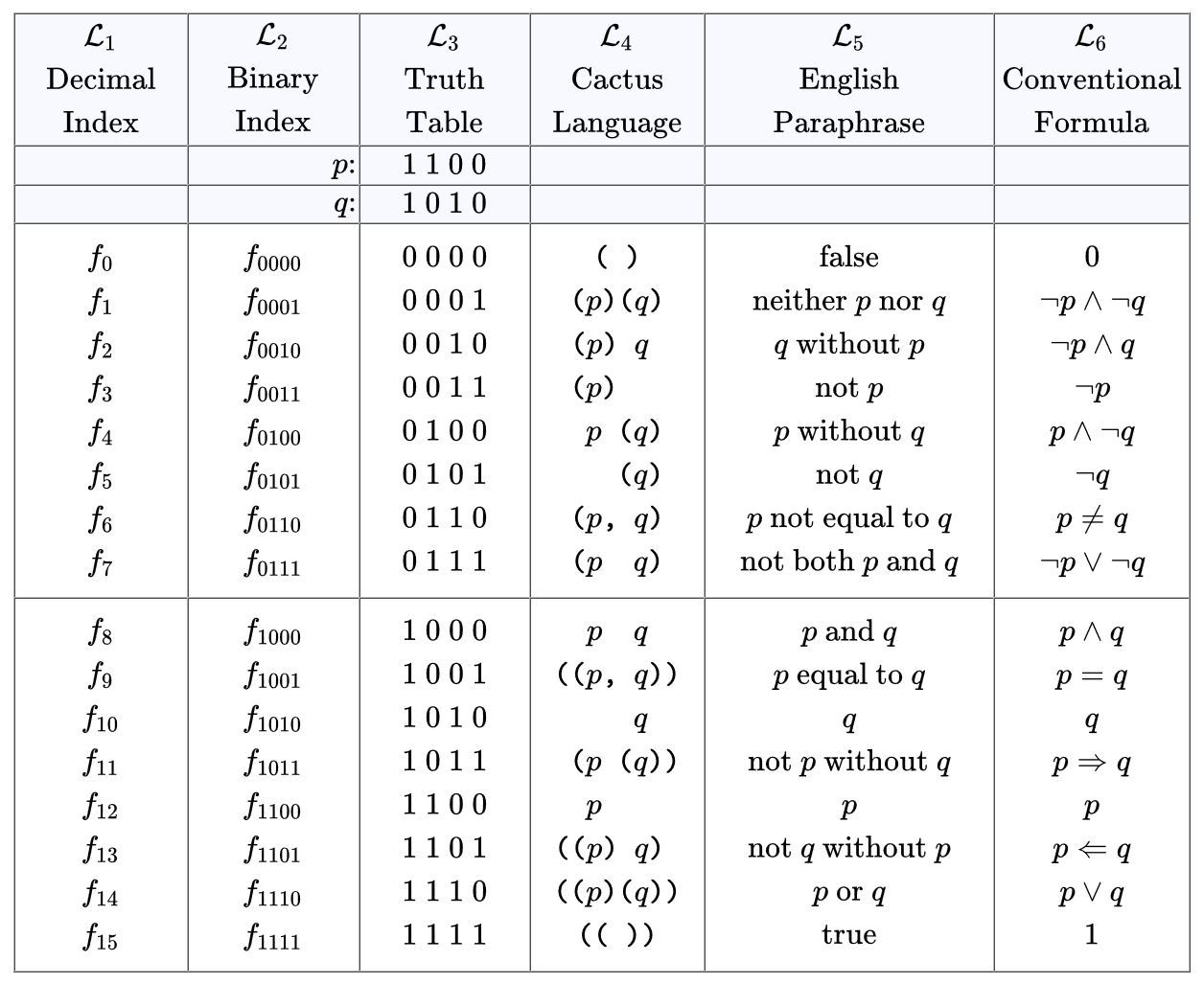
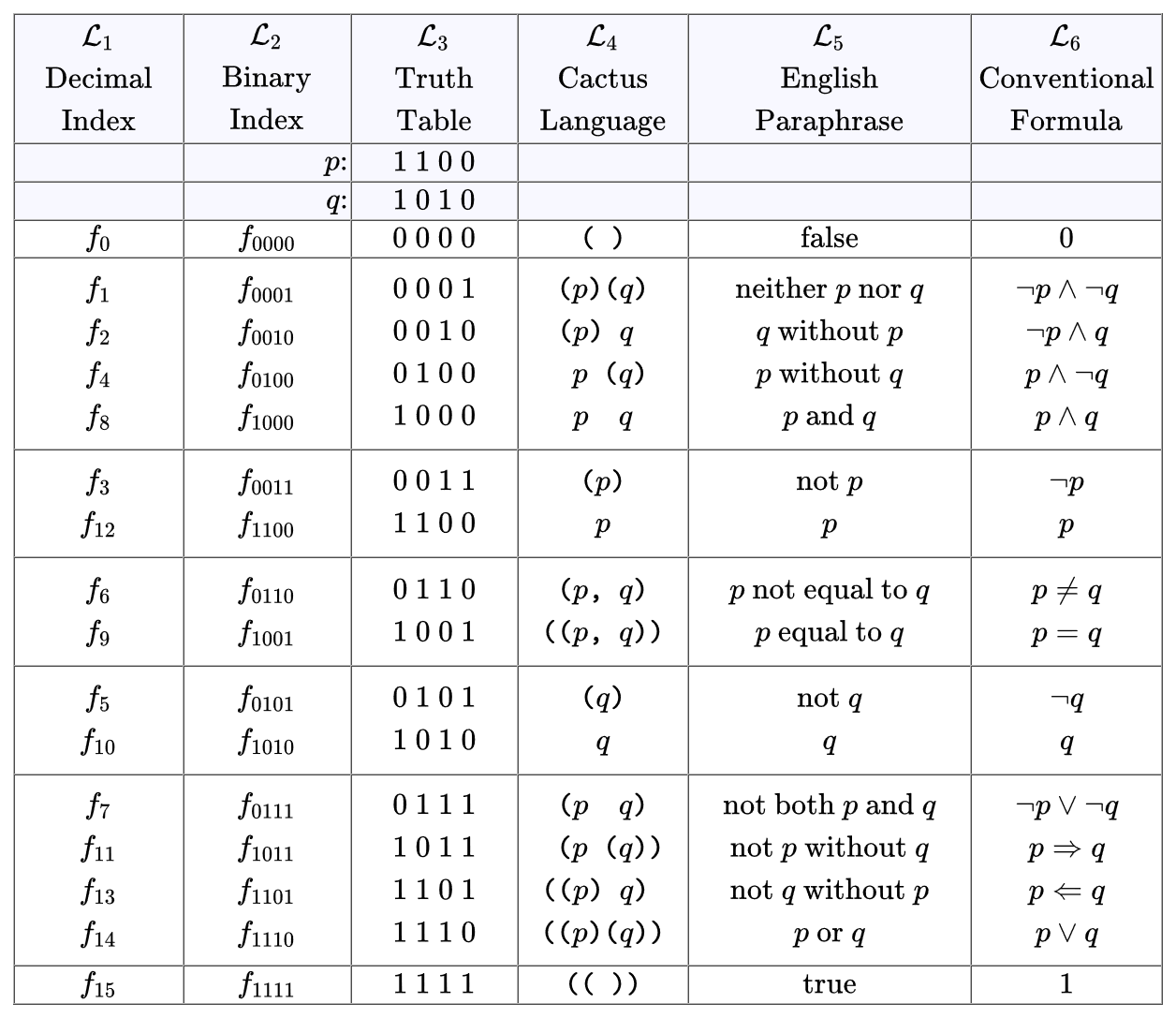
Tables A1 and A2 showed two ways of organizing the sixteen boolean functions or propositional forms on two variables, as expressed in several notations. In future discussions the two Tables will be described as the Index Order and the Orbit Order of propositions, respectively, “orbits” being the usual term in mathematics for similarity classes under a group action. For ease of comparison, here are fresh copies of both Tables on the same page.


Recalling the discussion up to this point, we took as our first example the boolean function 



In the next several posts we’ll extend our scope to the full set of boolean functions on two variables and examine how the differential operators 

Resources
- Logic Syllabus
- Minimal Negation Operator
- Survey of Differential Logic
- Survey of Animated Logical Graphs
cc: Academia.edu • Cybernetics • Laws of Form • Mathstodon (1) (2)
cc: Research Gate • Structural Modeling • Systems Science • Syscoi


Pingback: Survey of Differential Logic • 8 | Inquiry Into Inquiry
Pingback: Survey of Differential Logic • 8 | Systems Community of Inquiry