
Ongoing conversations with Dan Everett on Facebook have me backtracking to recurring questions about the relationship between formal language theory (as I once learned it) and the properties of natural languages as they are found occurring in the field. A point of particular interest is the role of recursion in formal and natural languages, along with collateral questions about its role in the cognitive sciences at large.
It has taken me quite a while to bring my reflections up to the threshold of minimal coherence — and the inquiry remains ongoing — but it may catalyze the thinking process if I simply share what I’ve thought so far …
Comment 1
Recursion is where you find it — so, myself not being a natural language researcher, when someone who is says they don’t find it in a given corpus I just take them at their word …
Comment 2
The question to which I keep returning has to do with the relationship between two ways we find recursion occurring.
One way I’d call pragmatic recursion — if I wanted to be precise and cover its full scope — since so many of its operations occur without conscious direction, but for now I’ll defer to more familiar language, calling it cognitive or conceptual recursion.
Comment 3
If we discard from the idea of recursion what is not of its essence, we find recursion occurs when our understanding of one situation has recourse to our understanding of other situations.
Very typically, the object situation presents itself as complex, difficult, or unfamiliar while the resource situations are regarded as being better understood.
It must be appreciated, however, that any ranking of situations by level of understanding is contingent on the circumstances in view and may vary radically in alternate settings.
Comment 4
Recursion occurs more markedly in syntactic recursion, where the recursive process shows its character as such in the symbols of its syntactic expression.
A sense of the difference can be gained by looking at a case of ostensible syntactic recursion. (How much substance backs the ostentation is a subject we’ll take up, maybe at length, but later …)
Consider the following diagram for the computation of a simple recursive function.
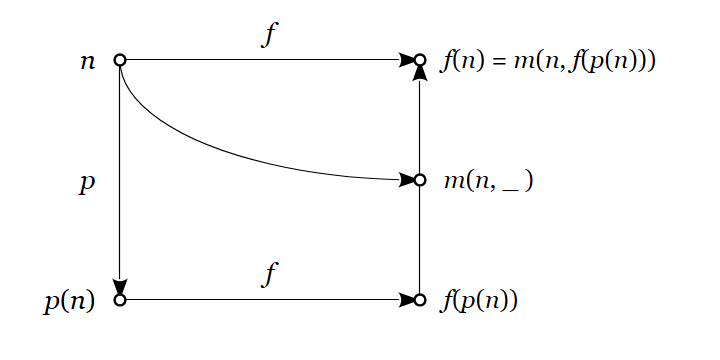
For example, the factorial function 


Comment 5
Recursion is rife in mathematics and computation, typically sporting its recursive character on its sleeve in the fashion of syntax sketched above. But mathematics and computation are overlearned subjects and practices, enjoying long histories of being gone over with an eye to articulating every last detail of any way they might be conceived and conducted. So it’s fair to ask whether all that artifice truly tutors nature or only creates a rationalized reconstruction of it. Then again, even if that’s all it does, is there anything of use to be learned from it?
Comment 6
The prevalence of recursion in mathematics arises from the architecture of mathematical systems.
Mathematical systems grow from a fourfold root.
- Primitives are taken as initial terms.
- Definitions expound ever more complex terms in relation to the primitives.
- Axioms are taken as initial truths.
- Theorems follow from the axioms by way of inference rules.
Recursive definitions of mathematical objects and inductive proofs of the corresponding theorems follow closely parallel patterns. And again, in computation, recursive programs follow the same patterns in action.
Resources
- Inquiry Driven Systems • Inquiry Into Inquiry
- Reflective Interpretive Frameworks • (1) • (2) • (3) • (4) • (5) • (6)
cc: Academia.edu • Cybernetics • Laws of Form • Mathstodon
cc: Research Gate • Structural Modeling • Systems Science • Syscoi


 Inquiry Into Inquiry