
Inquiry and Analogy • Higher Order Propositional Expressions
Interpretive Categories for Higher Order Propositions (n = 1)
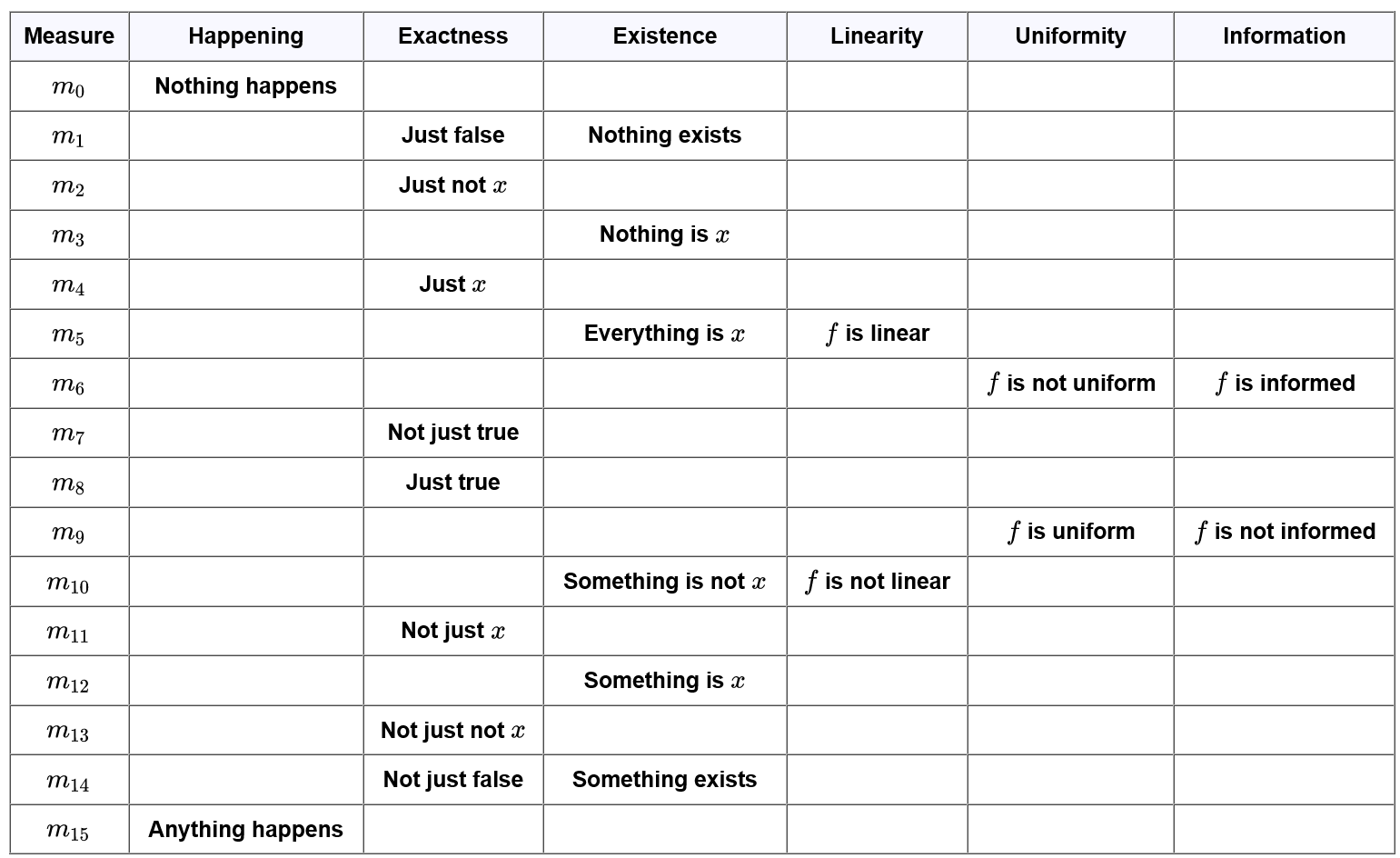
Table 12 presents a series of interpretive categories for the higher order propositions in Table 11. I’ll leave those for now to the reader’s contemplation and discuss them when we get two variables into the mix. The lower dimensional cases tend to exhibit condensed or degenerate structures and their full significance will become clearer once we get beyond the 1‑dimensional case.

Resources
- Logic Syllabus
- Boolean Function
- Boolean-Valued Function
- Logical Conjunction
- Minimal Negation Operator
- Introduction to Inquiry Driven Systems
- Functional Logic • Part 1 • Part 2 • Part 3
- Cactus Language • Part 1 • Part 2 • Part 3 • References • Document History
cc: FB | Peirce Matters • Laws of Form • Mathstodon • Ontolog • Academia.edu
cc: Conceptual Graphs • Cybernetics • Structural Modeling • Systems Science

 Inquiry Into Inquiry
Pingback: Survey of Abduction, Deduction, Induction, Analogy, Inquiry • 3 | Inquiry Into Inquiry
Pingback: Survey of Abduction, Deduction, Induction, Analogy, Inquiry • 4 | Inquiry Into Inquiry
Pingback: Survey of Abduction, Deduction, Induction, Analogy, Inquiry • 5 | Inquiry Into Inquiry
Pingback: Survey of Abduction, Deduction, Induction, Analogy, Inquiry • 5 | Systems Community of Inquiry