
Re: Richard J. Lipton • Logical Complexity Of Proofs
Re: Animated Logical Graphs • (35) (36) (37) (38) (39) (40) (41)
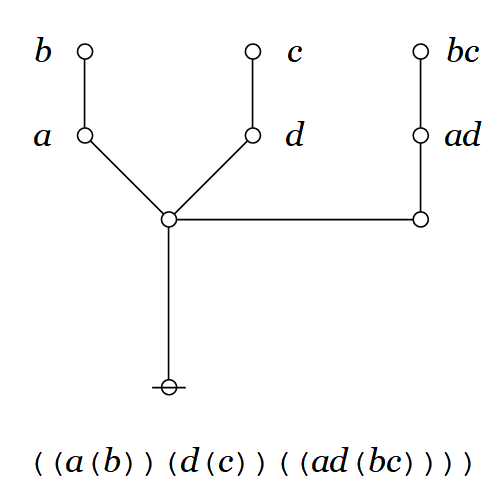
Now that our propositional formula is cast in the form of a graph its evaluation proceeds as a sequence of graphical transformations where each graph in turn belongs to the same formal equivalence class as its predecessor and thus of the first. The sequence terminates in a canonical graph making it manifest whether the initial formula is identically true by virtue of its form or not.
To be continued …
Reference
- Leibniz, Gottfried W. (1679–1686?), “Addenda to the Specimen of the Universal Calculus”, pp. 40–46 in G.H.R. Parkinson (ed., trans., 1966), Leibniz : Logical Papers, Oxford University Press, London, UK.
Praeclarum Theorema
- This Blog
- OEIS Wiki • (1) • (2) • (3)
- PlanetMath • Praeclarum Theorema
- Metamath Proof Explorer • Praeclarum Theorema
- Frithjof Dau • Computer Animated Proof of Leibniz’s Praeclarum Theorema
Resources
- Logic Syllabus
- Logical Graphs
- Cactus Language
- Futures Of Logical Graphs
- Minimal Negation Operators
- Survey of Theme One Program
- Survey of Animated Logical Graphs
- Propositional Equation Reasoning Systems
- How To Succeed In Proof Business Without Really Trying
Applications
- Applications of a Propositional Calculator • Constraint Satisfaction Problems
- Exploratory Qualitative Analysis of Sequential Observation Data
cc: Cybernetics • Ontolog • Peirce (1) (2) (3) (4) (5) (6) (7) • Structural Modeling • Systems

 Inquiry Into Inquiry
Pingback: Sign Relations, Triadic Relations, Relation Theory • Discussion 2 | Inquiry Into Inquiry
Pingback: Survey of Animated Logical Graphs • 3 | Inquiry Into Inquiry
Pingback: Survey of Animated Logical Graphs • 4 | Inquiry Into Inquiry
Pingback: Survey of Animated Logical Graphs • 5 | Inquiry Into Inquiry
Pingback: Survey of Animated Logical Graphs • 6 | Inquiry Into Inquiry
Pingback: Survey of Animated Logical Graphs • 7 | Inquiry Into Inquiry
Pingback: Survey of Animated Logical Graphs • 7 | Inquiry Into Inquiry
Pingback: Survey of Animated Logical Graphs • 8 | Inquiry Into Inquiry
Pingback: Survey of Animated Logical Graphs • 8 | Systems Community of Inquiry