

Re: Peirce List • Jerry Chandler
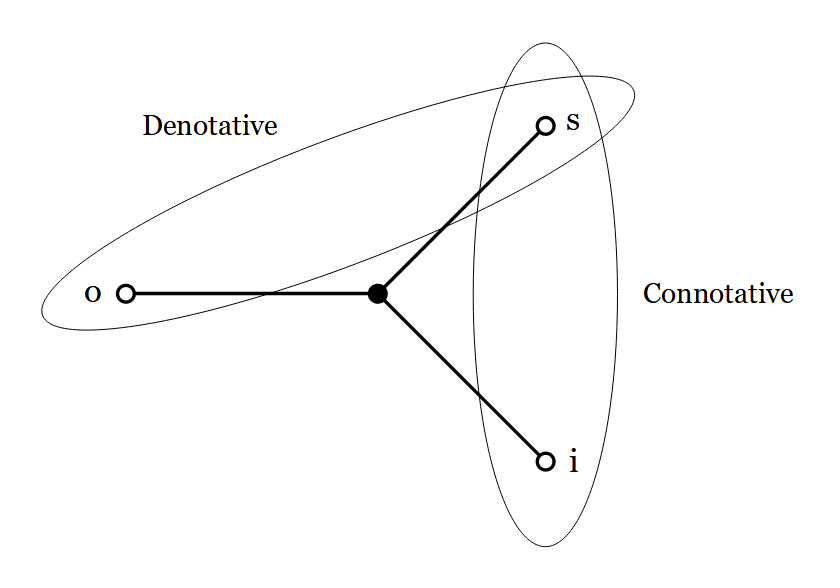
It is above all important to understand that Peirce’s concept of a sign relation is defined at a higher order of abstraction than any notion of causal or temporal order.
A sign relation 


As it happens, generative relationships between a generating structure and a generated class of structures are very common throughout mathematics and not unique to semiotics.
References
- Awbrey, S.M., and Awbrey, J.L. (2001), “Conceptual Barriers to Creating Integrative Universities”, Organization : The Interdisciplinary Journal of Organization, Theory, and Society 8(2), Sage Publications, London, UK, 269–284. Abstract. Online.
- Awbrey, S.M., and Awbrey, J.L. (September 1999), “Organizations of Learning or Learning Organizations : The Challenge of Creating Integrative Universities for the Next Century”, Second International Conference of the Journal ‘Organization’, Re‑Organizing Knowledge, Trans‑Forming Institutions : Knowing, Knowledge, and the University in the 21st Century, University of Massachusetts, Amherst, MA. Online.
- Awbrey, J.L., and Awbrey, S.M. (1995), “Interpretation as Action : The Risk of Inquiry”, Inquiry : Critical Thinking Across the Disciplines 15(1), 40–52. Archive. Journal. Online (doc) (pdf).
cc: Conceptual Graphs • Cybernetics • Structural Modeling • Systems Science
cc: FB | Semeiotics • Mathstodon • Laws of Form • Peirce List (1) (2) (3) (4) (5)


 Inquiry Into Inquiry
Pingback: Survey of Semiotics, Semiosis, Sign Relations • 4 | Inquiry Into Inquiry