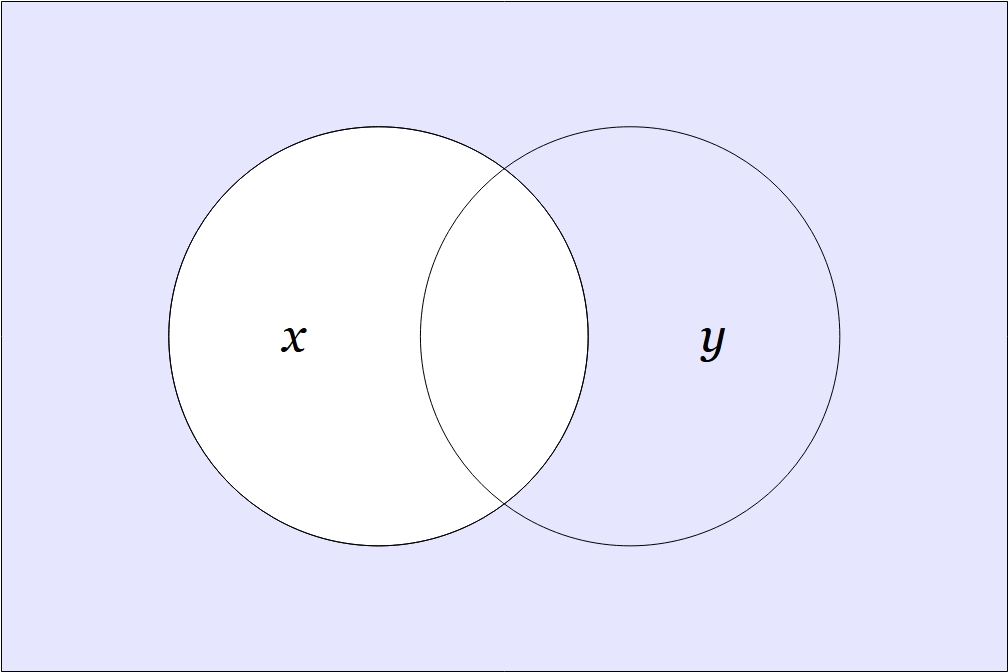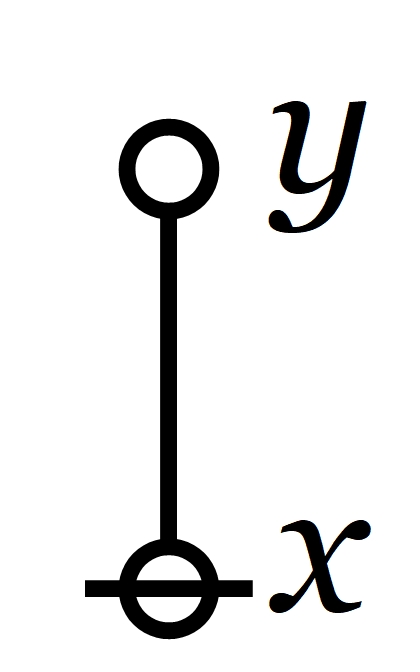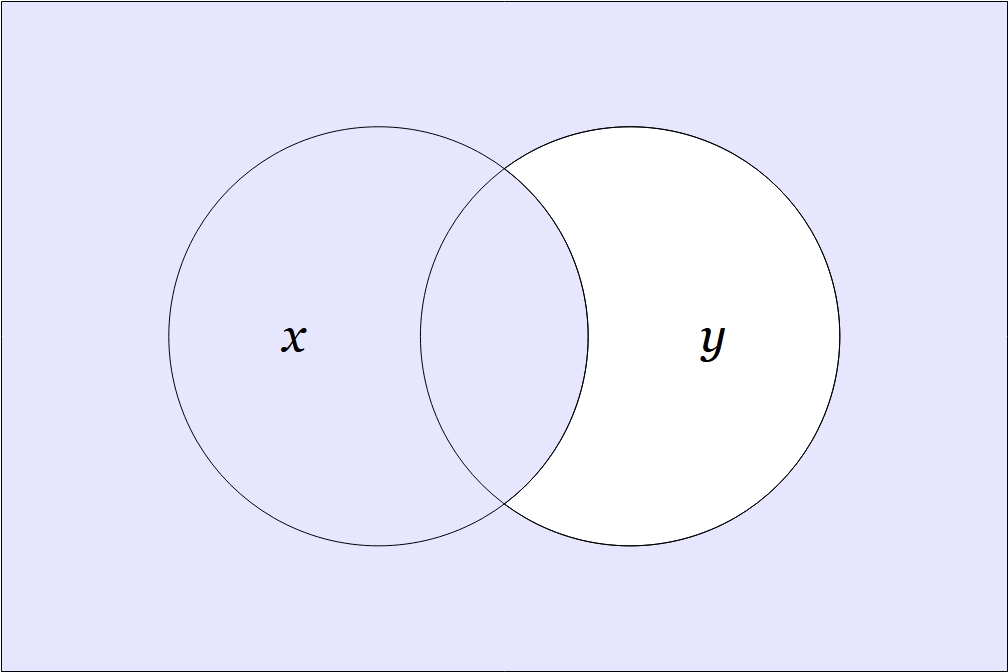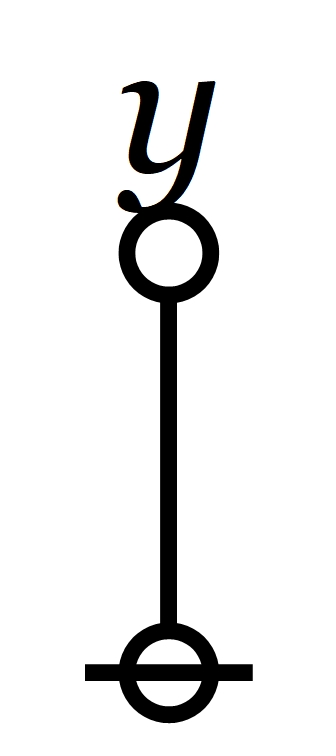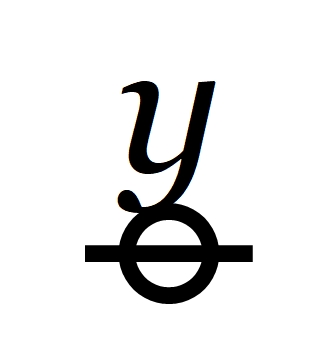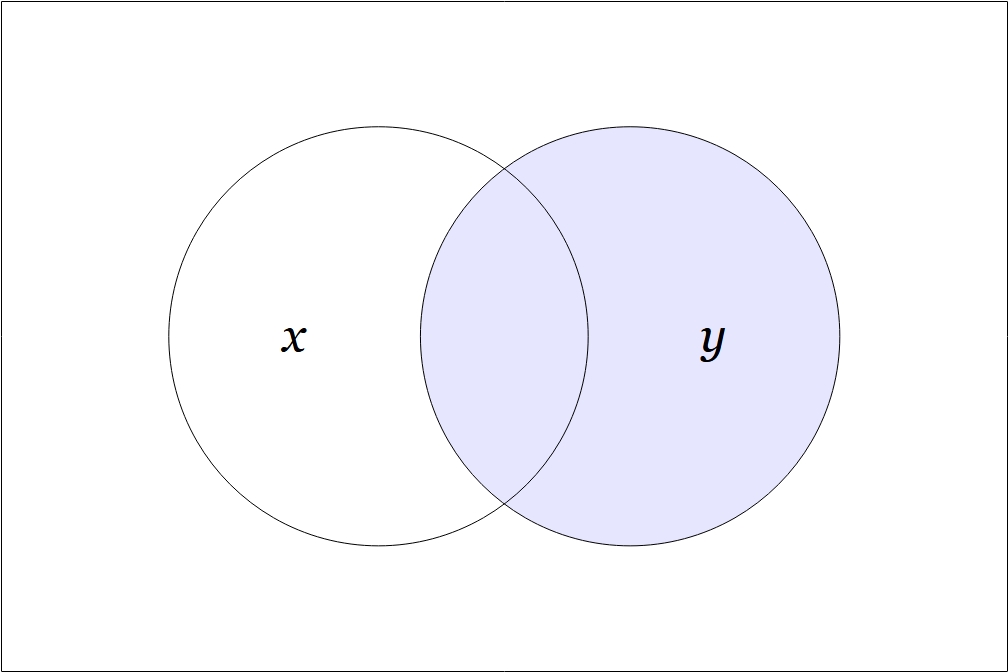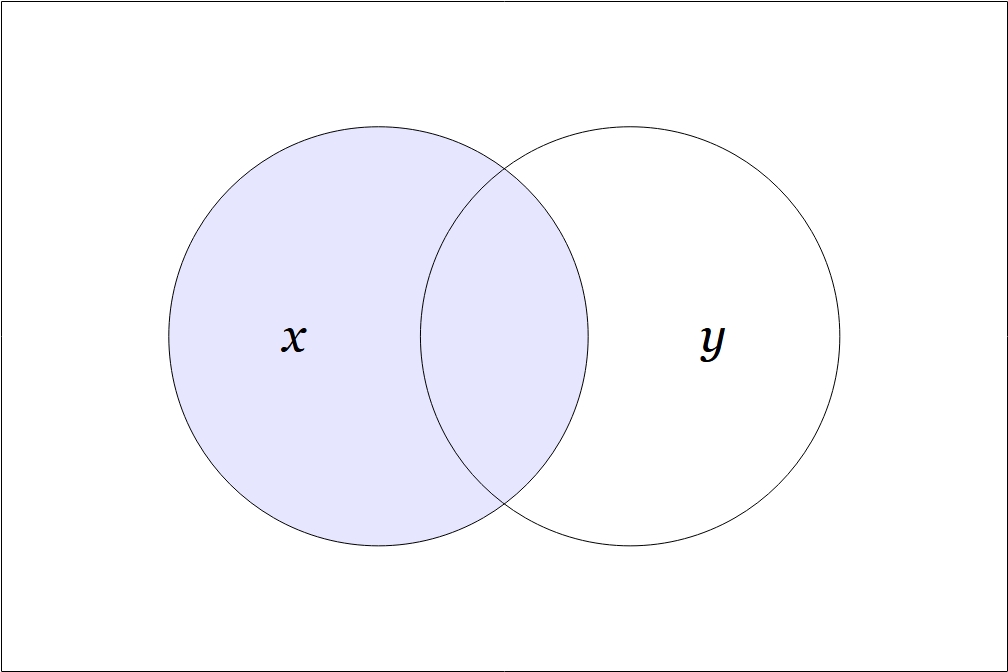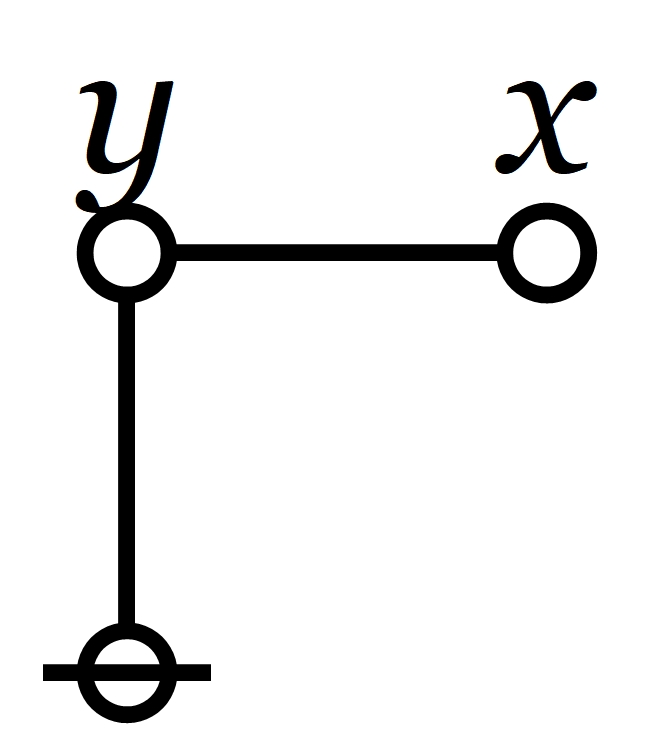
All Process, No Paradox • 8

These are the forms of time, which imitates eternity and revolves according to a law of number.

Plato • Timaeus

Re: Laws of FormSeth • James Bowery (1) (2) (3)Lyle Anderson

Dear Seth, James, Lyle,

Nothing about calling time an abstraction makes it a nullity.  I’m too much a realist about mathematical objects to ever think that.  As a rule, on the other hand, I try to avoid letting abstractions leave us so absent-minded as to forget the concrete realities from which they are abstracted.  Keeping time linked to process, especially the orders of standard process we call “clocks”, is just part and parcel of that practice.

Synchronicity being what it is, this very issue came up just last night in a very amusing Facebook discussion about “windshield wipers slappin’ time …”

At any rate, this thread is already moving too fast for the pace I keep these days but maybe I can resolve remaining confusions about the game afoot by recycling a post I shared to the old Laws of Form list.  This was originally a comment on Lou Kauffman’s blog back when he first started it.  Sadly, he wrote only a few more entries there in the time since.

Re: Lou KauffmanIterants, Imaginaries, Matrices

As serendipity would have it, Lou Kauffman, who knows a lot about the lines of inquiry Charles Sanders Peirce and George Spencer Brown pursued into graphical syntaxes for logic, just last month opened a blog and his very first post touched on perennial questions of logic and time — Logos and Chronos — puzzling the wits of everyone who has thought about them for as long as anyone can remember.  Just locally and recently these questions have arisen in the following contexts.

Kauffman’s treatment of logic, paradox, time, and imaginary truth values led me to make the following comments I think are very close to what I’d been struggling to say before.

Let me get some notational matters out of the way before continuing.

I use \mathbb{B} for a generic 2-point set, usually \{ 0, 1 \} and typically but not always interpreted for logic so that 0 = \mathrm{false} and 1 = \mathrm{true}.  I use “teletype” parentheses \texttt{(} \ldots \texttt{)} for negation, so that \texttt{(} x \texttt{)} = \lnot x for x ~\text{in}~ \mathbb{B}.  Later on I’ll be using teletype format lists \texttt{(} x_1 \texttt{,} \ldots \texttt{,} x_k \texttt{)} for minimal negation operators.

As long as we’re reading x as a boolean variable (x \in \mathbb{B}) the equation x = \texttt{(} x \texttt{)} is not paradoxical but simply false.  As an algebraic structure \mathbb{B} can be extended in many ways but it remains a separate question what sort of application, if any, such extensions might have to the normative science of logic.

On the other hand, the assignment statement x := \texttt{(} x \texttt{)} makes perfect sense in computational contexts.  The effect of the assignment operation on the value of the variable x is commonly expressed in time series notation as x' = \texttt{(} x \texttt{)} and the same change is expressed even more succinctly by defining \mathrm{d}x = x' - x and writing \mathrm{d}x = 1.

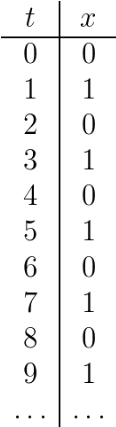
Now suppose we are observing the time evolution of a system X with a boolean state variable x : X \to \mathbb{B} and what we observe is the following time series.

Time Series 1

Computing the first differences we get:
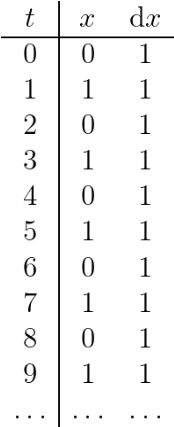
Time Series 2

Computing the second differences we get:
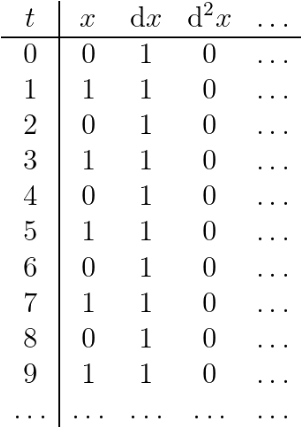
Time Series 3

This leads to thinking of the system X as having an extended state (x, \mathrm{d}x, \mathrm{d}^2 x, \ldots, \mathrm{d}^k x), and this additional language gives us the facility of describing state transitions in terms of the various orders of differences.  For example, the rule x' = \texttt{(} x \texttt{)} can now be expressed by the rule \mathrm{d}x = 1.

The following article has a few more examples along these lines.

Resources

cc: CyberneticsLaws of FormOntolog ForumPeirce List
cc: FB | CyberneticsStructural ModelingSystems Science

Posted in Animata, Boolean Functions, C.S. Peirce, Cybernetics, Differential Logic, Discrete Dynamics, Laws of Form, Logic, Logical Graphs, Lou Kauffman, Mathematics, Paradox, Peirce, Plato, Process, Spencer Brown, Timaeus, Time | Tagged , , , , , , , , , , , , , , , , , | 7 Comments

Differential Propositional Calculus • Discussion 3

That mathematics, in common with other art forms, can lead us beyond ordinary existence, and can show us something of the structure in which all creation hangs together, is no new idea.  But mathematical texts generally begin the story somewhere in the middle, leaving the reader to pick up the thread as best he can.  Here the story is traced from the beginning.

G. Spencer Brown • Laws of Form

Re: Laws of FormLyle Anderson (1) (2)

Dear Lyle,

Charles S. Peirce, with his x-ray vision, revealed for the first time in graphic detail the mathematical forms structuring our logical organon.  Spencer Brown broadened that perspective in two directions, tracing more clearly than Peirce’s bare foreshadowings the infrastructure of primary arithmetic and hypothesizing the existence of imaginary logical values in a larger algebraic superstructure.

Spencer Brown explored the algebraic extension of the boolean domain \mathbb{B} to a superset equipped with logical imaginaries, operating on analogy with the algebraic extension of the real line \mathbb{R} to the complex plane \mathbb{C}.  Seeing as how complex variables are frequently used to model time domains in physics and engineering, that will continue to be a likely and natural direction of exploration.

My own work, however, led me in a different direction.  There are many different ways of fruitfully extending a given domain.  Aside from the above class of algebraic extensions there is a class of differential extensions and when that proverbial road diverged I took the differential one.

Who knows? maybe on through that undergrowth the roads converge again …

Resources

cc: CyberneticsLaws of FormOntolog Forum • Peirce List (1) (2) (3)
cc: FB | Differential LogicStructural ModelingSystems Science

Posted in Amphecks, Boolean Functions, C.S. Peirce, Cactus Graphs, Category Theory, Change, Computational Complexity, Cybernetics, Differential Analytic Turing Automata, Differential Calculus, Differential Logic, Discrete Dynamics, Dynamical Systems, Equational Inference, Functional Logic, Gradient Descent, Graph Theory, Group Theory, Hologrammautomaton, Indicator Functions, Logic, Logical Graphs, Mathematical Models, Mathematics, Minimal Negation Operators, Painted Cacti, Peirce, Propositional Calculus, Propositional Equation Reasoning Systems, Time, Visualization | Tagged , , , , , , , , , , , , , , , , , , , , , , , , , , , , , , | 11 Comments

All Process, No Paradox • 7

Unlike more superficial forms of expertise, mathematics is a way of saying less and less about more and more.  A mathematical text is thus not an end in itself, but a key to a world beyond the compass of ordinary description.

G. Spencer Brown • Laws of Form

Re: Laws of FormJames Bowery

Dear James,

Sorry for the sluggish response … but I’ve been slogging through a mass of mindless link repair due to the slew of url-extinctions and url-mutations afflicting our web of maya over the last few years.  I’ve been working to recover-revise my better contributions to the old LoF list along the lines of what Spencer Brown wrote about time and imaginary logical values and the impact it had on my own work with logical graphs from the early days on.

There was a time when I spent a lot of time thinking about the “phenomenology of internal time consciousness” and so on but that was a long time passing.  I think I first learned the word phenomenology from early readings in Bachelard and Sartre but my current take on it is more heavily influenced by subsequent experiences in physics labs and libraries.

Physicists speak of the need to reflect on the circumstance that even our most exalted theories get their first leg up from our “naked eye” perception of “pointer readings”, that is, from the superposition in our visual field of a needle on a graduated dial, or the analogous incidentals in other sensory modes.  As a rule, a working physicist would never think of taking that “observation of obvious” truth in too reductive a sense, since that would lead to sheer sensationalism, and even the purest experimentalist has a better appreciation for the role of theoretical conception than that.

Well, I didn’t know I was going to write this much when I opened the page, but I started remembering experiences and thoughts from the earliest days.  At any rate, I think I’ll blog this on my series about Process and Paradox since that is occupying my mind at present and I wouldn’t want to sidetrack the time-phenomenology line.

Regards,

Jon

cc: CyberneticsLaws of FormOntolog ForumPeirce List
cc: FB | CyberneticsStructural ModelingSystems Science

Posted in Animata, C.S. Peirce, Change, Cybernetics, Differential Logic, Graph Theory, Laws of Form, Logic, Logical Graphs, Mathematics, Paradox, Peirce, Process, Process Thinking, Spencer Brown, Systems Theory, Time, Tolkien | Tagged , , , , , , , , , , , , , , , , , | 8 Comments

Animated Logical Graphs • 66

Re: Richard J. LiptonThe Art Of Math
Re: Animated Logical Graphs • (57)(58)(59)(60)(61)(62)(63)(64)(65)

Once we bring the dual interpretations of logical graphs to the same Table and relate their parleys to the same objects, it is clear we are dealing with a triadic sign relation of the sort taken up in C.S. Peirce’s semiotics or theory of signs.

A sign relation L \subseteq O \times S \times I, as a set L embedded in a cartesian product O \times S \times I, tells how the signs in S and the interpretant signs in I correlate with the objects or objective situations in O.

There are many ways of using sign relations to model various types of sign-theoretic situations and processes.  The following cases are often seen.

  • Some sign relations model co‑referring signs or transitions between signs within a single language or symbol system.  In that event L \subseteq O \times S \times I has S = I.
  • Other sign relations model translations between different languages or different interpretations of the same language, in other words, different ways of referring the same set of signs to a shared object domain.

The next Table extracts the sign relation L \subseteq O \times S \times I involved in switching between existential and entitative interpretations of logical graphs.

  • Column 1 shows the object domain O as the set of 16 boolean functions on 2 variables.

  • Column 2 shows the sign domain S as a representative set of logical graphs denoting the objects in O according to the existential interpretation.
  • Column 3 shows the interpretant domain I as the same set of logical graphs denoting the objects in O according to the entitative interpretation.

\text{Peirce Duality as Sign Relation}

Peirce Duality as Sign Relation

Resources

cc: Cybernetics (1) (2) • Peirce List (1) (2) (3) (4) (5) (6) (7) (8) (9) (10) (11) (12) (13)
cc: Ontolog Forum (1) (2) • Structural Modeling (1) (2) • Systems Science (1) (2)
cc: FB | Logical GraphsLaws of Form

Posted in Amphecks, Animata, Boolean Algebra, Boolean Functions, C.S. Peirce, Cactus Graphs, Constraint Satisfaction Problems, Deduction, Diagrammatic Reasoning, Duality, Equational Inference, Graph Theory, Laws of Form, Logic, Logical Graphs, Mathematics, Minimal Negation Operators, Model Theory, Painted Cacti, Peirce, Proof Theory, Propositional Calculus, Propositional Equation Reasoning Systems, Spencer Brown, Theorem Proving, Visualization | Tagged , , , , , , , , , , , , , , , , , , , , , , , , , | 15 Comments

Animated Logical Graphs • 65

Thus, what looks to us like a sphere of scientific knowledge more accurately should be represented as the inside of a highly irregular and spiky object, like a pincushion or porcupine, with very sharp extensions in certain directions, and virtually no knowledge in immediately adjacent areas.  If our intellectual gaze could shift slightly, it would alter each quill’s direction, and suddenly our entire reality would change.
Herbert J. Bernstein • “Idols of Modern Science”

Re: Laws of FormLyle Anderson
Re: Richard J. LiptonThe Art Of Math

Dear Lyle,

Thanks for the link to the Wikipedia article on Cactus Graphs, which I found surprisingly good for that venue.  I was pleased to see it mentioned the role my own first teacher in graph theory, Frank Harary, played in the history of cactus graphs.  Frank co-authored Graphical Enumeration and many papers with Ed Palmer, my second teacher in graph theory and later my advisor in grad school.

Synchronicity being what it is, one of the jobs I worked on between my undergrad decade and my first crack at grad school was scanning and measuring particle interactions on bubble-chamber filmstrips in a high-energy physics lab, so I got a gadshillion gammas engrammed in my brain from that time.

Regards,

Jon

Resources

cc: Cybernetics (1) (2)Laws of FormFB | Logical Graphs • Ontolog Forum (1) (2)
• Peirce List (1) (2) (3) (4) (5) (6) (7) (8) (9) (10) (11) (12) (13) • Structural Modeling (1) (2)
• Systems Science (1) (2)

Posted in Amphecks, Animata, Boolean Algebra, Boolean Functions, C.S. Peirce, Cactus Graphs, Constraint Satisfaction Problems, Deduction, Diagrammatic Reasoning, Duality, Equational Inference, Graph Theory, Laws of Form, Logic, Logical Graphs, Mathematics, Minimal Negation Operators, Model Theory, Painted Cacti, Peirce, Proof Theory, Propositional Calculus, Propositional Equation Reasoning Systems, Spencer Brown, Theorem Proving, Visualization | Tagged , , , , , , , , , , , , , , , , , , , , , , , , , | 15 Comments

Animated Logical Graphs • 64

If exegesis raised a hermeneutic problem, that is, a problem of interpretation, it is because every reading of a text always takes place within a community, a tradition, or a living current of thought, all of which display presuppositions and exigencies — regardless of how closely a reading may be tied to the quid, to “that in view of which” the text was written.

Paul Ricoeur • The Conflict of Interpretations

Re: Laws of FormJohn Mingers
Re: Richard J. LiptonThe Art Of Math

Dear John,

It occurred to me a picture might save a few thousand words.  A good place to start is the following Table from an earlier post on my blog.

The smart way to deal with parens + character strings in computing is to parse them into graph-theoretic data structures and then work on those instead of the strings themselves.  Usually one gets some sort of tree structures for the parse graphs.  In my work on logical graphs I eventually came to use the more general species of structure graph theorists call cactus graphs or cacti.

Referring to the Table —

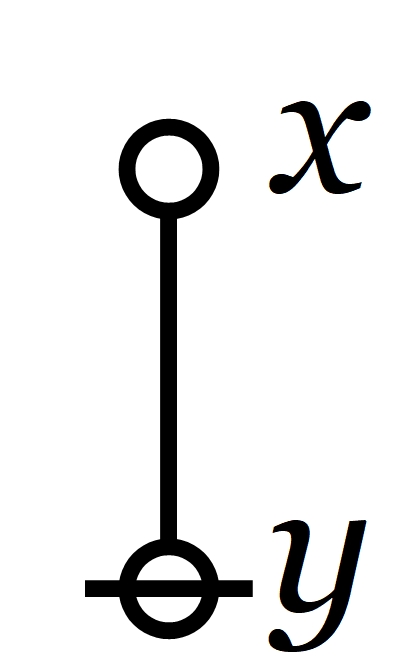
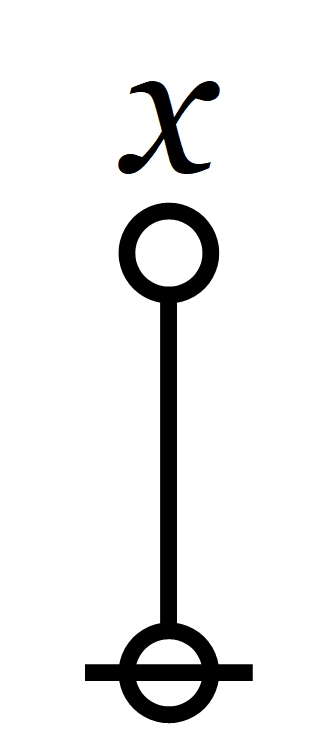
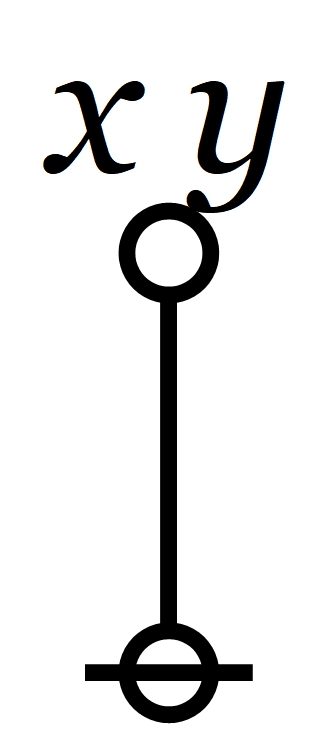
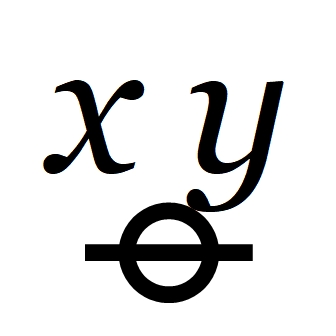
  • Column 1 shows the logical graphs I use for the sixteen boolean functions on two variables, with the string forms underneath.  The cactus string obtained by traversing the cactus graph uses parens + commas + variables in forms like \texttt{(} x \texttt{,} y \texttt{)} and \texttt{((} x \texttt{,} y \texttt{))}.
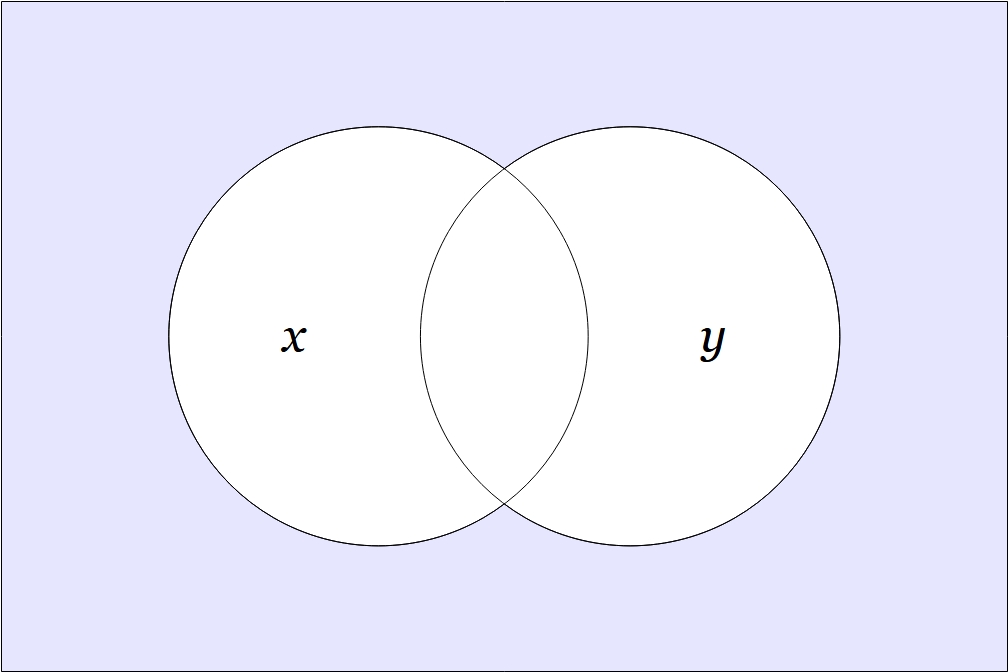
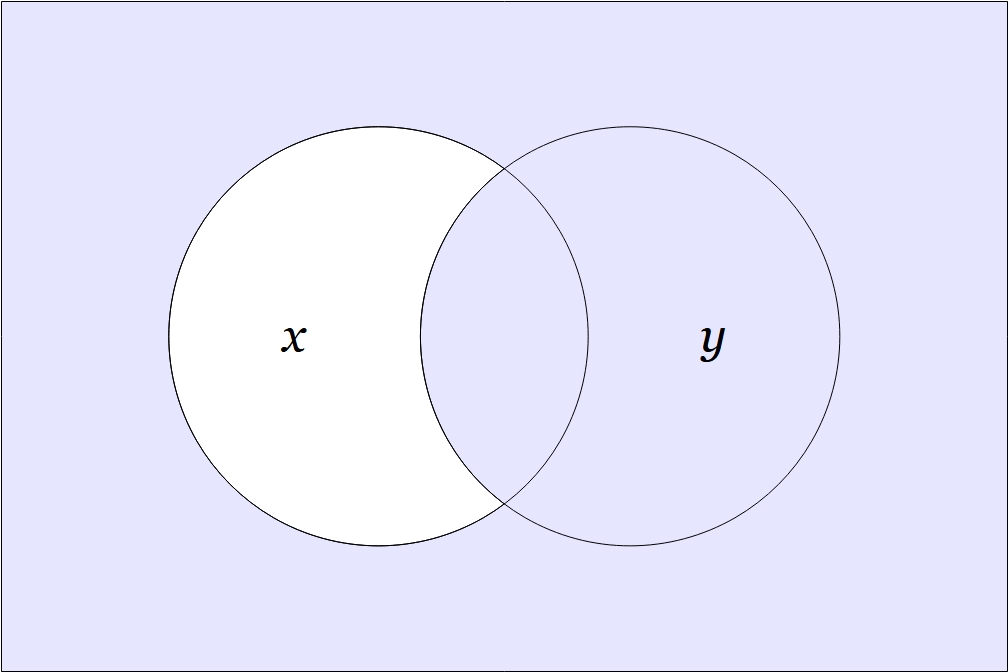
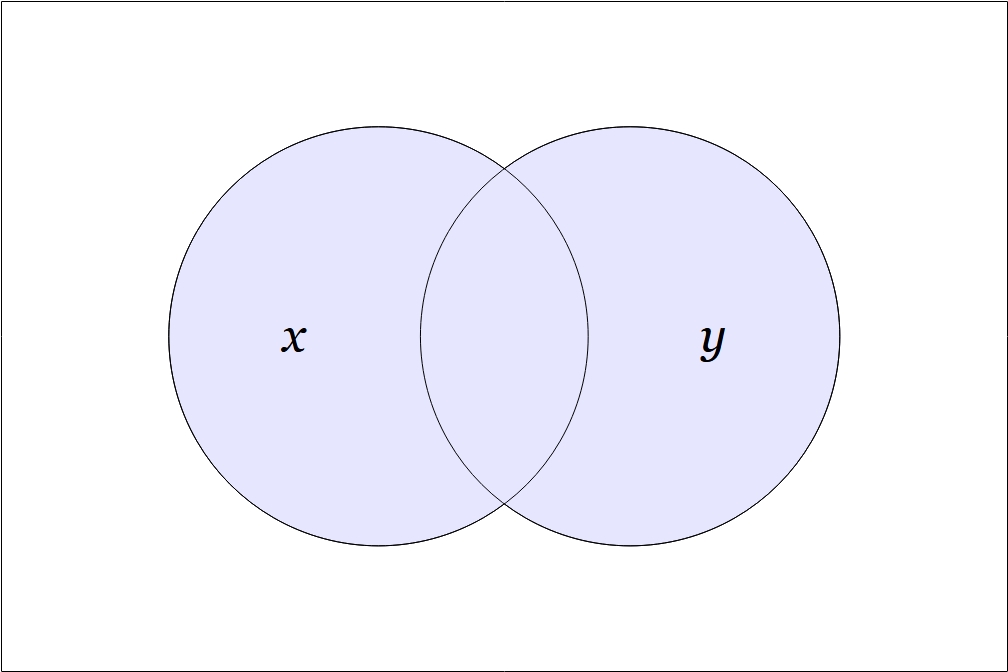
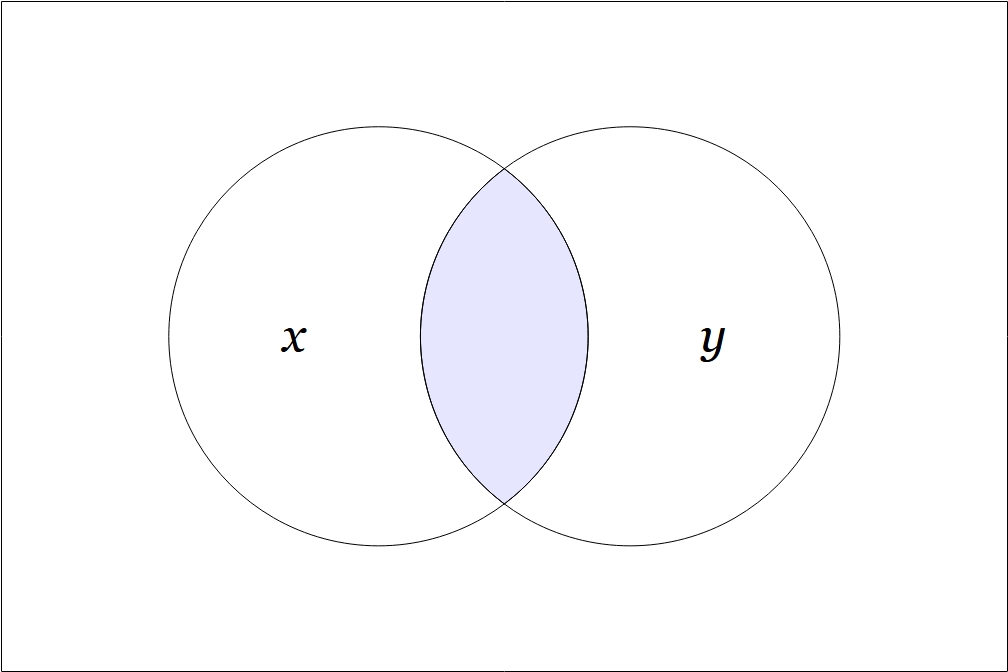
  • Column 2 shows the venn diagram associated with the entitative interpretation of the graph in Column 1.  This is the interpretation C.S. Peirce used in his earlier work on entitative graphs and the one Spencer Brown used in his Laws of Form.
  • Column 3 shows the venn diagram associated with the existential interpretation of the graph in Column 1.  This is the interpretation C.S. Peirce used in his later work on existential graphs.
Logical Graphs • Entitative and Existential Venn Diagrams
\text{Logical Graph} \text{Entitative Interpretation} \text{Existential Interpretation}
Cactus Stem
 
f₁₅(x,y) f₀(x,y)
\texttt{(} ~ \texttt{)}
 
\text{true}
f_{15}
\text{false}
f_{0}
Cactus (x)(y)
 
f₇(x,y) f₁(x,y)
\texttt{(} x \texttt{)(} y \texttt{)}
 
\lnot x \lor \lnot y
f_{7}
\lnot x \land \lnot y
f_{1}
Cactus (x)y
 
f₁₁(x,y) f₂(x,y)
\texttt{(} x \texttt{)} y
 
x \Rightarrow y
f_{11}
x \nLeftarrow y
f_{2}
Cactus (x)
 
f₃(x,y) f₃(x,y)
\texttt{(} x \texttt{)}
 
\lnot x
f_{3}
\lnot x
f_{3}
Cactus x(y)
 
f₁₃(x,y) f₄(x,y)
x \texttt{(} y \texttt{)}
 
x \Leftarrow y
f_{13}
x \nRightarrow y
f_{4}
Cactus (y)
 
f₅(x,y) f₅(x,y)
\texttt{(} y \texttt{)}
 
\lnot y
f_{5}
\lnot y
f_{5}
Cactus (x,y)
 
f₉(x,y) f₆(x,y)
\texttt{(} x \texttt{,} y \texttt{)}
 
x = y
f_{9}
x \ne y
f_{6}
Cactus (xy)
 
f₁(x,y) f₇(x,y)
\texttt{(} x y \texttt{)}
 
\lnot (x \lor y)
f_{1}
\lnot (x \land y)
f_{7}
Cactus xy
 
f₁₄(x,y) f₈(x,y)
x y
 
x \lor y
f_{14}
x \land y
f_{8}
Cactus ((x,y))
 
f₆(x,y) f₉(x,y)
\texttt{((} x \texttt{,} y \texttt{))}
 
x \ne y
f_{6}
x = y
f_{9}
Cactus y
 
f₁₀(x,y) f₁₀(x,y)
y
 
y
f_{10}
y
f_{10}
Cactus (x(y))
 
f₂(x,y) f₁₁(x,y)
\texttt{(} x \texttt{(} y \texttt{))}
 
x \nLeftarrow y
f_{2}
x \Rightarrow y
f_{11}
Cactus x
 
f₁₂(x,y) f₁₂(x,y)
x
 
x
f_{12}
x
f_{12}
Cactus ((x)y)
 
f₄(x,y) f₁₃(x,y)
\texttt{((} x \texttt{)} y \texttt{)}
 
x \nRightarrow y
f_{4}
x \Leftarrow y
f_{13}
Cactus ((x)(y))
 
f₈(x,y) f₁₄(x,y)
\texttt{((} x \texttt{)(} y \texttt{))}
 
x \land y
f_{8}
x \lor y
f_{14}
Cactus Root
 
f₀(x,y) f₁₅(x,y)
 
 
\text{false}
f_{0}
\text{true}
f_{15}

Take a gander at all that and I’ll discuss more tomorrow …

Regards,

Jon

Resources

cc: Cybernetics (1) (2)Laws of FormFB | Logical Graphs • Ontolog Forum (1) (2)
• Peirce List (1) (2) (3) (4) (5) (6) (7) (8) (9) (10) (11) (12) (13) • Structural Modeling (1) (2)
• Systems Science (1) (2)

Posted in Amphecks, Animata, Boolean Algebra, Boolean Functions, C.S. Peirce, Cactus Graphs, Constraint Satisfaction Problems, Deduction, Diagrammatic Reasoning, Duality, Equational Inference, Graph Theory, Laws of Form, Logic, Logical Graphs, Mathematics, Minimal Negation Operators, Model Theory, Painted Cacti, Peirce, Proof Theory, Propositional Calculus, Propositional Equation Reasoning Systems, Spencer Brown, Theorem Proving, Visualization | Tagged , , , , , , , , , , , , , , , , , , , , , , , , , | 16 Comments

Animated Logical Graphs • 63

Re: Richard J. LiptonThe Art Of Math
Re: Animated Logical Graphs • (57)(58)(59)(60)(61)(62)

We’ve been using the duality between entitative and existential interpretations of logical graphs to get a handle on the mathematical forms pervading logical laws.  A few posts ago we took up the tools of groups and symmetries and transformations to study the duality and we looked to the space of 2-variable boolean functions as a basic training grounds.  On those grounds the translation between interpretations presents as a group G of order two acting on a set X of sixteen logical graphs denoting boolean functions.

Last time we arrived at a Table showing how the group G partitions the set X into ten orbits of logical graphs.  Here again is that Table.

\text{Peirce Duality as Group Symmetry} \stackrel{_\bullet}{} \text{Orbit Order}

Peirce Duality as Group Symmetry • Orbit Order

I invited the reader to investigate the relationship between the group order |G| = 2, the number of orbits 10, and the total number of fixed points 16 + 4 = 20.  In the present case the product of the group order (2) and the number of orbits (10) is equal to the sum of the fixed points (20) — Is that just a fluke?  If not, why so?  And does it reflect a general rule?

We can make a beginning toward answering those questions by inspecting the incidence relation of fixed points and orbits in the Table above.  Each singleton orbit accumulates two hits, one from the group identity and one from the other group operation.  But each doubleton orbit also accumulates two hits, since the group identity fixes both of its two points.  Thus all the orbits are double-counted by counting the incidence of fixed points and orbits.  In sum, dividing the total number of fixed points by the order of the group brings us back to the exact number of orbits.

Resources

cc: Cybernetics (1) (2)Laws of FormFB | Logical Graphs • Ontolog Forum (1) (2)
• Peirce List (1) (2) (3) (4) (5) (6) (7) (8) (9) (10) (11) (12) (13) • Structural Modeling (1) (2)
• Systems Science (1) (2)

Posted in Amphecks, Animata, Boolean Algebra, Boolean Functions, C.S. Peirce, Cactus Graphs, Constraint Satisfaction Problems, Deduction, Diagrammatic Reasoning, Duality, Equational Inference, Graph Theory, Laws of Form, Logic, Logical Graphs, Mathematics, Minimal Negation Operators, Model Theory, Painted Cacti, Peirce, Proof Theory, Propositional Calculus, Propositional Equation Reasoning Systems, Spencer Brown, Theorem Proving, Visualization | Tagged , , , , , , , , , , , , , , , , , , , , , , , , , | 16 Comments

Animated Logical Graphs • 62

Re: Richard J. LiptonThe Art Of Math
Re: Animated Logical Graphs • (57)(58)(59)(60)(61)

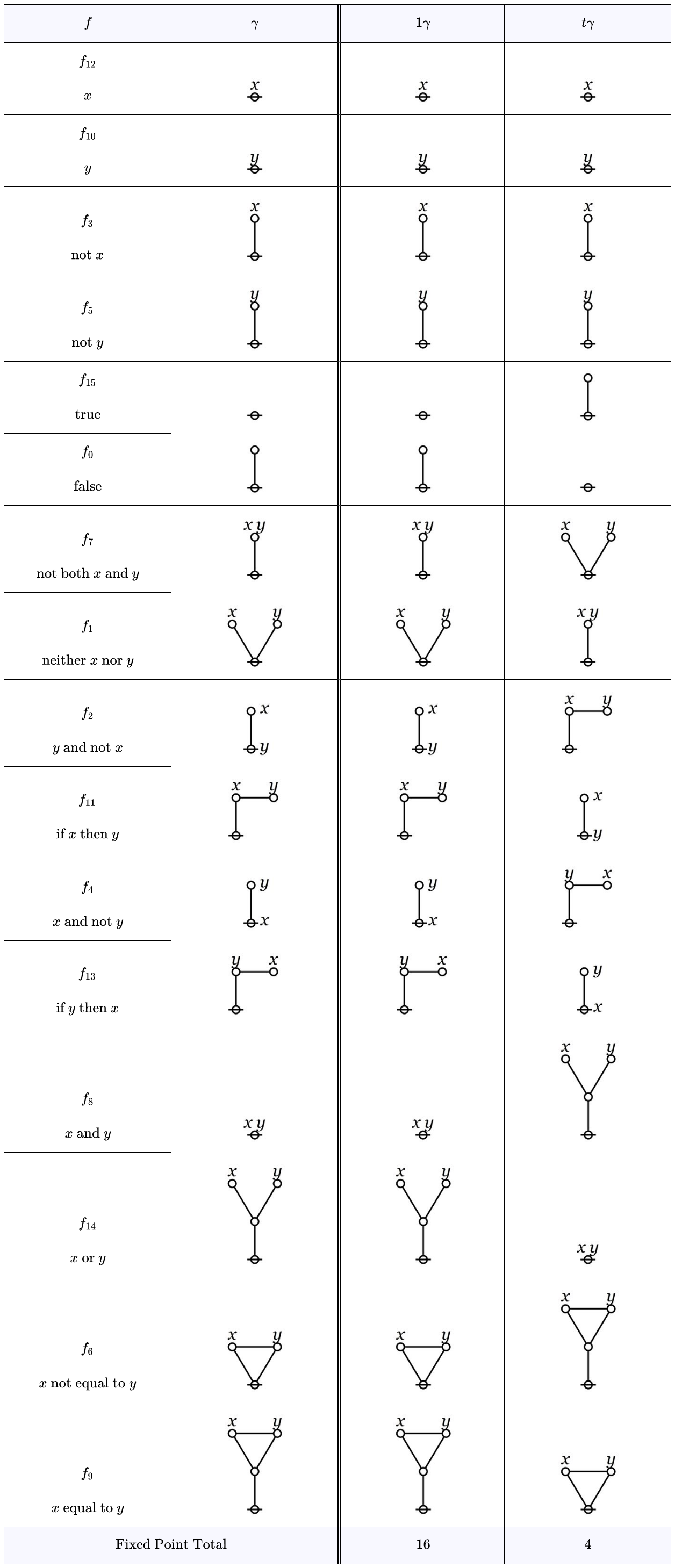
Another way of looking at the dual interpretation of logical graphs from a group-theoretic point of view is provided by the following Table.  In this arrangement we have sorted the rows of the previous Table to bring together similar graphs \gamma belonging to the set X, the similarity being determined by the action of the group G = \{ 1, t \}.  Transformation group theorists refer to the corresponding similarity classes as orbits of the group action under consideration.  The orbits are defined by the group acting transitively on them, meaning elements of the same orbit can always be transformed into one another by some group operation while elements of different orbits cannot.

\text{Peirce Duality as Group Symmetry} \stackrel{_\bullet}{} \text{Orbit Order}

Peirce Duality as Group Symmetry • Orbit Order

Scanning the Table we observe the 16 points of X fall into 10 orbits total, divided into 4 orbits of 1 point each and 6 orbits of 2 points each.  The points in singleton orbits are called fixed points of the transformation group since they are not moved but mapped into themselves by all group actions.  The bottom row of the Table tabulates the total number of fixed points for the group operations 1 and t respectively.  The group identity 1 always fixes all points, so its total is 16.  The group action t fixes only the four points in singleton orbits, giving a total of 4.

I leave it as an exercise for the reader to investigate the relationship between the group order |G| = 2, the number of orbits 10, and the total number of fixed points 16 + 4 = 20.

Resources

cc: Cybernetics (1) (2)Laws of FormFB | Logical Graphs • Ontolog Forum (1) (2)
• Peirce List (1) (2) (3) (4) (5) (6) (7) (8) (9) (10) (11) (12) • Structural Modeling (1) (2)
• Systems Science (1) (2)

Posted in Amphecks, Animata, Boolean Algebra, Boolean Functions, C.S. Peirce, Cactus Graphs, Constraint Satisfaction Problems, Deduction, Diagrammatic Reasoning, Duality, Equational Inference, Graph Theory, Laws of Form, Logic, Logical Graphs, Mathematics, Minimal Negation Operators, Model Theory, Painted Cacti, Peirce, Proof Theory, Propositional Calculus, Propositional Equation Reasoning Systems, Spencer Brown, Theorem Proving, Visualization | Tagged , , , , , , , , , , , , , , , , , , , , , , , , , | 18 Comments

Animated Logical Graphs • 61

Re: Richard J. LiptonThe Art Of Math
Re: Animated Logical Graphs • (57)(58)(59)(60)

Anything called a duality is naturally associated with a transformation group of order 2, say a group G acting on a set X.  Transformation groupies normally refer to X as a set of “points” even when the elements have additional structure of their own, as they often do.  A group of order two has the form G = \{ 1, t \}, where 1 is the identity element and the remaining element t satisfies the equation t^2 = 1, being on that account self-inverse.

A first look at the dual interpretation of logical graphs from a group-theoretic point of view is provided by the following Table.  The sixteen boolean functions f : \mathbb{B} \times \mathbb{B} \to \mathbb{B} on two variables are listed in Column 1.  Column 2 lists the elements of the set X, specifically, the sixteen logical graphs \gamma giving canonical expression to the boolean functions in Column 1.  Column 2 shows the graphs in existential order but the order is arbitrary since only the transformations of the set X into itself are material in this setting.  Column 3 shows the result 1 \gamma of the group element 1 acting on each graph \gamma in X, which is of course the same graph \gamma back again.  Column 4 shows the result t \gamma of the group element t acting on each graph \gamma in X, which is the entitative graph dual to the existential graph in Column 2.

\text{Peirce Duality as Group Symmetry}

Peirce Duality as Group Symmetry

The last Row of the Table displays a statistic of considerable interest to transformation group theorists.  It is the total incidence of fixed points, in other words, the number of points in X left invariant or unchanged by the respective group actions.  I’ll explain the significance of the fixed point parameter next time.

Resources

cc: Cybernetics (1) (2)Laws of FormFB | Logical Graphs • Ontolog Forum (1) (2)
• Peirce List (1) (2) (3) (4) (5) (6) (7) (8) (9) (10) (11) (12) • Structural Modeling (1) (2)
• Systems Science (1) (2)

Posted in Amphecks, Animata, Boolean Algebra, Boolean Functions, C.S. Peirce, Cactus Graphs, Constraint Satisfaction Problems, Deduction, Diagrammatic Reasoning, Duality, Equational Inference, Graph Theory, Laws of Form, Logic, Logical Graphs, Mathematics, Minimal Negation Operators, Model Theory, Painted Cacti, Peirce, Proof Theory, Propositional Calculus, Propositional Equation Reasoning Systems, Spencer Brown, Theorem Proving, Visualization | Tagged , , , , , , , , , , , , , , , , , , , , , , , , , | 19 Comments

Animated Logical Graphs • 60

Re: Laws of FormLyle Anderson
Re: Richard J. LiptonThe Art Of Math
Re: Animated Logical Graphs • (57)(58)(59)

LA:
Definition 1.  A group (G, *) is a set G together with a binary operation * : G \times G \to G satisfying the following three conditions.
  1. Associativity.  For any x, y, z \in G, we have (x * y) * z = x * (y * z).
  2. Identity.  There is an identity element e \in G such that \forall g \in G,
    we have e * g = g * e = g.
  3. Inverses.  Each element has an inverse, that is, for each g \in G,
    there is some h \in G such that g * h = h * g = e.

Dear Lyle,

Thanks for supplying that definition of a mathematical group.  It will afford us a wealth of useful concepts and notations as we proceed.  As you know, the above three axioms define what is properly called an abstract group.  Over the course of group theory’s history this definition was gradually abstracted from the more concrete examples of permutation groups and transformation groups initially arising in the theory of equations and their solvability.

As it happens, the application of group theory I’ll be developing over the next several posts will be using the more concrete type of structure, where a transformation group G is said to “act on” a set X by permuting its elements among themselves.  In the work we do here, each group G we contemplate will act a set X which may be viewed as either one of two things, either a canonical set of expressions in a formal language or the mathematical objects denoted by those expressions.

What you say about deriving arithmetic, algebra, group theory, and all the rest from the calculus of indications may well be true, but it remains to be shown if so, and that’s a ways down the road from here.

Resources

cc: Cybernetics (1) (2)Laws of FormFB | Logical Graphs • Ontolog Forum (1) (2)
• Peirce List (1) (2) (3) (4) (5) (6) (7) (8) (9) (10) (11) (12) • Structural Modeling (1) (2)
• Systems Science (1) (2)

Posted in Amphecks, Animata, Boolean Algebra, Boolean Functions, C.S. Peirce, Cactus Graphs, Constraint Satisfaction Problems, Deduction, Diagrammatic Reasoning, Duality, Equational Inference, Graph Theory, Laws of Form, Logic, Logical Graphs, Mathematics, Minimal Negation Operators, Model Theory, Painted Cacti, Peirce, Proof Theory, Propositional Calculus, Propositional Equation Reasoning Systems, Spencer Brown, Theorem Proving, Visualization | Tagged , , , , , , , , , , , , , , , , , , , , , , , , , | 20 Comments