Theory and Therapy of Representations • 5

Re: R.J. Lipton and K.W. ReganLegal Complexity

I do not pretend to understand the moral universe;
the arc is a long one, my eye reaches but little ways;
I cannot calculate the curve and complete the figure by
the experience of sight;  I can divine it by conscience.
And from what I see I am sure it bends towards justice.

🙞 Theodore Parker

The arc of the moral universe may bend toward justice — there’s hope it will.
For the logic of laws to converge on justice may take some doing on our part.

cc: Conceptual GraphsCyberneticsLaws of FormOntolog Forum
cc: FB | CyberneticsStructural ModelingSystems Science

Posted in Cybernetics, Democracy, Economics, Education, Expectation, Governance, Information, Inquiry, Intention, Justice, Law, Logic, Observation, Plato, Representation, Science, Semiosis, Semiotics, Society, Statistics, Virtue | Tagged , , , , , , , , , , , , , , , , , , , , | 2 Comments

Theme One Program • Jets and Sharks 3

Re: Theme One Program • Jets and Sharks • (1)(2)

Example 5. Jets and Sharks (cont.)

Given a representation of the Jets and Sharks universe in computer memory, we naturally want to see if the memory serves to supply the facts a well-constructed data base should.

In their PDP Handbook presentation of the Jets and Sharks example, McClelland and Rumelhart suggest several exercises for the reader to explore the performance of their neural pool memory model on the tasks of retrieval and generalization (Exercise 2.1).

Using cactus graphs or minimal negations to implement pools of mutually inhibitory neurons lends itself to neural architectures on a substantially different foundation from the garden variety connectionist models.  At a high level of abstraction, however, there is enough homology between the two orders to compare their performance on many of the same tasks.  With that in mind, I tried Theme One on a number of examples like the ones suggested by McClelland and Rumelhart.

What follows is a brief discussion of two examples as given in the original User Guide.  Next time I’ll fill in more details about the examples and discuss their bearing on the larger issues at hand.

With a query on the name “ken” we obtain the following output, giving all the features associated with Ken.

\text{Jets and Sharks} \stackrel{_\bullet}{} \text{Query 1}
Theme One Guide • Jets and Sharks • Query 1

With a query on the two features “college” and “sharks” we obtain the following outline of all features satisfying those constraints.

\text{Jets and Sharks} \stackrel{_\bullet}{} \text{Query 2}
Theme One Guide • Jets and Sharks • Query 2

From this we discover all college Sharks are 30‑something and married.  Further, we have a complete listing of their names broken down by occupation.

To be continued …

References

  • McClelland, J.L. (2015), Explorations in Parallel Distributed Processing : A Handbook of Models, Programs, and Exercises, 2nd ed. (draft), Stanford Parallel Distributed Processing LabOnline, Section 2.3, Figure 2.1.
  • McClelland, J.L., and Rumelhart, D.E. (1988), Explorations in Parallel Distributed Processing : A Handbook of Models, Programs, and Exercises, MIT Press, Cambridge, MA.  “Figure 1. Characteristics of a number of individuals belonging to two gangs, the Jets and the Sharks”, p. 39, from McClelland (1981).
  • McClelland, J.L. (1981), “Retrieving General and Specific Knowledge From Stored Knowledge of Specifics”, Proceedings of the Third Annual Conference of the Cognitive Science Society, Berkeley, CA.

Resources

cc: Conceptual GraphsCyberneticsLaws of FormOntolog Forum
cc: FB | Theme One ProgramStructural ModelingSystems Science

Posted in Algorithms, Animata, Artificial Intelligence, Boolean Functions, C.S. Peirce, Cactus Graphs, Cognition, Computation, Constraint Satisfaction Problems, Data Structures, Differential Logic, Equational Inference, Formal Languages, Graph Theory, Inquiry Driven Systems, Laws of Form, Learning Theory, Logic, Logical Graphs, Mathematics, Minimal Negation Operators, Painted Cacti, Peirce, Propositional Calculus, Semiotics, Spencer Brown, Visualization | Tagged , , , , , , , , , , , , , , , , , , , , , , , , , , | 3 Comments

Theme One Program • Jets and Sharks 2

Re: Theme One Program • Jets and Sharks • (1)

Example 5. Jets and Sharks (cont.)

As we saw last time, Theme One reads the text file shown below and constructs a cactus graph data structure in computer memory.  The cactus graph represents a single logical formula in propositional calculus and that proposition embodies the logical constraints defining the Jets and Sharks data base.

\text{Jets and Sharks} \stackrel{_\bullet}{} \text{Log File}
Theme One Guide • Jets and Sharks • Log File

Our cactus graph incorporates a vocabulary of 41 logical terms, each of which represents a boolean variable, so the proposition in question, call it ``q", is a boolean function of the form q : \mathbb{B}^{41} \to \mathbb{B}.  Given 2^{41} = 2,199,023,255,552 we know a truth table for q takes over two trillion rows and a venn diagram for q takes the same number of cells.  Topping it off, there are 2^{2^{41}} boolean functions of the form f : \mathbb{B}^{41} \to \mathbb{B} and q is just one of them.

Measures of strategy are clearly needed to negotiate patches of cacti like those.

To be continued …

References

  • McClelland, J.L. (2015), Explorations in Parallel Distributed Processing : A Handbook of Models, Programs, and Exercises, 2nd ed. (draft), Stanford Parallel Distributed Processing LabOnline, Section 2.3, Figure 2.1.
  • McClelland, J.L., and Rumelhart, D.E. (1988), Explorations in Parallel Distributed Processing : A Handbook of Models, Programs, and Exercises, MIT Press, Cambridge, MA.  “Figure 1. Characteristics of a number of individuals belonging to two gangs, the Jets and the Sharks”, p. 39, from McClelland (1981).
  • McClelland, J.L. (1981), “Retrieving General and Specific Knowledge From Stored Knowledge of Specifics”, Proceedings of the Third Annual Conference of the Cognitive Science Society, Berkeley, CA.

Resources

cc: Conceptual GraphsCyberneticsLaws of FormOntolog Forum
cc: FB | Theme One ProgramStructural ModelingSystems Science

Posted in Algorithms, Animata, Artificial Intelligence, Boolean Functions, C.S. Peirce, Cactus Graphs, Cognition, Computation, Constraint Satisfaction Problems, Data Structures, Differential Logic, Equational Inference, Formal Languages, Graph Theory, Inquiry Driven Systems, Laws of Form, Learning Theory, Logic, Logical Graphs, Mathematics, Minimal Negation Operators, Painted Cacti, Peirce, Propositional Calculus, Semiotics, Spencer Brown, Visualization | Tagged , , , , , , , , , , , , , , , , , , , , , , , , , , | 4 Comments

Theme One Program • Jets and Sharks 1

It is easy to spend a long time on the rudiments of learning and logic before getting down to practical applications — but I think we’ve circled square one long enough to expand our scope and see what the category of programs envisioned in Theme One can do with more substantial examples and exercises.

During the development of the Theme One program I tested successive implementations of its Reasoning Module or Logical Modeler on appropriate examples of logical problems current in the literature of the day.  The PDP Handbook of McClelland and Rumelhart set one of the wittiest gems ever to whet one’s app‑titude so I could hardly help but take it on.  The following text is a light revision of the way I set it up in the program’s User Guide.

Example 5. Jets and Sharks

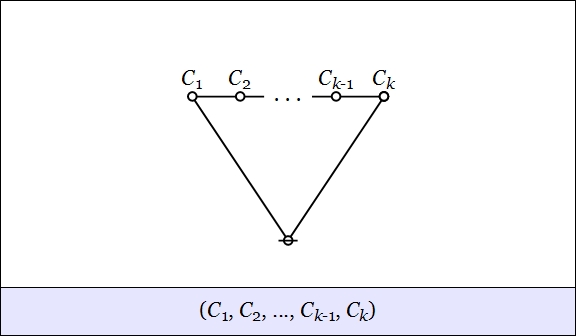
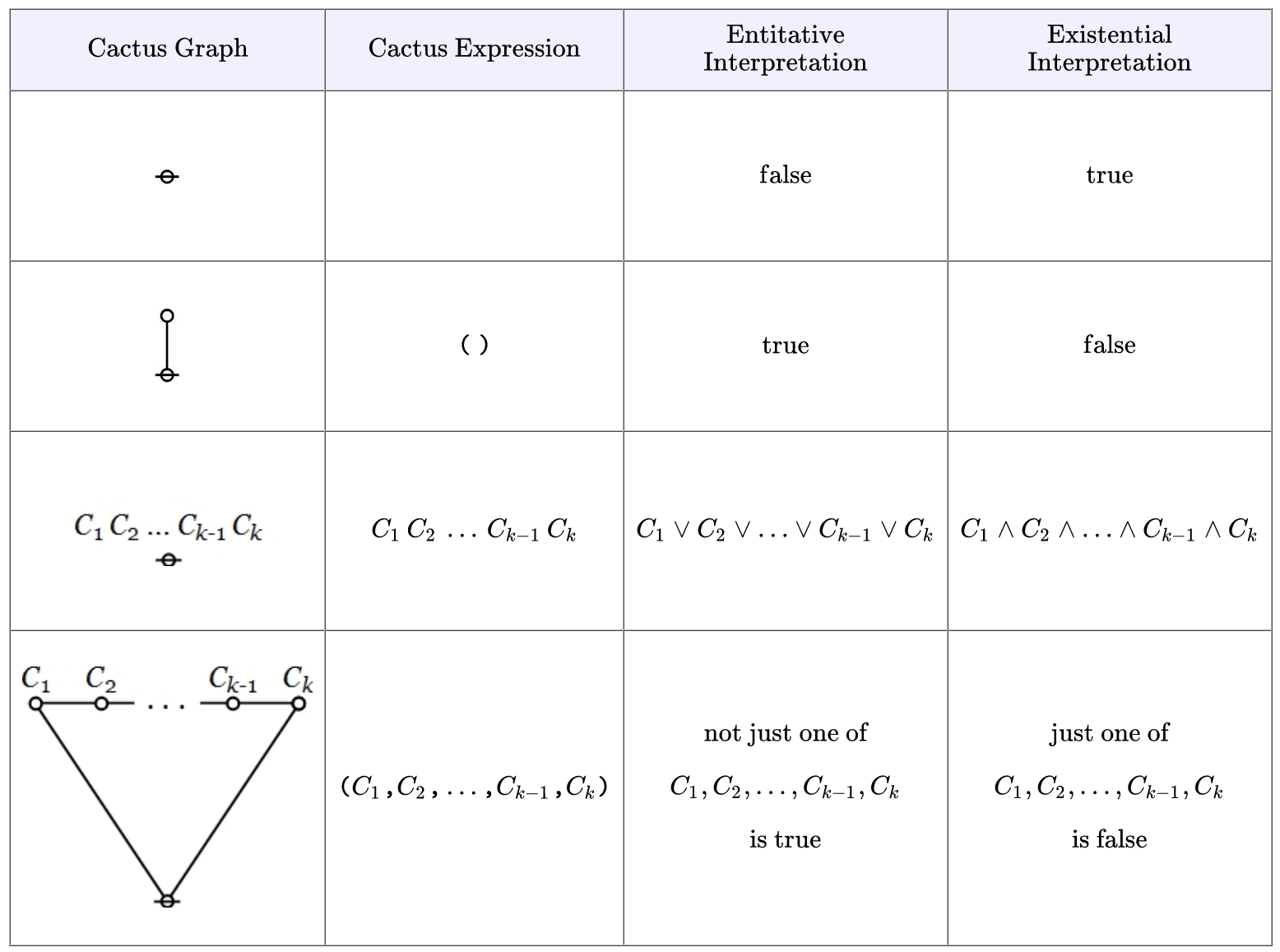
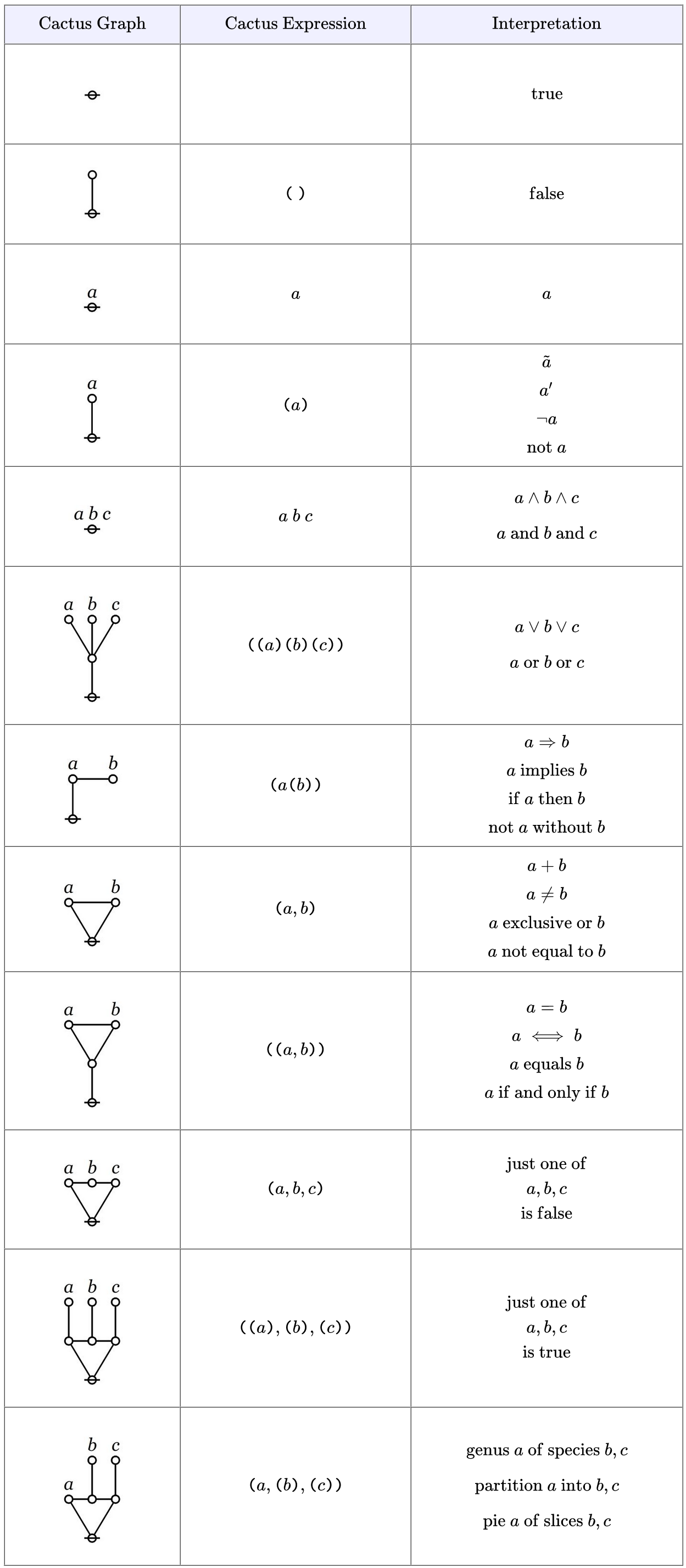
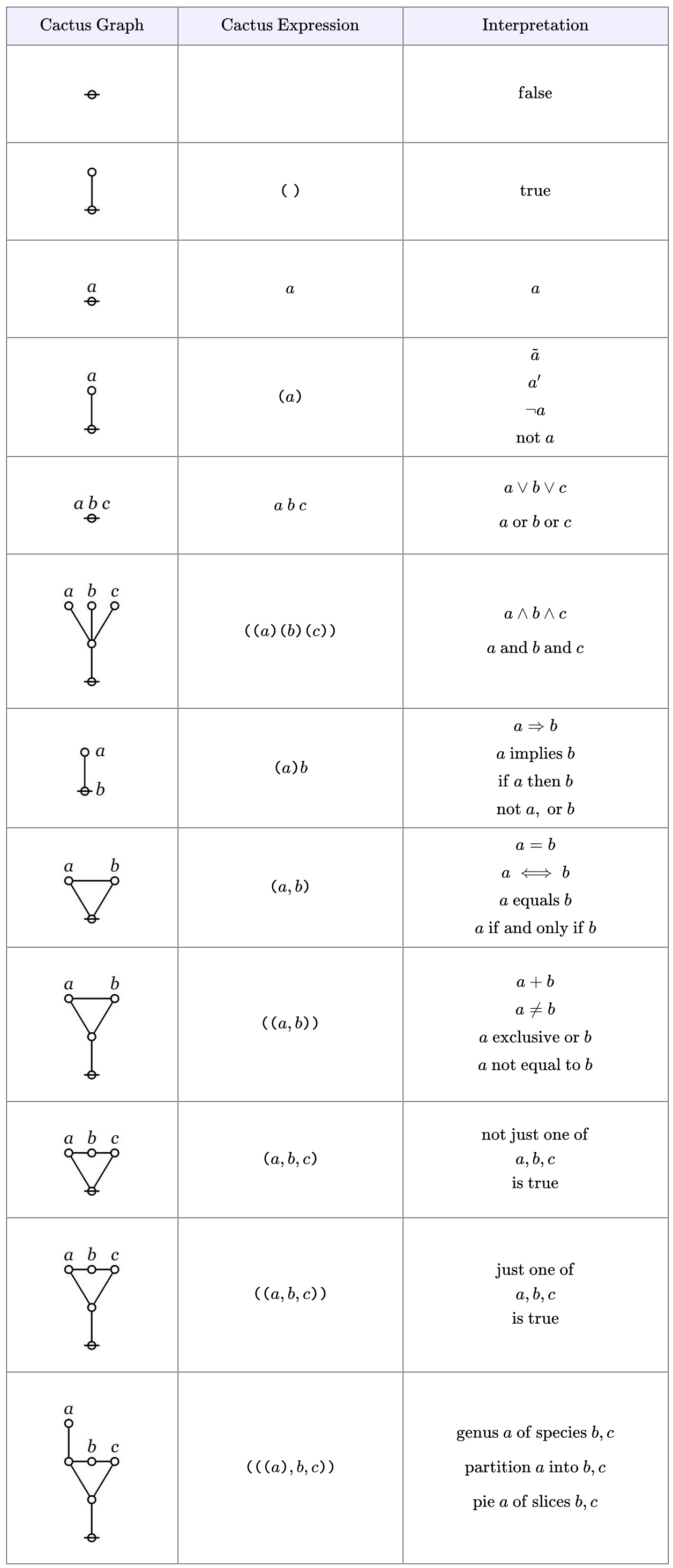
The propositional calculus based on the minimal negation operator can be interpreted in a way resembling the logic of activation states and competition constraints in one class of neural network models.  One way to do this is to interpret the blank or unmarked state as the resting state of a neural pool, the bound or marked state as its activated state, and to represent a mutually inhibitory pool of neurons A, B, C by the proposition \texttt{(} A \texttt{,} B \texttt{,} C \texttt{)}.  The manner of representation may be illustrated by transcribing a well-known example from the parallel distributed processing literature (McClelland and Rumelhart 1988) and working through a couple of the associated exercises as translated into logical graphs.

Displayed below is the text expression of a traversal string which Theme One parses into a cactus graph data structure in computer memory.  The cactus graph represents a single logical formula in propositional calculus and this proposition embodies all the logical constraints defining the Jets and Sharks data base.

\text{Jets and Sharks} \stackrel{_\bullet}{} \text{Log File}
Theme One Guide • Jets and Sharks • Log File

To be continued …

References

  • McClelland, J.L. (2015), Explorations in Parallel Distributed Processing : A Handbook of Models, Programs, and Exercises, 2nd ed. (draft), Stanford Parallel Distributed Processing LabOnline, Section 2.3, Figure 2.1.
  • McClelland, J.L., and Rumelhart, D.E. (1988), Explorations in Parallel Distributed Processing : A Handbook of Models, Programs, and Exercises, MIT Press, Cambridge, MA.  “Figure 1. Characteristics of a number of individuals belonging to two gangs, the Jets and the Sharks”, p. 39, from McClelland (1981).
  • McClelland, J.L. (1981), “Retrieving General and Specific Knowledge From Stored Knowledge of Specifics”, Proceedings of the Third Annual Conference of the Cognitive Science Society, Berkeley, CA.

Resources

cc: Conceptual GraphsCyberneticsLaws of FormOntolog Forum
cc: FB | Theme One ProgramStructural ModelingSystems Science

Posted in Algorithms, Animata, Artificial Intelligence, Boolean Functions, C.S. Peirce, Cactus Graphs, Cognition, Computation, Constraint Satisfaction Problems, Data Structures, Differential Logic, Equational Inference, Formal Languages, Graph Theory, Inquiry Driven Systems, Laws of Form, Learning Theory, Logic, Logical Graphs, Mathematics, Minimal Negation Operators, Painted Cacti, Peirce, Propositional Calculus, Semiotics, Spencer Brown, Visualization | Tagged , , , , , , , , , , , , , , , , , , , , , , , , , , | 5 Comments

Theme One Program • Motivation 6

Comments I made in reply to a correspondent’s questions about delimiters and tokenizing in the Learner module may be worth sharing here.

In one of the projects I submitted toward a Master’s in psychology I used the Theme One program to analyze samples of data from my advisor’s funded research study on family dynamics.  In one phase of the study observers viewed video-taped sessions of family members (parent and child) interacting in various modes (“play” or “work”) and coded qualitative features of each moment’s activity over a period of time.

The following page describes the application in more detail and reflects on its implications for the conduct of scientific inquiry in general.

In this application a “phrase” or “string” is a fixed-length sequence of qualitative features and a “clause” or “strand” is a sequence of such phrases delimited by what the observer judges to be a significant pause in the action.

In the qualitative research phases of the study one is simply attempting to discern any significant or recurring patterns in the data one possibly can.

In this case the observers are tokenizing the observations according to a codebook that has passed enough intercoder reliability studies to afford them all a measure of confidence it captures meaningful aspects of whatever reality is passing before their eyes and ears.

Resources

cc: Conceptual GraphsCyberneticsLaws of FormOntolog Forum
cc: FB | Theme One ProgramStructural ModelingSystems Science

Posted in Algorithms, Animata, Artificial Intelligence, Boolean Functions, C.S. Peirce, Cactus Graphs, Computation, Computational Complexity, Cybernetics, Data Structures, Differential Logic, Form, Formal Languages, Graph Theory, Inquiry, Inquiry Driven Systems, Intelligent Systems, Laws of Form, Learning, Logic, Logical Graphs, Mathematics, Minimal Negation Operators, Painted Cacti, Peirce, Pragmatics, Programming, Propositional Calculus, Propositional Equation Reasoning Systems, Reasoning, Semantics, Semiotics, Sign Relations, Spencer Brown, Syntax, Visualization | Tagged , , , , , , , , , , , , , , , , , , , , , , , , , , , , , , , , , , , | 3 Comments

Theme One Program • Motivation 5

Since I’m working from decades-old memories of first inklings I thought I might peruse the web for current information about Zipf’s Law.  I see there is now something called the Zipf–Mandelbrot (and sometimes –Pareto) Law and that was interesting because my wife Susan Awbrey made use of Mandelbrot’s ideas about self-similarity in her dissertation and communicated with him about it.  So there’s more to read up on.

Just off-hand, though, I think my Learner is dealing with a different problem.  It has more to do with the savings in effort a learner gets by anticipating future experiences based on its record of past experiences than the savings it gets by minimizing bits of storage as far as mechanically possible.  There is still a type of compression involved but it’s more like Korzybski’s “time-binding” than space-savings proper.  Speaking of old memories …

The other difference I see is that Zipf’s Law applies to an established and preferably large corpus of linguistic material, while my Learner has to start from scratch, accumulating experience over time, making the best of whatever data it has at the outset and every moment thereafter.

Resources

cc: Conceptual GraphsCyberneticsLaws of FormOntolog Forum
cc: FB | Theme One ProgramStructural ModelingSystems Science

Posted in Algorithms, Animata, Artificial Intelligence, Boolean Functions, C.S. Peirce, Cactus Graphs, Computation, Computational Complexity, Cybernetics, Data Structures, Differential Logic, Form, Formal Languages, Graph Theory, Inquiry, Inquiry Driven Systems, Intelligent Systems, Laws of Form, Learning, Logic, Logical Graphs, Mathematics, Minimal Negation Operators, Painted Cacti, Peirce, Pragmatics, Programming, Propositional Calculus, Propositional Equation Reasoning Systems, Reasoning, Semantics, Semiotics, Sign Relations, Spencer Brown, Syntax, Visualization | Tagged , , , , , , , , , , , , , , , , , , , , , , , , , , , , , , , , , , , | 3 Comments

Theme One Program • Motivation 4

From Zipf’s Law and the category of “things that vary inversely with frequency” I got my first brush with the idea that keeping track of usage frequencies is part and parcel of building efficient codes.

In its first application the environment the Learner has to learn is the usage behavior of its user, as given by finite sequences of characters from a finite alphabet, which sequences of characters might as well be called “words”, together with finite sequences of those words which might as well be called “phrases” or “sentences”.  In other words, Job One for the Learner is the job of constructing a “user model”.

In that frame of mind we are not seeking anything so grand as a Universal Induction Algorithm but simply looking for any approach to give us a leg up, complexity wise, in Interactive Real Time.

Resources

cc: Conceptual GraphsCyberneticsLaws of FormOntolog Forum
cc: FB | Theme One ProgramStructural ModelingSystems Science

Posted in Algorithms, Animata, Artificial Intelligence, Boolean Functions, C.S. Peirce, Cactus Graphs, Computation, Computational Complexity, Cybernetics, Data Structures, Differential Logic, Form, Formal Languages, Graph Theory, Inquiry, Inquiry Driven Systems, Intelligent Systems, Laws of Form, Learning, Logic, Logical Graphs, Mathematics, Minimal Negation Operators, Painted Cacti, Peirce, Pragmatics, Programming, Propositional Calculus, Propositional Equation Reasoning Systems, Reasoning, Semantics, Semiotics, Sign Relations, Spencer Brown, Syntax, Visualization | Tagged , , , , , , , , , , , , , , , , , , , , , , , , , , , , , , , , , , , | 3 Comments

Theme One Program • Motivation 3

Sometime around 1970 John B. Eulenberg came from Stanford to direct Michigan State’s Artificial Language Lab, where I would come to spend many interesting hours hanging out all through the 70s and 80s.  Along with its research program the lab did a lot of work on augmentative communication technology for limited mobility users and the observations I made there prompted the first inklings of my Learner program.

Early in that period I visited John’s course in mathematical linguistics, which featured Laws of Form among its readings, along with the more standard fare of Wall, Chomsky, Jackendoff, and the Unified Science volume by Charles Morris which credited Peirce with pioneering the pragmatic theory of signs.  I learned about Zipf’s Law relating the lengths of codes to their usage frequencies and I named the earliest avatar of my Learner program XyPh, partly after Zipf and playing on the xylem and phloem of its tree data structures.

Resources

cc: Conceptual GraphsCyberneticsLaws of FormOntolog Forum
cc: FB | Theme One ProgramStructural ModelingSystems Science

Posted in Algorithms, Animata, Artificial Intelligence, Boolean Functions, C.S. Peirce, Cactus Graphs, Computation, Computational Complexity, Cybernetics, Data Structures, Differential Logic, Form, Formal Languages, Graph Theory, Inquiry, Inquiry Driven Systems, Intelligent Systems, Laws of Form, Learning, Logic, Logical Graphs, Mathematics, Minimal Negation Operators, Painted Cacti, Peirce, Pragmatics, Programming, Propositional Calculus, Propositional Equation Reasoning Systems, Reasoning, Semantics, Semiotics, Sign Relations, Spencer Brown, Syntax, Visualization | Tagged , , , , , , , , , , , , , , , , , , , , , , , , , , , , , , , , , , , | 3 Comments

Theme One Program • Motivation 2

A side‑effect of working on the Theme One program over the course of a decade was the measure of insight it gave me into the reasons why empiricists and rationalists have so much trouble understanding each other, even when those two styles of thinking inhabit the very same soul.

The way it came about was this.  The code from which the program is currently assembled initially came from two distinct programs, ones I developed in alternate years, at first only during the summers.

In the Learner program I sought to implement a Humean empiricist style of learning algorithm for the adaptive uptake of coded sequences of occurrences in the environment, say, as codified in a formal language.  I knew all the theorems from formal language theory telling how limited any such strategy must ultimately be in terms of its generative capacity, but I wanted to explore the boundaries of that capacity in concrete computational terms.

In the Modeler program I aimed to implement a variant of Peirce’s graphical syntax for propositional logic, making use of graph-theoretic extensions I had developed over the previous decade.

As I mentioned, work on those two projects proceeded in a parallel series of fits and starts through interwoven summers for a number of years, until one day it dawned on me how the Learner, one of whose aliases was Index, could be put to work helping with sundry substitution tasks the Modeler needed to carry out.

So I began integrating the functions of the Learner and the Modeler, at first still working on the two component modules in an alternating manner, but devoting a portion of effort to amalgamating their principal data structures, bringing them into convergence with each other, and unifying them over a common basis.

Another round of seasons and many changes of mind and programming style, I arrived at a unified graph-theoretic data structure, strung like a wire through the far‑flung pearls of my programmed wit.  But the pearls I polished in alternate years maintained their shine along axes of polarization whose grains remained skew in regard to each other.  To put it more plainly, the strategies I imagined were the smartest tricks to pull from the standpoint of optimizing the program’s performance on the Learning task I found the next year were the dumbest moves to pull from the standpoint of its performance on the Reasoning task.  I gradually came to appreciate that trade-off as a discovery.

Resources

cc: Conceptual GraphsCyberneticsLaws of FormOntolog Forum
cc: FB | Theme One ProgramStructural ModelingSystems Science

Posted in Algorithms, Animata, Artificial Intelligence, Boolean Functions, C.S. Peirce, Cactus Graphs, Computation, Computational Complexity, Cybernetics, Data Structures, Differential Logic, Form, Formal Languages, Graph Theory, Inquiry, Inquiry Driven Systems, Intelligent Systems, Laws of Form, Learning, Logic, Logical Graphs, Mathematics, Minimal Negation Operators, Painted Cacti, Peirce, Pragmatics, Programming, Propositional Calculus, Propositional Equation Reasoning Systems, Reasoning, Semantics, Semiotics, Sign Relations, Spencer Brown, Syntax, Visualization | Tagged , , , , , , , , , , , , , , , , , , , , , , , , , , , , , , , , , , , | 3 Comments

Theme One Program • Motivation 1

The main idea behind the Theme One program is the efficient use of graph-theoretic data structures for the tasks of “learning” and “reasoning”.

I am thinking of learning in the sense of learning about an environment, in essence, gaining information about the nature of an environment and being able to apply the information acquired to a specific purpose.

Under the heading of reasoning I am simply lumping together all the ordinary sorts of practical activities which would probably occur to most people under that name.

There is a natural relation between the tasks.  Learning the character of an environment leads to the recognition of laws which govern the environment and making full use of that recognition requires the ability to reason logically about those laws in abstract terms.

Resources

cc: Conceptual GraphsCyberneticsLaws of FormOntolog Forum
cc: FB | Theme One ProgramStructural ModelingSystems Science

Posted in Algorithms, Animata, Artificial Intelligence, Boolean Functions, C.S. Peirce, Cactus Graphs, Computation, Computational Complexity, Cybernetics, Data Structures, Differential Logic, Form, Formal Languages, Graph Theory, Inquiry, Inquiry Driven Systems, Intelligent Systems, Laws of Form, Learning, Logic, Logical Graphs, Mathematics, Minimal Negation Operators, Painted Cacti, Peirce, Pragmatics, Programming, Propositional Calculus, Propositional Equation Reasoning Systems, Reasoning, Semantics, Semiotics, Sign Relations, Spencer Brown, Syntax, Visualization | Tagged , , , , , , , , , , , , , , , , , , , , , , , , , , , , , , , , , , , | 3 Comments