Peirce’s 1870 “Logic of Relatives” • Comment 11.13

Peirce’s 1870 “Logic of Relatives”Comment 11.13

As we make our way toward the foothills of Peirce’s 1870 Logic of Relatives there are several pieces of equipment we must not leave the plains without, namely, the utilities variously known as arrows, morphisms, homomorphisms, structure-preserving maps, among other names, depending on the altitude of abstraction we happen to be traversing at the moment in question.  As a moderate to middling but not too beaten track, let’s examine a few ways of defining morphisms that will serve us in the present discussion.

Suppose we are given three functions J, K, L satisfying the following conditions.

\begin{array}{lcccl}  J & : & X & \gets & Y  \\[6pt]  K & : & X & \gets & X \times X  \\[6pt]  L & : & Y & \gets & Y \times Y  \end{array}

\begin{array}{lll}  J(L(u, v)) & = & K(Ju, Jv)  \end{array}

Our sagittarian leitmotif can be rubricized in the following slogan.

The J-image of the L-product is the K-product of the J-images.

Figure 47 presents us with a picture of the situation in question.
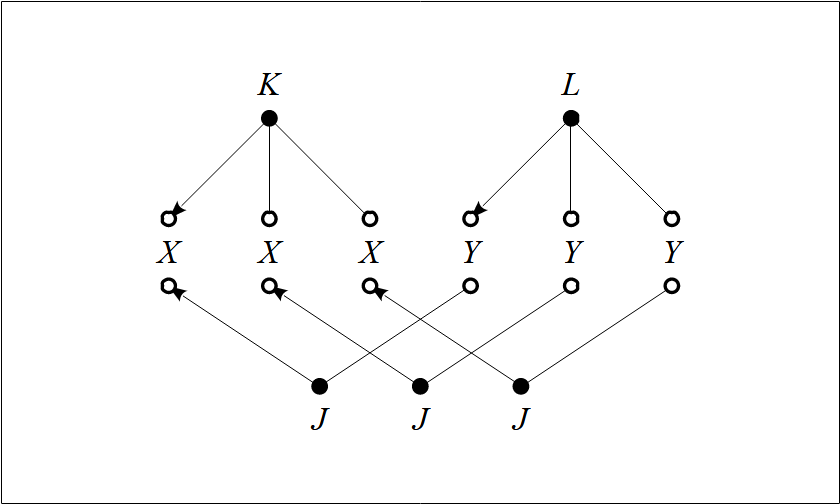
Structure Preserving Transformation J : K ← L
\text{Figure 47. Structure Preserving Transformation}~ J : K \gets L

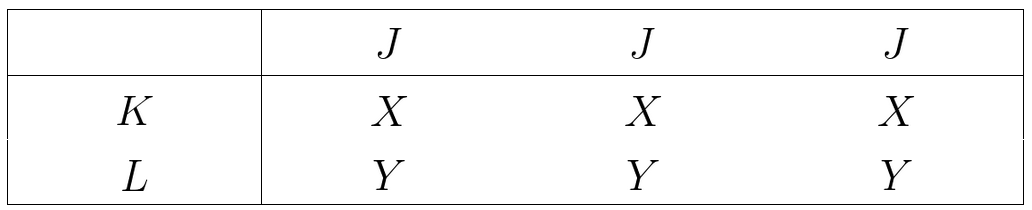
Table 48 gives the constraint matrix version of the same thing.

\text{Table 48. Structure Preserving Transformation}~ J : K \gets L
Structure Preserving Transformation J : K ← L

One way to read the Table is in terms of the informational redundancies it summarizes.  For example, one way to read it says that satisfying the constraint in the L row along with all the constraints in the J columns automatically satisfies the constraint in the K row.  Quite by design, that is one way to understand the equation J(L(u, v)) = K(Ju, Jv).

Resources

cc: CyberneticsOntolog ForumStructural ModelingSystems Science
cc: FB | Peirce MattersLaws of Form • Peirce List (1) (2) (3) (4) (5) (6) (7)

Posted in C.S. Peirce, Logic, Logic of Relatives, Logical Graphs, Mathematics, Relation Theory, Visualization | Tagged , , , , , , | 10 Comments

Peirce’s 1870 “Logic of Relatives” • Comment 11.12

Peirce’s 1870 “Logic of Relatives”Comment 11.12

Since functions are special cases of dyadic relations and since the space of dyadic relations is closed under relational composition — that is, the composition of two dyadic relations is again a dyadic relation — we know the relational composition of two functions has to be a dyadic relation.  If the relational composition of two functions is necessarily a function, too, then we would be justified in speaking of functional composition and also in saying the space of functions is closed under this functional form of composition.

Just for novelty’s sake, let’s try to prove this for relations that are functional on correlates.

The task is this — We are given a pair of dyadic relations:

\begin{array}{lll}  P \subseteq X \times Y & \text{and} & Q \subseteq Y \times Z  \end{array}

The dyadic relations P and Q are assumed to be functional on correlates, a premiss we express as follows.

\begin{array}{lll}  P : X \gets Y & \text{and} & Q : Y \gets Z  \end{array}

We are charged with deciding whether the relational composition P \circ Q \subseteq X \times Z is also functional on correlates, in symbols, whether P \circ Q : X \gets Z.

It always helps to begin by recalling the pertinent definitions.

For a dyadic relation L \subseteq X \times Y, we have the following equivalence.

\begin{array}{lll}  L ~\text{is a function}~ L : X \gets Y & \iff & L ~\text{is}~ 1\text{-regular at}~ Y.  \end{array}

As for the definition of relational composition, it is enough to consider the coefficient of the composite relation on an arbitrary ordered pair, i\!:\!j.  For that we have the following formula, where the summation indicated is logical disjunction.

(P \circ Q)_{ij} ~=~ \sum_k P_{ik} Q_{kj}

So let’s begin.

  • P : X \gets Y, or the fact that P ~\text{is}~ 1\text{-regular at}~ Y, means there is exactly one ordered pair i\!:\!k \in P for each k \in Y.
  • Q : Y \gets Z, or the fact that Q ~\text{is}~ 1\text{-regular at}~ Z, means there is exactly one ordered pair k\!:\!j \in Q for each j \in Z.
  • As a result, there is exactly one ordered pair i\!:\!j \in P \circ Q for each j \in Z, which means P \circ Q ~\text{is}~ 1\text{-regular at}~ Z, and so we have the function P \circ Q : X \gets Z.

And we are done.

Resources

cc: CyberneticsOntolog ForumStructural ModelingSystems Science
cc: FB | Peirce MattersLaws of Form • Peirce List (1) (2) (3) (4) (5) (6) (7)

Posted in C.S. Peirce, Logic, Logic of Relatives, Logical Graphs, Mathematics, Relation Theory, Visualization | Tagged , , , , , , | 10 Comments

Peirce’s 1870 “Logic of Relatives” • Comment 11.11

Peirce’s 1870 “Logic of Relatives”Comment 11.11

The preceding exercises were intended to beef-up our “functional literacy” skills to the point where we can read our functional alphabets backwards and forwards and recognize the local functionalities immanent in relative terms no matter where they reside among the domains of relations.  These skills will serve us in good stead as we work to build a catwalk from Peirce’s platform of 1870 to contemporary scenes on the logic of relatives, and back again.

By way of extending a few very tentative planks, let us experiment with the following definitions.

  • A relative term ``p" and the corresponding relation P \subseteq X \times Y are both called functional on rèlates if and only if P is a function at X.  We write this in symbols as P : X \to Y.
  • A relative term ``p" and the corresponding relation P \subseteq X \times Y are both called functional on correlates if and only if P is a function at Y.  We write this in symbols as P : X \gets Y.

When a relation happens to be a function, it may be excusable to use the same name for it in both applications, writing out explicit type markers like P : X \times Y,   P : X \to Y, and P : X \gets Y, as the case may be, when and if it serves to clarify matters.

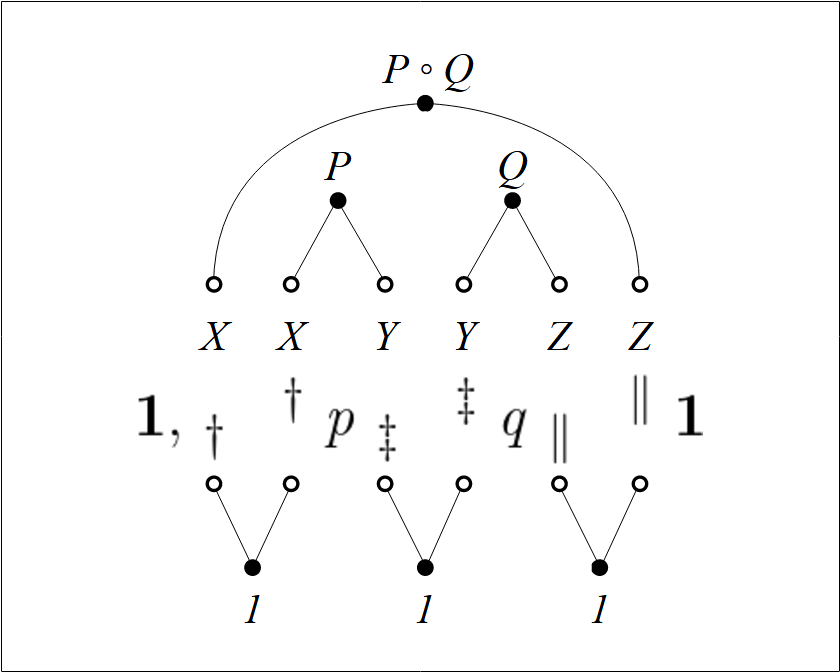
From this current, perhaps transient, perspective, it appears our next task is to examine how the known properties of relations are modified when aspects of functionality are spied in the mix.  Let us then return to our various ways of looking at relational composition and see what changes and what stays the same when the relations in question happen to be functions of various kinds at some of their domains.  Here is one generic picture of relational composition, cast in a style that hews pretty close to the line of potentials inherent in Peirce’s syntax of this period.

Universal Bracket P ◦ Q
\text{Figure 44. Anything that is a}~ p ~\text{of a}~ q ~\text{of Anything}

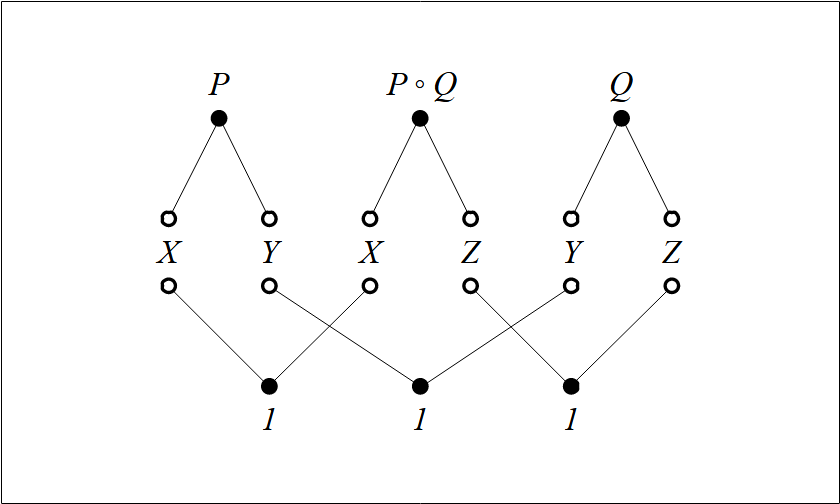
From this we extract the hypergraph picture of relational composition.

Relational Composition Figure P ◦ Q
\text{Figure 45. Relational Composition}~ P \circ Q

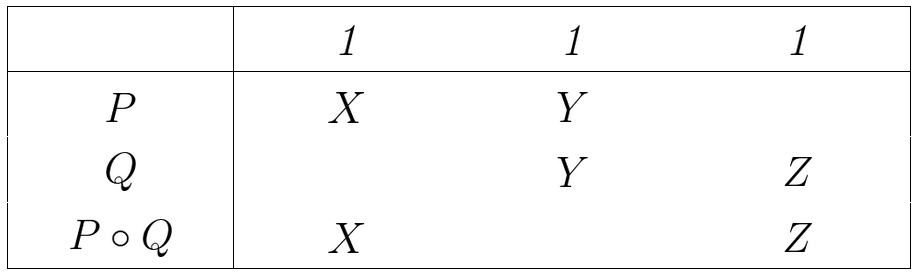
All the information contained in these Figures can be expressed in the form of a constraint satisfaction table, or spreadsheet picture of relational composition.

\text{Table 46. Relational Composition}~ P \circ Q

Relational Composition Table P ◦ Q

The following plan of study then presents itself, to see what easy mileage we can get in our exploration of functions by adopting the above templates as the primers of a paradigm.

Resources

cc: CyberneticsOntolog ForumStructural ModelingSystems Science
cc: FB | Peirce MattersLaws of Form • Peirce List (1) (2) (3) (4) (5) (6) (7)

Posted in C.S. Peirce, Logic, Logic of Relatives, Logical Graphs, Mathematics, Relation Theory, Visualization | Tagged , , , , , , | 10 Comments

Peirce’s 1870 “Logic of Relatives” • Comment 11.10

Peirce’s 1870 “Logic of Relatives”Comment 11.10

A dyadic relation F \subseteq X \times Y which qualifies as a function f : X \to Y may then enjoy a number of further distinctions.
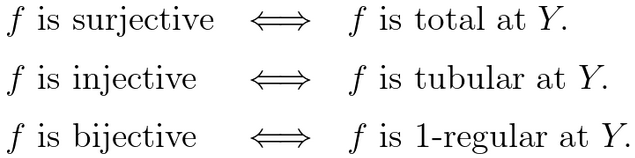
Definitions

For example, the function f : X \to Y shown below is neither total nor tubular at its codomain Y so it can enjoy none of the properties of being surjective, injective, or bijective.
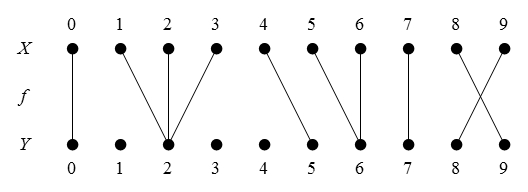
Function f : X → Y
\text{Figure 40. Function}~ f : X \to Y

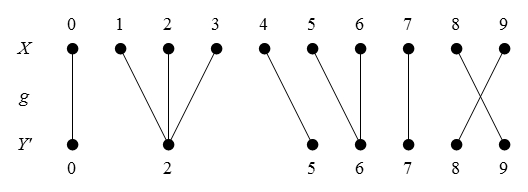
An easy way to extract a surjective function from any function is to reset its codomain to its range.  For example, the range of the function f above is Y^\prime = \{ 0, 2, 5, 6, 7, 8, 9 \}.  If we form a new function g : X \to Y^\prime that looks just like f on the domain X but is assigned the codomain Y^\prime, then g is surjective, and is described as a mapping onto Y^\prime.

Function g : X → Y'
\text{Figure 41. Function}~ g : X \to Y'

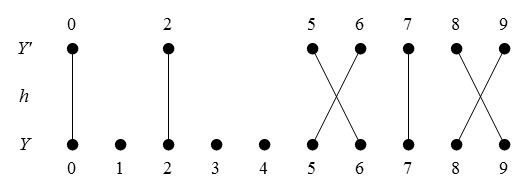
The function h : Y' \to Y is injective.

Function h : Y' → Y
\text{Figure 42. Function}~ h : Y' \to Y

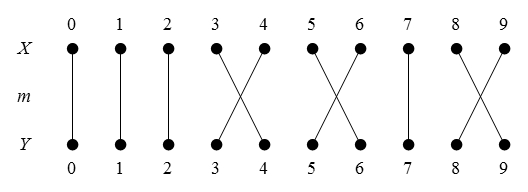
The function m : X \to Y is bijective.

Function m : X → Y
\text{Figure 43. Function}~ m : X \to Y

Resources

cc: CyberneticsOntolog ForumStructural ModelingSystems Science
cc: FB | Peirce MattersLaws of Form • Peirce List (1) (2) (3) (4) (5) (6) (7)

Posted in C.S. Peirce, Logic, Logic of Relatives, Logical Graphs, Mathematics, Relation Theory, Visualization | Tagged , , , , , , | 10 Comments

Peirce’s 1870 “Logic of Relatives” • Comment 11.9

Peirce’s 1870 “Logic of Relatives”Comment 11.9

Among the variety of regularities affecting dyadic relations we pay special attention to the c-regularity conditions where c is equal to 1.

Let P \subseteq X \times Y be an arbitrary dyadic relation.  The following properties can be defined.

Definitions 1

We previously examined dyadic relations exemplifying each of these regularity conditions.  Then we introduced a few bits of terminology and special-purpose notations for working with tubular relations.

Definitions 2

We arrive by way of this winding stair at the special cases of dyadic relations P \subseteq X \times Y variously described as 1-regular, total and tubular, or total prefunctions on specified domains, X or Y or both, and which are more often celebrated as functions on those domains.

If P is a pre-function P : X \rightharpoonup Y that happens to be total at X, then P is known as a function from X to Y, typically indicated as P : X \to Y.

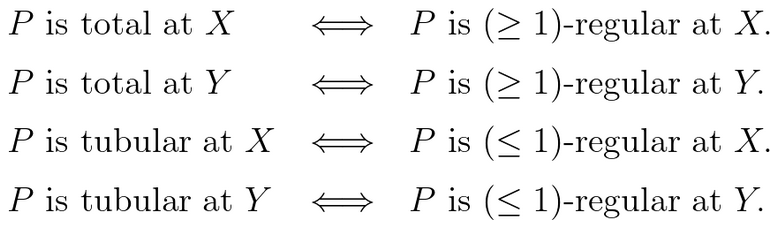
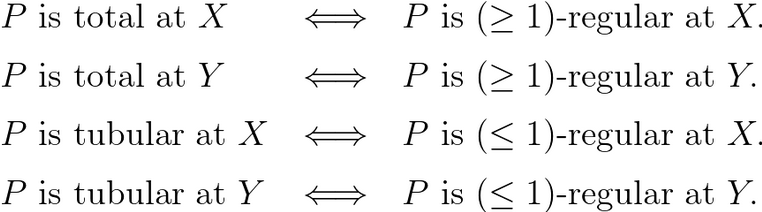
To say that a relation P \subseteq X \times Y is total and tubular at X is to say that P is 1-regular at X.  Thus, we may formalize the following definitions.

Definitions 3

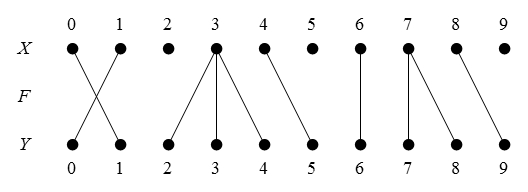
For example, let X = Y = \{ 0, 1, 2, 3, 4, 5, 6, 7, 8, 9 \} and let F \subseteq X \times Y be the dyadic relation depicted in the bigraph below.

Dyadic Relation F
\text{Figure 39. Dyadic Relation}~ F

We observe that F is a function at Y and we record this fact in either of the manners F : X \leftarrow Y or F : Y \to X.

Resources

cc: CyberneticsOntolog ForumStructural ModelingSystems Science
cc: FB | Peirce MattersLaws of Form • Peirce List (1) (2) (3) (4) (5) (6) (7)

Posted in C.S. Peirce, Logic, Logic of Relatives, Logical Graphs, Mathematics, Relation Theory, Visualization | Tagged , , , , , , | 9 Comments

Peirce’s 1870 “Logic of Relatives” • Comment 11.8

Peirce’s 1870 “Logic of Relatives”Comment 11.8

Let’s take a closer look at the numerical incidence properties of relations, concentrating on the assorted regularity conditions defined in the article on Relation Theory.

For example, L has the property of being c\text{-regular at}~ j if and only if the cardinality of the local flag L_{x @ j} is equal to c for all x in X_j, coded in symbols, if and only if |L_{x @ j}| = c for all x in X_j.

In like fashion, one may define the numerical incidence properties (< c)\text{-regular at}~ j, (> c)\text{-regular at}~ j, and so on.  For ease of reference, a number of such definitions are recorded below.
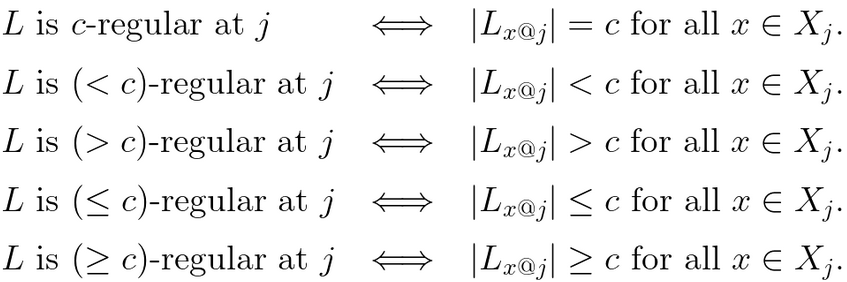
Definitions

Clearly, if any relation is (\le c)\text{-regular} on one of its domains X_j and also (\ge c)\text{-regular} on the same domain, then it must be (= c)\text{-regular} on that domain, in short, c\text{-regular} at j.

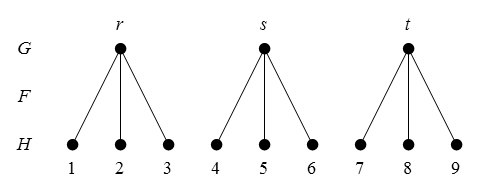
For example, let G = \{ r, s, t \} and H = \{ 1, 2, 3, 4, 5, 6, 7, 8, 9 \} and consider the dyadic relation F \subseteq G \times H bigraphed below.

Dyadic Relation F
\text{Figure 38. Dyadic Relation}~ F

We observe that F is 3-regular at G and 1-regular at H.

Resources

cc: CyberneticsOntolog ForumStructural ModelingSystems Science
cc: FB | Peirce MattersLaws of Form • Peirce List (1) (2) (3) (4) (5) (6) (7)

Posted in C.S. Peirce, Logic, Logic of Relatives, Logical Graphs, Mathematics, Relation Theory, Visualization | Tagged , , , , , , | 10 Comments

Peirce’s 1870 “Logic of Relatives” • Comment 11.7

Peirce’s 1870 “Logic of Relatives”Comment 11.7

We come now to the special cases of dyadic relations known as functions.  It will serve a dual purpose in the present exposition to take the class of functions as a source of object examples for clarifying the more abstruse concepts of Relation Theory.

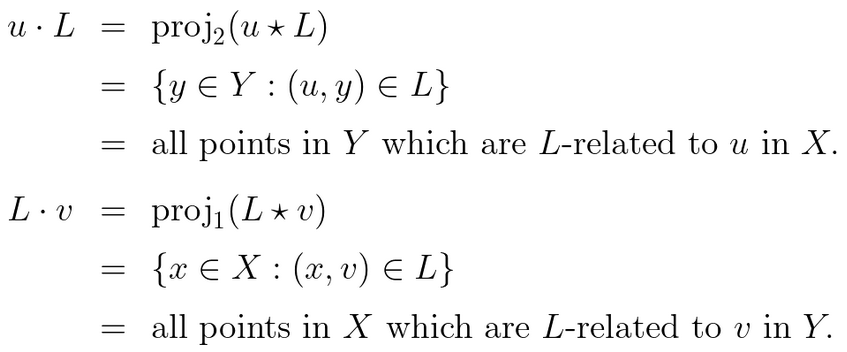
To begin, let us recall the definition of a local flag L_{a @ j} of a k-adic relation L.

Display 1

For a dyadic relation L \subseteq X \times Y the notation for local flags can be simplified in two ways.  First, the local flags L_{u @ 1} and L_{v @ 2} are often more conveniently notated as L_{u @ X} and L_{v @ Y}, respectively.  Second, the notation may be streamlined even further by making the following definitions.
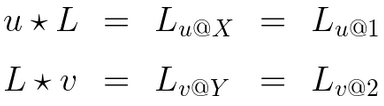
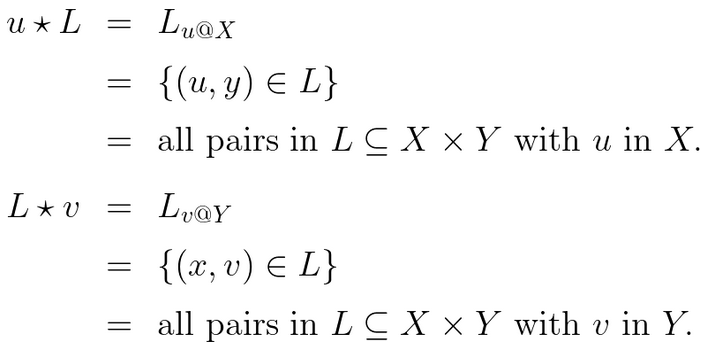
Display 2

In light of these conventions, the local flags of a dyadic relation L \subseteq X \times Y may be comprehended under the following descriptions.

Display 3

The following definitions are also useful.

Display 4

A sufficient illustration is supplied by the earlier example E.

Dyadic Relation E
\text{Figure 35. Dyadic Relation}~ E

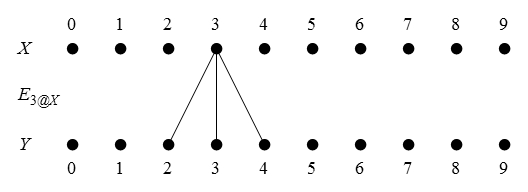
Figure 36 shows the local flag E_{3 @ X} of E.

Local Flag E_{3 @ X}
\text{Figure 36. Local Flag}~ E_{3 @ X}

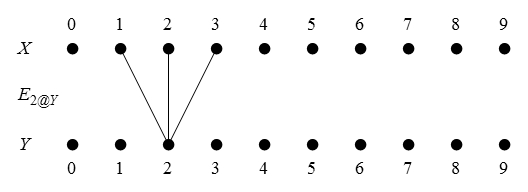
Figure 37 shows the local flag E_{2 @ Y} of E.

Local Flag E_{2 @ Y}
\text{Figure 37. Local Flag}~ E_{2 @ Y}

Resources

cc: CyberneticsOntolog ForumStructural ModelingSystems Science
cc: FB | Peirce MattersLaws of Form • Peirce List (1) (2) (3) (4) (5) (6) (7)

Posted in C.S. Peirce, Logic, Logic of Relatives, Logical Graphs, Mathematics, Relation Theory, Visualization | Tagged , , , , , , | 10 Comments

Peirce’s 1870 “Logic of Relatives” • Comment 11.6

Peirce’s 1870 “Logic of Relatives”Comment 11.6

Let’s continue working our way through the above definitions, constructing appropriate examples as we go.

Relation E_1 \subseteq X \times Y exemplifies the quality of totality at X.
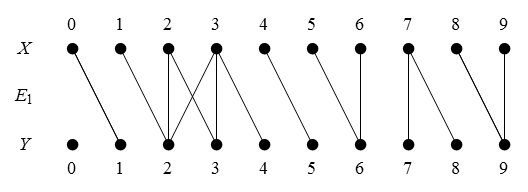
Dyadic Relation E₁
\text{Dyadic Relation}~ E_1

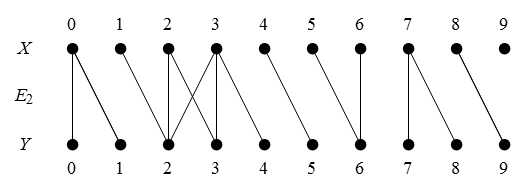
Relation E_2 \subseteq X \times Y exemplifies the quality of totality at Y.

Dyadic Relation E₂
\text{Dyadic Relation}~ E_2

Relation E_3 \subseteq X \times Y exemplifies the quality of tubularity at X.
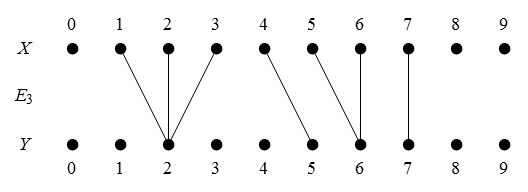
Dyadic Relation E₃
\text{Dyadic Relation}~ E_3

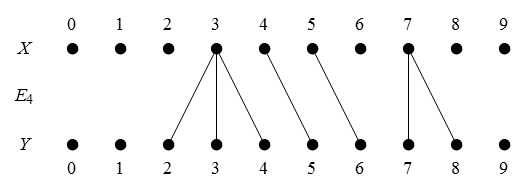
Relation E_4 \subseteq X \times Y exemplifies the quality of tubularity at Y.

Dyadic Relation E₄
\text{Dyadic Relation}~ E_4

So E_3 is a pre-function e_3 : X \rightharpoonup Y and E_4 is a pre-function e_4 : X \leftharpoonup Y.

Resources

cc: CyberneticsOntolog ForumStructural ModelingSystems Science
cc: FB | Peirce MattersLaws of Form • Peirce List (1) (2) (3) (4) (5) (6) (7)

Posted in C.S. Peirce, Logic, Logic of Relatives, Logical Graphs, Mathematics, Relation Theory, Visualization | Tagged , , , , , , | 10 Comments

Peirce’s 1870 “Logic of Relatives” • Comment 11.5

Peirce’s 1870 “Logic of Relatives”Comment 11.5

Everyone knows the right sort of diagram can be a great aid in rendering complex matters comprehensible.  With that in mind, let’s extract what we need from the Relation Theory article to illuminate Peirce’s 1870 Logic of Relatives and use it to fashion what icons we can within the current frame of discussion.

For the immediate present, we may begin with dyadic relations and describe the most frequently encountered species of relations and functions in terms of their local and numerical incidence properties.

Let P \subseteq X \times Y be an arbitrary dyadic relation.  The following properties of P can then be defined.

Display 1

If P \subseteq X \times Y is tubular at X, then P is known as a partial function or a pre-function from X to Y, frequently signalized by renaming P with an alternate lower case name, say {}^{\backprime\backprime} p {}^{\prime\prime}, and writing p : X \rightharpoonup Y.

Just by way of formalizing the definition:

Display 2

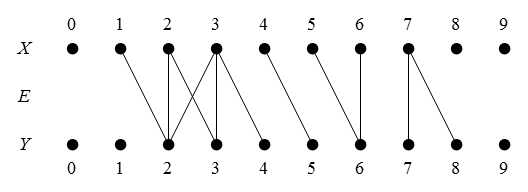
To illustrate these properties, let us fashion a generic enough example of a dyadic relation, E \subseteq X \times Y, where X = Y = \{ 0, 1, 2, 3, 4, 5, 6, 7, 8, 9 \}, and where the bigraph picture of E is shown in Figure 30.

Dyadic Relation E
\text{Figure 30. Dyadic Relation}~ E

If we scan along the X dimension from 0 to 9 we see that the incidence degrees of the X nodes with the Y domain are 0, 1, 2, 3, 1, 1, 1, 2, 0, 0 in that order.

If we scan along the Y dimension from 0 to 9 we see that the incidence degrees of the Y nodes with the X domain are 0, 0, 3, 2, 1, 1, 2, 1, 1, 0 in that order.

Thus, E is not total at either X or Y since there are nodes in both X and Y having incidence degrees less than 1.

Also, E is not tubular at either X or Y since there are nodes in both X and Y having incidence degrees greater than 1.

Clearly then the relation E cannot qualify as a pre-function, much less as a function, on either of its relational domains.

Resources

cc: CyberneticsOntolog ForumStructural ModelingSystems Science
cc: FB | Peirce MattersLaws of Form • Peirce List (1) (2) (3) (4) (5) (6) (7)

Posted in C.S. Peirce, Logic, Logic of Relatives, Logical Graphs, Mathematics, Relation Theory, Visualization | Tagged , , , , , , | 10 Comments

Peirce’s 1870 “Logic of Relatives” • Comment 11.4

Peirce’s 1870 “Logic of Relatives”Comment 11.4

The task before us is to clarify the relationships among relative terms, relations, and the special cases of relations given by equivalence relations, functions, and so on.

The first obstacle to get past is the order convention Peirce’s orientation to relative terms causes him to use for functions.  To focus on a concrete example of immediate use in this discussion, let’s take the “number of” function Peirce denotes by means of square brackets and re-formulate it as a dyadic relative term v in the following way.

v(t) ~:=~ [t] ~=~ \text{the number of the term}~ t.

To set the dyadic relative term v within a suitable context of interpretation, let’s suppose v corresponds to a relation V \subseteq \mathbb{R} \times S where \mathbb{R} is the set of real numbers and S is a suitable syntactic domain, here described as a set of terms.  The dyadic relation V is at first sight a function from S to \mathbb{R}.  It is, however, not always possible to assign a number to every term in whatever syntactic domain S we happen to pick, so we may eventually be forced to treat the dyadic relation V as a partial function from S to \mathbb{R}.  All things considered, then, let’s try the following budget of strategies and compromises.

First, let’s adapt the arrow notation for functions in such a way as to allow detaching the functional orientation from the order in which the names of domains are written on the page.  Second, let’s change the notation for partial functions, or pre-functions, to mark more clearly their distinction from functions.  This produces the following scheme.

q : X \to Y means q is functional at X.

q : X \leftarrow Y means q is functional at Y.

q : X \rightharpoonup Y means q is pre-functional at X.

q : X \leftharpoonup Y means q is pre-functional at Y.

Until it becomes necessary to stipulate otherwise, let’s assume v is a function in \mathbb{R} of S, written v : \mathbb{R} \leftarrow S, amounting to a functional alias of the dyadic relation V \subseteq \mathbb{R} \times S and associated with the dyadic relative term v whose rèlate lies in the set \mathbb{R} of real numbers and whose correlate lies in the set S of syntactic terms.

Note.  Please refer to the article on Relation Theory for the definitions of functions and pre‑functions used in the above discussion.

Resources

cc: CyberneticsOntolog ForumStructural ModelingSystems Science
cc: FB | Peirce MattersLaws of Form • Peirce List (1) (2) (3) (4) (5) (6) (7)

Posted in C.S. Peirce, Logic, Logic of Relatives, Logical Graphs, Mathematics, Relation Theory, Visualization | Tagged , , , , , , | 10 Comments