We come to the last of Peirce’s statements about the “number of” function, first quoted in Selection 11 and again with the whole set in Comment 11.2.
NOF 4.1
The conception of multiplication we have adopted is that of the application of one relation to another. […]
Even ordinary numerical multiplication involves the same idea, for  is a pair of triplets, and
  is a triplet of pairs, where “triplet of” and “pair of” are evidently relatives.
If we have an equation of the form

and there are just as many x’s per y as there are, per things, things of the universe, then we have also the arithmetical equation,
![[x][y] ~=~ [z].](https://s0.wp.com/latex.php?latex=%5Bx%5D%5By%5D+%7E%3D%7E+%5Bz%5D.&bg=ffffff&fg=000000&s=1&c=20201002)
(Peirce, CP 3.76)
Peirce here observes what may be called a contingent morphism. On a condition he gives, the mapping of logical terms to their corresponding numbers preserves the multiplication of relative terms after the fashion of the following formula.

Equivalently:
![[xy] = [x][y].](https://s0.wp.com/latex.php?latex=%5Bxy%5D+%3D+%5Bx%5D%5By%5D.&bg=ffffff&fg=000000&s=0&c=20201002)
The condition for this to hold is expressed by Peirce in the following manner.
There are just as many x’s per y as there are, per things, things of the universe.
Peirce’s phrasing on this point is admittedly hard to parse but if we stick with his story to the end I think we can see what he’s driving at.
NOF 4.2
For instance, if our universe is perfect men, and there are as many teeth to a Frenchman (perfect understood) as there are to any one of the universe, then
![[\mathit{t}][\mathrm{f}] ~=~ [\mathit{t}\mathrm{f}]](https://s0.wp.com/latex.php?latex=%5B%5Cmathit%7Bt%7D%5D%5B%5Cmathrm%7Bf%7D%5D+%7E%3D%7E+%5B%5Cmathit%7Bt%7D%5Cmathrm%7Bf%7D%5D&bg=ffffff&fg=000000&s=1&c=20201002)
holds arithmetically. (Peirce, CP 3.76).
Now that is something we can sink our teeth into and trace the bigraph representation of the situation. It will help to recall our first examination of the “tooth of” relation and to adjust the picture we sketched of it on that occasion.
Transcribing Peirce’s example:
![\begin{array}{ll} \text{Let} & \mathrm{m} ~=~ \text{man} \\[8pt] \text{and} & \mathit{t} ~=~ \text{tooth of}\,\underline{~~~~}. \\[8pt] \text{Then} & v(\mathit{t}) ~=~ [\mathit{t}] ~=~ \displaystyle\frac{[\mathit{t}\mathrm{m}]}{[\mathrm{m}]}. \end{array}](https://s0.wp.com/latex.php?latex=%5Cbegin%7Barray%7D%7Bll%7D++%5Ctext%7BLet%7D++%26++%5Cmathrm%7Bm%7D+%7E%3D%7E+%5Ctext%7Bman%7D++%5C%5C%5B8pt%5D++%5Ctext%7Band%7D++%26++%5Cmathit%7Bt%7D+%7E%3D%7E+%5Ctext%7Btooth+of%7D%5C%2C%5Cunderline%7B%7E%7E%7E%7E%7D.++%5C%5C%5B8pt%5D++%5Ctext%7BThen%7D+%26++v%28%5Cmathit%7Bt%7D%29+%7E%3D%7E+%5B%5Cmathit%7Bt%7D%5D+%7E%3D%7E+%5Cdisplaystyle%5Cfrac%7B%5B%5Cmathit%7Bt%7D%5Cmathrm%7Bm%7D%5D%7D%7B%5B%5Cmathrm%7Bm%7D%5D%7D.++%5Cend%7Barray%7D&bg=ffffff&fg=000000&s=1&c=20201002)
That is to say, the number of the relative term “tooth of” is equal to the number of teeth of humans divided by the number of humans. In a universe of perfect human dentition this gives a quotient of 32.
The dyadic relative term  determines a dyadic relation
  where
where  contains all the teeth and
  contains all the people under discussion.
To make the case as simple as possible and still cover the point, suppose there are just four people in our universe of discourse and just two of them are French. The bigraph product below shows the pertinent facts of the case.
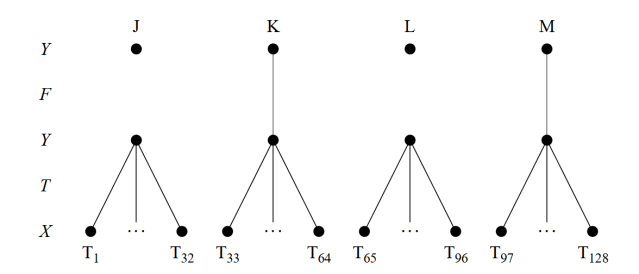

In this picture the order of relational composition flows down the page. For convenience in composing relations, the absolute term  is inflected by the comma functor to form the dyadic relative term
  which in turn determines the idempotent representation of Frenchmen as a subset of mankind,
By way of a legend for the Figure, we have the following data.
![\begin{array}{lllr} \mathrm{m} & = & \mathrm{J} ~+\!\!,~ \mathrm{K} ~+\!\!,~ \mathrm{L} ~+\!\!,~ \mathrm{M} \qquad = & \mathbf{1} \\[6pt] \mathrm{f} & = & \mathrm{K} ~+\!\!,~ \mathrm{M} \\[6pt] \mathrm{f,} & = & \mathrm{K}\!:\!\mathrm{K} ~+\!\!,~ \mathrm{M}\!:\!\mathrm{M} \\[6pt] \mathit{t} & = & (T_{001} ~+\!\!,~ \dots ~+\!\!,~ T_{032}):J & ~+\!\!, \\[6pt] & & (T_{033} ~+\!\!,~ \dots ~+\!\!,~ T_{064}):K & ~+\!\!, \\[6pt] & & (T_{065} ~+\!\!,~ \dots ~+\!\!,~ T_{096}):L & ~+\!\!, \\[6pt] & & (T_{097} ~+\!\!,~ \dots ~+\!\!,~ T_{128}):M \end{array}](https://s0.wp.com/latex.php?latex=%5Cbegin%7Barray%7D%7Blllr%7D++%5Cmathrm%7Bm%7D+%26+%3D+%26++%5Cmathrm%7BJ%7D+%7E%2B%5C%21%5C%21%2C%7E+%5Cmathrm%7BK%7D+%7E%2B%5C%21%5C%21%2C%7E+%5Cmathrm%7BL%7D+%7E%2B%5C%21%5C%21%2C%7E+%5Cmathrm%7BM%7D+%5Cqquad+%3D+%26+%5Cmathbf%7B1%7D++%5C%5C%5B6pt%5D++%5Cmathrm%7Bf%7D+%26+%3D+%26+%5Cmathrm%7BK%7D+%7E%2B%5C%21%5C%21%2C%7E+%5Cmathrm%7BM%7D++%5C%5C%5B6pt%5D++%5Cmathrm%7Bf%2C%7D+%26+%3D+%26+%5Cmathrm%7BK%7D%5C%21%3A%5C%21%5Cmathrm%7BK%7D+%7E%2B%5C%21%5C%21%2C%7E+%5Cmathrm%7BM%7D%5C%21%3A%5C%21%5Cmathrm%7BM%7D++%5C%5C%5B6pt%5D++%5Cmathit%7Bt%7D+%26+%3D+%26+%28T_%7B001%7D+%7E%2B%5C%21%5C%21%2C%7E+%5Cdots+%7E%2B%5C%21%5C%21%2C%7E+T_%7B032%7D%29%3AJ+%26+%7E%2B%5C%21%5C%21%2C++%5C%5C%5B6pt%5D++%26+%26+%28T_%7B033%7D+%7E%2B%5C%21%5C%21%2C%7E+%5Cdots+%7E%2B%5C%21%5C%21%2C%7E+T_%7B064%7D%29%3AK+%26+%7E%2B%5C%21%5C%21%2C++%5C%5C%5B6pt%5D++%26+%26+%28T_%7B065%7D+%7E%2B%5C%21%5C%21%2C%7E+%5Cdots+%7E%2B%5C%21%5C%21%2C%7E+T_%7B096%7D%29%3AL+%26+%7E%2B%5C%21%5C%21%2C++%5C%5C%5B6pt%5D++%26+%26+%28T_%7B097%7D+%7E%2B%5C%21%5C%21%2C%7E+%5Cdots+%7E%2B%5C%21%5C%21%2C%7E+T_%7B128%7D%29%3AM++%5Cend%7Barray%7D&bg=ffffff&fg=000000&s=1&c=20201002)
We can use this picture to make sense of Peirce’s statement, repeated below.
NOF 4.2
For instance, if our universe is perfect men, and there are as many teeth to a Frenchman (perfect understood) as there are to any one of the universe, then
holds arithmetically. (Peirce, CP 3.76)
In statistical terms, Peirce is saying this: If the population of Frenchmen is a fair sample of the general population with regard to the factor of dentition, then the morphic equation,
![[\mathit{t}\mathrm{f}] ~=~ [\mathit{t}][\mathrm{f}],](https://s0.wp.com/latex.php?latex=%5B%5Cmathit%7Bt%7D%5Cmathrm%7Bf%7D%5D+%7E%3D%7E+%5B%5Cmathit%7Bt%7D%5D%5B%5Cmathrm%7Bf%7D%5D%2C&bg=ffffff&fg=000000&s=1&c=20201002)
whose transpose gives the equation,
![[\mathit{t}] ~=~ \displaystyle\frac{[\mathit{t}\mathrm{f}]}{[\mathrm{f}]},](https://s0.wp.com/latex.php?latex=%5B%5Cmathit%7Bt%7D%5D+%7E%3D%7E+%5Cdisplaystyle%5Cfrac%7B%5B%5Cmathit%7Bt%7D%5Cmathrm%7Bf%7D%5D%7D%7B%5B%5Cmathrm%7Bf%7D%5D%7D%2C&bg=ffffff&fg=000000&s=1&c=20201002)
is every bit as true as the defining equation in this circumstance, namely,
![[\mathit{t}] ~=~ \displaystyle\frac{[\mathit{t}\mathrm{m}]}{[\mathrm{m}]}.](https://s0.wp.com/latex.php?latex=%5B%5Cmathit%7Bt%7D%5D+%7E%3D%7E+%5Cdisplaystyle%5Cfrac%7B%5B%5Cmathit%7Bt%7D%5Cmathrm%7Bm%7D%5D%7D%7B%5B%5Cmathrm%7Bm%7D%5D%7D.&bg=ffffff&fg=000000&s=1&c=20201002)
Resources
cc: Cybernetics • Ontolog Forum • Structural Modeling • Systems Science
cc: FB | Peirce Matters • Laws of Form (1) (2) • Peirce List (1) (2) (3) (4) (5) (6) (7)

![[\mathrm{m,}][\mathrm{b}] ~=~ [\mathrm{m,}\mathrm{b}],](https://s0.wp.com/latex.php?latex=%5B%5Cmathrm%7Bm%2C%7D%5D%5B%5Cmathrm%7Bb%7D%5D+%7E%3D%7E+%5B%5Cmathrm%7Bm%2C%7D%5Cmathrm%7Bb%7D%5D%2C&bg=ffffff&fg=000000&s=1&c=20201002)
![[\mathrm{m}]](https://s0.wp.com/latex.php?latex=%5B%5Cmathrm%7Bm%7D%5D&bg=ffffff&fg=000000&s=0&c=20201002)
![[\mathrm{m,}]](https://s0.wp.com/latex.php?latex=%5B%5Cmathrm%7Bm%2C%7D%5D&bg=ffffff&fg=000000&s=0&c=20201002)
![[\mathrm{m,}\mathrm{b}] = [\mathrm{m,}][\mathrm{b}]](https://s0.wp.com/latex.php?latex=%5B%5Cmathrm%7Bm%2C%7D%5Cmathrm%7Bb%7D%5D+%3D+%5B%5Cmathrm%7Bm%2C%7D%5D%5B%5Cmathrm%7Bb%7D%5D&bg=ffffff&fg=000000&s=0&c=20201002)







 and
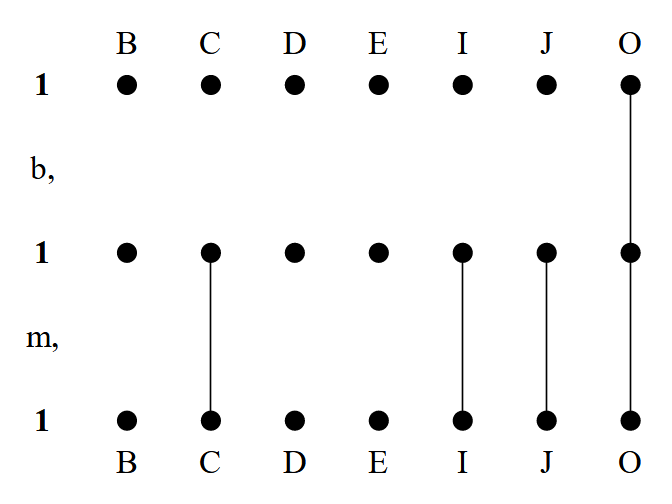
and  That allows us to illustrate the case in relief, by returning to our earlier staging of Othello and examining the premiss that “men are just as apt to be black as things in general” within the frame of that empirical if fictional universe of discourse.
![\begin{array}{*{15}{l}} \mathrm{b} & = & \mathrm{O} \\[6pt] \mathrm{m} & = & \mathrm{C} & +\!\!, & \mathrm{I} & +\!\!, & \mathrm{J} & +\!\!, & \mathrm{O} \\[6pt] \mathbf{1} & = & \mathrm{B} & +\!\!, & \mathrm{C} & +\!\!, & \mathrm{D} & +\!\!, & \mathrm{E} & +\!\!, & \mathrm{I} & +\!\!, & \mathrm{J} & +\!\!, & \mathrm{O} \\[12pt] \mathrm{b,} & = & \mathrm{O\!:\!O} \\[6pt] \mathrm{m,} & = & \mathrm{C\!:\!C} & +\!\!, & \mathrm{I\!:\!I} & +\!\!, & \mathrm{J\!:\!J} & +\!\!, & \mathrm{O\!:\!O} \\[6pt] \mathbf{1,} & = & \mathrm{B\!:\!B} & +\!\!, & \mathrm{C\!:\!C} & +\!\!, & \mathrm{D\!:\!D} & +\!\!, & \mathrm{E\!:\!E} & +\!\!, & \mathrm{I\!:\!I} & +\!\!, & \mathrm{J\!:\!J} & +\!\!, & \mathrm{O\!:\!O} \end{array}](https://s0.wp.com/latex.php?latex=%5Cbegin%7Barray%7D%7B%2A%7B15%7D%7Bl%7D%7D++%5Cmathrm%7Bb%7D+%26+%3D+%26+%5Cmathrm%7BO%7D++%5C%5C%5B6pt%5D++%5Cmathrm%7Bm%7D+%26+%3D+%26++%5Cmathrm%7BC%7D+%26+%2B%5C%21%5C%21%2C+%26++%5Cmathrm%7BI%7D+%26+%2B%5C%21%5C%21%2C+%26++%5Cmathrm%7BJ%7D+%26+%2B%5C%21%5C%21%2C+%26++%5Cmathrm%7BO%7D++%5C%5C%5B6pt%5D++%5Cmathbf%7B1%7D+%26+%3D+%26++%5Cmathrm%7BB%7D+%26+%2B%5C%21%5C%21%2C+%26++%5Cmathrm%7BC%7D+%26+%2B%5C%21%5C%21%2C+%26++%5Cmathrm%7BD%7D+%26+%2B%5C%21%5C%21%2C+%26++%5Cmathrm%7BE%7D+%26+%2B%5C%21%5C%21%2C+%26++%5Cmathrm%7BI%7D+%26+%2B%5C%21%5C%21%2C+%26++%5Cmathrm%7BJ%7D+%26+%2B%5C%21%5C%21%2C+%26++%5Cmathrm%7BO%7D++%5C%5C%5B12pt%5D++%5Cmathrm%7Bb%2C%7D+%26+%3D+%26+%5Cmathrm%7BO%5C%21%3A%5C%21O%7D++%5C%5C%5B6pt%5D++%5Cmathrm%7Bm%2C%7D+%26+%3D+%26++%5Cmathrm%7BC%5C%21%3A%5C%21C%7D+%26+%2B%5C%21%5C%21%2C+%26++%5Cmathrm%7BI%5C%21%3A%5C%21I%7D+%26+%2B%5C%21%5C%21%2C+%26++%5Cmathrm%7BJ%5C%21%3A%5C%21J%7D+%26+%2B%5C%21%5C%21%2C+%26++%5Cmathrm%7BO%5C%21%3A%5C%21O%7D++%5C%5C%5B6pt%5D++%5Cmathbf%7B1%2C%7D+%26+%3D+%26++%5Cmathrm%7BB%5C%21%3A%5C%21B%7D+%26+%2B%5C%21%5C%21%2C+%26++%5Cmathrm%7BC%5C%21%3A%5C%21C%7D+%26+%2B%5C%21%5C%21%2C+%26++%5Cmathrm%7BD%5C%21%3A%5C%21D%7D+%26+%2B%5C%21%5C%21%2C+%26++%5Cmathrm%7BE%5C%21%3A%5C%21E%7D+%26+%2B%5C%21%5C%21%2C+%26++%5Cmathrm%7BI%5C%21%3A%5C%21I%7D+%26+%2B%5C%21%5C%21%2C+%26++%5Cmathrm%7BJ%5C%21%3A%5C%21J%7D+%26+%2B%5C%21%5C%21%2C+%26++%5Cmathrm%7BO%5C%21%3A%5C%21O%7D++%5Cend%7Barray%7D&bg=ffffff&fg=000000&s=1&c=20201002)
![[\mathrm{m,}\mathrm{b}] ~=~ [\mathrm{m,}][\mathrm{b}].](https://s0.wp.com/latex.php?latex=%5B%5Cmathrm%7Bm%2C%7D%5Cmathrm%7Bb%7D%5D+%7E%3D%7E+%5B%5Cmathrm%7Bm%2C%7D%5D%5B%5Cmathrm%7Bb%7D%5D.&bg=ffffff&fg=000000&s=1&c=20201002)
![[\mathrm{b}]](https://s0.wp.com/latex.php?latex=%5B%5Cmathrm%7Bb%7D%5D&bg=ffffff&fg=000000&s=0&c=20201002) is not zero, the next equation follows.
is not zero, the next equation follows.![[\mathrm{m,}] ~=~ \displaystyle{[\mathrm{m,}\mathrm{b}] \over [\mathrm{b}]}.](https://s0.wp.com/latex.php?latex=%5B%5Cmathrm%7Bm%2C%7D%5D+%7E%3D%7E+%5Cdisplaystyle%7B%5B%5Cmathrm%7Bm%2C%7D%5Cmathrm%7Bb%7D%5D+%5Cover+%5B%5Cmathrm%7Bb%7D%5D%7D.&bg=ffffff&fg=000000&s=1&c=20201002)
 by means of the corresponding idempotent term




![\begin{matrix} m \land b = b \\[6pt] \mathrm{b} \implies \mathrm{m} \\[6pt] \mathrm{b} ~-\!\!\!< \mathrm{m} \end{matrix}](https://s0.wp.com/latex.php?latex=%5Cbegin%7Bmatrix%7D++m+%5Cland+b+%3D+b++%5C%5C%5B6pt%5D++%5Cmathrm%7Bb%7D+%5Cimplies+%5Cmathrm%7Bm%7D++%5C%5C%5B6pt%5D++%5Cmathrm%7Bb%7D+%7E-%5C%21%5C%21%5C%21%3C+%5Cmathrm%7Bm%7D++%5Cend%7Bmatrix%7D&bg=ffffff&fg=000000&s=1&c=20201002)
![\displaystyle [\mathrm{m,}] ~=~ {[\mathrm{m,}\mathrm{b}] \over [\mathrm{b}]} ~=~ {[\mathrm{b}] \over [\mathrm{b}]} ~=~ \mathfrak{1}.](https://s0.wp.com/latex.php?latex=%5Cdisplaystyle+%5B%5Cmathrm%7Bm%2C%7D%5D+%7E%3D%7E+%7B%5B%5Cmathrm%7Bm%2C%7D%5Cmathrm%7Bb%7D%5D+%5Cover+%5B%5Cmathrm%7Bb%7D%5D%7D+%7E%3D%7E+%7B%5B%5Cmathrm%7Bb%7D%5D+%5Cover+%5B%5Cmathrm%7Bb%7D%5D%7D+%7E%3D%7E+%5Cmathfrak%7B1%7D.&bg=ffffff&fg=000000&s=1&c=20201002)
![\displaystyle [\mathrm{m,}] ~=~ {[\mathrm{m,}\mathbf{1}] \over [\mathbf{1}]} ~=~ {[\mathrm{m}] \over [\mathbf{1}]} ~=~ {4 \over 7}.](https://s0.wp.com/latex.php?latex=%5Cdisplaystyle+%5B%5Cmathrm%7Bm%2C%7D%5D+%7E%3D%7E+%7B%5B%5Cmathrm%7Bm%2C%7D%5Cmathbf%7B1%7D%5D+%5Cover+%5B%5Cmathbf%7B1%7D%5D%7D+%7E%3D%7E+%7B%5B%5Cmathrm%7Bm%7D%5D+%5Cover+%5B%5Cmathbf%7B1%7D%5D%7D+%7E%3D%7E+%7B4+%5Cover+7%7D.&bg=ffffff&fg=000000&s=1&c=20201002)
 and
and 


 while
while 



 be the number of things in general. Expressed in Peirce’s notation we have the equation
 ![[\mathbf{1}] = N.](https://s0.wp.com/latex.php?latex=%5B%5Cmathbf%7B1%7D%5D+%3D+N.&bg=ffffff&fg=000000&s=0&c=20201002) On the assumption that
On the assumption that ![\begin{array}{lll} [\mathrm{m,} \mathrm{b}] & = & \mathrm{P}(\mathrm{m}\mathrm{b}) N \\[6pt] & = & \mathrm{P}(\mathrm{m}) \mathrm{P}(\mathrm{b}) N \\[6pt] & = & \mathrm{P}(\mathrm{m}) [\mathrm{b}] \\[6pt] & = & [\mathrm{m,}] [\mathrm{b}]. \end{array}](https://s0.wp.com/latex.php?latex=%5Cbegin%7Barray%7D%7Blll%7D++%5B%5Cmathrm%7Bm%2C%7D+%5Cmathrm%7Bb%7D%5D+%26+%3D+%26+%5Cmathrm%7BP%7D%28%5Cmathrm%7Bm%7D%5Cmathrm%7Bb%7D%29+N++%5C%5C%5B6pt%5D++%26+%3D+%26+%5Cmathrm%7BP%7D%28%5Cmathrm%7Bm%7D%29+%5Cmathrm%7BP%7D%28%5Cmathrm%7Bb%7D%29+N++%5C%5C%5B6pt%5D++%26+%3D+%26+%5Cmathrm%7BP%7D%28%5Cmathrm%7Bm%7D%29+%5B%5Cmathrm%7Bb%7D%5D++%5C%5C%5B6pt%5D++%26+%3D+%26+%5B%5Cmathrm%7Bm%2C%7D%5D+%5B%5Cmathrm%7Bb%7D%5D.++%5Cend%7Barray%7D&bg=ffffff&fg=000000&s=1&c=20201002)
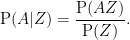
 = “the probability of a thing in general being a man”. That seems to make sense.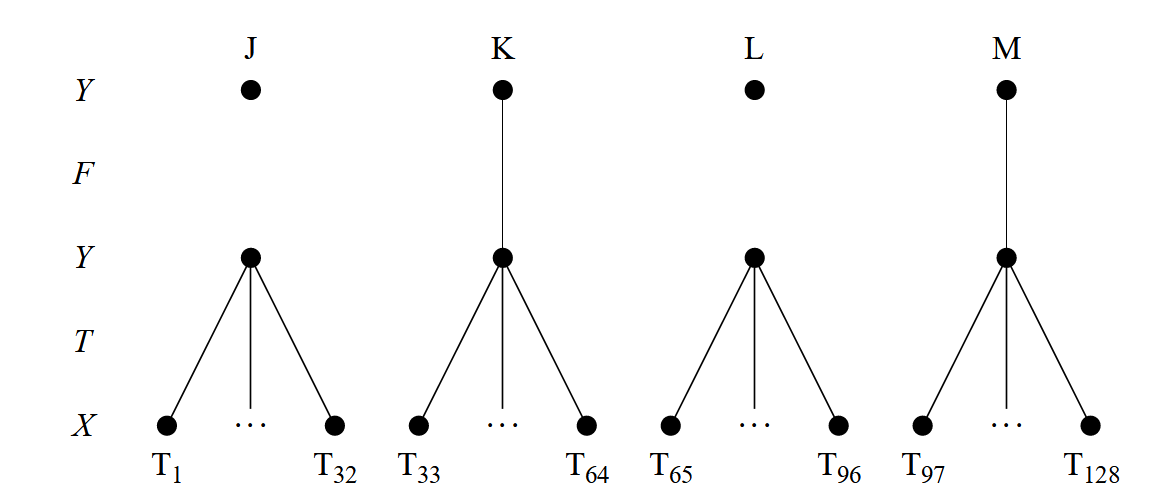
 such that
 ![v : s \mapsto [s],](https://s0.wp.com/latex.php?latex=v+%3A+s+%5Cmapsto+%5Bs%5D%2C&bg=ffffff&fg=000000&s=0&c=20201002) and discussed the extent to which its use as a measure satisfies the relevant measure-theoretic principles, beginning with the following two.
and discussed the extent to which its use as a measure satisfies the relevant measure-theoretic principles, beginning with the following two. ” to indicate what he calls the “regular non-invertible addition”, corresponding to the inclusive disjunction of logical terms or the union of their extensions as sets.
 ” to indicate what he calls the “invertible addition”, corresponding to the exclusive disjunction of logical terms or the symmetric difference of their extensions as sets.
![[x ~+\!\!,~ y] ~ \overset{?}{=} ~ [x] ~+~ [y]](https://s0.wp.com/latex.php?latex=%5Bx+%7E%2B%5C%21%5C%21%2C%7E+y%5D+%7E+%5Coverset%7B%3F%7D%7B%3D%7D+%7E+%5Bx%5D+%7E%2B%7E+%5By%5D&bg=ffffff&fg=000000&s=1&c=20201002)

![[x ~+\!\!,~ y] ~ \le ~ [x] ~+~ [y]](https://s0.wp.com/latex.php?latex=%5Bx+%7E%2B%5C%21%5C%21%2C%7E+y%5D+%7E+%5Cle+%7E+%5Bx%5D+%7E%2B%7E+%5By%5D&bg=ffffff&fg=000000&s=1&c=20201002)

 and this is the definition of zero. This interpretation is given by Boole, and is very neat, on account of the resemblance between the ordinary conception of zero and that of nothing, and because we shall thus have
![[0] ~=~ 0.](https://s0.wp.com/latex.php?latex=%5B0%5D+%7E%3D%7E+0.&bg=ffffff&fg=000000&s=1&c=20201002)
 in
in  and the number
  we have the following equation.
![v(0) ~=~ [0] ~=~ 0.](https://s0.wp.com/latex.php?latex=v%280%29+%7E%3D%7E+%5B0%5D+%7E%3D%7E+0.&bg=ffffff&fg=000000&s=1&c=20201002)
 Let
Let  denote the implication relation on logical terms, let
  denote the less than or equal to relation on real numbers, and let
  be any pair of absolute terms in the syntactic domain
  Then we observe the following relationships.
![\begin{array}{lll} x ~-\!\!\!< y & \Rightarrow & [x] \le [y] \end{array}](https://s0.wp.com/latex.php?latex=%5Cbegin%7Barray%7D%7Blll%7D++x+%7E-%5C%21%5C%21%5C%21%3C+y+%26+%5CRightarrow+%26+%5Bx%5D+%5Cle+%5By%5D++%5Cend%7Barray%7D&bg=ffffff&fg=000000&s=1&c=20201002)
 and
and  here adopted fulfill all absolute requirements, but they have the supererogatory virtue of being very nearly the same as the common significations. Equality is, in fact, nothing but the identity of two numbers; numbers that are equal are those which are predicable of the same collections, just as terms that are identical are those which are predicable of the same classes. So, to write
  is to say that 5 is part of 7, just as to write
  is to say that Frenchmen are part of men. Indeed, if
  then the number of Frenchmen is less than the number of men, and if
  then the number of Vice‑Presidents is equal to the number of Presidents of the Senate; so that the numbers may always be substituted for the terms themselves, in case no signs of operation occur in the equations or inequalities.
 on logical terms preserves the relations of implication or inclusion which impose an ordering on those terms. Here Peirce uses a single symbol
  to denote the linear ordering on numbers, but also what amounts to the implication ordering on logical terms and the inclusion ordering on classes. Later he will introduce distinctive symbols for the logical orderings. The links among terms, sets, and numbers can be pursued in all directions and Peirce has already indicated in an earlier paper how he would construct the integers from sets, that is, from the aggregate denotations of terms. I will try to get back to that another time.
![\begin{matrix} \mathrm{f} < \mathrm{m} & \Rightarrow & [\mathrm{f}] < [\mathrm{m}]. \end{matrix}](https://s0.wp.com/latex.php?latex=%5Cbegin%7Bmatrix%7D++%5Cmathrm%7Bf%7D+%3C+%5Cmathrm%7Bm%7D+%26+%5CRightarrow+%26+%5B%5Cmathrm%7Bf%7D%5D+%3C+%5B%5Cmathrm%7Bm%7D%5D.++%5Cend%7Bmatrix%7D&bg=ffffff&fg=000000&s=1&c=20201002)
 be a set with the ordering
 be a set with the ordering

 and so on to indicate a set with a given ordering.
 is order-preserving if and only if a statement of a particular form holds for all
  and
and  in
in  namely, the following.
 has just this character, as exemplified in the case at hand.
![\begin{matrix} \mathrm{f} & < & \mathrm{m} & \Rightarrow & [\mathrm{f}] & < & [\mathrm{m}] \\[6pt] \mathrm{f} & < & \mathrm{m} & \Rightarrow & v(\mathrm{f}) & < & v(\mathrm{m}) \end{matrix}](https://s0.wp.com/latex.php?latex=%5Cbegin%7Bmatrix%7D++%5Cmathrm%7Bf%7D+%26+%3C+%26+%5Cmathrm%7Bm%7D+%26+%5CRightarrow+%26+%5B%5Cmathrm%7Bf%7D%5D+%26+%3C+%26+%5B%5Cmathrm%7Bm%7D%5D++%5C%5C%5B6pt%5D++%5Cmathrm%7Bf%7D+%26+%3C+%26+%5Cmathrm%7Bm%7D+%26+%5CRightarrow+%26+v%28%5Cmathrm%7Bf%7D%29++%26+%3C+%26+v%28%5Cmathrm%7Bm%7D%29++%5Cend%7Bmatrix%7D&bg=ffffff&fg=000000&s=1&c=20201002)
![[\mathit{t}].](https://s0.wp.com/latex.php?latex=%5B%5Cmathit%7Bt%7D%5D.&bg=ffffff&fg=000000&s=0&c=20201002) It is convenient to have a prefix notation for the function mapping a term
It is convenient to have a prefix notation for the function mapping a term ![[\mathit{t}]](https://s0.wp.com/latex.php?latex=%5B%5Cmathit%7Bt%7D%5D&bg=ffffff&fg=000000&s=0&c=20201002) but Peirce previously reserved the letter
but Peirce previously reserved the letter  for logical
  so let’s use
  as a variant for
  The number of a relative with two correlates would be the average number of things so related to a pair of individuals; and so on for relatives of higher numbers of correlates. I propose to denote the number of a logical term by enclosing the term in square brackets, thus
  where
where  is the set of real numbers.
 ![\begin{array}{ll} \text{Let} & \mathrm{m} ~=~ \text{man} \\[8pt] \text{and} & \mathit{t} ~=~ \text{tooth of}\,\underline{~~~~}. \\[8pt] \text{Then} & v(\mathit{t}) ~=~ [\mathit{t}] ~=~ \displaystyle\frac{[\mathit{t}\mathrm{m}]}{[\mathrm{m}]}. \end{array}](https://s0.wp.com/latex.php?latex=%5Cbegin%7Barray%7D%7Bll%7D++%5Ctext%7BLet%7D++%26+%5Cmathrm%7Bm%7D+%7E%3D%7E+%5Ctext%7Bman%7D++%5C%5C%5B8pt%5D++%5Ctext%7Band%7D++%26+%5Cmathit%7Bt%7D+%7E%3D%7E+%5Ctext%7Btooth+of%7D%5C%2C%5Cunderline%7B%7E%7E%7E%7E%7D.++%5C%5C%5B8pt%5D++%5Ctext%7BThen%7D+%26+v%28%5Cmathit%7Bt%7D%29+%7E%3D%7E+%5B%5Cmathit%7Bt%7D%5D+%7E%3D%7E+%5Cdisplaystyle%5Cfrac%7B%5B%5Cmathit%7Bt%7D%5Cmathrm%7Bm%7D%5D%7D%7B%5B%5Cmathrm%7Bm%7D%5D%7D.++%5Cend%7Barray%7D&bg=ffffff&fg=000000&s=1&c=20201002)
 in a universe of perfect human dentition is equal to the number of teeth of humans divided by the number of humans, that is,
  might be drawn as follows, showing just the first few items in the toothy part of
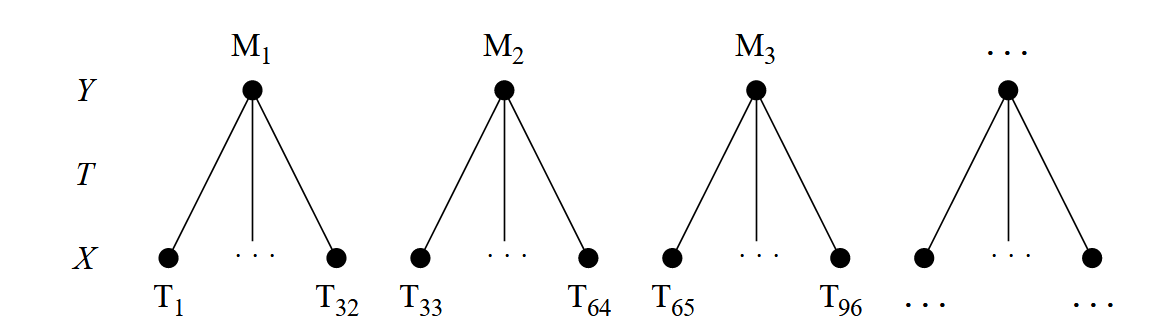

 since we are counting only teeth which occupy exactly one mouth of a tooth-bearing creature.
 we have the following data.
![\begin{array}{lcccll} J & : & \mathbb{R} & \gets & \mathbb{R} & \text{(properly restricted)} \\[6pt] K & : & \mathbb{R} & \gets & \mathbb{R} \times \mathbb{R} & \text{where}~ K(r, s) = r + s \\[6pt] L & : & \mathbb{R} & \gets & \mathbb{R} \times \mathbb{R} & \text{where}~ L(u, v) = u \cdot v \end{array}](https://s0.wp.com/latex.php?latex=%5Cbegin%7Barray%7D%7Blcccll%7D++J+%26+%3A+%26+%5Cmathbb%7BR%7D+%26+%5Cgets+%26+%5Cmathbb%7BR%7D+%26+%5Ctext%7B%28properly+restricted%29%7D++%5C%5C%5B6pt%5D++K+%26+%3A+%26+%5Cmathbb%7BR%7D+%26+%5Cgets+%26+%5Cmathbb%7BR%7D+%5Ctimes+%5Cmathbb%7BR%7D+%26+%5Ctext%7Bwhere%7D%7E+K%28r%2C+s%29+%3D+r+%2B+s++%5C%5C%5B6pt%5D++L+%26+%3A+%26+%5Cmathbb%7BR%7D+%26+%5Cgets+%26+%5Cmathbb%7BR%7D+%5Ctimes+%5Cmathbb%7BR%7D+%26+%5Ctext%7Bwhere%7D%7E+L%28u%2C+v%29+%3D+u+%5Ccdot+v++%5Cend%7Barray%7D&bg=ffffff&fg=000000&s=1&c=20201002)
![\begin{matrix} J & : & [+] \gets [\,\cdot\,] \\[6pt] [+] & \subseteq & \mathbb{R} \times \mathbb{R} \times \mathbb{R} \\[6pt] [\,\cdot\,] & \subseteq & \mathbb{R} \times \mathbb{R} \times \mathbb{R} \end{matrix}](https://s0.wp.com/latex.php?latex=%5Cbegin%7Bmatrix%7D++J+%26+%3A+%26+%5B%2B%5D+%5Cgets+%5B%5C%2C%5Ccdot%5C%2C%5D++%5C%5C%5B6pt%5D++%5B%2B%5D+%26+%5Csubseteq+%26+%5Cmathbb%7BR%7D+%5Ctimes+%5Cmathbb%7BR%7D+%5Ctimes+%5Cmathbb%7BR%7D++%5C%5C%5B6pt%5D++%5B%5C%2C%5Ccdot%5C%2C%5D+%26+%5Csubseteq+%26+%5Cmathbb%7BR%7D+%5Ctimes+%5Cmathbb%7BR%7D+%5Ctimes+%5Cmathbb%7BR%7D++%5Cend%7Bmatrix%7D&bg=ffffff&fg=000000&s=1&c=20201002)
 or simple concatenation, but they remain in general distinct whether considered as operations or as relations, no matter what signs of operation are used. In such a setting, our chiasmatic theme may run a bit like one of the following two variants.

 and
and 
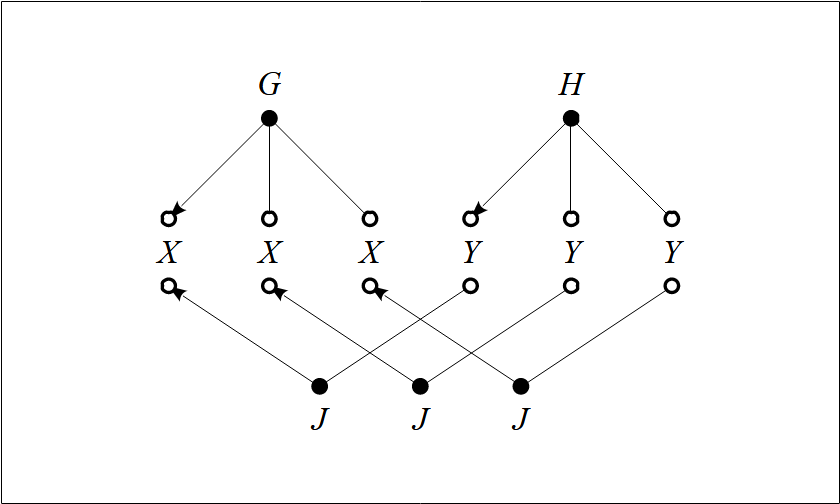

 takes on the shape
  which looks analogous to the distributive multiplication of a factor
  That is why morphisms are regarded as generalizations of linear functions and are frequently referred to in those terms.
 say, one of the mappings of reals into reals commonly known as logarithm functions, where you get to pick your favorite base.
 and
and  and the formula
  becomes
  where ordinary multiplication and addition are indicated by a dot
  and a plus sign
  respectively.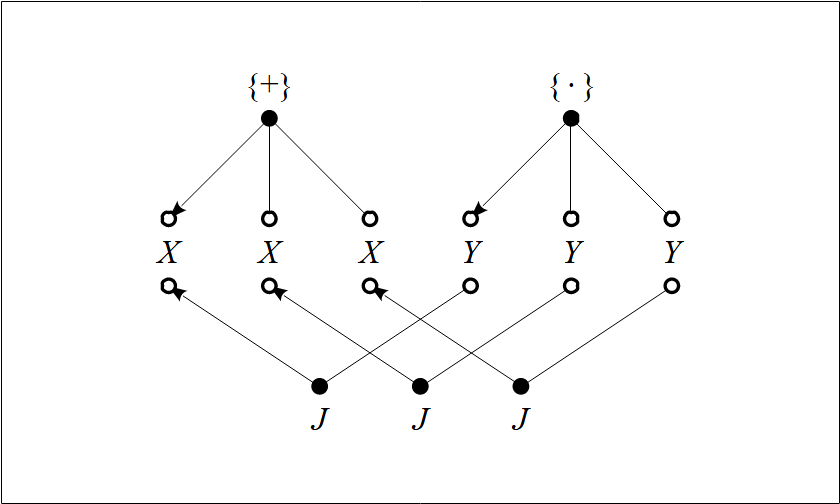



 Inquiry Into Inquiry