Scientific Attitude • 1

There is an outlook on the world I call the Scientific Attitude (SA).  There are times when the letter “A” is better served by apperception, approach, or attunement, but attitude will do for a start.

The scientific attitude accepts appearances, as appearances, but it does not stop there — it inquires after the possible realities that would both save and solve the appearances.

Reality is what persists and the scientific attitude accepts its limitation to what persists.  Thisness and thatness may come and go, but scientific knowledge rests on results that are reproducible.  It is knowledge of particulars in general terms.

Posted in Appearance, Epistemology, Generality, Haecceity, Inquiry, Inquiry Into Inquiry, Knowledge, Logic, Logic of Science, Philosophy of Science, Pragmatic Maxim, Reality, Reproducibility, Science, Scientific Attitude, Scientific Method | Tagged , , , , , , , , , , , , , , , | Leave a comment

Relations & Their Relatives • Discussion 3

Re: Peirce ListEdwina TaborskyHoward Pattee

In the best mathematical terms, a triadic relation is a cartesian product of three sets together with a specified subset of that cartesian product.

Alternatively, one may think of a triadic relation as a set of 3-tuples contained in a specified cartesian product.

It is important to recognize that sets have formal properties that their elements do not.  The greatest number of category mistakes that bedevil errant discussions of relations and especially triadic sign relations arise from a failure to grasp this fact.

For example, the irreducibility (or indecomposability) of triadic relations is a property of sets-of-triples, not of individual triples.

See the articles under the following heading for concrete examples and further discussion.

Additional Resources

Posted in C.S. Peirce, Cartesian Product, Category Theory, Dyadic Relations, Logic, Logic of Relatives, Mathematics, Peirce's Categories, Relation Theory, Rheme, Semiotics, Set Theory, Sign Relations, Triadic Relations, Triadicity | Tagged , , , , , , , , , , , , , , | 13 Comments

Relations & Their Relatives • Discussion 2

Re: Peirce ListHelmut Raulien

In systems theory and engineering there is a well-recognized duality or complementarity between the dimensions of Control and Information, frequently cast in terms of action and perception, actuators and detectors, effectors and sensors, and a variety of other aliases.  There we find the dual devices of reachability matrices, representing the operations it takes to put a system in a given state, and observability matrices, representing the operations it takes to identify a system as being in a given state.

The appearance of matrices at this point, understood in the sense of 2-dimensional arrays of coefficients, may give us a clue to the dyadic character of the analysis and design models issuing from them.  And yet there is every opportunity in systems theory and engineering to open up the additional “elbow room” that triadic relations provide.

Resources

cc: Category TheoryCyberneticsOntologStructural ModelingSystems Science
cc: FB | Relation TheoryLaws of FormPeirce List

Posted in C.S. Peirce, Category Theory, Control, Cybernetics, Dyadic Relations, Information, Inquiry, Logic, Logic of Relatives, Mathematics, Peirce, Relation Theory, Semiosis, Semiotics, Sign Relations, Systems Theory, Triadic Relations | Tagged , , , , , , , , , , , , , , , , | 14 Comments

Peirce’s 1880 “Algebra Of Logic” Chapter 3 • Selection 7

Chapter 3. The Logic of Relatives (cont.)

§4. Classification of Relatives

225.   Individual relatives are of one or other of the two forms

\begin{array}{lll}  \mathrm{A : A} & \qquad & \mathrm{A : B},  \end{array}

and simple relatives are negatives of one or other of these two forms.

226.   The forms of general relatives are of infinite variety, but the following may be particularly noticed.

Relatives may be divided into those all whose individual aggregants are of the form \mathrm{A : A} and those which contain individuals of the form \mathrm{A : B}.  The former may be called concurrents, the latter opponents.

Concurrents express a mere agreement among objects.  Such, for instance, is the relative ‘man that is ──’, and a similar relative may be formed from any term of singular reference.  We may denote such a relative by the symbol for the term of singular reference with a comma after it;  thus (m,\!) will denote ‘man that is ──’ if (m) denotes ‘man’.  In the same way a comma affixed to an n-fold relative will convert it into an (n + 1)-fold relative.  Thus,  (l) being ‘lover of ──’,  (l,\!) will be ‘lover that is ── of ──’.

The negative of a concurrent relative will be one each of whose simple components is of the form \mathrm{\overline{A : A}}, and the negative of an opponent relative will be one which has components of the form \mathrm{\overline{A : B}}.

We may also divide relatives into those which contain individual aggregants of the form \mathrm{A : A} and those which contain only aggregants of the form \mathrm{A : B}.  The former may be called self-relatives, the latter alio-relatives.  We also have negatives of self-relatives and negatives of alio-relatives.

References

  • Peirce, C.S. (1880), “On the Algebra of Logic”, American Journal of Mathematics 3, 15–57.  Collected Papers (CP 3.154–251), Chronological Edition (CE 4, 163–209).
  • Peirce, C.S., Collected Papers of Charles Sanders Peirce, vols. 1–6, Charles Hartshorne and Paul Weiss (eds.), vols. 7–8, Arthur W. Burks (ed.), Harvard University Press, Cambridge, MA, 1931–1935, 1958.  Volume 3 : Exact Logic, 1933.
  • Peirce, C.S., Writings of Charles S. Peirce : A Chronological Edition, Peirce Edition Project (eds.), Indiana University Press, Bloomington and Indianapolis, IN, 1981–.  Volume 4 (1879–1884), 1986.

Resources

Posted in Dyadic Relations, Logic, Logic of Relatives, Mathematics, Peirce, Relation Theory, Semiotics, Sign Relations, Triadic Relations | Tagged , , , , , , , , | 11 Comments

Relations & Their Relatives • Discussion 1

Re: Peirce ListHelmut Raulien

The divisor of relation signified by x|y is a dyadic relation on the set of positive integers \mathbb{M} and thus may be understood as a subset of the cartesian product \mathbb{M} \times \mathbb{M}.  It is an example of a partial order, while the less than or equal to relation signified by x \le y is an example of a total order relation.

The mathematics of relations can be applied most felicitously to semiotics but there we must bump the adicity or arity up to three.  We take any sign relation L to be subset of a cartesian product O \times S \times I, where O is the set of objects under consideration in a given discussion, S is the set of signs, and I is the set of interpretant signs involved in the same discussion.

One thing we need to understand is the sign relation L \subseteq O \times S \times I relevant to a given level of discussion may be rather more abstract than what we would call a sign process proper, that is, a structure extended through a dimension of time.  Indeed, many of the most powerful sign relations generate sign processes through iteration or recursion or similar operations.  In that event, the most penetrating analysis of the sign process or semiosis in view is achieved through grasping the generative sign relation at its core.

Resources

cc: Category TheoryCyberneticsOntologStructural ModelingSystems Science
cc: FB | Relation TheoryLaws of FormPeirce List

Posted in C.S. Peirce, Category Theory, Dyadic Relations, Logic, Logic of Relatives, Logical Graphs, Mathematics, Nominalism, Peirce, Pragmatism, Realism, Relation Theory, Semiotics, Sign Relations, Triadic Relations, Visualization | Tagged , , , , , , , , , , , , , , , | 15 Comments

Mathematical Demonstration and the Doctrine of Individuals • 2

Selection from C.S. Peirce’s “Logic Of Relatives” (1870)

In reference to the doctrine of individuals, two distinctions should be borne in mind.  The logical atom, or term not capable of logical division, must be one of which every predicate may be universally affirmed or denied.  For, let \mathrm{A} be such a term.  Then, if it is neither true that all \mathrm{A} is \mathrm{X} nor that no \mathrm{A} is \mathrm{X}, it must be true that some \mathrm{A} is \mathrm{X} and some \mathrm{A} is not \mathrm{X};  and therefore \mathrm{A} may be divided into \mathrm{A} that is \mathrm{X} and \mathrm{A} that is not \mathrm{X}, which is contrary to its nature as a logical atom.

Such a term can be realized neither in thought nor in sense.

Not in sense, because our organs of sense are special — the eye, for example, not immediately informing us of taste, so that an image on the retina is indeterminate in respect to sweetness and non-sweetness.  When I see a thing, I do not see that it is not sweet, nor do I see that it is sweet;  and therefore what I see is capable of logical division into the sweet and the not sweet.  It is customary to assume that visual images are absolutely determinate in respect to color, but even this may be doubted.  I know no facts which prove that there is never the least vagueness in the immediate sensation.

In thought, an absolutely determinate term cannot be realized, because, not being given by sense, such a concept would have to be formed by synthesis, and there would be no end to the synthesis because there is no limit to the number of possible predicates.

A logical atom, then, like a point in space, would involve for its precise determination an endless process.  We can only say, in a general way, that a term, however determinate, may be made more determinate still, but not that it can be made absolutely determinate.  Such a term as “the second Philip of Macedon” is still capable of logical division — into Philip drunk and Philip sober, for example;  but we call it individual because that which is denoted by it is in only one place at one time.  It is a term not absolutely indivisible, but indivisible as long as we neglect differences of time and the differences which accompany them.  Such differences we habitually disregard in the logical division of substances.  In the division of relations, etc., we do not, of course, disregard these differences, but we disregard some others.  There is nothing to prevent almost any sort of difference from being conventionally neglected in some discourse, and if I be a term which in consequence of such neglect becomes indivisible in that discourse, we have in that discourse,

[I] = 1.

This distinction between the absolutely indivisible and that which is one in number from a particular point of view is shadowed forth in the two words individual (τὸ ἄτομον) and singular (τὸ καθ᾿ ἕκαστον);  but as those who have used the word individual have not been aware that absolute individuality is merely ideal, it has come to be used in a more general sense.  (CP 3.93)

Note

Peirce explains his use of the square bracket notation at CP 3.65.

I propose to denote the number of a logical term by enclosing the term in square brackets, thus, [t].

The number of an absolute term, as in the case of I, is defined as the number of individuals it denotes.

References

  • Peirce, C.S. (1870), “Description of a Notation for the Logic of Relatives, Resulting from an Amplification of the Conceptions of Boole’s Calculus of Logic”, Memoirs of the American Academy of Arts and Sciences 9, 317–378, 26 January 1870.  Reprinted, Collected Papers 3.45–149, Chronological Edition 2, 359–429.  Online (1) (2) (3).
  • Peirce, C.S., Collected Papers of Charles Sanders Peirce, vols. 1–6, Charles Hartshorne and Paul Weiss (eds.), vols. 7–8, Arthur W. Burks (ed.), Harvard University Press, Cambridge, MA, 1931–1935, 1958.
  • Peirce, C.S., Writings of Charles S. Peirce : A Chronological Edition, Peirce Edition Project (eds.), Indiana University Press, Bloomington and Indianapolis, IN, 1981–.

Resources

Posted in C.S. Peirce, Deduction, Doctrine of Individuals, Foundations of Mathematics, Identity, Information = Comprehension × Extension, Logic, Logic of Relatives, Mathematical Demonstration, Mathematics, Relation Theory | Tagged , , , , , , , , , , | 6 Comments

Mathematical Demonstration and the Doctrine of Individuals • 1

Selection from C.S. Peirce’s “Logic Of Relatives” (1870)

Demonstration of the sort called mathematical is founded on suppositions of particular cases.  The geometrician draws a figure;  the algebraist assumes a letter to signify a single quantity fulfilling the required conditions.  But while the mathematician supposes an individual case, his hypothesis is yet perfectly general, because he considers no characters of the individual case but those which must belong to every such case.

The advantage of his procedure lies in the fact that the logical laws of individual terms are simpler than those which relate to general terms, because individuals are either identical or mutually exclusive, and cannot intersect or be subordinated to one another as classes can.

Mathematical demonstration is not, therefore, more restricted to matters of intuition than any other kind of reasoning.  Indeed, logical algebra conclusively proves that mathematics extends over the whole realm of formal logic;  and any theory of cognition which cannot be adjusted to this fact must be abandoned.  We may reap all the advantages which the mathematician is supposed to derive from intuition by simply making general suppositions of individual cases.  (CP 3.92)

References

  • Peirce, C.S. (1870), “Description of a Notation for the Logic of Relatives, Resulting from an Amplification of the Conceptions of Boole’s Calculus of Logic”, Memoirs of the American Academy of Arts and Sciences 9, 317–378, 26 January 1870.  Reprinted, Collected Papers 3.45–149, Chronological Edition 2, 359–429.  Online (1) (2) (3).
  • Peirce, C.S., Collected Papers of Charles Sanders Peirce, vols. 1–6, Charles Hartshorne and Paul Weiss (eds.), vols. 7–8, Arthur W. Burks (ed.), Harvard University Press, Cambridge, MA, 1931–1935, 1958.
  • Peirce, C.S., Writings of Charles S. Peirce : A Chronological Edition, Peirce Edition Project (eds.), Indiana University Press, Bloomington and Indianapolis, IN, 1981–.

Resources

Posted in C.S. Peirce, Deduction, Doctrine of Individuals, Foundations of Mathematics, Identity, Information = Comprehension × Extension, Logic, Logic of Relatives, Mathematical Demonstration, Mathematics, Relation Theory | Tagged , , , , , , , , , , | 5 Comments

Relations & Their Relatives • 3

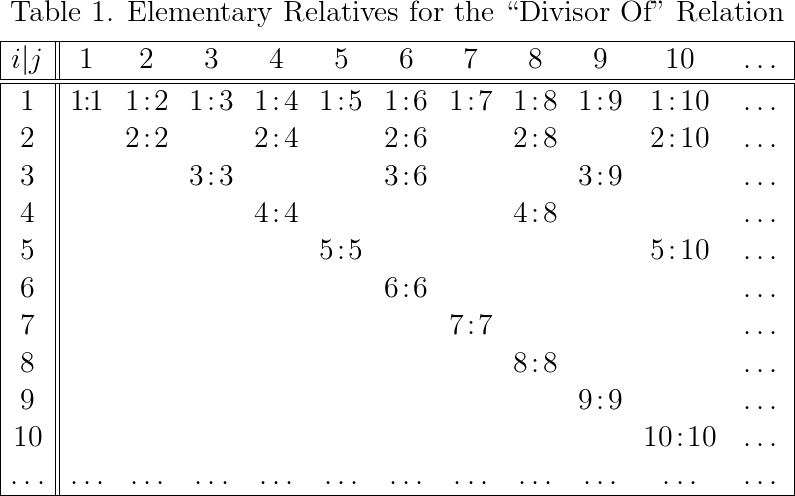
Here are two ways of looking at the divisibility relation, a dyadic relation of fundamental importance in number theory.

Table 1 shows the first few ordered pairs of the relation on positive integers corresponding to the relative term, “divisor of”.  Thus, the ordered pair {i\!:\!j} appears in the relation if and only if {i} divides {j}, for which the usual notation is {i|j}.

Elementary Relatives for the “Divisor Of” Relation

Table 2 shows the same information in the form of a logical matrix.  This has a coefficient of {1} in row {i} and column {j} when {i|j}, otherwise it has a coefficient of {0}.  (The zero entries have been omitted for ease of reading.)

Logical Matrix for the “Divisor Of” Relation

Just as matrices in linear algebra represent linear transformations, these logical arrays and matrices represent logical transformations.

Resources

cc: Category TheoryCyberneticsOntologStructural ModelingSystems Science
cc: FB | Relation TheoryLaws of FormPeirce List

Posted in C.S. Peirce, Category Theory, Dyadic Relations, Logic, Logic of Relatives, Logical Graphs, Mathematics, Nominalism, Peirce, Pragmatism, Realism, Relation Theory, Semiotics, Sign Relations, Triadic Relations, Visualization | Tagged , , , , , , , , , , , , , , , | 12 Comments

Relations & Their Relatives • 2

What is the relationship between “logical relatives” and “mathematical relations”?  The word relative used as a noun in logic is short for relative term — as such it refers to an item of language used to denote a formal object.

What kind of object is that?  The way things work in mathematics we are free to make up a formal object corresponding directly to the term, so long as we can form a consistent theory of it, but it’s probably easier and more practical in the long run to relate the relative term to the kinds of relations ordinarily treated in mathematics and universally applied in relational databases.

In those contexts a relation is just a set of ordered tuples and if you are a fan of strong typing like I am, such a set is always set in a specific setting, namely, it’s a subset of a specified cartesian product.

Peirce wrote k-tuples (x_1, x_2, \ldots, x_{k-1}, x_k) in the form x_1 : x_2 : \ldots : x_{k-1} : x_k and referred to them as elementary k-adic relatives.  He treated a collection of k-tuples as a logical aggregate or logical sum and often regarded them as being arranged in k-dimensional arrays.

Time for some concrete examples, which I will give in the next post.

Resources

cc: Category TheoryCyberneticsOntologStructural ModelingSystems Science
cc: FB | Relation TheoryLaws of FormPeirce List

Posted in C.S. Peirce, Category Theory, Dyadic Relations, Logic, Logic of Relatives, Logical Graphs, Mathematics, Nominalism, Peirce, Pragmatism, Realism, Relation Theory, Semiotics, Sign Relations, Triadic Relations, Visualization | Tagged , , , , , , , , , , , , , , , | 10 Comments

Relations & Their Relatives • 1

Sign relations are special cases of triadic relations in much the same way binary operations in mathematics are special cases of triadic relations.  It amounts to a minor complication that we participate in sign relations whenever we talk or think about anything else but it still makes sense to try and tease the separate issues apart as much as we possibly can.

As far as relations in general go, relative terms are often expressed by slotted frames like “brother of __”, “divisor of __”, and “sum of __ and __”.  Peirce referred to these kinds of incomplete expressions as rhemes or rhemata and Frege used the adjective ungesättigt or unsaturated to convey more or less the same idea.

Switching the focus to sign relations, it’s fair to ask what kinds of objects might be denoted by pieces of code like “brother of __”, “divisor of __”, and “sum of __ and __”.  And while we’re at it, what is this thing called denotation, anyway?

Resources

cc: Category TheoryCyberneticsOntologStructural ModelingSystems Science
cc: FB | Relation TheoryLaws of FormPeirce List

Posted in C.S. Peirce, Category Theory, Dyadic Relations, Logic, Logic of Relatives, Logical Graphs, Mathematics, Nominalism, Peirce, Pragmatism, Realism, Relation Theory, Semiotics, Sign Relations, Triadic Relations, Visualization | Tagged , , , , , , , , , , , , , , , | 10 Comments