
Let’s examine Peirce’s second example of a disjunctive term — neat, swine, sheep, deer — within the style of lattice framework we used before.
Hence if we find out that neat are herbivorous, swine are herbivorous, sheep are herbivorous, and deer are herbivorous; we may be sure that there is some class of animals which covers all these, all the members of which are herbivorous. (468–469).
Accordingly, if we are engaged in symbolizing and we come to such a proposition as “Neat, swine, sheep, and deer are herbivorous”, we know firstly that the disjunctive term may be replaced by a true symbol. But suppose we know of no symbol for neat, swine, sheep, and deer except cloven‑hoofed animals. (469).
This is apparently a stock example of inductive reasoning Peirce is borrowing from traditional discussions, so let us pass over the circumstance that modern taxonomies may classify swine as omnivores.
In view of the analogical symmetries the disjunctive term shares with the conjunctive case, we can run through this example in fairly short order. We have the following four terms.
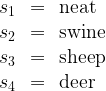
Suppose 

Figure 2 shows the implication ordering of logical terms in the form of a lattice diagram.
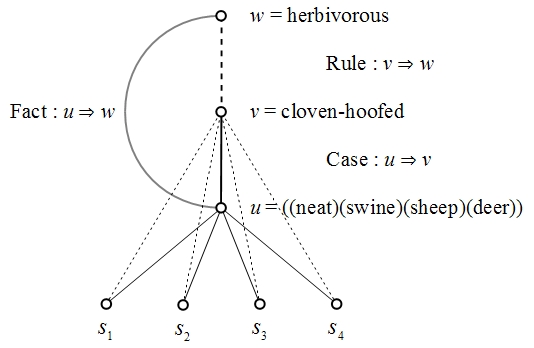

Here we have a situation which is dual to the structure of the conjunctive example. There is a gap between the logical disjunction 


Once again, the sheer implausibility of imagining the disjunctive term 
Reference
- Peirce, C.S. (1866), “The Logic of Science, or, Induction and Hypothesis”, Lowell Lectures of 1866, pp. 357–504 in Writings of Charles S. Peirce : A Chronological Edition, Volume 1, 1857–1866, Peirce Edition Project, Indiana University Press, Bloomington, IN, 1982.
Resources
- This Blog • Survey of Pragmatic Semiotic Information
- OEIS Wiki • Information = Comprehension × Extension
- C.S. Peirce • Upon Logical Comprehension and Extension
cc: Conceptual Graphs • Cybernetics • Structural Modeling • Systems Science
cc: FB | Inquiry Into Inquiry • Laws of Form • Mathstodon • Academia.edu
cc: Research Gate


 Inquiry Into Inquiry
Pingback: Survey of Pragmatic Semiotic Information • 8 | Inquiry Into Inquiry
Pingback: Survey of Pragmatic Semiotic Information • 8 | Inquiry Into Inquiry
Pingback: Information = Comprehension × Extension • Comment 6 | Inquiry Into Inquiry
Pingback: Survey of Pragmatic Semiotic Information • 9 | Inquiry Into Inquiry
Pingback: Survey of Pragmatic Semiotic Information • 9 | Systems Community of Inquiry