
From Dyadic to Triadic to Sign Relations
Peirce’s notation for elementary relatives was illustrated earlier by a dyadic relation from number theory, namely, the relation written 

Cf: Relations & Their Relatives • 3
Table 1 shows the first few ordered pairs of the relation on positive integers corresponding to the relative term, “divisor of”. Thus, the ordered pair 


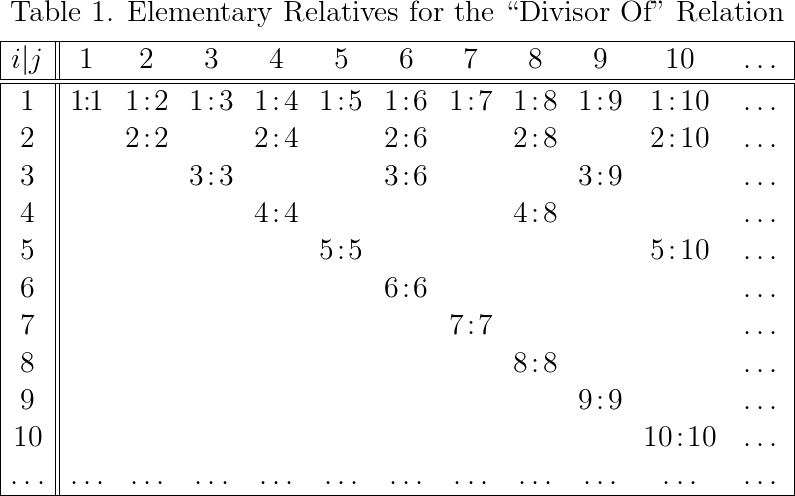
Table 2 shows the same information in the form of a logical matrix. This has a coefficient of 


Just as matrices of real coefficients in linear algebra represent linear transformations, matrices of boolean coefficients represent logical transformations. The capacity of dyadic relations to generate transformations gives us part of what we need to know about the dynamics of semiosis inherent in sign relations.
Cf: Relations & Their Relatives • Discussion 1
The “divisor of” relation 


The mathematics of relations can be applied most felicitously to semiotics but there we must bump the adicity or arity up to three. We take any sign relation 


One thing we need to understand is the sign relation 
Resources
cc: Category Theory • Cybernetics • Ontolog • Structural Modeling • Systems Science
cc: FB | Relation Theory • Laws of Form • Peirce List (1) (2) (3)


 Inquiry Into Inquiry
Pingback: Survey of Relation Theory • 4 | Inquiry Into Inquiry
Pingback: Relations & Their Relatives • Discussion 18 | Inquiry Into Inquiry
Pingback: Survey of Relation Theory • 5 | Inquiry Into Inquiry
Pingback: Survey of Relation Theory • 2 | Inquiry Into Inquiry
Pingback: Survey of Relation Theory • 3 | Inquiry Into Inquiry
Pingback: Survey of Relation Theory • 6 | Inquiry Into Inquiry
Pingback: Survey of Relation Theory • 7 | Inquiry Into Inquiry
Pingback: Survey of Relation Theory • 8 | Inquiry Into Inquiry