Cybernetics • Regulation In Biological Systems • Discussion 2

Re: Systems ScienceJack Ring

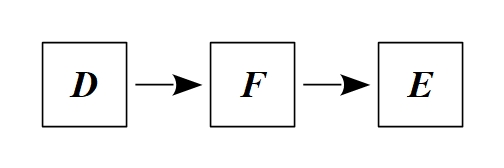
In the last selection we found Ashby making what may strike us initially as a surprising inference.  Starting from the assumption that “an essential function of F as a regulator is that it shall block the transmission of variety from disturbance to essential variable” he draws the conclusion that “the regulator’s function is to block the flow of information”.

Ashby’s reasoning at this point caused me to do a double take, because I normally think of information as a resource for reducing variety, in other words, the dispersive quality of entropy.  But a little reflection convinced me Ashby is making sense here, so long as we read him right.

Jack Ring’s suggestion, “Consider that the regulator blocks information that is detrimental to the system mission”, serves to point us in the right direction.  Strictly speaking, though, it is not the information about temperature variation that is detrimental to the system’s mission but the temperature variation itself.  The regulator acts in such a way as to block the information about variation, but solely as a side effect of damping the real variation.

But we need to keep one thing in mind.  When we speak of the regulator blocking the flow of information, we are talking about the whole system (D, F, E) as a “black box”, where the net information flow from input to output is as low as possible.  When we turn to a finer-grained analysis of regulated systems we will see that all sorts of information has to be processed inside the system in order to achieve its mission.

Reference

  • Ashby, W.R. (1956), An Introduction to Cybernetics, Chapman and Hall, London, UK.  Republished by Methuen and Company, London, UK, 1964.  Online.

cc: CyberneticsOntolog ForumStructural ModelingSystems Science

Posted in Adaptive Systems, Ashby, C.S. Peirce, Communication, Control, Cybernetics, Evolution, Information, Inquiry Driven Systems, Learning, Logic, Mathematics, Peirce, Purpose, Regulation, Survival, Truth Theory, W. Ross Ashby | Tagged , , , , , , , , , , , , , , , , , | 7 Comments

Cybernetics • Regulation In Biological Systems • Selection 7

Let’s pick up the observation Ashby made at the end of the last selection, regarding the job of a regulator, and continue with his text from there.

Regulation In Biological Systems

Survival

Ashby Cybernetics Figure 10.5.2

10/6.[cont.]   If F is a regulator, the insertion of F between D and E lessens the variety that is transmitted from D to E.  Thus an essential function of F as a regulator is that it shall block the transmission of variety from disturbance to essential variable.

Since this characteristic also implies that the regulator’s function is to block the flow of information, let us look at the thesis more closely to see whether it is reasonable.

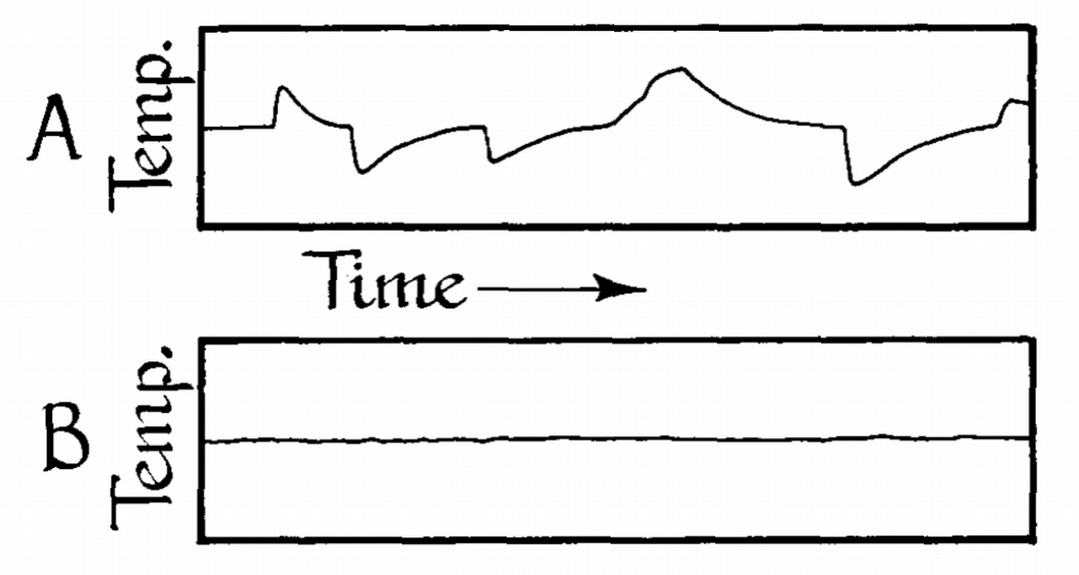
Suppose that two water-baths are offered me, and I want to decide which to buy.  I test each for a day against similar disturbances and then look at the records of the temperatures;  they are as in Fig. 10/6/1.

Ashby Cybernetics Figure 10.6.1

Fig. 10/6/1

There is no doubt that \mathrm{Model}~ B is the better;  and I decide this precisely because its record gives me no information, as does A\text{'s}, about what disturbances, of heat or cold, came to it.  The thermometer and water in bath B have been unable, as it were, to see anything of the disturbances D.

Reference

  • Ashby, W.R. (1956), An Introduction to Cybernetics, Chapman and Hall, London, UK.  Republished by Methuen and Company, London, UK, 1964.  Online.

cc: CyberneticsOntolog ForumStructural ModelingSystems Science

Posted in Adaptive Systems, Ashby, C.S. Peirce, Communication, Control, Cybernetics, Evolution, Information, Inquiry Driven Systems, Learning, Logic, Mathematics, Peirce, Purpose, Regulation, Survival, Truth Theory, W. Ross Ashby | Tagged , , , , , , , , , , , , , , , , , | 9 Comments

Cybernetics • Regulation In Biological Systems • Selection 6

Regulation In Biological Systems

Survival

Ashby Cybernetics Figure 10.5.2

10/6.   Regulation blocks the flow of variety.   On what scale can any particular mechanism F be measured for its value or success as a regulator?  The perfect thermostat would be one that, in spite of disturbance, kept the temperature constant at the desired level.  In general, there are two characteristics required:  the maintenance of the temperature within close limits, and the correspondence of this range with the desired one.  What we must notice in particular is that the set of permissible values, \eta, has less variety than the set of all possible values in E;  for \eta is some set selected from the states of E.  If F is a regulator, the insertion of F between D and E lessens the variety that is transmitted from D to E.  Thus an essential function of F as a regulator is that it shall block the transmission of variety from disturbance to essential variable.

Reference

  • Ashby, W.R. (1956), An Introduction to Cybernetics, Chapman and Hall, London, UK.  Republished by Methuen and Company, London, UK, 1964.  Online.

cc: CyberneticsOntolog ForumStructural ModelingSystems Science

Posted in Adaptive Systems, Ashby, C.S. Peirce, Communication, Control, Cybernetics, Evolution, Information, Inquiry Driven Systems, Learning, Logic, Mathematics, Peirce, Purpose, Regulation, Survival, Truth Theory, W. Ross Ashby | Tagged , , , , , , , , , , , , , , , , , | 9 Comments

Cybernetics • Regulation In Biological Systems • Discussion 1

Re: Ontolog ForumJon AwbreyPaola Di Maio

JA:
We continue in pursuit of a system-theoretic answer to the question:  What are formalisms and all their embodiments in brains and computers good for?
PDM:
Could you also provide a brief answer to the question, through your analysis of the text you reference — we all suffer from attention deficit and may forget what you were trying to say at the beginning.

I know what you mean.  Brevity is the soul of wit, but the brief lives of mortal attention spans struggle to embody half of it.  I personally have trouble remembering what I was thinking a few days ago unless I wrote it down somewhere I can easily find again.

My question about the good of embodied formalisms was intended to call attention to a natural connection between Pragmatic Truth and Cybernetic Purpose.  Pragmatic ways of thinking about the role of representations in relating interpreters to objective realities naturally harmonize with systems thinking about the role of information in achieving the objectives of agents.  In either mode of thinking we tend to become quickly dissatisfied with disembodied abstractions, detached from dynamic context and meaningful purpose.

Reference

  • Ashby, W.R. (1956), An Introduction to Cybernetics, Chapman and Hall, London, UK.  Republished by Methuen and Company, London, UK, 1964.  Online.

cc: CyberneticsOntolog ForumStructural ModelingSystems Science

Posted in Adaptive Systems, Ashby, C.S. Peirce, Communication, Control, Cybernetics, Evolution, Information, Inquiry Driven Systems, Learning, Logic, Mathematics, Peirce, Purpose, Regulation, Survival, Truth Theory, W. Ross Ashby | Tagged , , , , , , , , , , , , , , , , , | 6 Comments

Cybernetics • Regulation In Biological Systems • Selection 5

Regulation In Biological Systems

Survival

Ashby Cybernetics Figure 10.5.2

10/5.[concl.]   To make the assumptions clear, here are some simple cases, as illustration.  (Inanimate regulatory systems are given first for simplicity.)

(1) The thermostatically-controlled water-bath.  E is its temperature, and what is desired (\eta) is the temperature range between, say 36° and 37°C.  D is the set of all the disturbances that may drive the temperature outside that range — addition of cold water, cold draughts blowing, immersion of cold objects, etc.  F is the whole regulatory machinery.  F, by its action, tends to lessen the effect of D on E.
(2) The automatic pilot.  E is a vector with three components — yaw, pitch, and roll — and \eta is the set of positions in which these three are all within certain limits.  D is the set of disturbances that may affect these variables, such as gusts of wind, movements of the passengers in the plane, and irregularities in the thrusts of the engines.  F is the whole machinery — pilot, ailerons, rudder, etc. — whose action determines how D shall affect E.

(3) The bicycle rider.  E is chiefly his angle with the vertical.  \eta is the set of small permissible deviations.  D is the set of those disturbances that threaten to make the deviation become large.  F is the whole machinery — mechanical, anatomical, neuronic — that determines what the effect of D is on E.

Many other examples will occur later.  Meanwhile we can summarise by saying that natural selection favours those gene-patterns that get, in whatever way, a regulator F between the disturbances D and the essential variables E.  Other things being equal, the better F is as a regulator, the larger the organism’s chance of survival.

Reference

  • Ashby, W.R. (1956), An Introduction to Cybernetics, Chapman and Hall, London, UK.  Republished by Methuen and Company, London, UK, 1964.  Online.

cc: CyberneticsOntolog ForumStructural ModelingSystems Science

Posted in Adaptive Systems, Ashby, C.S. Peirce, Communication, Control, Cybernetics, Evolution, Information, Inquiry Driven Systems, Learning, Logic, Mathematics, Peirce, Purpose, Regulation, Survival, Truth Theory, W. Ross Ashby | Tagged , , , , , , , , , , , , , , , , , | 6 Comments

Cybernetics • Regulation In Biological Systems • Selection 4

Regulation In Biological Systems

Survival

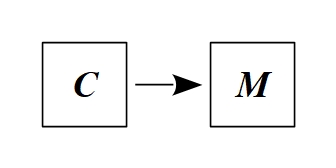
10/5.[cont.]   Now regard the system as one of parts in communication.  In the previous section the diagram of immediate effects (of cat and mouse) was (or could be regarded as)

Ashby Cybernetics Figure 10.5.1

We are now considering the case in which the diagram is

Ashby Cybernetics Figure 10.5.2

in which E is the set of essential variables, D is the source of disturbance and dangers (such as C) from the rest of the world, and F is the interpolated part (shell, brain, etc.) formed by the gene-pattern for the protection of E.  (F may also include such parts of the environment as may similarly be used for E\text{'s} protection — burrow for rabbit, shell for hermit-crab, pike for pike-man, and sword (as defence) for swordsman.)

For convenience in reference throughout Part III, let the states of the essential variables E be divided into a set \eta — those that correspond to “organism living” or “good” — and \text{not-}\eta — those that correspond to “organism not living” or “bad”.  (Often the classification cannot be as simple as this, but no difficulty will occur in principle;  nothing to be said excludes the possibility of a finer classification.)

Reference

  • Ashby, W.R. (1956), An Introduction to Cybernetics, Chapman and Hall, London, UK.  Republished by Methuen and Company, London, UK, 1964.  Online.

cc: CyberneticsOntolog ForumStructural ModelingSystems Science

Posted in Adaptive Systems, Ashby, C.S. Peirce, Communication, Control, Cybernetics, Evolution, Information, Inquiry Driven Systems, Learning, Logic, Mathematics, Peirce, Purpose, Regulation, Survival, Truth Theory, W. Ross Ashby | Tagged , , , , , , , , , , , , , , , , , | 6 Comments

Cybernetics • Regulation In Biological Systems • Selection 3

Regulation In Biological Systems

Survival

10/5.   What is it survives, over the ages?  Not the individual organism, but certain peculiarly well compounded gene-patterns, particularly those that lead to the production of an individual that carries the gene-pattern well protected within itself, and that, within the span of one generation, can look after itself.

What this means is that those gene-patterns are specially likely to survive (and therefore to exist today) that cause to grow, between themselves and the dangerous world, some more or less elaborate mechanism for defence.  So the genes in Testudo cause the growth of a shell;  and the genes in Homo cause the growth of a brain.  (The genes that did not cause such growths have long since been eliminated.)

Reference

  • Ashby, W.R. (1956), An Introduction to Cybernetics, Chapman and Hall, London, UK.  Republished by Methuen and Company, London, UK, 1964.  Online.

cc: CyberneticsOntolog ForumStructural ModelingSystems Science

Posted in Adaptive Systems, Ashby, C.S. Peirce, Communication, Control, Cybernetics, Evolution, Information, Inquiry Driven Systems, Learning, Logic, Mathematics, Peirce, Purpose, Regulation, Survival, Truth Theory, W. Ross Ashby | Tagged , , , , , , , , , , , , , , , , , | 6 Comments

Cybernetics • Regulation In Biological Systems • Selection 2

Regulation In Biological Systems

Survival

10/4.   What has just been said is well enough known.  It enables us, however, to join these facts on to the ideas developed in this book and to show the connexion exactly.

For consider what is meant, in general, by “survival”.  Suppose a mouse is trying to escape from a cat, so that the survival of the mouse is in question.  As a dynamic system, the mouse can be in a variety of states;  thus it can be in various postures, its head can be turned this way or that, its temperature can have various values, it may have two ears or one.  These different states may occur during its attempt to escape and it may still be said to have survived.  On the other hand if the mouse changes to the state in which it is in four separated pieces, or has lost its head, or has become a solution of amino-acids circulating in the cat’s blood then we do not consider its arrival at one of these states as corresponding to “survival”.

The concept of “survival” can thus be translated into perfectly rigorous terms, similar to those used throughout the book.  The various states (M for Mouse) that the mouse may be in initially and that it may pass into after the affair with the cat is a set M_1, M_2, \ldots, M_k, \ldots, M_n.  We decide that, for various reasons of what is practical and convenient, we shall restrict the words “living mouse” to mean the mouse in one of the states in some subset of these possibilities, in M_1 to M_k say.  If now some operation C (for cat) acts on the mouse in state M_i, and C(M_i) gives, say, M_2, then we may say that M has “survived” the operation of C, for M_2 is in the set M_1, \ldots, M_k.

If now a particular mouse is very skilled and always survives the operation C, then all the states C(M_1), C(M_2), \ldots, C(M_k), are contained in the set M_1, \ldots, M_k.  We now see that this representation of survival is identical with that of the “stability” of a set (S.5/5).  Thus the concepts of “survival” and “stability” can be brought into an exact relationship;  and facts and theorems about either can be used with the other, provided the exactness is sustained.

The states M are often defined in terms of variables.  The states M_1, \ldots, M_k, that correspond to the living organism are then those states in which certain essential variables are kept within assigned (“physiological”) limits.

Reference

  • Ashby, W.R. (1956), An Introduction to Cybernetics, Chapman and Hall, London, UK.  Republished by Methuen and Company, London, UK, 1964.  Online.

cc: CyberneticsOntolog ForumPeirce ListStructural ModelingSystems Science

Posted in Adaptive Systems, Ashby, C.S. Peirce, Communication, Control, Cybernetics, Evolution, Information, Inquiry Driven Systems, Learning, Logic, Mathematics, Peirce, Purpose, Regulation, Survival, Truth Theory, W. Ross Ashby | Tagged , , , , , , , , , , , , , , , , , | 6 Comments

Cybernetics • Regulation In Biological Systems • Selection 1

Regulation In Biological Systems

10/3.   The foundation.   Let us start at the beginning.  The most basic facts in biology are that this earth is now two thousand million years old, and that the biologist studies mostly that which exists today.  From these two facts follow a well-known deduction, which I would like to restate in our terms.

We saw in S.4/23 that if a dynamic system is large and composed of parts with much repetition, and if it contains any property that is autocatalytic, i.e. whose occurrence at one point increases the probability that it will occur again at another point, then such a system is, so far as that property is concerned, essentially unstable in its absence.  This earth contained carbon and other necessary elements, and it is a fact that many combinations of carbon, nitrogen, and a few others are self-reproducing.  It follows that though the state of “being lifeless” is almost a state of equilibrium, yet this equilibrium is unstable (S.5/6), a single deviation from it being sufficient to start a trajectory that deviates more and more from the “lifeless” state.  What we see today in the biological world are these “autocatalytic” processes showing all the peculiarities that have been imposed on them by two thousand million years of elimination of those forms that cannot survive.

The organisms we see today are deeply marked by the selective action of two thousand million years’ attrition.  Any form in any way defective in its power of survival has been eliminated;  and today the features of almost every form bear the marks of being adapted to ensure survival rather than any other possible outcome.  Eyes, roots, cilia, shells and claws are so fashioned as to maximise the chance of survival.  And when we study the brain we are again studying a means to survival.

Reference

  • Ashby, W.R. (1956), An Introduction to Cybernetics, Chapman and Hall, London, UK.  Republished by Methuen and Company, London, UK, 1964.  Online.

cc: CyberneticsOntolog ForumPeirce ListStructural ModelingSystems Science

Posted in Adaptive Systems, Ashby, C.S. Peirce, Communication, Control, Cybernetics, Evolution, Information, Inquiry Driven Systems, Learning, Logic, Mathematics, Peirce, Purpose, Regulation, Survival, Truth Theory, W. Ross Ashby | Tagged , , , , , , , , , , , , , , , , , | 8 Comments

Pragmatic Truth • Discussion 18

Re: Pragmatic Truth • Discussion • (14)(16)(17)
Re: Peirce ListTom Gollier

We do not live in axiom systems.  We do not live encased in languages, formal or natural.  There is no reason to think we will ever have exact and exhaustive theories of what’s out there, and the truth, as we know, is “out there”.  Peirce understood there are more truths in mathematics than are dreamt of in logic — and Gödel’s realism should have put the last nail in the coffin of logicism — but some ways of thinking just never get a clue.

That brings us to the question —

  • What are formalisms and all their embodiments in brains and computers good for?

For that I’ll turn to cybernetics …

cc: CyberneticsOntolog ForumPeirce ListStructural ModelingSystems Science

Posted in Aristotle, C.S. Peirce, Coherence, Concordance, Congruence, Consensus, Convergence, Correspondence, Dewey, Fixation of Belief, Information, Inquiry, John Dewey, Kant, Logic, Logic of Science, Method, Peirce, Philosophy, Pragmatic Maxim, Pragmatism, Semiotics, Sign Relations, Triadic Relations, Truth, Truth Theory, William James | Tagged , , , , , , , , , , , , , , , , , , , , , , , , , , | 12 Comments