Cactus Language • Discussion 3

Re: Cactus Language • Stylistics 1
Re: CyberneticsShann Turnbull

ST:
How does your posting meet the test of being relevant to the Wiener definition of Cybernetic?

Cybernetics can explain how all living things are self‑regulating, self‑governing and to some extent self‑repairing.  Models are not needed because they are illustrated in practice everywhere.

The web pages heading you referred to does not support cybernetics being hard science subject to empirical testing.

It states:

As a result, we can hardly conceive of how many possibilities there are for what we call objective reality.  Our sharp quills of knowledge are so narrow and so concentrated in particular directions that with science there are myriads of totally different real worlds, each one accessible from the next simply by slight alterations — shifts of gaze — of every particular discipline and subspecialty.

May I suggest that you share your interest in semantics with only those dedicated to your topic?  Refer to International Association of Literary Semantics.

Hopefully, the audience of this list, also interested in non‑testable science, will follow you to more efficient focus discussion on the cybcom list.

Thanks for your comments, Shann.  It’s good to know one has a Reader.

It’s not usually necessary to give too weighty a justification for an epigraph like the one I used.  They may be intended as nothing more than a bit of light relief from the daily te deums before turning back to the task at hand, a sidelong reflection on the broader scene, or even a counterpoint to the main theme in view.  I can see how some of that may need to be developed as we go but I would not wish to get overly diverted by it.  In the present time frame I have moved on to the topic of Cactus Language Mechanics, beginning with the following post.

It appears I have run out of time for today.  I’ll take up the rest of your comments next time.

Regards,
Jon

Resources

cc: Academia.edu • BlueSky • Laws of Form • Mathstodon • Research Gate
cc: Conceptual GraphsCyberneticsStructural ModelingSystems Science

Posted in Automata, Boolean Algebra, Boolean Functions, C.S. Peirce, Cactus Graphs, Differential Logic, Equational Inference, Formal Grammars, Formal Languages, Graph Theory, Logic, Logical Graphs, Mathematics, Minimal Negation Operators, Painted Cacti, Propositional Calculus, Visualization | Tagged , , , , , , , , , , , , , , , , | 3 Comments

Cactus Language • Mechanics 1

We are only now beginning to see how this works.  Clearly one of the mechanisms for picking a reality is the sociohistorical sense of what is important — which research program, with all its particularity of knowledge, seems most fundamental, most productive, most penetrating.  The very judgments which make us push narrowly forward simultaneously make us forget how little we know.  And when we look back at history, where the lesson is plain to find, we often fail to imagine ourselves in a parallel situation.  We ascribe the differences in world view to error, rather than to unexamined but consistent and internally justified choice.

Herbert J. Bernstein • “Idols of Modern Science”

The discussion to follow takes up the mechanics of parsing cactus language expressions into the corresponding computational data structures.  Parsing translates each cactus expression into a computational form articulating its syntactic structure and preparing it for automated modes of processing and evaluation.

For present purposes it is necessary to describe the target data structures only at a fairly high level of abstraction, ignoring the details of address pointers and record structures and leaving the more operational aspects of implementation to the imagination of prospective programmers.  In that way we may put off to another stage of elaboration and refinement the description of a program which creates those pointers and transforms those graph‑theoretic data structures.

Resources

cc: Academia.edu • BlueSky • Laws of FormMathstodonResearch Gate
cc: Conceptual Graphs • CyberneticsStructural ModelingSystems Science

Posted in Automata, Boolean Algebra, Boolean Functions, C.S. Peirce, Cactus Graphs, Differential Logic, Equational Inference, Formal Grammars, Formal Languages, Graph Theory, Logic, Logical Graphs, Mathematics, Minimal Negation Operators, Painted Cacti, Propositional Calculus, Visualization | Tagged , , , , , , , , , , , , , , , , | 3 Comments

Charles Sanders Peirce, George Spencer Brown, and Me • 20

Re: Laws of FormJames Bowery

JB:
I’m interested in those who have approached the notion of self‑duality from the meta‑perspective of switching perspectives between Directed Cyclic Graphs of NiNAND and NiNOR gates (Ni for N‑Inputs à la boolean network theory).  The burgeoning interest in what might be called “The Self‑Simulation Hypothesis” founded on the notion of self‑duality rather demands this meta‑perspective.

Going through my notes I see I blogged fairly extensively on the En‑Ex duality last year.  There’s so much going on in the world right now I’m having trouble maintaining focus so I’ll just post a collection of links to the relevant title searches against the day when I can review those series and bring them to bear on the topics above.

Resources

cc: Academia.edu • BlueSky • Laws of FormMathstodonResearch Gate
cc: Conceptual GraphsCyberneticsStructural ModelingSystems Science

Posted in Abstraction, Amphecks, Analogy, Animata, Boolean Algebra, Boolean Functions, C.S. Peirce, Cactus Graphs, Cybernetics, Deduction, Differential Analytic Turing Automata, Differential Logic, Duality, Form, Graph Theory, Inquiry, Inquiry Driven Systems, Laws of Form, Logic, Logical Graphs, Mathematics, Minimal Negation Operators, Model Theory, Proof Theory, Propositional Calculus, Semiotics, Sign Relational Manifolds, Sign Relations, Spencer Brown, Theorem Proving, Time, Topology | Tagged , , , , , , , , , , , , , , , , , , , , , , , , , , , , , , , | 1 Comment

Charles Sanders Peirce, George Spencer Brown, and Me • 19

Re: Laws of FormJames Bowery

JB:
I’m interested in those who have approached the notion of self‑duality from the meta‑perspective of switching perspectives between Directed Cyclic Graphs of NiNAND and NiNOR gates (Ni for N‑Inputs à la boolean network theory).  The burgeoning interest in what might be called “The Self‑Simulation Hypothesis” founded on the notion of self‑duality rather demands this meta‑perspective.

As far as logical graphs and boolean functions go, the main form of duality occupying me for the last half century has been the duality between existential and entitative interpretations of logical graphs for propositional calculus.  That duality points to a deeper mathematical unity underlying the diversity of logical interpretation.  To my way of thinking, that unity of form is the most significant fact Peirce discovered about the relationship between mathematics and logic.  Sheffer, Huntington, Spencer Brown, and all the most perceptive writers who followed Peirce, have been able to appreciate its fundamental status.

Various folks who are likely to be reading this now will recognize how various subsets of us have been through the whole array of tangent topics and issues at varying levels of attention and interest for a very long time, so I will take a moment to check my notes and see what seems most salient for current concerns.

Resources

cc: Academia.edu • BlueSky • Laws of FormMathstodonResearch Gate
cc: Conceptual GraphsCyberneticsStructural ModelingSystems Science

Posted in Abstraction, Amphecks, Analogy, Animata, Boolean Algebra, Boolean Functions, C.S. Peirce, Cactus Graphs, Cybernetics, Deduction, Differential Analytic Turing Automata, Differential Logic, Duality, Form, Graph Theory, Inquiry, Inquiry Driven Systems, Laws of Form, Logic, Logical Graphs, Mathematics, Minimal Negation Operators, Model Theory, Proof Theory, Propositional Calculus, Semiotics, Sign Relational Manifolds, Sign Relations, Spencer Brown, Theorem Proving, Time, Topology | Tagged , , , , , , , , , , , , , , , , , , , , , , , , , , , , , , , | 1 Comment

Charles Sanders Peirce, George Spencer Brown, and Me • 18

Re: Laws of FormJames Bowery

JB:
I’m interested in those who have approached the notion of self‑duality from the meta‑perspective of switching perspectives between Directed Cyclic Graphs of NiNAND and NiNOR gates (Ni for N‑Inputs à la boolean network theory).  The burgeoning interest in what might be called “The Self‑Simulation Hypothesis” founded on the notion of self‑duality rather demands this meta‑perspective.

Hi James, it’s been a while … Picking up this thread again always leads me through a maze of reminiscence — I’m used to that — but it’s taking more time than usual to sort out what bears on the topics you raise, more from the richness of the embedding matrix than any lack of content … but I will keep at it … here’s a first bit …

Parametrized families of logical operators like the ones you mention are some of the first things I remember discussing with one of my former logic professors, Herb Hendry, who told me they are called “multigrade operators”.  Herb taught in the philosophy department at Michigan State and became an early adopter of instructional technology for teaching logic, developing a software package by the name of CALL for Computer Assisted Logic Lessons.  It was only natural that I would come to have many discussions with him about my own adventures in computing for logic.

Then as now I came at everything from a Peircean direction and I had early on learned about the operators Peirce described as the ampheck \curlywedge and its dual \bar\curlywedge — McCulloch would later refer to both as amphecks for reasons we’ll get to eventually — and others of my teachers called NNOR and NAND, respectively.

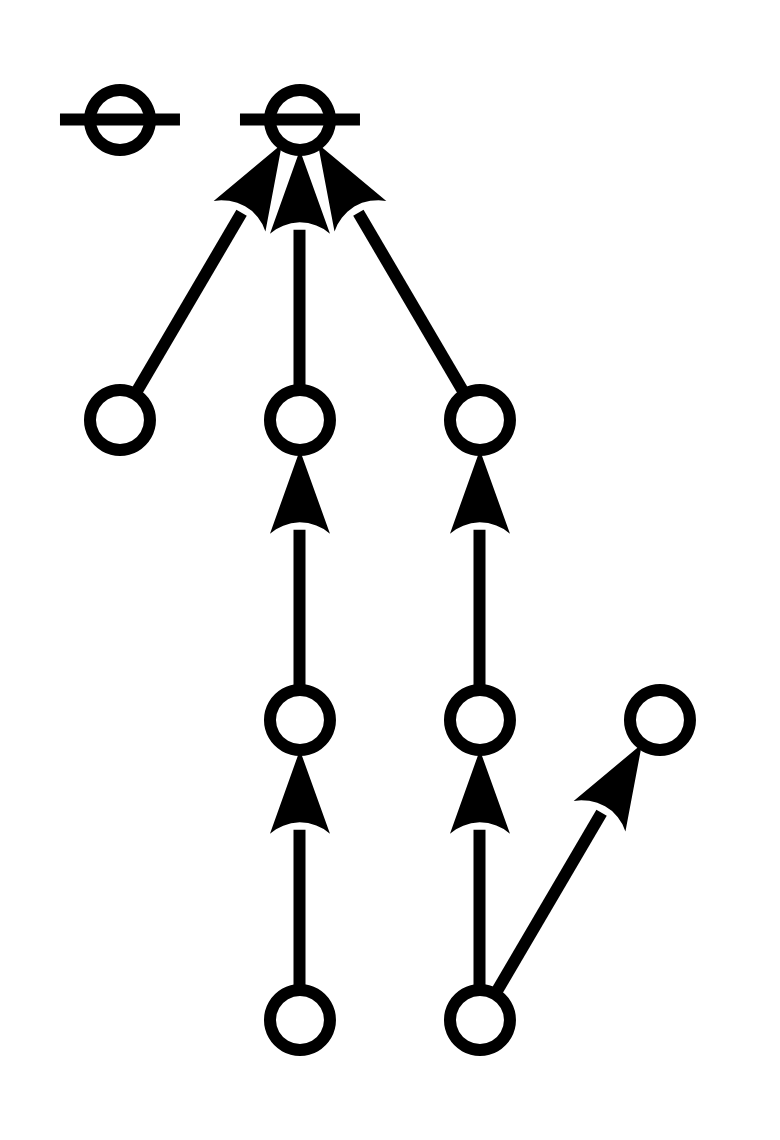
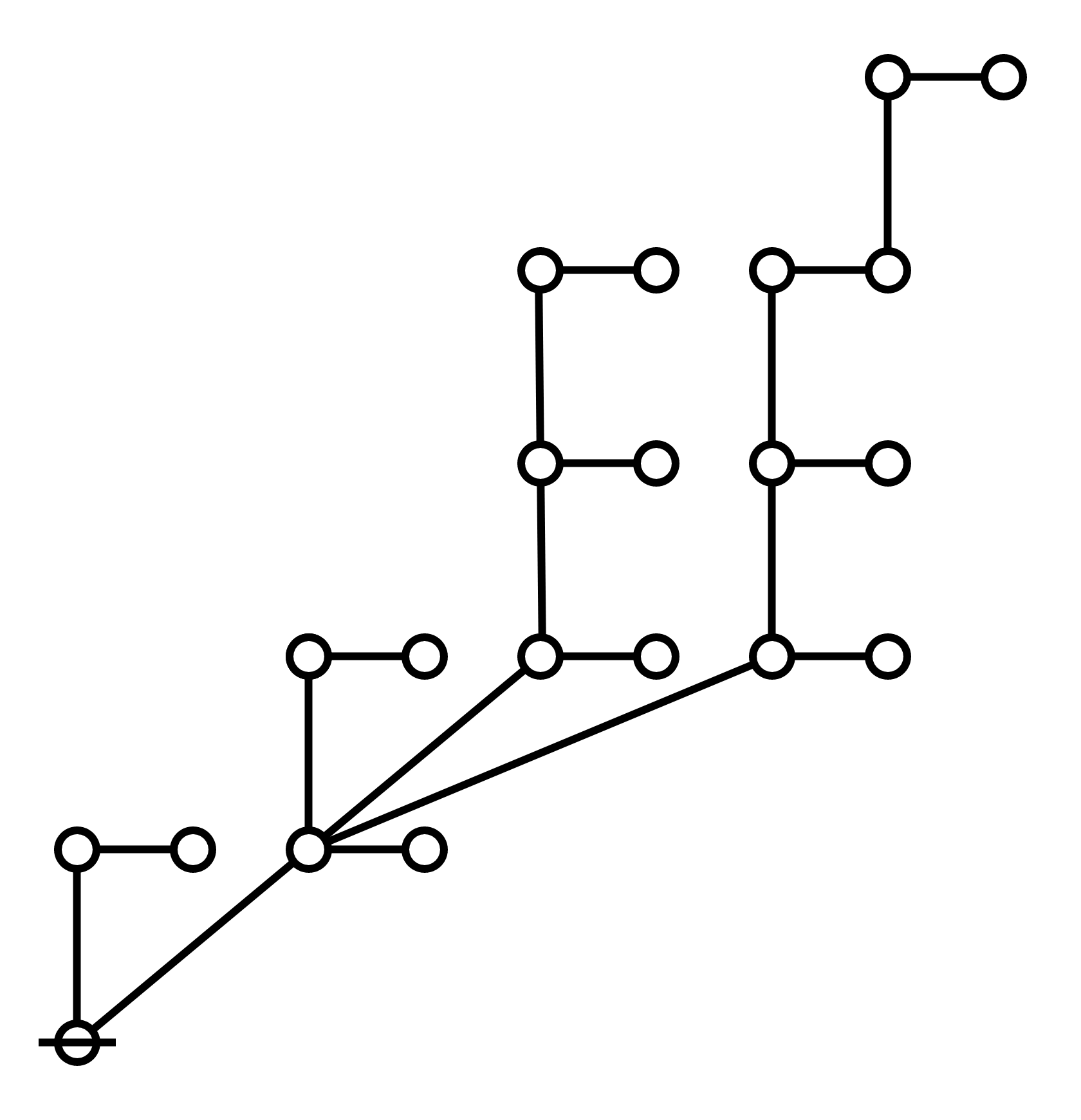
Making a long story as short as possible, the natural extensions of NAND and NNOR to finite numbers of variables are represented by logical graphs of the following forms.

Cactus Graphs for NCON and NDIS E(1‥n)

Working under what amounts to Peirce’s existential interpretation, an expression of the form \texttt{(} e_1 \ldots e_n \texttt{)} is a negation of a conjunction while an expression of the form \texttt{(} e_1 \texttt{)} \ldots \texttt{(} e_n \texttt{)} is a negation of a disjunction, which is also a conjunction of many negations.

For concreteness of orientation, the corresponding venn diagrams for the case where n = 3 are shown below.

Venn Diagrams for NCON and NDIS (p, q, r)

References

Resources

cc: Academia.edu • BlueSky • Laws of FormMathstodonResearch Gate
cc: Conceptual GraphsCyberneticsStructural ModelingSystems Science

Posted in Abstraction, Amphecks, Analogy, Animata, Boolean Algebra, Boolean Functions, C.S. Peirce, Cactus Graphs, Cybernetics, Deduction, Differential Analytic Turing Automata, Differential Logic, Duality, Form, Graph Theory, Inquiry, Inquiry Driven Systems, Laws of Form, Logic, Logical Graphs, Mathematics, Minimal Negation Operators, Model Theory, Proof Theory, Propositional Calculus, Semiotics, Sign Relational Manifolds, Sign Relations, Spencer Brown, Theorem Proving, Time, Topology | Tagged , , , , , , , , , , , , , , , , , , , , , , , , , , , , , , , | 1 Comment

Charles Sanders Peirce, George Spencer Brown, and Me • 17

Re: Laws of FormJames Bowery

JB:
I’m interested in those who have approached the notion of self‑duality from the meta‑perspective of switching perspectives between Directed Cyclic Graphs of NiNAND and NiNOR gates (Ni for N‑Inputs à la boolean network theory).  The burgeoning interest in what might be called “The Self‑Simulation Hypothesis” founded on the notion of self‑duality rather demands this meta‑perspective.

Thanks, James, I’ve been needing a break about here — the series on Cactus Language is very important but it can be rough going at times — as far as the current thread goes it’s been a long time passing so allow me a bit of anamnesis to remember why I walked into the room.

Resources

cc: Academia.edu • BlueSky • Laws of FormMathstodonResearch Gate
cc: Conceptual GraphsCyberneticsStructural ModelingSystems Science

Posted in Abstraction, Amphecks, Analogy, Animata, Boolean Algebra, Boolean Functions, C.S. Peirce, Cactus Graphs, Cybernetics, Deduction, Differential Analytic Turing Automata, Differential Logic, Duality, Form, Graph Theory, Inquiry, Inquiry Driven Systems, Laws of Form, Logic, Logical Graphs, Mathematics, Minimal Negation Operators, Model Theory, Proof Theory, Propositional Calculus, Semiotics, Sign Relational Manifolds, Sign Relations, Spencer Brown, Theorem Proving, Time, Topology | Tagged , , , , , , , , , , , , , , , , , , , , , , , , , , , , , , , | 1 Comment

Cactus Language • Pragmatics 16

Stricture, Strait, Constraint, Information, Complexity

The ways in which strictures and straits at different levels of complexity relate to one another can be given systematic treatment by introducing the following pair of definitions.

Excerpt of a Stricture
The j^\text{th} excerpt of a stricture ``S_1 \times \ldots \times S_k", regarded in a frame of discussion where the number of places is bounded by k, is a stricture of the form ``X \times \ldots \times S_j \times \ldots \times X".

The j^\text{th} excerpt can be written more briefly in context as the stricture ``(S_j)_{[j]}", an assertion which places the j^\text{th} set in the j^\text{th} place of the product.

Extract of a Strait
The j^\text{th} extract of a strait S_1 \times \ldots \times S_k, regarded in a frame of discussion where the number of places is bounded by k, is a strait of the form X \times \ldots \times S_j \times \ldots \times X.

The j^\text{th} extract can be denoted more briefly in context by the stricture ``(S_j)_{[j]}", an assertion which places the j^\text{th} set in the j^\text{th} place of the product.

Using the above definitions, a stricture of the form ``S_1 \times \ldots \times S_k" can be expressed in terms of simpler strictures, namely, as the following conjunction of its individual excerpts.

\begin{array}{lll}  ``S_1 \times \ldots \times S_k" & = & ``(S_1)_{[1]}" \land \ldots \land ``(S_k)_{[k]}"  \end{array}

In a similar vein, a strait of the form S_1 \times \ldots \times S_k can be expressed in terms of simpler straits, namely, as the following intersection of its individual extracts.

\begin{array}{lll}  S_1 \times \ldots \times S_k & = & (S_1)_{[1]} \cap \ldots \cap (S_k)_{[k]}  \end{array}

Resources

cc: Academia.edu • BlueSky • Laws of FormMathstodonResearch Gate
cc: Conceptual GraphsCyberneticsStructural ModelingSystems Science

Posted in Automata, Boolean Algebra, Boolean Functions, C.S. Peirce, Cactus Graphs, Differential Logic, Equational Inference, Formal Grammars, Formal Languages, Graph Theory, Logic, Logical Graphs, Mathematics, Minimal Negation Operators, Painted Cacti, Propositional Calculus, Visualization | Tagged , , , , , , , , , , , , , , , , | 2 Comments

Cactus Language • Pragmatics 15

Stricture, Strait, Constraint, Information, Complexity

From here it is easy to see how the concatenation of languages is related to the intersection of sets and thus to the conjunction of logical propositions.  In the upshot a cartesian product P \times Q is described by a logical proposition P_{[1]} \land Q_{[2]} subject to the following interpretation.

  • P_{[1]} says there is an element from the set P in the 1st place of the product P \times Q.
  • Q_{[2]} says there is an element from the set Q in the 2nd place of the product P \times Q.

The integration of those two pieces of information can be taken to specify a yet to be fully determined relation.

In a corresponding fashion at the level of elements, the ordered pair (p, q) is described by a conjunction of propositions, namely p_{[1]} \land q_{[2]}, subject to the following interpretation.

  • p_{[1]} says that p occupies the 1st place of the product element under construction.
  • q_{[2]} says that q occupies the 2nd place of the product element under construction.

Taking the cartesian product of P and Q or the concatenation of \mathfrak{L}_1 and \mathfrak{L}_2 in the above manner shifts the level of active construction from the tupling of elements in P and Q or the concatenation of strings in \mathfrak{L}_1 and \mathfrak{L}_2 to the concatenation of external signs describing those sets or languages.

Thus we pass to a conjunction of indexed propositions P_{[1]} and Q_{[2]} or a conjunction of assertions (\mathfrak{L}_1)_{[1]} and (\mathfrak{L}_2)_{[2]} which mark the indicated sets or languages for insertion in the indicated places of a product set or product language, respectively.  On closer examination, we can recognize the subscripting by the indices ``[1]" and ``[2]" as a type of concatenation, in this case accomplished through the posting of editorial remarks from an external mark‑up language.

Resources

cc: Academia.edu • BlueSky • Laws of FormMathstodonResearch Gate
cc: Conceptual GraphsCyberneticsStructural ModelingSystems Science

Posted in Automata, Boolean Algebra, Boolean Functions, C.S. Peirce, Cactus Graphs, Differential Logic, Equational Inference, Formal Grammars, Formal Languages, Graph Theory, Logic, Logical Graphs, Mathematics, Minimal Negation Operators, Painted Cacti, Propositional Calculus, Visualization | Tagged , , , , , , , , , , , , , , , , | 2 Comments

Cactus Language • Pragmatics 14

Stricture, Strait, Constraint, Information, Complexity

To give a concrete example of strictures and straits in action, let us institute a frame of discussion where the number of places in a relation is bounded at two and the variety of sets under active consideration is limited to the subsets P and Q of a universe X.  Under those conditions one may use the following sorts of expression as schematic strictures.

\begin{matrix}  ``X" & ``P" & ``Q"  \\[4pt]  ``X \times X" & ``X \times P" & ``X \times Q"  \\[4pt]  ``P \times X" & ``P \times P" & ``P \times Q"  \\[4pt]  ``Q \times X" & ``Q \times P" & ``Q \times Q"  \end{matrix}

The above strictures and their corresponding straits are stratified according to the amounts of information they contain, or the levels of constraint they impose, as shown in the following table.

\begin{array}{lcccc}  \text{High:} & ``P \times P" & ``P \times Q" & ``Q \times P" & ``Q \times Q"  \\[4pt]  \text{Med:} & ``P" & ``X \times P" & ``P \times X"  \\[4pt]  \text{Med:} & ``Q" & ``X \times Q" & ``Q \times X"  \\[4pt]  \text{Low:} & ``X" & ``X \times X"  \end{array}

In that framework, the complex strait P \times Q can be defined in terms of the simpler straits P \times X and X \times Q as the following set‑theoretic intersection.

\begin{array}{lllll}  P \times Q & = & P \times X & \cap & X \times Q  \end{array}

Resources

cc: Academia.edu • BlueSky • Laws of FormMathstodonResearch Gate
cc: Conceptual GraphsCyberneticsStructural ModelingSystems Science

Posted in Automata, Boolean Algebra, Boolean Functions, C.S. Peirce, Cactus Graphs, Differential Logic, Equational Inference, Formal Grammars, Formal Languages, Graph Theory, Logic, Logical Graphs, Mathematics, Minimal Negation Operators, Painted Cacti, Propositional Calculus, Visualization | Tagged , , , , , , , , , , , , , , , , | 2 Comments

Cactus Language • Pragmatics 13

Stricture, Strait, Constraint, Information, Complexity

Within the framework of a particular discussion, it is customary to set a bound on the number of places and to limit the variety of sets regarded as being under active consideration and it is further convenient to index the places of the indicated relations and their encompassing cartesian products in some fixed way.

But the whole idea of a stricture is to specify a strait capable of extending through and beyond fixed frames of discussion.  In other words, a stricture is conceived to constrain a strait at a certain point and then to leave it literally embedded, if tacitly expressed, in a yet to be fully specified relation, one involving an unspecified number of unspecified domains.

A quantity of information is a measure of constraint.  In that respect, a set of comparable strictures is ordered on account of the information each one conveys and a system of comparable straits is ordered in accord with the amount of information it takes to pin each one down.

Strictures which are more constraining and straits which are more constrained are placed at higher levels of information than those which are less so and entities involving more information are said to have greater complexity than entities involving less information, which are said to have greater simplicity.

Resources

cc: Academia.edu • BlueSky • Laws of FormMathstodonResearch Gate
cc: Conceptual GraphsCyberneticsStructural ModelingSystems Science

Posted in Automata, Boolean Algebra, Boolean Functions, C.S. Peirce, Cactus Graphs, Differential Logic, Equational Inference, Formal Grammars, Formal Languages, Graph Theory, Logic, Logical Graphs, Mathematics, Minimal Negation Operators, Painted Cacti, Propositional Calculus, Visualization | Tagged , , , , , , , , , , , , , , , , | 2 Comments