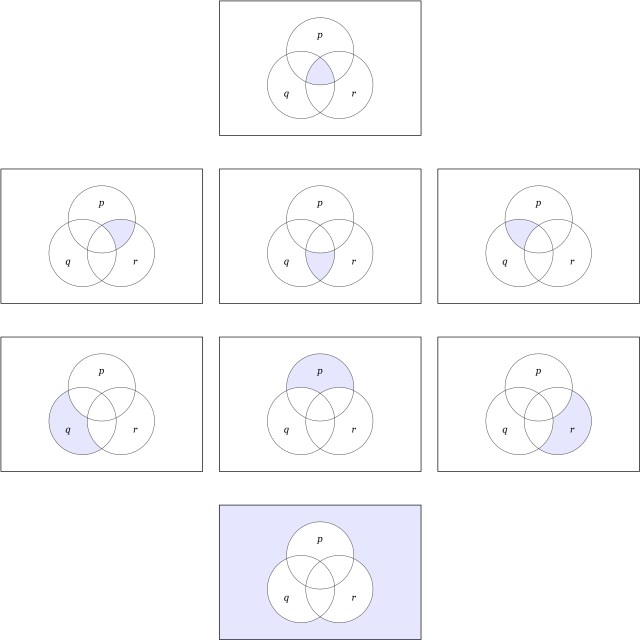
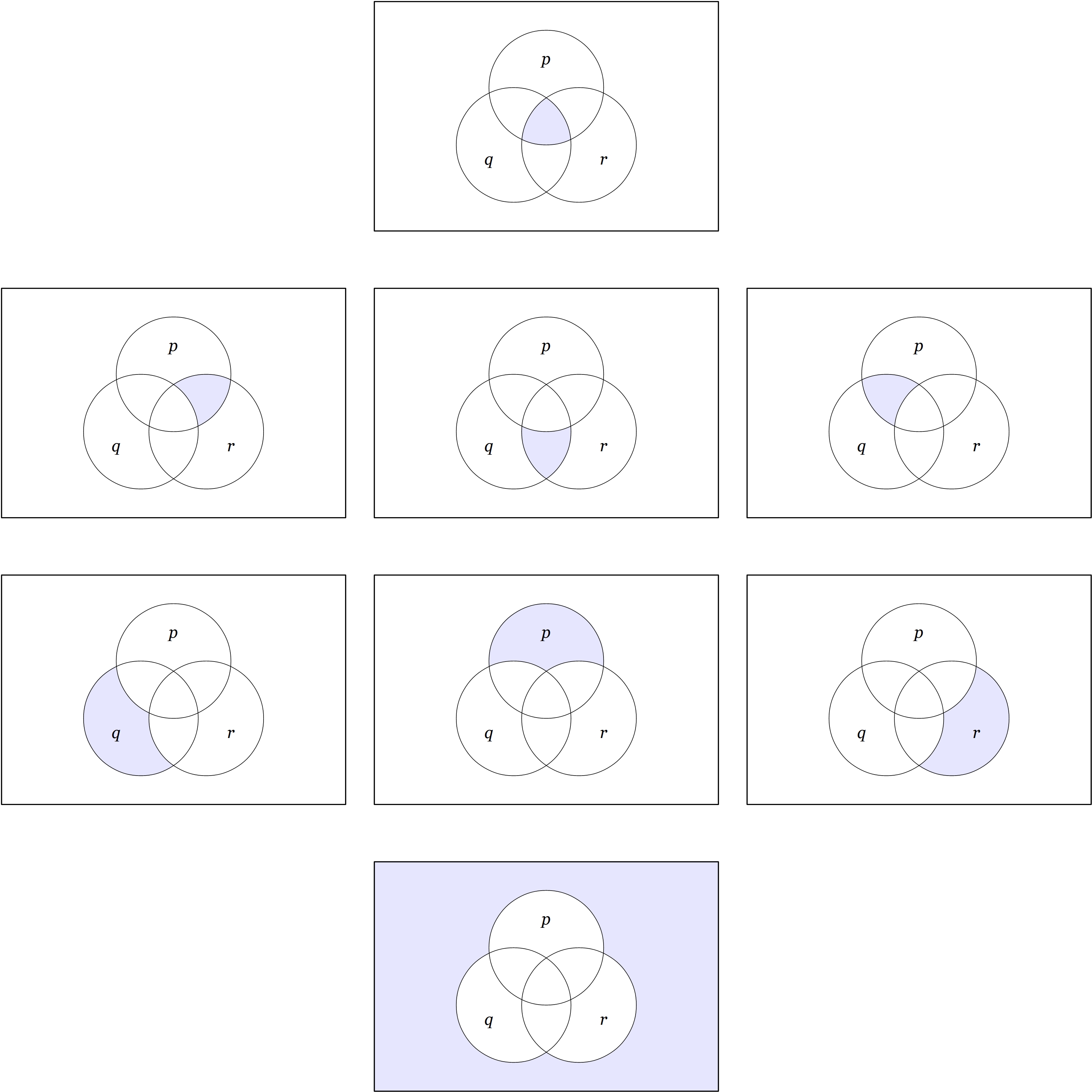
Differential Logic • 18

Tangent and Remainder Maps

If we follow the classical line which singles out linear functions as ideals of simplicity then we may complete the analytic series of the proposition f = pq : X \to \mathbb{B} in the following way.

The next venn diagram shows the differential proposition \mathrm{d}f = \mathrm{d}(pq) : \mathrm{E}X \to \mathbb{B} we get by extracting the linear approximation to the difference map \mathrm{D}f = \mathrm{D}(pq) : \mathrm{E}X \to \mathbb{B} at each cell or point of the universe X.  What results is the logical analogue of what would ordinarily be called the differential of pq but since the adjective differential is being attached to just about everything in sight the alternative name tangent map is commonly used for \mathrm{d}f whenever it’s necessary to single it out.

Tangent Map d(pq) : EX → B
\text{Tangent Map}~ \mathrm{d}(pq) : \mathrm{E}X \to \mathbb{B}

To be clear about what’s being indicated here, it’s a visual way of summarizing the following data.

\begin{array}{rcccccc}  \mathrm{d}(pq)  & = &  p & \cdot & q & \cdot &  \texttt{(} \mathrm{d}p \texttt{,} \mathrm{d}q \texttt{)}  \\[4pt]  & + &  p & \cdot & \texttt{(} q \texttt{)} & \cdot &  \mathrm{d}q  \\[4pt]  & + &  \texttt{(} p \texttt{)} & \cdot & q & \cdot &  \mathrm{d}p  \\[4pt]  & + &  \texttt{(} p \texttt{)} & \cdot & \texttt{(} q \texttt{)} & \cdot & 0  \end{array}

To understand the extended interpretations, that is, the conjunctions of basic and differential features which are being indicated here, it may help to note the following equivalences.

\begin{matrix}  \texttt{(} \mathrm{d}p \texttt{,} \mathrm{d}q \texttt{)}  & = &  \texttt{~} \mathrm{d}p \texttt{~} \texttt{(} \mathrm{d}q \texttt{)}  & + &  \texttt{(} \mathrm{d}p \texttt{)} \texttt{~} \mathrm{d}q \texttt{~}  \\[4pt]  dp  & = &  \texttt{~} \mathrm{d}p \texttt{~} \texttt{~} \mathrm{d}q \texttt{~}  & + &  \texttt{~} \mathrm{d}p \texttt{~} \texttt{(} \mathrm{d}q \texttt{)}  \\[4pt]  \mathrm{d}q  & = &  \texttt{~} \mathrm{d}p \texttt{~} \texttt{~} \mathrm{d}q \texttt{~}  & + &  \texttt{(} \mathrm{d}p \texttt{)} \texttt{~} \mathrm{d}q \texttt{~}  \end{matrix}

Capping the analysis of the proposition pq in terms of succeeding orders of linear propositions, the final venn diagram of the series shows the remainder map \mathrm{r}(pq) : \mathrm{E}X \to \mathbb{B}, which happens to be linear in pairs of variables.

Remainder r(pq) : EX → B
\text{Remainder}~ \mathrm{r}(pq) : \mathrm{E}X \to \mathbb{B}

Reading the arrows off the map produces the following data.

\begin{array}{rcccccc}  \mathrm{r}(pq)  & = & p & \cdot & q & \cdot & \mathrm{d}p ~ \mathrm{d}q  \\[4pt]  & + & p & \cdot & \texttt{(} q \texttt{)} & \cdot & \mathrm{d}p ~ \mathrm{d}q  \\[4pt]  & + & \texttt{(} p \texttt{)} & \cdot & q & \cdot & \mathrm{d}p ~ \mathrm{d}q  \\[4pt]  & + & \texttt{(} p \texttt{)} & \cdot & \texttt{(} q \texttt{)} & \cdot & \mathrm{d}p ~ \mathrm{d}q  \end{array}

In short, \mathrm{r}(pq) is a constant field, having the value \mathrm{d}p~\mathrm{d}q at each cell.

Resources

cc: Academia.eduCyberneticsStructural ModelingSystems Science
cc: Conceptual GraphsLaws of FormMathstodonResearch Gate

Posted in Amphecks, Animata, Boolean Algebra, Boolean Functions, C.S. Peirce, Cactus Graphs, Change, Cybernetics, Differential Calculus, Differential Logic, Discrete Dynamics, Equational Inference, Functional Logic, Gradient Descent, Graph Theory, Inquiry Driven Systems, Logic, Logical Graphs, Mathematics, Minimal Negation Operators, Propositional Calculus, Time, Zeroth Order Logic | Tagged , , , , , , , , , , , , , , , , , , , , , , | 4 Comments

Differential Logic • 17

Enlargement and Difference Maps

Continuing with the example pq : X \to \mathbb{B}, the following venn diagram shows the enlargement or shift map \mathrm{E}(pq) : \mathrm{E}X \to \mathbb{B} in the same style of field picture we drew for the tacit extension \boldsymbol\varepsilon (pq) : \mathrm{E}X \to \mathbb{B}.

Enlargement E(pq) : EX → B
\text{Enlargement}~ \mathrm{E}(pq) : \mathrm{E}X \to \mathbb{B}

\begin{array}{rcccccc}  \mathrm{E}(pq)   & = & p & \cdot & q & \cdot &  \texttt{(} \mathrm{d}p \texttt{)(} \mathrm{d}q \texttt{)}  \\[4pt]  & + & p & \cdot & \texttt{(} q \texttt{)} & \cdot &  \texttt{(} \mathrm{d}p \texttt{)~} \mathrm{d}q \texttt{~}  \\[4pt]  & + & \texttt{(} p \texttt{)} & \cdot & q & \cdot &  \texttt{~} \mathrm{d}p \texttt{~(} \mathrm{d}q \texttt{)}  \\[4pt]  & + & \texttt{(} p \texttt{)} & \cdot & \texttt{(} q \texttt{)} & \cdot &  \texttt{~} \mathrm{d}p \texttt{~~} \mathrm{d}q \texttt{~}  \end{array}

A very important conceptual transition has just occurred here, almost tacitly, as it were.  Generally speaking, having a set of mathematical objects of compatible types, in this case the two differential fields \boldsymbol\varepsilon f and \mathrm{E}f, both of the type \mathrm{E}X \to \mathbb{B}, is very useful, because it allows us to consider those fields as integral mathematical objects which can be operated on and combined in the ways we usually associate with algebras.

In the present case one notices the tacit extension \boldsymbol\varepsilon f and the enlargement \mathrm{E}f are in a sense dual to each other.  The tacit extension \boldsymbol\varepsilon f indicates all the arrows out of the region where f is true and the enlargement \mathrm{E}f indicates all the arrows into the region where f is true.  The only arc they have in common is the no‑change loop \texttt{(} \mathrm{d}p \texttt{)(} \mathrm{d}q \texttt{)} at pq.  If we add the two sets of arcs in mod 2 fashion then the loop of multiplicity 2 zeroes out, leaving the 6 arrows of \mathrm{D}(pq) = \boldsymbol\varepsilon(pq) + \mathrm{E}(pq) shown in the following venn diagram.

Differential D(pq) : EX → B
\text{Difference}~ \mathrm{D}(pq) : \mathrm{E}X \to \mathbb{B}

\begin{array}{rcccccc}  \mathrm{D}(pq)   & = & p & \cdot & q & \cdot &  \texttt{((} \mathrm{d}p \texttt{)(} \mathrm{d}q \texttt{))}  \\[4pt]  & + & p & \cdot & \texttt{(} q \texttt{)} & \cdot &  \texttt{~(} \mathrm{d}p \texttt{)~} \mathrm{d}q \texttt{~~}  \\[4pt]  & + & \texttt{(} p \texttt{)} & \cdot & q & \cdot &  \texttt{~~} \mathrm{d}p \texttt{~(} \mathrm{d}q \texttt{)~}  \\[4pt]  & + & \texttt{(} p \texttt{)} & \cdot & \texttt{(}q \texttt{)} & \cdot &  \texttt{~~} \mathrm{d}p \texttt{~~} \mathrm{d}q \texttt{~~}  \end{array}

Resources

cc: Academia.eduCyberneticsStructural ModelingSystems Science
cc: Conceptual GraphsLaws of FormMathstodonResearch Gate

Posted in Amphecks, Animata, Boolean Algebra, Boolean Functions, C.S. Peirce, Cactus Graphs, Change, Cybernetics, Differential Calculus, Differential Logic, Discrete Dynamics, Equational Inference, Functional Logic, Gradient Descent, Graph Theory, Inquiry Driven Systems, Logic, Logical Graphs, Mathematics, Minimal Negation Operators, Propositional Calculus, Time, Zeroth Order Logic | Tagged , , , , , , , , , , , , , , , , , , , , , , | 4 Comments

Differential Logic • 16

Propositions and Tacit Extensions

Now that we’ve introduced the field picture as an aid to visualizing propositions and their analytic series, a pleasing way to picture the relationship of a proposition f : X \to \mathbb{B} to its enlargement or shift map \mathrm{E}f : \mathrm{E}X \to \mathbb{B} and its difference map \mathrm{D}f : \mathrm{E}X \to \mathbb{B} can now be drawn.

To illustrate the possibilities, let’s return to the differential analysis of the conjunctive proposition f(p, q) = pq and give its development a slightly different twist at the appropriate point.

The proposition pq : X \to \mathbb{B} is shown again in the venn diagram below.  In the field picture it may be seen as a scalar field — analogous to a potential hill in physics but in logic amounting to a potential plateau — where the shaded region indicates an elevation of 1 and the unshaded region indicates an elevation of 0.

Proposition pq : X → B
\text{Proposition}~ pq : X \to \mathbb{B}

Given a proposition f : X \to \mathbb{B}, the tacit extension of f to \mathrm{E}X is denoted \boldsymbol\varepsilon f : \mathrm{E}X \to \mathbb{B} and defined by the equation \boldsymbol\varepsilon f = f, so it’s really just the same proposition residing in a bigger universe.  Tacit extensions formalize the intuitive idea that a function on a given set of variables can be extended to a function on a superset of those variables in such a way that the new function obeys the same constraints on the old variables, with a “don’t care” condition on the new variables.

The tacit extension of the scalar field pq : X \to \mathbb{B} to the differential field \boldsymbol\varepsilon (pq) : \mathrm{E}X \to \mathbb{B} is shown in the following venn diagram.

Tacit Extension ε(pq) : EX → B
\text{Tacit Extension}~ \boldsymbol\varepsilon (pq) : \mathrm{E}X \to \mathbb{B}

\begin{array}{rcccccc}  \boldsymbol\varepsilon (pq)  & = &  p & \cdot & q & \cdot &  \texttt{(} \mathrm{d}p \texttt{)}  \texttt{(} \mathrm{d}q \texttt{)}  \\[4pt]  & + &  p & \cdot & q & \cdot &  \texttt{(} \mathrm{d}p \texttt{)}  \texttt{~} \mathrm{d}q \texttt{~}  \\[4pt]  & + &  p & \cdot & q & \cdot &  \texttt{~} \mathrm{d}p \texttt{~}  \texttt{(} \mathrm{d}q \texttt{)}  \\[4pt]  & + &  p & \cdot & q & \cdot &  \texttt{~} \mathrm{d}p \texttt{~}  \texttt{~} \mathrm{d}q \texttt{~}  \end{array}

Resources

cc: Academia.eduCyberneticsStructural ModelingSystems Science
cc: Conceptual GraphsLaws of FormMathstodonResearch Gate

Posted in Amphecks, Animata, Boolean Algebra, Boolean Functions, C.S. Peirce, Cactus Graphs, Change, Cybernetics, Differential Calculus, Differential Logic, Discrete Dynamics, Equational Inference, Functional Logic, Gradient Descent, Graph Theory, Inquiry Driven Systems, Logic, Logical Graphs, Mathematics, Minimal Negation Operators, Propositional Calculus, Time, Zeroth Order Logic | Tagged , , , , , , , , , , , , , , , , , , , , , , | 4 Comments

Differential Logic • 15

Differential Fields

The structure of a differential field may be described as follows.  With each point of X there is associated an object of the following type:  a proposition about changes in X, that is, a proposition g : \mathrm{d}X \to \mathbb{B}.  In that frame of reference, if {X^\bullet} is the universe generated by the set of coordinate propositions \{ p, q \} then \mathrm{d}X^\bullet is the differential universe generated by the set of differential propositions \{ \mathrm{d}p, \mathrm{d}q \}.  The differential propositions \mathrm{d}p and \mathrm{d}q may thus be interpreted as indicating ``\text{change in}~ p" and ``\text{change in}~ q", respectively.

A differential operator \mathrm{W}, of the first order type we are currently considering, takes a proposition f : X \to \mathbb{B} and gives back a differential proposition \mathrm{W}f : \mathrm{E}X \to \mathbb{B}.  In the field view of the scene, we see the proposition f : X \to \mathbb{B} as a scalar field and we see the differential proposition \mathrm{W}f : \mathrm{E}X \to \mathbb{B} as a vector field, specifically, a field of propositions about contemplated changes in X.

The field of changes produced by \mathrm{E} on pq is shown in the following venn diagram.

Enlargement E(pq) : EX → B
\text{Enlargement}~ \mathrm{E}(pq) : \mathrm{E}X \to \mathbb{B}

\begin{array}{rcccccc}  \mathrm{E}(pq)   & = & p & \cdot & q & \cdot &  \texttt{(} \mathrm{d}p \texttt{)(} \mathrm{d}q \texttt{)}  \\[4pt]  & + & p & \cdot & \texttt{(} q \texttt{)} & \cdot &  \texttt{(} \mathrm{d}p \texttt{)~} \mathrm{d}q \texttt{~}  \\[4pt]  & + & \texttt{(} p \texttt{)} & \cdot & q & \cdot &  \texttt{~} \mathrm{d}p \texttt{~(} \mathrm{d}q \texttt{)}  \\[4pt]  & + & \texttt{(} p \texttt{)} & \cdot & \texttt{(} q \texttt{)} & \cdot &  \texttt{~} \mathrm{d}p \texttt{~~} \mathrm{d}q \texttt{~}  \end{array}

The differential field \mathrm{E}(pq) specifies the changes which need to be made from each point of X in order to reach one of the models of the proposition pq, that is, in order to satisfy the proposition pq.

The field of changes produced by \mathrm{D} on pq is shown in the following venn diagram.

Differential D(pq) : EX → B
\text{Difference}~ \mathrm{D}(pq) : \mathrm{E}X \to \mathbb{B}

\begin{array}{rcccccc}  \mathrm{D}(pq)   & = & p & \cdot & q & \cdot &  \texttt{((} \mathrm{d}p \texttt{)(} \mathrm{d}q \texttt{))}  \\[4pt]  & + & p & \cdot & \texttt{(} q \texttt{)} & \cdot &  \texttt{~(} \mathrm{d}p \texttt{)~} \mathrm{d}q \texttt{~~}  \\[4pt]  & + & \texttt{(} p \texttt{)} & \cdot & q & \cdot &  \texttt{~~} \mathrm{d}p \texttt{~(} \mathrm{d}q \texttt{)~}  \\[4pt]  & + & \texttt{(} p \texttt{)} & \cdot & \texttt{(}q \texttt{)} & \cdot &  \texttt{~~} \mathrm{d}p \texttt{~~} \mathrm{d}q \texttt{~~}  \end{array}

The differential field \mathrm{D}(pq) specifies the changes which need to be made from each point of X in order to feel a change in the felt value of the field pq.

Resources

cc: Academia.eduCyberneticsStructural ModelingSystems Science
cc: Conceptual GraphsLaws of FormMathstodonResearch Gate

Posted in Amphecks, Animata, Boolean Algebra, Boolean Functions, C.S. Peirce, Cactus Graphs, Change, Cybernetics, Differential Calculus, Differential Logic, Discrete Dynamics, Equational Inference, Functional Logic, Gradient Descent, Graph Theory, Inquiry Driven Systems, Logic, Logical Graphs, Mathematics, Minimal Negation Operators, Propositional Calculus, Time, Zeroth Order Logic | Tagged , , , , , , , , , , , , , , , , , , , , , , | 4 Comments

Differential Logic • 14

Field Picture

Let us summarize the outlook on differential logic we’ve reached so far.  We’ve been considering a class of operators on universes of discourse, each of which takes us from considering one universe of discourse X^\bullet to considering a larger universe of discourse \mathrm{E}X^\bullet.  An operator \mathrm{W} of that general type, namely, \mathrm{W} : X^\bullet \to \mathrm{E}X^\bullet, acts on each proposition f : X \to \mathbb{B} of the source universe {X^\bullet} to produce a proposition \mathrm{W}f : \mathrm{E}X \to \mathbb{B} of the target universe \mathrm{E}X^\bullet.

The operators we’ve examined so far are the enlargement or shift operator \mathrm{E} : X^\bullet \to \mathrm{E}X^\bullet and the difference operator \mathrm{D} : X^\bullet \to \mathrm{E}X^\bullet.  The operators \mathrm{E} and \mathrm{D} act on propositions in X^\bullet, that is, propositions of the form f : X \to \mathbb{B} which amount to propositions about the subject matter of X, and they produce propositions of the form \mathrm{E}f, \mathrm{D}f : \mathrm{E}X \to \mathbb{B} which amount to propositions about specified collections of changes conceivably occurring in X.

At this point we find ourselves in need of visual representations, suitable arrays of concrete pictures to anchor our more earthy intuitions and help us keep our wits about us as we venture into ever more rarefied airs of abstraction.

One good picture comes to us by way of the field concept.  Given a space X, a field of a specified type Y over X is formed by associating with each point of X an object of type Y.  If that sounds like the same thing as a function from X to the space of things of type Y — it is nothing but — and yet it does seem helpful to vary the mental images and take advantage of the figures of speech most naturally springing to mind under the emblem of the field idea.

In the field picture a proposition f : X \to \mathbb{B} becomes a scalar field, that is, a field of values in \mathbb{B}.

For example, consider the logical conjunction pq : X \to \mathbb{B} shown in the following venn diagram.

Conjunction pq : X → B
\text{Conjunction}~ pq : X \to \mathbb{B}

Each of the operators \mathrm{E}, \mathrm{D} : X^\bullet \to \mathrm{E}X^\bullet takes us from considering propositions f : X \to \mathbb{B}, here viewed as scalar fields over X, to considering the corresponding differential fields over X, analogous to what in real analysis are usually called vector fields over X.

Resources

cc: Academia.eduCyberneticsStructural ModelingSystems Science
cc: Conceptual GraphsLaws of FormMathstodonResearch Gate

Posted in Amphecks, Animata, Boolean Algebra, Boolean Functions, C.S. Peirce, Cactus Graphs, Change, Cybernetics, Differential Calculus, Differential Logic, Discrete Dynamics, Equational Inference, Functional Logic, Gradient Descent, Graph Theory, Inquiry Driven Systems, Logic, Logical Graphs, Mathematics, Minimal Negation Operators, Propositional Calculus, Time, Zeroth Order Logic | Tagged , , , , , , , , , , , , , , , , , , , , , , | 4 Comments

Differential Logic • 13

Transforms Expanded over Ordinary and Differential Variables

Two views of how the difference operator \mathrm{D} acts on the set of sixteen functions f : \mathbb{B} \times \mathbb{B} \to \mathbb{B} are shown below.  Table A5 shows the expansion of \mathrm{D}f over the set \{ p, q \} of ordinary variables and Table A6 shows the expansion of \mathrm{D}f over the set \{ \mathrm{d}p, \mathrm{d}q \} of differential variables.

Difference Map Expanded over Ordinary Variables

\text{Table A5.}~~ \mathrm{D}f ~\text{Expanded over Ordinary Variables}~ \{ p, q \}

Df Expanded over Ordinary Variables {p, q}

Difference Map Expanded over Differential Variables

\text{Table A6.}~~ \mathrm{D}f ~\text{Expanded over Differential Variables}~ \{ \mathrm{d}p, \mathrm{d}q \}

Df Expanded over Differential Variables {dp, dq}

Resources

cc: Academia.eduCyberneticsStructural ModelingSystems Science
cc: Conceptual GraphsLaws of FormMathstodonResearch Gate

Posted in Amphecks, Animata, Boolean Algebra, Boolean Functions, C.S. Peirce, Cactus Graphs, Change, Cybernetics, Differential Calculus, Differential Logic, Discrete Dynamics, Equational Inference, Functional Logic, Gradient Descent, Graph Theory, Inquiry Driven Systems, Logic, Logical Graphs, Mathematics, Minimal Negation Operators, Propositional Calculus, Time, Zeroth Order Logic | Tagged , , , , , , , , , , , , , , , , , , , , , , | 4 Comments

Differential Logic • 12

Transforms Expanded over Ordinary and Differential Variables

A first view of how the shift operator \mathrm{E} acts on the set of sixteen functions f : \mathbb{B} \times \mathbb{B} \to \mathbb{B} was provided by Table A3 in the previous post, expanding the expressions of \mathrm{E}f over the set \{ p, q \} of ordinary variables.

A complementary view of the same material is provided by Table 4 below, this time expanding the expressions of \mathrm{E}f over the set \{ \mathrm{d}p, \mathrm{d}q \} of differential variables.

Enlargement Map Expanded over Differential Variables

\text{Table A4.}~~ \mathrm{E}f ~\text{Expanded over Differential Variables}~ \{ \mathrm{d}p, \mathrm{d}q \}

Ef Expanded over Differential Variables {dp, dq}

Resources

cc: Academia.eduCyberneticsStructural ModelingSystems Science
cc: Conceptual GraphsLaws of FormMathstodonResearch Gate

Posted in Amphecks, Animata, Boolean Algebra, Boolean Functions, C.S. Peirce, Cactus Graphs, Change, Cybernetics, Differential Calculus, Differential Logic, Discrete Dynamics, Equational Inference, Functional Logic, Gradient Descent, Graph Theory, Inquiry Driven Systems, Logic, Logical Graphs, Mathematics, Minimal Negation Operators, Propositional Calculus, Time, Zeroth Order Logic | Tagged , , , , , , , , , , , , , , , , , , , , , , | 4 Comments

Differential Logic • 11

Transforms Expanded over Ordinary and Differential Variables

As promised last time, in the next several posts we’ll extend our scope to the full set of boolean functions on two variables and examine how the differential operators \mathrm{E} and \mathrm{D} act on that set.  There being some advantage to singling out the enlargement or shift operator \mathrm{E} in its own right, we’ll begin by computing \mathrm{E}f for each of the functions f : \mathbb{B} \times \mathbb{B} \to \mathbb{B}.

Enlargement Map Expanded over Ordinary Variables

We first encountered the shift operator when we imagined ourselves being in a state described by the truth of a certain proposition and contemplated the value of that proposition in various other states, as determined by a collection of differential propositions describing the steps we might take to change our state.

Restated in terms of our initial example, we imagined ourselves being in a state described by the truth of the proposition pq and contemplated the value of that proposition in various other states, as determined by the differential propositions \mathrm{d}p and \mathrm{d}q describing the steps we might take to change our state.

Those thoughts led us from the boolean function of two variables f_{8}(p, q) = pq to the boolean function of four variables \mathrm{E}f_{8}(p, q, \mathrm{d}p, \mathrm{d}q) = \texttt{(} p \texttt{,} \mathrm{d}p \texttt{)(} q \texttt{,} \mathrm{d}q \texttt{)}, as shown in the entry for f_{8} in the first three columns of Table A3.

\text{Table A3.}~~ \mathrm{E}f ~\text{Expanded over Ordinary Variables}~ \{ p, q \}

Ef Expanded over Ordinary Variables {p, q}

Let’s catch a breath here and discuss the full Table next time.

Resources

cc: Academia.eduCyberneticsStructural ModelingSystems Science
cc: Conceptual GraphsLaws of FormMathstodonResearch Gate

Posted in Amphecks, Animata, Boolean Algebra, Boolean Functions, C.S. Peirce, Cactus Graphs, Change, Cybernetics, Differential Calculus, Differential Logic, Discrete Dynamics, Equational Inference, Functional Logic, Gradient Descent, Graph Theory, Inquiry Driven Systems, Logic, Logical Graphs, Mathematics, Minimal Negation Operators, Propositional Calculus, Time, Zeroth Order Logic | Tagged , , , , , , , , , , , , , , , , , , , , , , | 4 Comments

Differential Logic • 10

Propositional Forms on Two Variables

Tables A1 and A2 showed two ways of organizing the sixteen boolean functions or propositional forms on two variables, as expressed in several notations.  In future discussions the two Tables will be described as the Index Order and the Orbit Order of propositions, respectively, “orbits” being the usual term in mathematics for similarity classes under a group action.  For ease of comparison, here are fresh copies of both Tables on the same page.

\text{Table A1. Propositional Forms on Two Variables (Index Order)}

Table A1. Propositional Forms on Two Variables

\text{Table A2. Propositional Forms on Two Variables (Orbit Order)}

Table A2. Propositional Forms on Two Variables

Recalling the discussion up to this point, we took as our first example the boolean function f_{8}(p, q) = pq corresponding to the logical conjunction p \land q and examined how the differential operators \mathrm{E} and \mathrm{D} act on f_{8}.  Each operator takes the boolean function of two variables f_{8}(p, q) and gives back a boolean function of four variables, \mathrm{E}f_{8}(p, q, \mathrm{d}p, \mathrm{d}q) and \mathrm{D}f_{8}(p, q, \mathrm{d}p, \mathrm{d}q), respectively.

In the next several posts we’ll extend our scope to the full set of boolean functions on two variables and examine how the differential operators \mathrm{E} and \mathrm{D} act on that set.  There being some advantage to singling out the enlargement or shift operator \mathrm{E} in its own right, we’ll begin by computing \mathrm{E}f for each function f in the above Tables.

Resources

cc: Academia.eduCyberneticsStructural ModelingSystems Science
cc: Conceptual GraphsLaws of FormMathstodonResearch Gate

Posted in Amphecks, Animata, Boolean Algebra, Boolean Functions, C.S. Peirce, Cactus Graphs, Change, Cybernetics, Differential Calculus, Differential Logic, Discrete Dynamics, Equational Inference, Functional Logic, Gradient Descent, Graph Theory, Inquiry Driven Systems, Logic, Logical Graphs, Mathematics, Minimal Negation Operators, Propositional Calculus, Time, Zeroth Order Logic | Tagged , , , , , , , , , , , , , , , , , , , , , , | 4 Comments

Differential Logic • 9

Propositional Forms on Two Variables

Table A2 arranges the propositional forms on two variables according to another plan, sorting propositions with similar shapes into seven subclasses.  Thereby hangs many a tale, to be told in time.

\text{Table A2. Propositional Forms on Two Variables}

Table A2. Propositional Forms on Two Variables

Resources

cc: Academia.eduCyberneticsStructural ModelingSystems Science
cc: Conceptual GraphsLaws of FormMathstodonResearch Gate

Posted in Amphecks, Animata, Boolean Algebra, Boolean Functions, C.S. Peirce, Cactus Graphs, Change, Cybernetics, Differential Calculus, Differential Logic, Discrete Dynamics, Equational Inference, Functional Logic, Gradient Descent, Graph Theory, Inquiry Driven Systems, Logic, Logical Graphs, Mathematics, Minimal Negation Operators, Propositional Calculus, Time, Zeroth Order Logic | Tagged , , , , , , , , , , , , , , , , , , , , , , | 4 Comments