
Re: Information = Comprehension × Extension • Comment 2
Returning to Peirce’s example of inductive inference, let’s try to get a clearer picture of why he connects it with disjunctive terms and indicial signs. At this point in time I can’t say I’m entirely satisfied with my understanding of the relationship between disjunctive terms, indicial signs, and inductive inferences as presented by Peirce in his early accounts. What follows is just one of the simplest and least question‑begging attempts at rational reconstruction I’ve been able to devise.
Figure 2 shows the implication ordering of logical terms in the form of a lattice diagram.
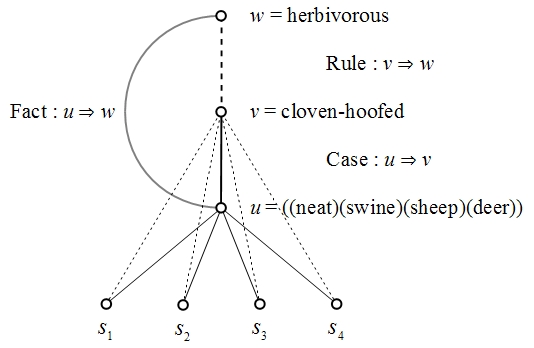

Figure 4 shows an inductive step of inquiry, as taken on the cue of an indicial sign.
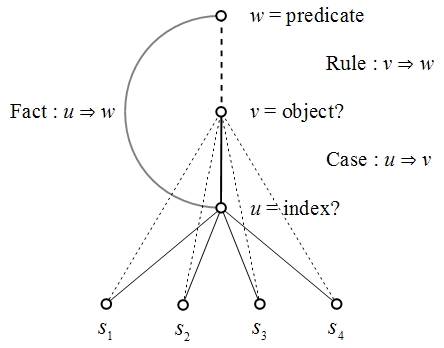

If there is any distinguishing feature shared by all the instances under the disjunctive description “neat, swine, sheep, deer” then sign users may take that feature as a predictor of being herbivorous, precisely because all the things under the disjunctive description are herbivorous. But everything under the disjunctive description is cloven‑hoofed, so the cases under the disjunctive description serve to indicate, support, or witness the utility of the induction from cloven‑hoofed to herbivorous.
Reference
- Peirce, C.S. (1866), “The Logic of Science, or, Induction and Hypothesis”, Lowell Lectures of 1866, pp. 357–504 in Writings of Charles S. Peirce : A Chronological Edition, Volume 1, 1857–1866, Peirce Edition Project, Indiana University Press, Bloomington, IN, 1982.
Resources
- This Blog • Survey of Pragmatic Semiotic Information
- OEIS Wiki • Information = Comprehension × Extension
- C.S. Peirce • Upon Logical Comprehension and Extension
cc: Conceptual Graphs • Cybernetics • Structural Modeling • Systems Science
cc: FB | Inquiry Into Inquiry • Laws of Form • Mathstodon • Academia.edu
cc: Research Gate


 Inquiry Into Inquiry
Pingback: Survey of Pragmatic Semiotic Information • 8 | Inquiry Into Inquiry
Pingback: Survey of Pragmatic Semiotic Information • 8 | Inquiry Into Inquiry
Pingback: Survey of Pragmatic Semiotic Information • 9 | Inquiry Into Inquiry
Pingback: Survey of Pragmatic Semiotic Information • 9 | Systems Community of Inquiry