

Re: Peirce List • Jerry Chandler
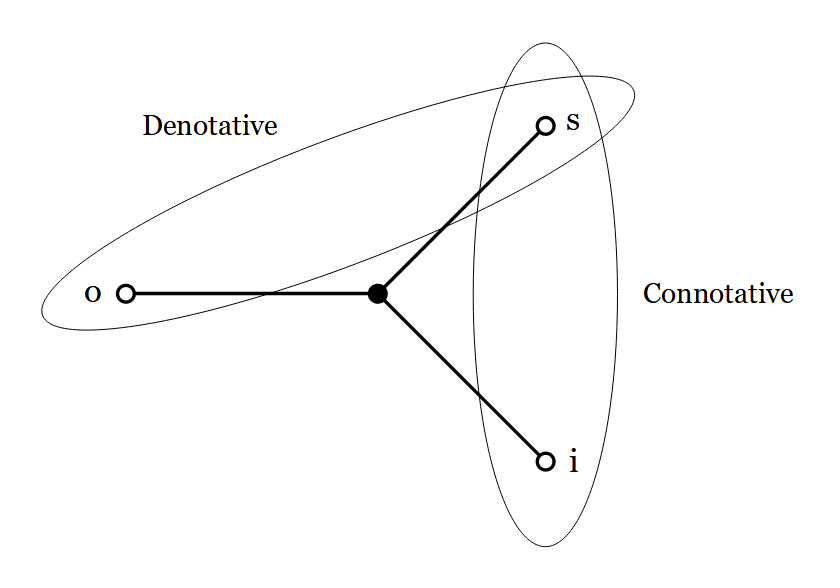
An elementary sign relation is an ordered triple 


But what is the significance of that ordering?
In any presentation of subject matter we have to distinguish the natural order of things from the order of consideration or presentation in which things are taken up on a given occasion.
The natural order of things comes to light through the discovery of invariants over a variety of presentations and representations. That type of order tends to take a considerable effort to reveal.
The order of consideration or presentation is often more arbitrary, making some aspects of the subject matter more salient than others depending on the paradigm or perspective one has chosen.
In the case of sign relations, the order in which we take up the domains 

References
- Awbrey, S.M., and Awbrey, J.L. (2001), “Conceptual Barriers to Creating Integrative Universities”, Organization : The Interdisciplinary Journal of Organization, Theory, and Society 8(2), Sage Publications, London, UK, 269–284. Abstract. Online.
- Awbrey, S.M., and Awbrey, J.L. (September 1999), “Organizations of Learning or Learning Organizations : The Challenge of Creating Integrative Universities for the Next Century”, Second International Conference of the Journal ‘Organization’, Re‑Organizing Knowledge, Trans‑Forming Institutions : Knowing, Knowledge, and the University in the 21st Century, University of Massachusetts, Amherst, MA. Online.
- Awbrey, J.L., and Awbrey, S.M. (1995), “Interpretation as Action : The Risk of Inquiry”, Inquiry : Critical Thinking Across the Disciplines 15(1), 40–52. Archive. Journal. Online (doc) (pdf).
cc: Conceptual Graphs • Cybernetics • Structural Modeling • Systems Science
cc: FB | Semeiotics • Mathstodon • Laws of Form • Academia.edu

 Inquiry Into Inquiry
Pingback: Survey of Semiotics, Semiosis, Sign Relations • 4 | Inquiry Into Inquiry
Pingback: Survey of Semiotics, Semiosis, Sign Relations • 5 | Inquiry Into Inquiry
Pingback: Survey of Semiotics, Semiosis, Sign Relations • 6 | Inquiry Into Inquiry
Pingback: Survey of Semiotics, Semiosis, Sign Relations • 6 | Systems Community of Inquiry