A differential propositional calculus is a propositional calculus extended by a set of terms for describing aspects of change and difference, for example, processes taking place in a universe of discourse or transformations mapping a source universe to a target universe.
Casual Introduction
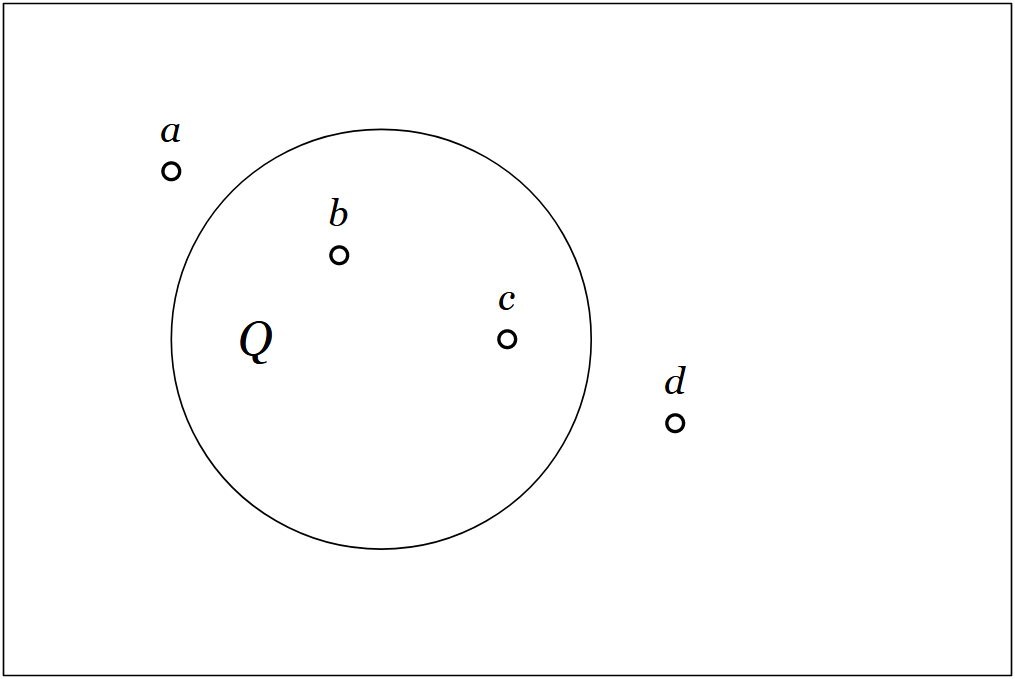
Consider the situation represented by the venn diagram in Figure 1.
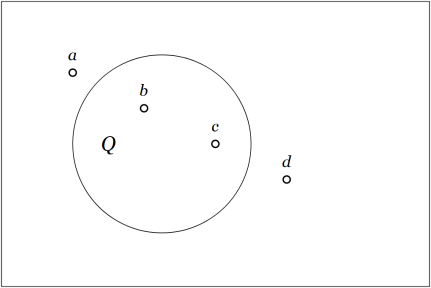

The area of the rectangle represents a universe of discourse,  The universe under discussion may be a population of individuals having various additional properties or it may be a collection of locations occupied by various individuals. The area of the “circle” represents the individuals having the property
  or the locations in the corresponding region
  Four individuals,
  are singled out by name. It happens that
  and
and  currently reside in region
  while
while  and
and  do not.
Now consider the situation represented by the venn diagram in Figure 2.
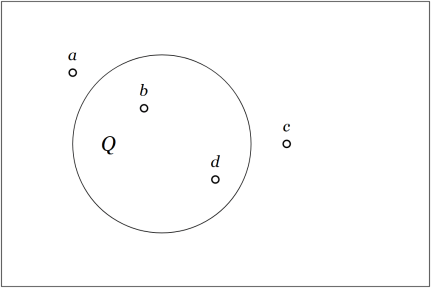

Figure 2 differs from Figure 1 solely in the circumstance that the object is outside the region while the object is inside the region So far, nothing says our encountering these Figures in this order is other than purely accidental but if we interpret this sequence of frames as a “moving picture” representation of their natural order in a temporal process then it would be natural to suppose and have remained as they were with regard to the quality while and have changed their standings in that respect. In particular, has moved from the region where is true to the region where is false while has moved from the region where is false to the region where is true.
Figure 3 returns to the situation in Figure 1, but this time interpolates a new quality specifically tailored to account for the relation between Figure 1 and Figure 2.
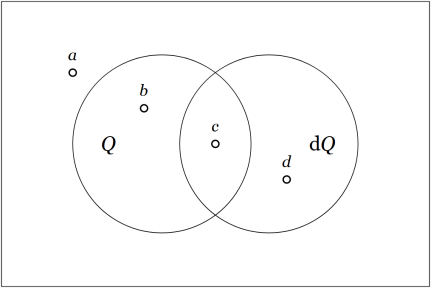

This new quality,  is an example of a differential quality, since its absence or presence qualifies the absence or presence of change occurring in another quality. As with any other quality, it is represented in the venn diagram by means of a “circle” distinguishing two halves of the universe of discourse, in this case, the portions of
  outside and inside the region
Figure 1 represents a universe of discourse,  together with a basis of discussion,
  for expressing propositions about the contents of that universe. Once the quality is given a name, say, the symbol
  we have the basis for a formal language specifically cut out for discussing in terms of
  This language is more formally known as the propositional calculus with alphabet
In the context marked by and  there are just four distinct pieces of information which can be expressed in the corresponding propositional calculus, namely, the constant proposition
  the negative proposition
  the positive proposition
  and the constant proposition
For example, referring to the points in Figure 1, the constant proposition  holds of no points, the negative proposition
  holds of and
  the positive proposition holds of and
  and the constant proposition
  holds of all points in the sample.
Figure 3 extends the basis of description for the space to a set of two qualities  and the corresponding terms of description to an alphabet of two symbols
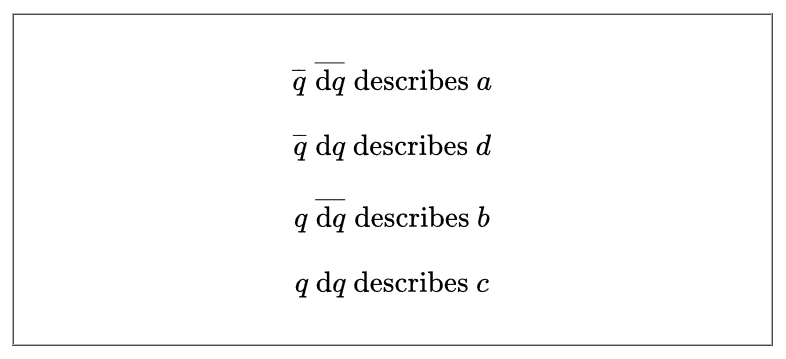
Any propositional calculus over two basic propositions allows for the expression of sixteen propositions all together. Salient among those propositions in the present setting are the four which single out the individual sample points at the initial moment of observation. Table 4 lists the initial state descriptions, using overlines to express logical negations.


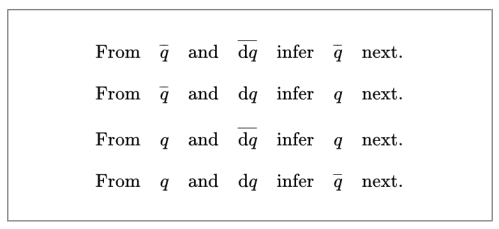
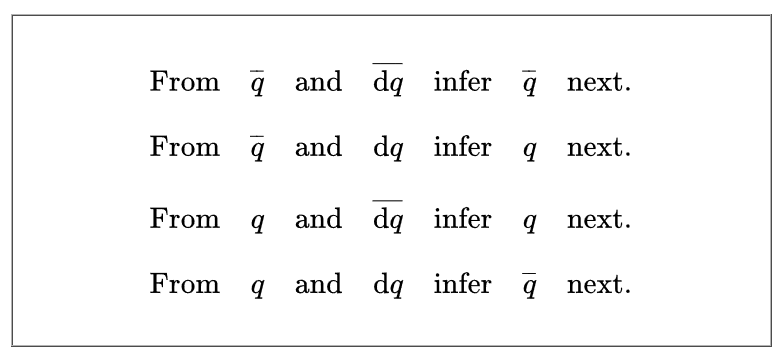
Table 5 shows the rules of inference responsible for giving the differential quality  its meaning in practice.

Resources
cc: Cybernetics • Ontolog Forum • Peirce List • Structural Modeling • Systems Science




 Inquiry Into Inquiry
Pingback: Survey of Differential Logic • 3 | Inquiry Into Inquiry
Pingback: Survey of Differential Logic • 4 | Inquiry Into Inquiry
Pingback: Survey of Differential Logic • 5 | Inquiry Into Inquiry
Pingback: Survey of Differential Logic • 6 | Inquiry Into Inquiry