Cactus Language • Preliminaries 14

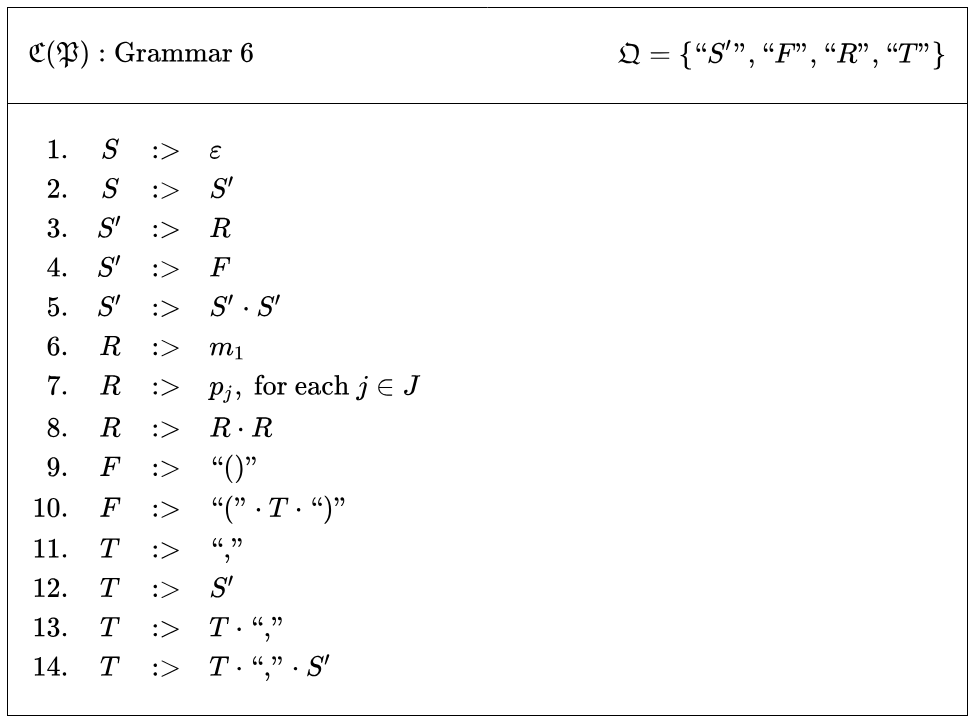
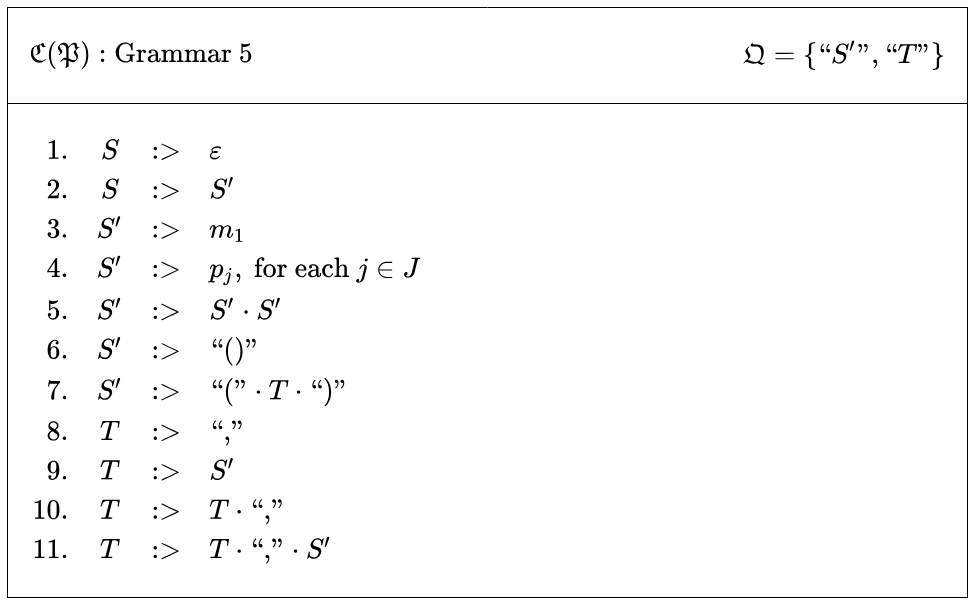
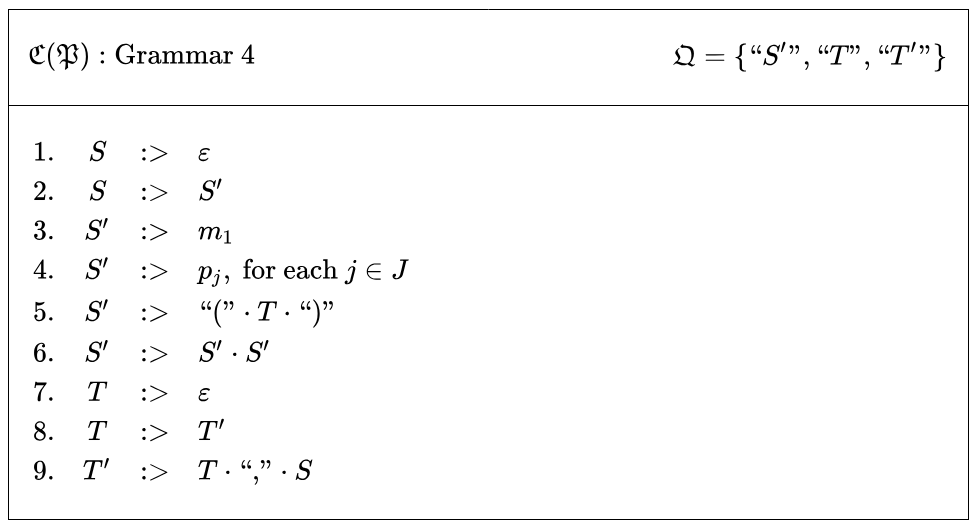
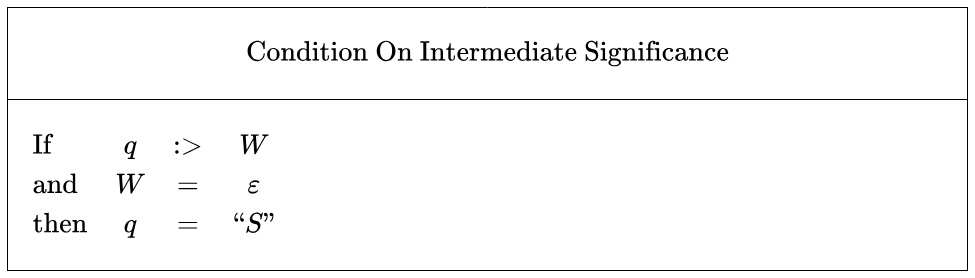
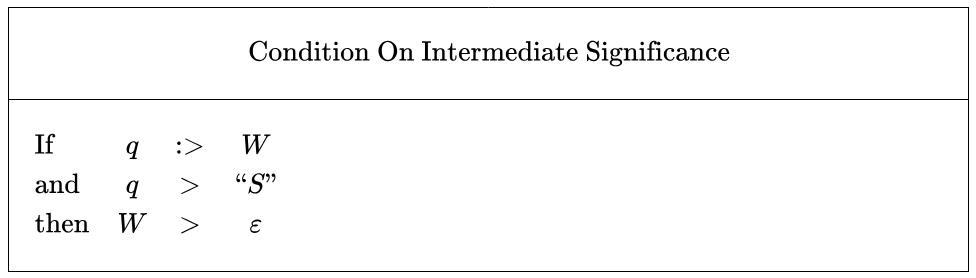
A notation of the form S :> T is introduced to indicate a category of grammatical relationships whose sense is suggested by any of the following readings.

\begin{array}{l}  S ~\mathrm{covers}~ T  \\[2pt]  S ~\mathrm{governs}~ T  \\[2pt]  S ~\mathrm{rules}~ T  \\[2pt]  S ~\mathrm{subsumes}~ T  \\[2pt]  S ~\mathrm{types~over}~ T  \end{array}

The form S :> T plays a number of roles in the description of formal languages by means of formal grammars, flexible enough to be read in the following variety of senses.

Individual
The named or quoted string T is being typed as a sentence S of the language \mathfrak{L}.
Extensional
Each member of the set T also belongs to the set S of sentences in the language \mathfrak{L}.
Intensional
The quality of being T entails the quality S of being a sentence in the language \mathfrak{L}.

Resources

cc: Academia.edu • BlueSky • Laws of FormMathstodonResearch Gate
cc: Conceptual GraphsCyberneticsStructural ModelingSystems Science

Posted in Automata, Boolean Algebra, Boolean Functions, C.S. Peirce, Cactus Graphs, Differential Logic, Equational Inference, Formal Grammars, Formal Languages, Graph Theory, Logic, Logical Graphs, Mathematics, Minimal Negation Operators, Painted Cacti, Propositional Calculus, Visualization | Tagged , , , , , , , , , , , , , , , , | 2 Comments

Cactus Language • Preliminaries 13

Consider what effects that might conceivably
have practical bearings you conceive the
objects of your conception to have.  Then,
your conception of those effects is the
whole of your conception of the object.

Charles S. Peirce • Issues of Pragmaticism

We have before us what appears to be a maximally concise description of our subject matter.

The painted cactus language with paints in the set \mathfrak{P} = \{ p_j : j \in J \} is the formal language \mathfrak{L} = \mathfrak{C} (\mathfrak{P}) \subseteq \mathfrak{A}^* = (\mathfrak{M} \cup \mathfrak{P})^* defined as follows.

\begin{array}{ll}  \text{PC 1.} & \text{The blank symbol}~ m_1 ~\text{is a sentence.}  \\  \text{PC 2.} & \text{The paint}~ p_j ~\text{is a sentence for each}~ j ~\text{in}~ J.  \\  \text{PC 3.} & \mathrm{Conc}^0 ~\text{and}~ \mathrm{Surc}^0 ~\text{are sentences.}  \\  \text{PC 4.} & \text{For each positive integer}~ n,  \\  & \text{if}~ s_1, \ldots, s_n ~\text{are sentences}  \\  & \text{then}~ \mathrm{Conc}_{k=1}^n s_k ~\text{is a sentence}  \\  & \text{and}~ \mathrm{Surc}_{k=1}^n s_k ~\text{is a sentence.}  \end{array}

Here we encounter a problem.  The very conciseness of that description presents an obstacle to understanding, glossing over infinities and divinities of detail which must be comprehended in effectively finite form, especially if we have in mind developing a fully computational parser.

A start in that direction, taking steps toward an effective description of cactus languages, a finitary conception of their membership conditions, and a bounded characterization of a typical sentence of that form, can be made by recasting the above description of cactus expressions into the pattern of what is called, more or less roughly, a formal grammar.

Resources

cc: Academia.edu • BlueSky • Laws of FormMathstodonResearch Gate
cc: Conceptual GraphsCyberneticsStructural ModelingSystems Science

Posted in Automata, Boolean Algebra, Boolean Functions, C.S. Peirce, Cactus Graphs, Differential Logic, Equational Inference, Formal Grammars, Formal Languages, Graph Theory, Logic, Logical Graphs, Mathematics, Minimal Negation Operators, Painted Cacti, Propositional Calculus, Visualization | Tagged , , , , , , , , , , , , , , , , | 2 Comments

Cactus Language • Preliminaries 12

We are engaged in teasing out the consequences of the following description of our subject.

The painted cactus language with paints in the set \mathfrak{P} = \{ p_j : j \in J \} is the formal language \mathfrak{L} = \mathfrak{C} (\mathfrak{P}) \subseteq \mathfrak{A}^* = (\mathfrak{M} \cup \mathfrak{P})^* defined as follows.

\begin{array}{ll}  \text{PC 1.} & \text{The blank symbol}~ m_1 ~\text{is a sentence.}  \\  \text{PC 2.} & \text{The paint}~ p_j ~\text{is a sentence for each}~ j ~\text{in}~ J.  \\  \text{PC 3.} & \mathrm{Conc}^0 ~\text{and}~ \mathrm{Surc}^0 ~\text{are sentences.}  \\  \text{PC 4.} & \text{For each positive integer}~ n,  \\  & \text{if}~ s_1, \ldots, s_n ~\text{are sentences}  \\  & \text{then}~ \mathrm{Conc}_{k=1}^n s_k ~\text{is a sentence}  \\  & \text{and}~ \mathrm{Surc}_{k=1}^n s_k ~\text{is a sentence.}  \end{array}

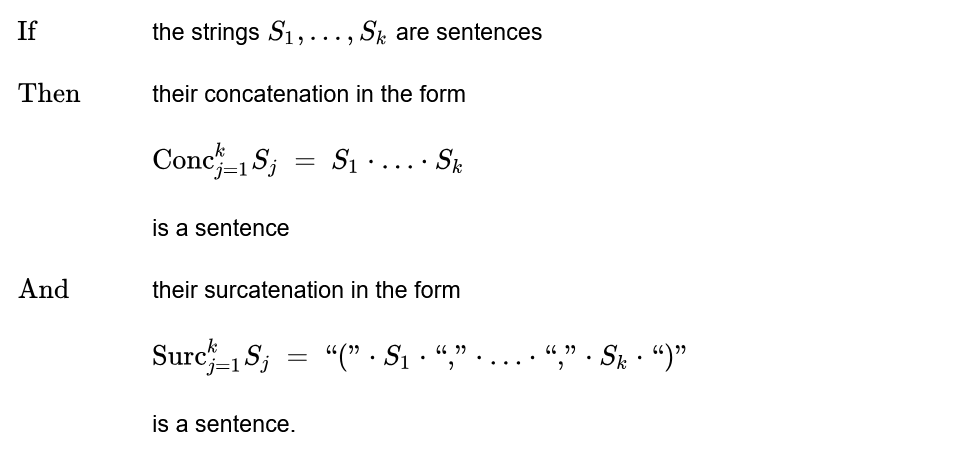
Only one thing remains to cast that description of cactus language into a commonly acceptable form.  As presently formulated, the principle PC 4 appears to be attempting to define an infinite number of new concepts all in a single step, at least, it appears to invoke the indefinitely long sequences of operators \mathrm{Conc}^n and \mathrm{Surc}^n for all n > 0.

As a general rule one prefers to work with effectively finite descriptions of conceptual objects.  That means restricting each description to a finite number of schematic principles, each of which involves a finite number of schematic effects.  In that way we hope to arrive at a finite number of schemata explicitly relating conditions to results.

Resources

cc: Academia.edu • BlueSky • Laws of FormMathstodonResearch Gate
cc: Conceptual GraphsCyberneticsStructural ModelingSystems Science

Posted in Automata, Boolean Algebra, Boolean Functions, C.S. Peirce, Cactus Graphs, Differential Logic, Equational Inference, Formal Grammars, Formal Languages, Graph Theory, Logic, Logical Graphs, Mathematics, Minimal Negation Operators, Painted Cacti, Propositional Calculus, Visualization | Tagged , , , , , , , , , , , , , , , , | 2 Comments

Cactus Language • Preliminaries 11

Given the idea of a Parce on \mathfrak{P} as a member of the cactus language \mathfrak{C}(\mathfrak{P}) a number of frequently occurring sublanguages and commonly invoked operations on their expressions can now be given succinct definition.

A bare Parce, a bit loosely referred to as a bare cactus expression, is a Parce on the empty palette \mathfrak{P} = \varnothing.  A bare Parce is a sentence in the bare cactus language, variously notated as follows.

\mathfrak{C}^0 = \mathfrak{C} (\varnothing) = \mathrm{Parce}^0 = \mathrm{Parce}(\varnothing)

That set of strings, regarded as a formal language in its own right, is a sublanguage of every cactus language \mathfrak{C}(\mathfrak{P}).  A bare cactus expression is commonly encountered in practice when one has occasion to start with an arbitrary Parce and then finds reason to delete or erase all its paints.

Resources

cc: Academia.edu • BlueSky • Laws of FormMathstodonResearch Gate
cc: Conceptual GraphsCyberneticsStructural ModelingSystems Science

Posted in Automata, Boolean Algebra, Boolean Functions, C.S. Peirce, Cactus Graphs, Differential Logic, Equational Inference, Formal Grammars, Formal Languages, Graph Theory, Logic, Logical Graphs, Mathematics, Minimal Negation Operators, Painted Cacti, Propositional Calculus, Visualization | Tagged , , , , , , , , , , , , , , , , | 2 Comments

Cactus Language • Preliminaries 10

Last time we arrived at the following definition of our subject matter.

The painted cactus language with paints in the set \mathfrak{P} = \{ p_j : j \in J \} is the formal language \mathfrak{L} = \mathfrak{C} (\mathfrak{P}) \subseteq \mathfrak{A}^* = (\mathfrak{M} \cup \mathfrak{P})^* defined as follows.

\begin{array}{ll}  \text{PC 1.} & \text{The blank symbol}~ m_1 ~\text{is a sentence.}  \\  \text{PC 2.} & \text{The paint}~ p_j ~\text{is a sentence for each}~ j ~\text{in}~ J.  \\  \text{PC 3.} & \mathrm{Conc}^0 ~\text{and}~ \mathrm{Surc}^0 ~\text{are sentences.}  \\  \text{PC 4.} & \text{For each positive integer}~ n,  \\  & \text{if}~ s_1, \ldots, s_n ~\text{are sentences}  \\  & \text{then}~ \mathrm{Conc}_{k=1}^n s_k ~\text{is a sentence}  \\  & \text{and}~ \mathrm{Surc}_{k=1}^n s_k ~\text{is a sentence.}  \end{array}

A sentence of \mathfrak{C} (\mathfrak{P}) is known as a painted and rooted cactus expression on the palette \mathfrak{P}, more briefly as a Parce on \mathfrak{P}, or simply as a cactus expression when the context is clear.

Resources

cc: Academia.edu • BlueSky • Laws of FormMathstodonResearch Gate
cc: Conceptual GraphsCyberneticsStructural ModelingSystems Science

Posted in Automata, Boolean Algebra, Boolean Functions, C.S. Peirce, Cactus Graphs, Differential Logic, Equational Inference, Formal Grammars, Formal Languages, Graph Theory, Logic, Logical Graphs, Mathematics, Minimal Negation Operators, Painted Cacti, Propositional Calculus, Visualization | Tagged , , , , , , , , , , , , , , , , | 2 Comments

Cactus Language • Discussion 2

Re: Cactus Language • Preliminaries 9
Re: Cactus Language • Discussion 1
Re: Alex Shkotin

AS:
Interesting language.  It’s unusual to treat “ ” as a sentence.  Usually it is just a separator for other lexemes.

Are the following correct?

  • One blank in brackets i.e. ``\texttt{(~)}" is a sentence.
  • Two blanks in brackets i.e. ``\texttt{(~~)}" is not a sentence.

Are the three strings below sentences?

  • \texttt{(,,)}
  • \texttt{(~,~,~)}
  • \texttt{((),(),())}

And at last.  You use your own notation to define formal language.  Is it correct that this language is context‑free?

Thanks for the questions, Alex,

As I mentioned in the first discussion post, the current presentation of Cactus Language is rather abstract and formal because that’s what we need to implement a fully computational parser for the family of languages we have in mind.  That is all well and good but it does leave us hanging when it comes to motivation and remembering why we are bothering with such a mass of formal detail.

When I find myself getting lost in syntactic abstractions it’s a good idea to stop and remind myself what led me to explore the computational powers of cactus graphs in the first place.  In my case it began with C.S. Peirce’s and Spencer Brown’s systems of logical graphs.  Two developments of that work which take up the story much nearer to scratch can be found on the following pages.

Short answers to the above questions —

  • One blank in brackets i.e. ``\texttt{(~)}" is a sentence.
  • Two blanks in brackets i.e. ``\texttt{(~~)}" is a sentence.
    (Blanks can be concatenated any number of times.)
  • All three of the other strings listed above are sentences.

Finally, I think cactus languages are context‑free as I think the last best grammars I constructed for them are context‑free, but that is one of those hazy memories I’ll need to check out on the current pass through the material.

Resources

cc: Academia.edu • BlueSky • Laws of Form • Mathstodon • Research Gate
cc: Conceptual GraphsCyberneticsStructural ModelingSystems Science

Posted in Automata, Boolean Algebra, Boolean Functions, C.S. Peirce, Cactus Graphs, Differential Logic, Equational Inference, Formal Grammars, Formal Languages, Graph Theory, Logic, Logical Graphs, Mathematics, Minimal Negation Operators, Painted Cacti, Propositional Calculus, Visualization | Tagged , , , , , , , , , , , , , , , , | 2 Comments

Cactus Language • Discussion 1

Re: Cactus Language • Preliminaries 9
Re: CyberneticsJoe Bury

JB:
What does subcatenation and surcatenation mean?  Their definitions are not found in a dictionary.  I get the formulas you wrote but I don’t understand the meaning.

Thanks for the question, Joe,

The current presentation of Cactus Language is rather abstract and formal because that’s what we need for a fully computational parsing algorithm, and there’s quite a bit more to do on that score as we go, but I have written more intuitive introductions to the same material various times before — You might try one of the following for starters.

Keeping it short and simple as possible —

  • Under the Existential Interpretation
    • The syntactic connective of Concatenation is interpreted as the Logical Conjunction, which says all of its operands are true.
    • The syntactic connective of Surcatenation is interpreted as the Minimal Negation Operation, which says exactly one of its operands is false.
  • Under the Entitative Interpretation
    • The syntactic connective of Concatenation is interpreted as the Logical Disjunction, which says some of its operands are true.
    • The syntactic connective of Surcatenation is interpreted as the Dual of Minimal Negation, which says not just one of its operands is true.

Resources

cc: Academia.edu • BlueSky • Laws of Form • Mathstodon • Research Gate
cc: Conceptual GraphsCyberneticsStructural ModelingSystems Science

Posted in Automata, Boolean Algebra, Boolean Functions, C.S. Peirce, Cactus Graphs, Differential Logic, Equational Inference, Formal Grammars, Formal Languages, Graph Theory, Logic, Logical Graphs, Mathematics, Minimal Negation Operators, Painted Cacti, Propositional Calculus, Visualization | Tagged , , , , , , , , , , , , , , , , | 3 Comments

Survey of Theme One Program • 7

This is a Survey of resources relating to the Theme One Program I worked on all through the 1980s.  The aim was to develop fundamental algorithms and data structures for integrating empirical learning with logical reasoning.  I had earlier developed separate programs for basic components of those tasks, in particular, two‑level formal language learning and propositional constraint satisfaction, the latter using an extension of C.S. Peirce’s logical graphs as a syntax for propositional logic.  Thus arose the question of how well it might be possible to get “empiricist” and “rationalist” modes of operation to cooperate.  The long‑term vision is the implementation of an Automated Research Tool able to double as a platform for Inquiry Driven Education.

Wiki Hub

Documentation

Blog Series

Blog Dialogs

Applications

References

  • Awbrey, S.M., and Awbrey, J.L. (May 1991), “An Architecture for Inquiry • Building Computer Platforms for Discovery”, Proceedings of the Eighth International Conference on Technology and Education, Toronto, Canada, pp. 874–875.  Online.
  • Awbrey, J.L., and Awbrey, S.M. (January 1991), “Exploring Research Data Interactively • Developing a Computer Architecture for Inquiry”, Poster presented at the Annual Sigma Xi Research Forum, University of Texas Medical Branch, Galveston, TX.
  • Awbrey, J.L., and Awbrey, S.M. (August 1990), “Exploring Research Data Interactively • Theme One : A Program of Inquiry”, Proceedings of the Sixth Annual Conference on Applications of Artificial Intelligence and CD-ROM in Education and Training, Society for Applied Learning Technology, Washington, DC, pp. 9–15.  Online.

cc: FB | Theme One ProgramLaws of FormMathstodonAcademia.edu
cc: Conceptual GraphsCyberneticsStructural ModelingSystems Science

Posted in Algorithms, Animata, Artificial Intelligence, Automated Research Tools, Boolean Functions, C.S. Peirce, Cactus Graphs, Constraint Satisfaction Problems, Data Structures, Differential Logic, Equational Inference, Formal Languages, Graph Theory, Inquiry Driven Systems, Laws of Form, Learning Theory, Logic, Logical Graphs, Mathematics, Minimal Negation Operators, Painted Cacti, Propositional Calculus, Propositional Equation Reasoning Systems, Spencer Brown, Visualization | Tagged , , , , , , , , , , , , , , , , , , , , , , , , | 80 Comments

Survey of Semiotics, Semiosis, Sign Relations • 6

C.S. Peirce defines logic as “formal semiotic”, using formal to highlight the place of logic as a normative science, over and above the descriptive study of signs and their role in wider fields of play.  Understanding logic as Peirce understands it thus requires a companion study of semiotics, semiosis, and sign relations.

What follows is a Survey of blog and wiki resources on the theory of signs, variously known as semeiotic or semiotics, and the actions referred to as semiosis which transform signs among themselves in relation to their objects, all as based on C.S. Peirce’s concept of triadic sign relations.

Elements

Blog Series

  • Peircean Semiotics and Triadic Sign Relations • (1)(2)(3)

Blog Dialogs

Sources

  • C.S. Peirce • Algebra of Logic ∫ Philosophy of Notation • (1)(2)
  • C.S. Peirce • Algebra of Logic 1885 • Selections • (1)(2)(3)(4)

Topics

Excursions

  • Semiositis • (1)
  • Signspiel • (1)
  • Skiourosemiosis • (1)

References

  • Awbrey, S.M., and Awbrey, J.L. (2001), “Conceptual Barriers to Creating Integrative Universities”, Organization : The Interdisciplinary Journal of Organization, Theory, and Society 8(2), Sage Publications, London, UK, 269–284.  AbstractOnline.
  • Awbrey, S.M., and Awbrey, J.L. (September 1999), “Organizations of Learning or Learning Organizations : The Challenge of Creating Integrative Universities for the Next Century”, Second International Conference of the Journal ‘Organization’, Re‑Organizing Knowledge, Trans‑Forming Institutions : Knowing, Knowledge, and the University in the 21st Century, University of Massachusetts, Amherst, MA.  Online.
  • Awbrey, J.L., and Awbrey, S.M. (1995), “Interpretation as Action : The Risk of Inquiry”, Inquiry : Critical Thinking Across the Disciplines 15(1), 40–52.  ArchiveJournal.  Online (doc) (pdf).
  • Awbrey, J.L., and Awbrey, S.M. (1992), “Interpretation as Action : The Risk of Inquiry”, The Eleventh International Human Science Research Conference, Oakland University, Rochester, Michigan.

cc: FB | SemeioticsLaws of FormMathstodonOntologAcademia.edu
cc: Conceptual GraphsCyberneticsStructural ModelingSystems Science

Posted in C.S. Peirce, Icon Index Symbol, Inquiry, Logic, Logic of Relatives, Mathematics, Relation Theory, Semiosis, Semiotics, Sign Relations, Triadic Relations, Triadicity, Visualization | Tagged , , , , , , , , , , , , | 28 Comments

Survey of Relation Theory • 9

In the present Survey of blog and wiki resources for Relation Theory, relations are viewed from the perspective of combinatorics, in other words, as a topic in discrete mathematics, with special attention to finite structures and concrete set‑theoretic constructions, many of which arise quite naturally in applications.  This approach to relation theory is distinct from, though closely related to, its study from the perspectives of abstract algebra on the one hand and formal logic on the other.

Elements

Relational Concepts

Relation Composition Relation Construction Relation Reduction
Relative Term Sign Relation Triadic Relation
Logic of Relatives Hypostatic Abstraction Continuous Predicate

Illustrations

Information‑Theoretic Perspective

  • Mathematical Demonstration and the Doctrine of Individuals • (1)(2)

Blog Series

Peirce’s 1870 “Logic of Relatives”

Peirce’s 1880 “Algebra of Logic” Chapter 3

Peirce’s 1885 “Algebra of Logic”

  • C.S. Peirce • Algebra of Logic ∫ Philosophy of Notation • (1)(2)
  • C.S. Peirce • Algebra of Logic 1885 • Selections • (1)(2)(3)(4)

Resources

cc: FB | Relation TheoryLaws of FormMathstodonOntologAcademia.edu
cc: Conceptual GraphsCyberneticsStructural ModelingSystems Science

Posted in Algebra, Algebra of Logic, C.S. Peirce, Category Theory, Combinatorics, Discrete Mathematics, Duality, Dyadic Relations, Formal Languages, Foundations of Mathematics, Graph Theory, Group Theory, Logic, Logic of Relatives, Logical Graphs, Mathematics, Model Theory, Relation Theory, Semiotics, Set Theory, Sign Relational Manifolds, Sign Relations, Triadic Relations, Type Theory | Tagged , , , , , , , , , , , , , , , , , , , , , , , | 10 Comments