Logical Graphs • Formal Development 8

Exemplary Proofs

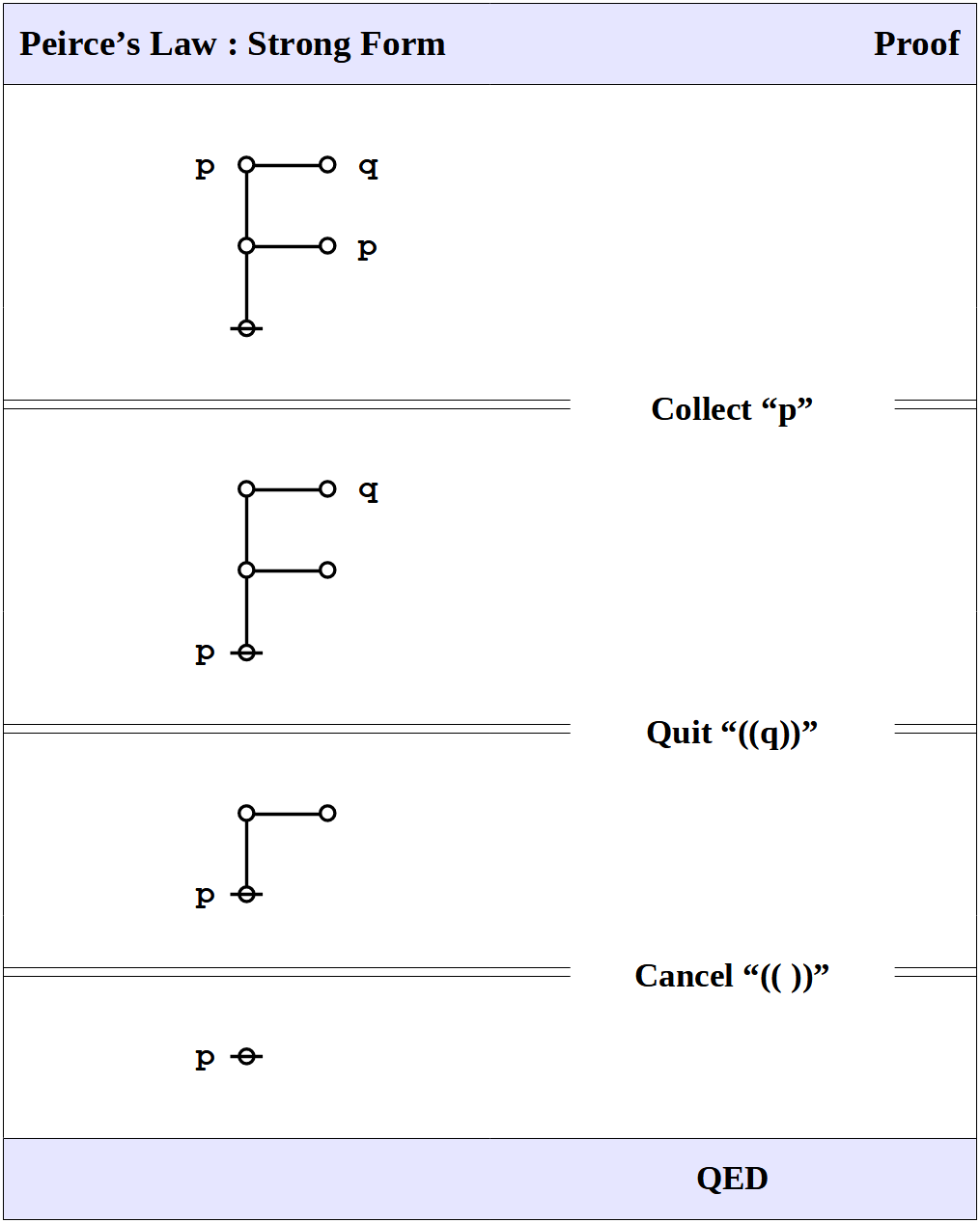
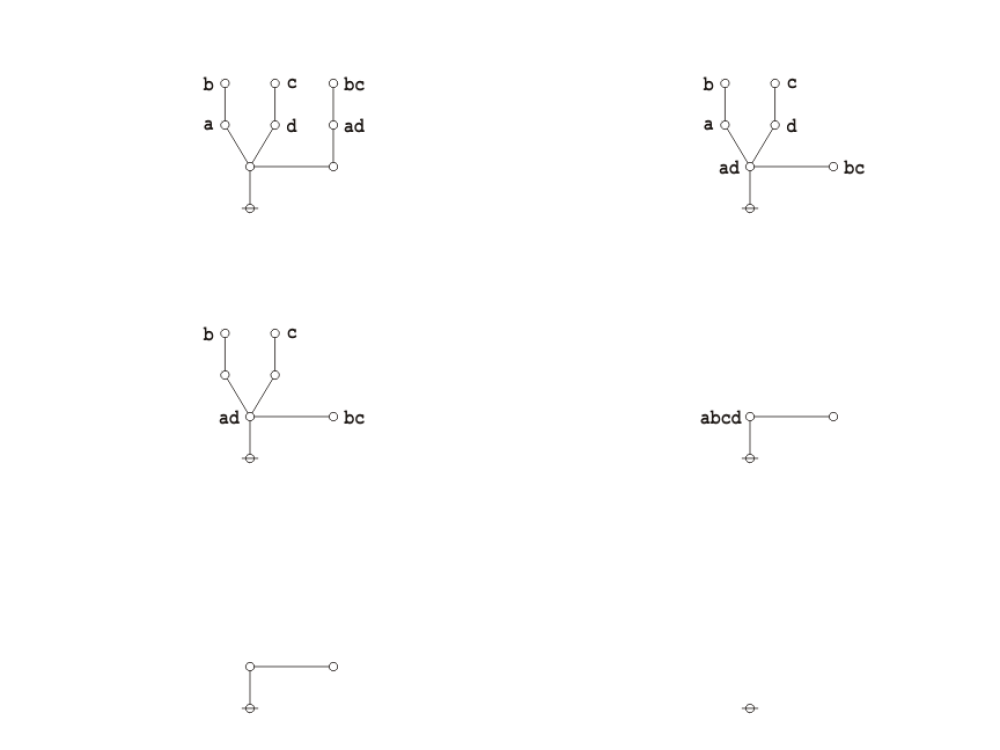
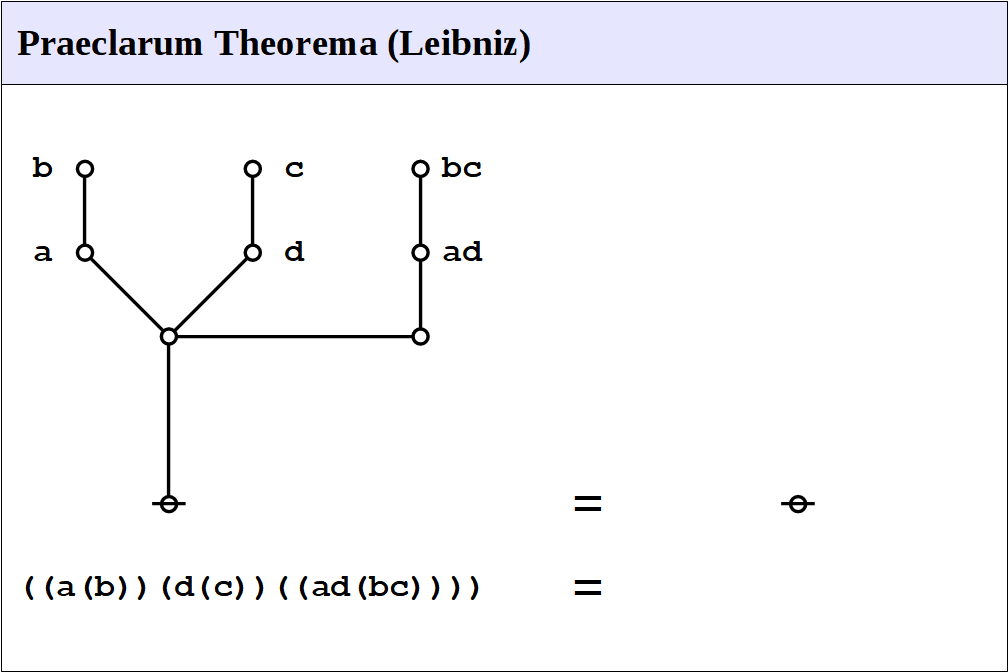
Using no more than the axioms and theorems recorded so far, it is possible to prove a multitude of much more complex theorems.  A couple of all‑time favorites are linked below.

cc: FB | Logical GraphsLaws of FormMathstodonAcademia.edu
cc: Conceptual GraphsCyberneticsStructural ModelingSystems Science

Posted in Animata, Boolean Algebra, Boolean Functions, C.S. Peirce, Cactus Graphs, Deduction, Diagrammatic Reasoning, Equational Inference, Graph Theory, Laws of Form, Logic, Logical Graphs, Mathematics, Painted Cacti, Peirce, Propositional Calculus, Propositional Equation Reasoning Systems, Semiotics, Spencer Brown, Visualization | Tagged , , , , , , , , , , , , , , , , , , , | 3 Comments

Logical Graphs • Formal Development 7

Frequently Used Theorems (concl.)

C3.  Dominant Form Theorem

The third of the frequently used theorems of service to this survey is one Spencer Brown annotates as Consequence 3 (C3) or Integration.  A better mnemonic might be dominance and recession theorem (DART), but perhaps the brevity of dominant form theorem (DFT) is sufficient reminder of its double‑edged role in proofs.

Dominant Form Theorem

Here is a proof of the Dominant Form Theorem.

Dominant Form Theorem • Proof

cc: FB | Logical GraphsLaws of FormMathstodonAcademia.edu
cc: Conceptual GraphsCyberneticsStructural ModelingSystems Science

Posted in Animata, Boolean Algebra, Boolean Functions, C.S. Peirce, Cactus Graphs, Deduction, Diagrammatic Reasoning, Equational Inference, Graph Theory, Laws of Form, Logic, Logical Graphs, Mathematics, Painted Cacti, Peirce, Propositional Calculus, Propositional Equation Reasoning Systems, Semiotics, Spencer Brown, Visualization | Tagged , , , , , , , , , , , , , , , , , , , | 3 Comments

Logical Graphs • Formal Development 6

Frequently Used Theorems (cont.)

C2.  Generation Theorem

One theorem of frequent use goes under the nickname of the weed and seed theorem (WAST).  The proof is just an exercise in mathematical induction, once a suitable basis is laid down, and it will be left as an exercise for the reader.  What the WAST says is that a label can be freely distributed or freely erased anywhere in a subtree whose root is labeled with that label.  The second in our list of frequently used theorems is in fact the base case of this weed and seed theorem.  In Laws of Form it goes by the names of Consequence 2 (C2) or Generation.

Generation Theorem

Here is a proof of the Generation Theorem.

Generation Theorem • Proof

cc: FB | Logical GraphsLaws of FormMathstodonAcademia.edu
cc: Conceptual GraphsCyberneticsStructural ModelingSystems Science

Posted in Animata, Boolean Algebra, Boolean Functions, C.S. Peirce, Cactus Graphs, Deduction, Diagrammatic Reasoning, Equational Inference, Graph Theory, Laws of Form, Logic, Logical Graphs, Mathematics, Painted Cacti, Peirce, Propositional Calculus, Propositional Equation Reasoning Systems, Semiotics, Spencer Brown, Visualization | Tagged , , , , , , , , , , , , , , , , , , , | 3 Comments

Logical Graphs • Formal Development 5

Frequently Used Theorems

To familiarize ourselves with equational proofs in logical graphs let’s run though the proofs of a few basic theorems in the primary algebra.

C1.  Double Negation Theorem

The first theorem goes under the names of Consequence 1 (C1), the double negation theorem (DNT), or Reflection.

Double Negation Theorem

The proof that follows is adapted from the one George Spencer Brown gave in his book Laws of Form and credited to two of his students, John Dawes and D.A. Utting.

Double Negation Theorem • Proof

cc: FB | Logical GraphsLaws of FormMathstodonAcademia.edu
cc: Conceptual GraphsCyberneticsStructural ModelingSystems Science

Posted in Animata, Boolean Algebra, Boolean Functions, C.S. Peirce, Cactus Graphs, Deduction, Diagrammatic Reasoning, Equational Inference, Graph Theory, Laws of Form, Logic, Logical Graphs, Mathematics, Painted Cacti, Peirce, Propositional Calculus, Propositional Equation Reasoning Systems, Semiotics, Spencer Brown, Visualization | Tagged , , , , , , , , , , , , , , , , , , , | 3 Comments

Logical Graphs • Formal Development 4

Equational Inference

All the initials I_1, I_2, J_1, J_2 have the form of equations.  This means the inference steps they license are reversible.  The proof annotation scheme employed below makes use of double bars =\!=\!=\!=\!=\!= to mark this fact, though it will often be left to the reader to decide which of the two possible directions is the one required for applying the indicated axiom.

The actual business of proof is a far more strategic affair than the routine cranking of inference rules might suggest.  Part of the reason for this lies in the circumstance that the customary types of inference rules combine the moving forward of a state of inquiry with the losing of information along the way that doesn’t appear immediately relevant, at least, not as viewed in the local focus and short run of the proof in question.  Over the long haul, this has the pernicious side‑effect that one is forever strategically required to reconstruct much of the information one had strategically thought to forget at earlier stages of proof, where “before the proof started” can be counted as an earlier stage of the proof in view.

This is just one of the reasons it can be very instructive to study equational inference rules of the sort our axioms have just provided.  Although equational forms of reasoning are paramount in mathematics, they are less familiar to the student of the usual logic textbooks, who may find a few surprises here.

cc: FB | Logical GraphsLaws of FormMathstodonAcademia.edu
cc: Conceptual GraphsCyberneticsStructural ModelingSystems Science

Posted in Animata, Boolean Algebra, Boolean Functions, C.S. Peirce, Cactus Graphs, Deduction, Diagrammatic Reasoning, Equational Inference, Graph Theory, Laws of Form, Logic, Logical Graphs, Mathematics, Painted Cacti, Peirce, Propositional Calculus, Propositional Equation Reasoning Systems, Semiotics, Spencer Brown, Visualization | Tagged , , , , , , , , , , , , , , , , , , , | 3 Comments

Logical Graphs • Formal Development 3

Logical Interpretation

One way of assigning logical meaning to the initial equations is known as the entitative interpretation (En).  Under En, the axioms read as follows.

Entitative Interpretation

Another way of assigning logical meaning to the initial equations is known as the existential interpretation (Ex).  Under Ex, the axioms read as follows.

Existential Interpretation

cc: FB | Logical GraphsLaws of FormMathstodonAcademia.edu
cc: Conceptual GraphsCyberneticsStructural ModelingSystems Science

Posted in Animata, Boolean Algebra, Boolean Functions, C.S. Peirce, Cactus Graphs, Deduction, Diagrammatic Reasoning, Equational Inference, Graph Theory, Laws of Form, Logic, Logical Graphs, Mathematics, Painted Cacti, Peirce, Propositional Calculus, Propositional Equation Reasoning Systems, Semiotics, Spencer Brown, Visualization | Tagged , , , , , , , , , , , , , , , , , , , | 3 Comments

Logical Graphs • Formal Development 2

Axioms

The formal system of logical graphs is defined by a foursome of formal equations, called initials when regarded purely formally, in abstraction from potential interpretations, and called axioms when interpreted as logical equivalences.  There are two arithmetic initials and two algebraic initials, as shown below.

Arithmetic Initials

Axiom I₁

Axiom I₂

Algebraic Initials

Axiom J₁

Axiom J₂

cc: FB | Logical GraphsLaws of FormMathstodonAcademia.edu
cc: Conceptual GraphsCyberneticsStructural ModelingSystems Science

Posted in Animata, Boolean Algebra, Boolean Functions, C.S. Peirce, Cactus Graphs, Deduction, Diagrammatic Reasoning, Equational Inference, Graph Theory, Laws of Form, Logic, Logical Graphs, Mathematics, Painted Cacti, Peirce, Propositional Calculus, Propositional Equation Reasoning Systems, Semiotics, Spencer Brown, Visualization | Tagged , , , , , , , , , , , , , , , , , , , | 3 Comments

Logical Graphs • Formal Development 1

Recap

A first approach to logical graphs can be found in the article linked below.

That introduces the initial elements of logical graphs and hopefully supplies the reader with an intuitive sense of their motivation and rationale.

Formal Development

Logical graphs are next presented as a formal system by going back to the initial elements and developing their consequences in a systematic manner.

The next order of business is to give the precise axioms used to develop the formal system of logical graphs.  The axioms derive from C.S. Peirce’s various systems of graphical syntax via the calculus of indications described in Spencer Brown’s Laws of Form.  The formal proofs to follow will use a variation of Spencer Brown’s annotation scheme to mark each step of the proof according to which axiom is called to license the corresponding step of syntactic transformation, whether it applies to graphs or to strings.

cc: FB | Logical GraphsLaws of FormMathstodonAcademia.edu
cc: Conceptual GraphsCyberneticsStructural ModelingSystems Science

Posted in Animata, Boolean Algebra, Boolean Functions, C.S. Peirce, Cactus Graphs, Deduction, Diagrammatic Reasoning, Equational Inference, Graph Theory, Laws of Form, Logic, Logical Graphs, Mathematics, Painted Cacti, Peirce, Propositional Calculus, Propositional Equation Reasoning Systems, Semiotics, Spencer Brown, Visualization | Tagged , , , , , , , , , , , , , , , , , , , | 3 Comments

Sign Relations, Triadic Relations, Relation Theory • Discussion 11

Re: Michael ShapiroRedefining Arbitrariness in Language

MS:
The matter of arbitrariness in language is primarily associated with the work of the Swiss linguist, Ferdinand de Saussure (1857–1913), whose book of lectures, Cours de linguistique Générale, is widely recognized to have laid the foundations of European structural linguistics in the twentieth century.  One of Saussure’s most quoted positions points out that the meaning of words is arbitrary, in that, for instance, the word arbre in French and its equivalent tree in English have nothing to do “naturally” with the object they signify.  Any other sequence of sounds could in theory designate the same object.  These are just the words French and English happen to have inherited from their history.

I prefer to think of the word “arbitrary” as reminding us how every aspect of a sign’s functioning is relative to an arbiter, a judge, an interpreter.  That brings semiology more into harmony with Peirce’s semiotics — if only Saussure had realized how it embeds all dyadic sign relations within the fold of triadic sign relations!

cc: FB | SemeioticsLaws of FormOntologMathstodonAcademia.edu
cc: Conceptual GraphsCyberneticsStructural ModelingSystems Science

Posted in C.S. Peirce, Icon Index Symbol, Information, Inquiry Driven Systems, Logic, Logic of Relatives, Mathematics, Peirce, Pragmatism, Relation Theory, Semiosis, Semiotics, Sign Relations, Triadic Relations, Triadicity, Visualization | Tagged , , , , , , , , , , , , , , , | 5 Comments

Logical Graphs • Formal Development

Logical graphs are next presented as a formal system by going back to the initial elements and developing their consequences in a systematic manner.

Formal Development

Logical Graphs • First Impressions gives an informal introduction to the initial elements of logical graphs and hopefully supplies the reader with an intuitive sense of their motivation and rationale.

The next order of business is to give the precise axioms used to develop the formal system of logical graphs.  The axioms derive from C.S. Peirce’s various systems of graphical syntax via the calculus of indications described in Spencer Brown’s Laws of Form.  The formal proofs to follow will use a variation of Spencer Brown’s annotation scheme to mark each step of the proof according to which axiom is called to license the corresponding step of syntactic transformation, whether it applies to graphs or to strings.

Axioms

The formal system of logical graphs is defined by a foursome of formal equations, called initials when regarded purely formally, in abstraction from potential interpretations, and called axioms when interpreted as logical equivalences.  There are two arithmetic initials and two algebraic initials, as shown below.

Arithmetic Initials

Axiom I₁

Axiom I₂

Algebraic Initials

Axiom J₁

Axiom J₂

Logical Interpretation

One way of assigning logical meaning to the initial equations is known as the entitative interpretation (En).  Under En, the axioms read as follows.

\begin{array}{ccccc}  \mathrm{I_1}  & : & \text{true} ~ \text{or} ~ \text{true}  & = & \text{true}  \\[4pt]  \mathrm{I_2}  & : & \text{not} ~ \text{true}  & = & \text{false}  \\[4pt]  \mathrm{J_1}  & : & a ~ \text{or} ~ \text{not} ~ a  & = & \text{true}  \\[4pt]  \mathrm{J_2}  & : & (a ~ \text{or} ~ b) ~ \text{and} ~ (a ~ \text{or} ~ c)  & = & a ~ \text{or} ~ (b ~ \text{and} ~ c)  \end{array}

Another way of assigning logical meaning to the initial equations is known as the existential interpretation (Ex).  Under Ex, the axioms read as follows.

\begin{array}{ccccc}  \mathrm{I_1}  & : & \text{false} ~ \text{and} ~ \text{false}  & = & \text{false}  \\[4pt]  \mathrm{I_2}  & : & \text{not} ~ \text{false}  & = & \text{true}  \\[4pt]  \mathrm{J_1}  & : & a ~ \text{and} ~ \text{not} ~ a   & = & \text{false}  \\[4pt]  \mathrm{J_2}  & : & (a ~ \text{and} ~ b) ~ \text{or} ~ (a\ \text{and}\ c)  & = & a ~ \text{and} ~ (b ~ \text{or} ~ c)  \end{array}

Equational Inference

All the initials I_1, I_2, J_1, J_2 have the form of equations.  This means the inference steps they license are reversible.  The proof annotation scheme employed below makes use of double bars =\!=\!=\!=\!=\!= to mark this fact, though it will often be left to the reader to decide which of the two possible directions is the one required for applying the indicated axiom.

The actual business of proof is a far more strategic affair than the routine cranking of inference rules might suggest.  Part of the reason for this lies in the circumstance that the customary types of inference rules combine the moving forward of a state of inquiry with the losing of information along the way that doesn’t appear immediately relevant, at least, not as viewed in the local focus and short run of the proof in question.  Over the long haul, this has the pernicious side‑effect that one is forever strategically required to reconstruct much of the information one had strategically thought to forget at earlier stages of proof, where “before the proof started” can be counted as an earlier stage of the proof in view.

This is just one of the reasons it can be very instructive to study equational inference rules of the sort our axioms have just provided.  Although equational forms of reasoning are paramount in mathematics, they are less familiar to the student of the usual logic textbooks, who may find a few surprises here.

Frequently Used Theorems

To familiarize ourselves with equational proofs in logical graphs let’s run though the proofs of a few basic theorems in the primary algebra.

C1.  Double Negation Theorem

The first theorem goes under the names of Consequence 1 (C1), the double negation theorem (DNT), or Reflection.

Double Negation Theorem

The proof that follows is adapted from the one George Spencer Brown gave in his book Laws of Form and credited to two of his students, John Dawes and D.A. Utting.

Double Negation Theorem • Proof

C2.  Generation Theorem

One theorem of frequent use goes under the nickname of the weed and seed theorem (WAST).  The proof is just an exercise in mathematical induction, once a suitable basis is laid down, and it will be left as an exercise for the reader.  What the WAST says is that a label can be freely distributed or freely erased anywhere in a subtree whose root is labeled with that label.  The second in our list of frequently used theorems is in fact the base case of this weed and seed theorem.  In Laws of Form it goes by the names of Consequence 2 (C2) or Generation.

Generation Theorem

Here is a proof of the Generation Theorem.

Generation Theorem • Proof

C3.  Dominant Form Theorem

The third of the frequently used theorems of service to this survey is one Spencer Brown annotates as Consequence 3 (C3) or Integration.  A better mnemonic might be dominance and recession theorem (DART), but perhaps the brevity of dominant form theorem (DFT) is sufficient reminder of its double‑edged role in proofs.

Dominant Form Theorem

Here is a proof of the Dominant Form Theorem.

Dominant Form Theorem • Proof

Exemplary Proofs

Using no more than the axioms and theorems recorded so far, it is possible to prove a multitude of much more complex theorems.  A couple of all‑time favorites are listed below.

cc: FB | Logical Graphs

Posted in Animata, Boolean Algebra, Boolean Functions, C.S. Peirce, Cactus Graphs, Deduction, Equational Inference, Graph Theory, Laws of Form, Logic, Logical Graphs, Mathematics, Propositional Calculus, Propositional Equation Reasoning Systems, Semiotics, Spencer Brown, Visualization | Tagged , , , , , , , , , , , , , , , , | 35 Comments