
Soon after I made my third foray into grad school, this time in Systems Engineering, I was trying to explain sign relations to my advisor and he, being the very model of a modern systems engineer, asked me to give a concrete example of a sign relation, as simple as possible without being trivial. After much cudgeling of the grey matter I came up with a pair of examples which had the added benefit of bearing instructive relationships to each other. Despite their simplicity, the examples to follow have subtleties of their own and their careful treatment serves to illustrate important issues in the general theory of signs.
Imagine a discussion between two people, Ann and Bob, and attend only to the aspects of their interpretive practice involving the use of the following nouns and pronouns.

- The object domain of their discussion is the set of two people

- The sign domain of their discussion is the set of four signs

Ann and Bob are not only the passive objects of linguistic references but also the active interpreters of the language they use. The system of interpretation associated with each language user can be represented in the form of an individual three‑place relation known as the sign relation of that interpreter.
In terms of its set‑theoretic extension, a sign relation 



Broadly speaking, the three domains of a sign relation may be any sets at all but the types of sign relations contemplated in formal settings are usually constrained to having 


When it becomes necessary to refer to the whole set of objects and signs in the union of the domains 

To facilitate an interest in the formal structures of sign relations and to keep notations as simple as possible as the examples become more complicated, it serves to introduce the following general notations.
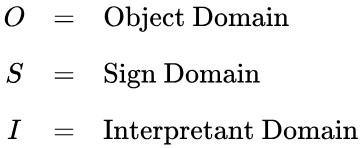
Introducing a few abbreviations for use in the Example, we have the following data.

In the present example,

Tables 1a and 1b show the sign relations associated with the interpreters 



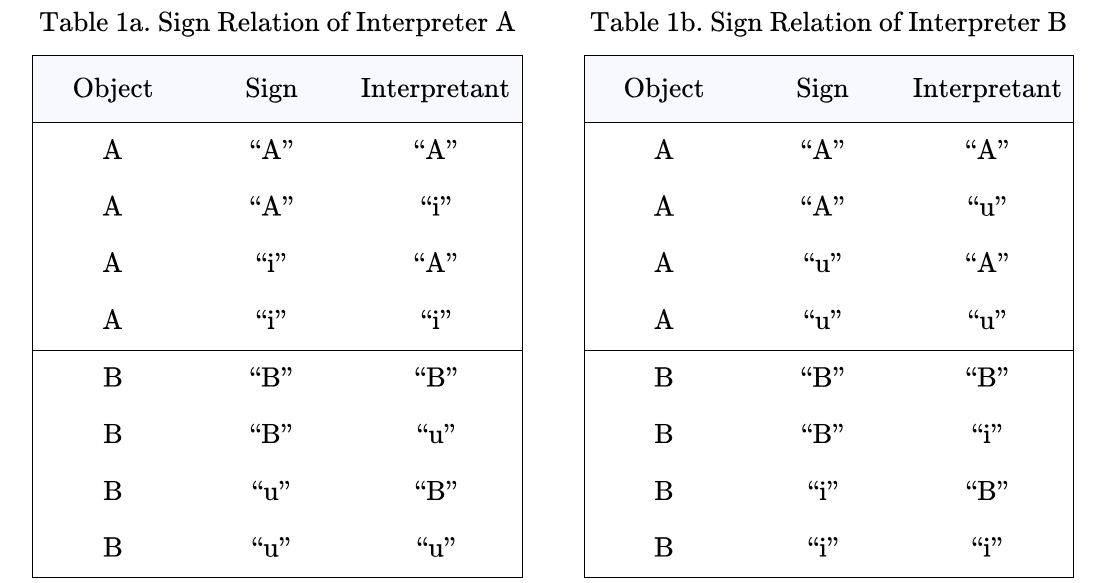
The Tables codify a rudimentary level of interpretive practice for the agents 
Already in this elementary context, there are several meanings which might attach to the project of a formal semiotics, or a formal theory of meaning for signs. In the process of discussing the alternatives, it is useful to introduce a few terms occasionally used in the philosophy of language to point out the needed distinctions. That is the task we’ll turn to next.
Resources
- Sign Relation • OEIS • MyWikiBiz • Wikiversity
- Survey of Semiotics, Semiosis, Sign Relations
cc: Academia.edu • Laws of Form • Research Gate • Syscoi
cc: Cybernetics • Structural Modeling • Systems Science
 are shown in the following Table.

 appears under the name
 appears under the name


![[x \Rightarrow y] ~=~ F_{11}^{(2)} (x, y) ~=~ \texttt{(} ~x~ \texttt{(} ~y~ \texttt{))} ~=~ [\mathrm{not}~ x ~\mathrm{without}~ y].](https://s0.wp.com/latex.php?latex=%5Bx+%5CRightarrow+y%5D+%7E%3D%7E+F_%7B11%7D%5E%7B%282%29%7D+%28x%2C+y%29+%7E%3D%7E+%5Ctexttt%7B%28%7D+%7Ex%7E+%5Ctexttt%7B%28%7D+%7Ey%7E+%5Ctexttt%7B%29%29%7D+%7E%3D%7E+%5B%5Cmathrm%7Bnot%7D%7E+x+%7E%5Cmathrm%7Bwithout%7D%7E+y%5D.&bg=ffffff&fg=000000&s=0&c=20201002)
![[x \Leftarrow y] ~=~ F_{13}^{(2)} (x, y) ~=~ \texttt{((} ~x~ \texttt{)} ~y~ \texttt{)} ~=~ [\mathrm{not}~ y ~\mathrm{without}~ x].](https://s0.wp.com/latex.php?latex=%5Bx+%5CLeftarrow+y%5D+%7E%3D%7E+F_%7B13%7D%5E%7B%282%29%7D+%28x%2C+y%29+%7E%3D%7E+%5Ctexttt%7B%28%28%7D+%7Ex%7E+%5Ctexttt%7B%29%7D+%7Ey%7E+%5Ctexttt%7B%29%7D+%7E%3D%7E+%5B%5Cmathrm%7Bnot%7D%7E+y+%7E%5Cmathrm%7Bwithout%7D%7E+x%5D.&bg=ffffff&fg=000000&s=0&c=20201002)
![[x \Leftrightarrow y] ~=~ [x = y] ~=~ F_{9}^{(2)} (x, y) ~=~ \texttt{((} ~x~ \texttt{,} ~y~ \texttt{))}.](https://s0.wp.com/latex.php?latex=%5Bx+%5CLeftrightarrow+y%5D+%7E%3D%7E+%5Bx+%3D+y%5D+%7E%3D%7E+F_%7B9%7D%5E%7B%282%29%7D+%28x%2C+y%29+%7E%3D%7E+%5Ctexttt%7B%28%28%7D+%7Ex%7E+%5Ctexttt%7B%2C%7D+%7Ey%7E+%5Ctexttt%7B%29%29%7D.&bg=ffffff&fg=000000&s=0&c=20201002)
![[x \neq y] ~=~ [x + y] ~=~ F_{6}^{(2)} (x, y) ~=~ \texttt{(} ~x~ \texttt{,} ~y~ \texttt{)}.](https://s0.wp.com/latex.php?latex=%5Bx+%5Cneq+y%5D+%7E%3D%7E+%5Bx+%2B+y%5D+%7E%3D%7E+F_%7B6%7D%5E%7B%282%29%7D+%28x%2C+y%29+%7E%3D%7E+%5Ctexttt%7B%28%7D+%7Ex%7E+%5Ctexttt%7B%2C%7D+%7Ey%7E+%5Ctexttt%7B%29%7D.&bg=ffffff&fg=000000&s=0&c=20201002)
 on zero variables is just an element of the boolean domain
  The following Table shows several ways of referring to those elements, for the sake of consistency using the same format we’ll use in subsequent Tables, however degenerate it appears in this case.

 of the following form. The superscript
  gives the dimension of the functional domain, in effect, the number of variables, and the subscript
  is a binary string formed from the functional values, using the obvious coding of boolean values into binary values.
 renders the blank expression for logical truth more visible in context.


![\begin{matrix} F_0^{(1)} & = & F_{00}^{(1)} & = & 0 ~:~ \mathbb{B} \to \mathbb{B}. \\[4pt] F_3^{(1)} & = & F_{11}^{(1)} & = & 1 ~:~ \mathbb{B} \to \mathbb{B}. \end{matrix}](https://s0.wp.com/latex.php?latex=%5Cbegin%7Bmatrix%7D++F_0%5E%7B%281%29%7D+%26+%3D+%26+F_%7B00%7D%5E%7B%281%29%7D+%26+%3D+%26+0+%7E%3A%7E+%5Cmathbb%7BB%7D+%5Cto+%5Cmathbb%7BB%7D.++%5C%5C%5B4pt%5D++F_3%5E%7B%281%29%7D+%26+%3D+%26+F_%7B11%7D%5E%7B%281%29%7D+%26+%3D+%26+1+%7E%3A%7E+%5Cmathbb%7BB%7D+%5Cto+%5Cmathbb%7BB%7D.++%5Cend%7Bmatrix%7D&bg=ffffff&fg=000000&s=0&c=20201002)
 Thus the function
  is recognizable as the negation operation and the function
  is obviously the identity operation.
 can be used to indicate the logical denotation
  of a sentence
  or the logical denotation
  of a cactus


 a cactus
  and a proposition
  as basic data, and fixing the rest by recursion on those ingredients.
 of a set of propositions
  is a proposition which is true if and only if every one of the

 of a set of propositions
  is finite, for instance, if
  and if each proposition


 is the proposition
  a proposition regarded as primitive, at least, with respect to the level of analysis represented in the current instance of
 also known as a needle, is the boolean value
 each of which needs to be interpreted, that is to say, equipped with a semantic function defined on its domain.
 the painted and rooted cactus expressions collectively forming the language

 the painted and rooted cacti themselves, a family of graphs or species of data structures formed by parsing the language of strings.
 in other words, to define a mapping from the space of syntactic expressions to a space of logical statements which “interprets” each expression of
  as an expression which says something, an expression which bears a meaning, in short, an expression which denotes a proposition, and is in the end a sign of an indicator function.
 places is signified by the concatenation of the
  the blank connective is an empty string or a blank symbol, both of which have the same denotation among propositions.
 the blank connective takes the form
  In the type of data called a text, the use of the center dot “⋅” is generally supplanted by whatever number of spaces and line breaks serve to improve the readability of the resulting text.
 with any number of spaces between the parentheses, all of which have the same denotation among propositions.

 Inquiry Into Inquiry